
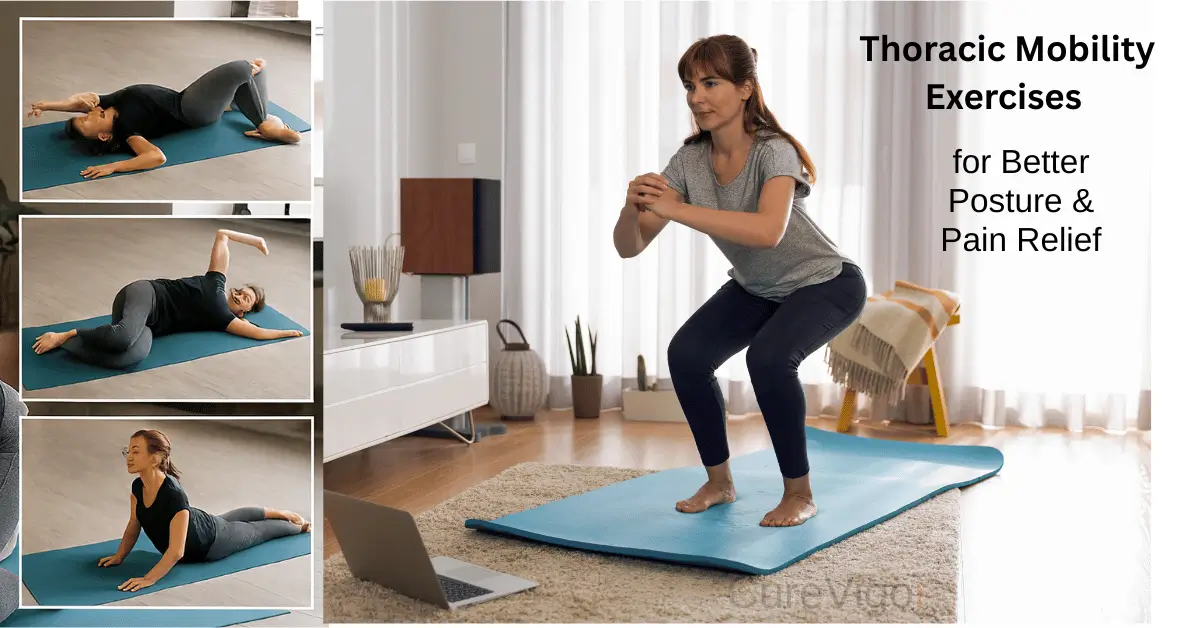
Discover the best thoracic mobility exercises to improve posture, relieve pain, and enhance flexibility. Learn how to loosen a tight thoracic spine and increase mobility with easy-to-follow routines.
What is Thoracic Mobility?
Thoracic mobility refers to the ability of the thoracic spine, which runs from the base of your neckto your mid-back, to move freely and perform various movements, such as flexion, extension, and rotation.
This spinal area is crucial for maintaining proper posture, stability, and mobility. When the thoracic spine becomes immobile, it can lead to compensations in other parts of the body, causing discomfort and injury in the lower back, neck, and shoulders.
Thoracic mobility is crucial for maintaining good posture, relieving pain, and enhancing overall body function.
The thoracic spine, located between the cervical (neck) and lumbar (lower back) regions, plays a vital role in our movement patterns.
However, modern sedentary lifestyles often limit thoracic mobility, leading to stiffness, discomfort, and injury.

This guide will explore the best thoracic mobility exercises to improve posture, reduce pain, and enhance overall well-being.
The Importance of Thoracic Mobility
The thoracic spine consists of 12 vertebrae, which support the ribcage and protect vital organs such as the heart and lungs.
When this region becomes restricted, it can lead to compensations in the lower back and neck, potentially causing discomfort or injury. Improved thoracic mobility helps to:
- Correct posture
- Relieve back, neck, and shoulder pain
- Enhance athletic performance
- Promote better breathing
- Prevent injury
By incorporating thoracic mobility exercises into your routine, you can counteract the effects of poor posture and repetitive strain caused by prolonged sitting.
Causes of Thoracic Immobility
Several factors can contribute to reduced mobility in the thoracic spine, including:
- Sedentary Lifestyle: Prolonged sitting, especially with poor posture, can lead to thoracic stiffness and reduced mobility.
- Poor Posture: Slouching or rounding the shoulders for extended periods strains the thoracic spine and can lead to immobility.
- Weak Core Muscles: A weak core reduces spinal support, leading to compensations that can limit thoracic mobility.
- Age: As we age, the spine loses flexibility, particularly in the thoracic region, unless regular mobility exercises are performed.
How to Improve Thoracic Mobility
Improving thoracic mobility requires a combination of stretching, strengthening, and movement-based exercises that target the thoracic spine. These exercises should improve the upper back’s rotation, flexion, and extension.
Key Thoracic Mobility Exercises
1. Thoracic Spine Rotation (Thread the Needle)
Thoracic rotation is essential for everyday activities such as turning your head or twisting your torso. This exercise stretches and strengthens the muscles around the spine, promoting greater mobility.
How to perform:
- Start on all fours (hands and knees) in a tabletop position.
- Reach your right arm underneath your body, threading it through the space between your left arm and knee.
- Allow your torso to rotate, bringing your right shoulder closer to the ground.
- Hold for a few seconds, then return to the starting position.
- Repeat on the other side.
Reps: 10 per side
2. Cat-Cow Stretch
This classic yoga pose stretches the entire spine and encourages segmental movement through the thoracic region. It’s excellent for warming up the spine and enhancing flexibility.
How to perform:
- Begin in the tabletop position on your hands and knees.
- Inhale and arch your back, dropping your belly towards the floor as you lift your head and chest (Cow position).
- Exhale and round your back, tucking your chin towards your chest (Cat position).
- Move fluidly between these two positions for the duration of the exercise.
Reps: 10-15
3. Wall Angels
Wall angels help activate the upper back muscles and improve thoracic extension, which can counteract the slouched posture many people develop from sitting.
How to perform:
- Stand flat against a wall, feet a few inches from the base.
- Press your lower back into the wall to maintain a neutral spine.
- Raise your arms to shoulder height and press them against the wall, forming a “W” shape.
- Slowly raise your arms overhead, keeping them in contact with the wall until they form a “Y” shape.
- Lower your arms back to the starting position.
Reps: 10-12
4. Open Book Stretch
The open book stretch targets the muscles surrounding the thoracic spine and encourages rotation, thereby improving spinal mobility.
How to perform:
- Lie on your side with your knees bent and stacked on each other.
- Extend your arms straight out in front of you, palms facing each other.
- Keeping your lower body still, open your top arm and rotate your torso toward the opposite side, creating a “T” shape.
- Hold for a few seconds, then return to the starting position.
Reps: 10 per side
5. Foam Roller Thoracic Extension
A foam roller is a great way to relieve tension in the thoracic spine and encourage extension, which is crucial for proper posture.
How to perform:
- Sit on the ground and place a foam roller behind you at your mid-back level.
- Lean back over the roller, supporting your head with your hands.
- Allow your back to arch over the roller, keeping your core engaged.
- Roll slowly up and down the thoracic spine, pausing at any areas of tightness.
Reps: Roll for 30-60 seconds
6. Quadruped T-Spine Rotation
This exercise improves thoracic rotation while stabilizing the lumbar spine, making it ideal for enhancing mobility without stressing the lower back.
How to perform:
- Begin on all fours in the tabletop position.
- Place one hand behind your head, with your elbow pointing to the side.
- Rotate your torso, lowering your elbow toward your supporting arm, then rotate it upward to open your chest.
- Focus on moving only through the thoracic spine without rotating your hips.
Reps: 10 per side
7. Child’s Pose with Side Reach
This variation of Child’s Pose targets the thoracic spine and shoulders, helping to relieve tightness and improve mobility.
How to perform:
- Start kneeling with your big toes touching and your knees spread wide.
- Sit your hips back towards your heels and reach your arms before you, lowering your chest to the ground.
- Walk your hands to the right side, feeling a stretch through the left side of your torso.
- Hold for 20-30 seconds, then switch to the other side.
Reps: Hold for 20-30 seconds per side
Sample Thoracic Mobility Routine
Here’s a sample routine that incorporates several of the exercises outlined above. This routine can be done 2-3 times a week for optimal results.
Exercise Reps/Sets
- Thoracic Spine Rotation: 10 per side
- Cat-Cow Stretch: 10-15
- Wall Angels: 10-12
- Open Book Stretch: 10 per side
- Foam Roller Thoracic Ext: 30-60 sec roll
- Quadruped T-Spine Rotation: 10 per side
- Child’s Pose with Reach: 20-30 sec hold
Common Mistakes to Avoid
When working on thoracic mobility, it’s essential to avoid the inevitable common mistakes that can limit progress:
- Overarching the Lower Back: Focus on thoracic mobility rather than allowing the lower back to compensate for limited movement.
- Neglecting Core Engagement: A strong core helps stabilize the spine, so always engage your abdominal muscles during these exercises.
- Inconsistency: Thoracic mobility improves with consistent practice. Incorporate these exercises into your routine for the best results.
Bottom Line
Maintaining good posture and a healthy, pain-free back requires thoracic mobility. This region is prone to tension that can lead to neck and lower back compensation, which can be painful and harmful.
Targeted exercises such as foam roller extensions, needle thread, and scapular retractions can help you improve the strength and flexibility of your thoracic spine. Include thoracic mobility exercises in your regimen to enhance overall mobility, manage pain, and improve posture.
FAQs on Thoracic Mobility Exercises
Q. How to Increase Thoracic Spine Mobility?
To increase thoracic spine mobility, incorporate exercises that promote rotation, extension, and flexibility in this region. These include:
- Thoracic Spine Rotation (Thread the Needle)
- Foam Roller Thoracic Extensions
- Cat-Cow Stretch
- Wall Angels
- Open Book Stretch
Regular yoga and stretching can also help maintain thoracic spine flexibility and health. Regularly performing these exercises can enhance your posture and range of motion.
Q. What Causes Poor Thoracic Mobility?
Impaired thoracic mobility is often caused by factors such as:
- Sedentary lifestyle: prolonged sitting leads to slouching and stiffness.
- Poor posture: Hunching over desks or electronic devices restricts thoracic spine movement.
- Lack of exercise: Not engaging in activities that promote spine mobility can lead to tightness.
- Injury or trauma: Previous injuries may limit thoracic movement.
- Aging: As we age, joint flexibility naturally decreases, leading to spinal stiffness.
Q. What is Thoracic Mobility?
Thoracic mobility refers to the thoracic spine’s (the middle section of the back) range of motion. This region has twelve vertebrae, which are necessary for several movements, including flexion, extension, and rotation.
Proper thoracic mobility enables better posture, spinal alignment, and overall movement patterns, whereas limitations can lead to pain and compensation in other parts of the body.
Q. How to Manipulate the Thoracic Spine?
A chiropractor or physical therapist, for example, is usually the one who does thoracic spine manipulation. The objective is to use targeted, controlled force on the thoracic region’s joints to:
- Lessen soreness and stiffness
- Improve the alignment of your spine
- Recover your range of motion
Thoracic manipulation requires training, as improper techniques can cause harm. Self-mobilization methods, such as thoracic extensions or foam rolling, can occasionally help restore lubrication in the area.
Q. How to Test Thoracic Spine Mobility?
Testing thoracic spine mobility involves assessing both rotation and extension. One standard method is the Seated Thoracic Rotation Test:
- Sit straight (flat) on the floor with your arms crossed over your chest.
- Rotate your torso as far as possible to one side, keeping your hips square.
- Use a tape measure or visual markers to gauge the degree of rotation.
- Repeat on the other side and compare both sides.
If there is a noticeable restriction in rotation, it may indicate poor thoracic mobility. You can also assess a limited extension by performing the Wall Angel Test to see whether you can maintain contact with the wall through your back and arms.
Q. How to Lose a Tight Thoracic Spine?
Ensure your thoracic spine is loose using exercises and stretches that increase flexibility and mobility. Effective methods include:
- Foam rolling: Exfoliating the thoracic region helps relax fascia and tight muscles.
- Exercises for Thoracic Extension: Foam roller extensions help increase upper back flexibility.
- Stretching: Poses such as Child’s Pose with Side Reach and Cat-Cow Stretch gently stretch the thoracic spine.
- Thoracic Rotation Exercises: Movements like the Open Book Stretch and Quadrupod T-Spine Rotation improve rotational mobility.
When performed regularly, these exercises can increase the thoracic spine range of motion and reduce stiffness.
Final Thoughts
Thoracic mobility exercises are essential for improving overall movement patterns, reducing pain, and maintaining good posture.
These exercises are very effective, whether you’re an athlete looking to improve performance or address back or neck problems. To fully use your thoracic spine, you must be consistent in your practice of these exercises.
Read more articles on optimal health.
You might like to read: