



Evidence-based guidance on sleep, nutrition, energy, fitness, and long-term health — written for nurses, drivers, dispatchers, and everyone whose day begins at sundown.
Thank you for reading this post, don't forget to subscribe!Each pillar is a living library — protocols, guides, meal plans, and clinical references written specifically for shift biology.
Engineer recovery sleep that survives daylight, noise, and a rotating schedule.
7h 24mAvg restored sleep ↗Time-aware eating windows that keep glucose steady through the small hours.
12+Shift-meal blueprints ↗Caffeine timing, light exposure, and naps that don't wreck the next morning.
3amAlertness, sustained ↗Strength and mobility routines that fit a 20-minute window after handoff.
20 minBefore bed ↗Screening, hormones, and metabolic care plans built for shift biology.
LifetimeEvidence libraryA 2,000-word field manual on circadian misalignment for permanent and rotating shift workers. Includes melatonin dosing windows, blackout protocols, the case against weekend "catch-up sleep," and a practical onboarding template for new night shift workers.
Over 15 million Americans work night shifts. Almost none of the health advice on the internet was written for them. Healthline, WebMD, Sleep Foundation — they write for people who sleep at night and eat during daylight hours. This guide is different. Everything here is written specifically for people whose schedule runs against the clock.
You already know that working nights is hard on your body. You feel it every morning when the sun rises and you still have two hours left on your shift. You feel it when you get home and cannot sleep despite being completely exhausted. You feel it on your days off when you do not know whether to stay on your night schedule or flip back to something that feels normal.
What most night shift workers do not know is exactly why this happens — and more importantly, exactly what to do about it. That is what CureVigor exists to explain. This is not a list of generic sleep tips. It is a complete guide to every dimension of night shift health — sleep, nutrition, energy, fitness, and long-term wellbeing — in plain, practical language that actually fits the life you are living.
Every human body runs on a 24-hour internal clock called the circadian rhythm. This clock is controlled primarily by light — specifically, a cluster of neurons in your brain called the suprachiasmatic nucleus (SCN), which detects daylight through your eyes and uses that signal to regulate hormones, body temperature, digestion, and alertness.
When it is light outside, your SCN suppresses melatonin (your sleep hormone) and raises cortisol (your alertness hormone). When darkness falls, the process reverses. This system evolved over millions of years to keep humans awake during daylight and asleep at night. When you work nights, you are asking your body to override this system every single day.
Night shift workers sleep on average 1.5 to 2 hours less per day than day workers. A 2023 study in Frontiers in Psychiatry analysing over 37,000 workers found that night workers reported short sleep at 26%, compared to just 12% for day workers. Over time, this cumulative sleep debt impairs judgment, reaction time, and long-term health.
The result is what researchers call chronic circadian misalignment — your body clock and your work schedule are permanently out of sync. This is not a personal failure. It is biology. And it is manageable with the right strategies.
Night shift health is not one problem — it is five interconnected problems. Addressing one without the others only gets you part of the way. Each area has its own dedicated pillar on this site with comprehensive guides, meal plans, schedules, and protocols.
Everything in night shift health starts with sleep. If you are not sleeping enough or well enough during the day, every other strategy becomes harder. Fatigue makes you eat poorly, skip exercise, feel anxious or depressed, and make dangerous mistakes at work. Most night shift workers are missing at least two of the four critical pillars that make daytime sleep work.
This is your highest priority. A 2022 Northwestern University study found that even 100 lux of ambient light during sleep raised heart rate, activated the sympathetic nervous system, and increased insulin resistance. Blackout curtains plus a sleep mask together — not one or the other.
Morning light on the way home triggers your SCN to suppress melatonin and boost cortisol — the exact wrong response when you are about to sleep. Blocking that morning light with sunglasses gives your melatonin a better chance to hold until you are in bed.
The most common mistake night shift workers make is flipping to a normal schedule on days off. The CDC-recommended compromise: stay up until 3–4am on days off, sleep until noon. This preserves a core overlap so your body never has to fully re-adjust.
Research shows 0.5–1mg taken 30–60 minutes before sleep is as effective — and often more effective — than 5mg or 10mg doses. Melatonin is not a sedative. It is a timing signal. Higher doses cause next-day grogginess without adding any sleep benefit.
Your digestive system also runs on a circadian rhythm. Insulin sensitivity, gut motility, and hunger hormones are all timed to the day-night cycle. Eating a large meal at 3am — when your gut expects to be resting — causes blood sugar spikes, poor digestion, and weight gain over time. This is why so many night shift workers struggle with their weight despite not eating more than their day-shift colleagues.
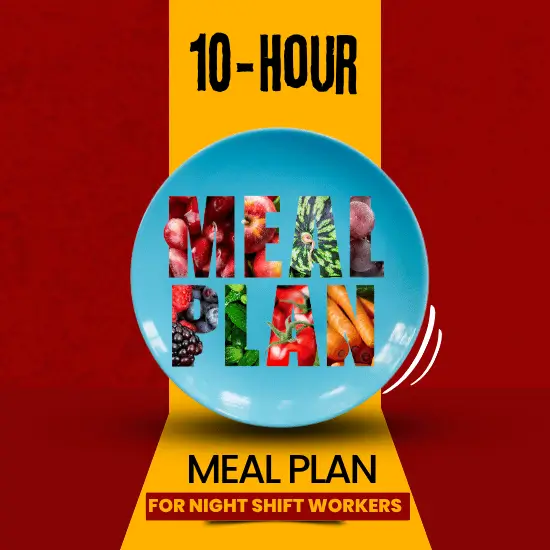
Front-load your main meal before your shift or in the first two hours. Your insulin sensitivity is better at the start of your waking period. A proper meal at 8pm before a 10pm shift sets you up far better than eating the same food at 3am.
Eat smaller, more frequent meals during your shift rather than one large meal at break time. Small amounts every 2–3 hours keep blood sugar stable without triggering the heavy digestion that causes energy crashes in the middle of the night.
Avoid heavy, greasy food in the second half of your shift. High-fat food raises your core body temperature and makes the sleep you get after your shift shorter and lighter.
Greek yoghurt with berries · Hard-boiled eggs · A banana with peanut butter · Oats with honey · Hummus and vegetables · A small handful of mixed nuts. These keep blood sugar stable, digest easily, and do not spike cortisol the way ultra-processed snacks do.
Every night shift worker hits a wall between 2am and 5am. This is your circadian nadir — the lowest point in your 24-hour alertness cycle. It is driven by biology, not by how much you slept or how much coffee you drank. You cannot eliminate it. But you can prepare for it with two science-backed tools: strategic caffeine use and planned napping.
Caffeine strategy: Cut off all caffeine at least 5–6 hours before your intended sleep time. If you plan to sleep at 8am, your last caffeine should be no later than 2–3am. Use small spaced doses (50–100mg every 2 hours) rather than a large single serving.
Napping strategy: A 20-minute nap at your break significantly reduces errors in the second half of your shift. A 90-minute nap completes a full sleep cycle and is ideal before a shift. Avoid 30–60 minute naps — these interrupt deep sleep and leave you more groggy than before. The coffee nap is highly effective: drink a coffee immediately before a 20-minute nap. Caffeine kicks in exactly as you wake up.
Exercise is one of the most powerful tools available to night shift workers for improving sleep quality, managing weight, and protecting long-term health. The challenge is not motivation — it is timing. Exercise before your shift if you want alertness during work. Exercise after your shift only if you allow at least 3 hours before sleep, since intense exercise raises core body temperature and delays sleep onset.
The most damaging fitness mistake night shift workers make is all-or-nothing thinking. Research shows that even 20 minutes of walking before a shift meaningfully improves mood, alertness, and sleep quality. Resistance training two to three times per week improves insulin sensitivity, directly counteracting the metabolic disruption that shift work causes.
Night shift work carries real long-term health risks documented in peer-reviewed research — elevated cardiovascular risk, higher rates of metabolic syndrome, increased type 2 diabetes risk, vitamin D deficiency from lack of sunlight, and elevated rates of depression and anxiety.
A 2022 systematic review pooling data from over 200,000 workers found shift workers had a 17% higher risk of cardiovascular events. A 2025 review found that 27% of shift workers meet criteria for Shift Work Sleep Disorder. These risks are real. They are also not inevitable.
The most overlooked risk is vitamin D deficiency. Night shift workers never see sunlight during waking hours. Deficiency is nearly universal in this population and is linked to immune dysfunction, bone density loss, mood disorders, and cardiovascular risk. A daily D3 supplement with K2 addresses this almost completely.
| Shift type | Recommended sleep window | Days off strategy |
|---|---|---|
| Fixed nights (11pm–7am) | Sleep 7:30am – 3:30pm | Stay up until 3–4am, sleep until noon |
| Fixed nights (7pm–7am) | Sleep 8am – 4pm | Stay up until 4am, sleep until 12–1pm |
| Rotating shifts | Sleep immediately after each shift | Gradual shift: 1hr earlier per day off |
| Split sleep | 3–4hr after shift + 3–4hr before shift | Maintain at least one consistent block |
If you can only do one thing today, make it this: set up your bedroom for complete daytime darkness before your next sleep. Blackout curtains, a sleep mask, or both. This single change improves daytime sleep quality more than any supplement, schedule change, or routine. Everything else builds from better sleep.
Everything in this guide connects. Better sleep improves your food choices. Better nutrition improves your energy. Better energy means you can exercise. Exercise improves your sleep quality and long-term metabolic health. The five pillars reinforce each other — even one small improvement creates a ripple effect across all the others.
Start with the area where you are struggling most. Every article on CureVigor is written to stand alone. But if you are new here and want a clear starting point, begin with the Sleep Pillar guide. It is the foundation everything else is built on. You are not alone — 15 million Americans work nights and this site exists to prove it is manageable.
Protocols, citations, and one quiet ritual — delivered while your colleagues sleep. No tracking pixels. Unsubscribe anytime.
Health and energy for people who work while the world sleeps. Research-backed, practically written.
Editorial information, not medical advice. Consult a clinician about your shift schedule.