
Learn how meditation for anxiety can ease stress, calm panic, and reduce overthinking with simple breathing, grounding, and mindfulness practices.
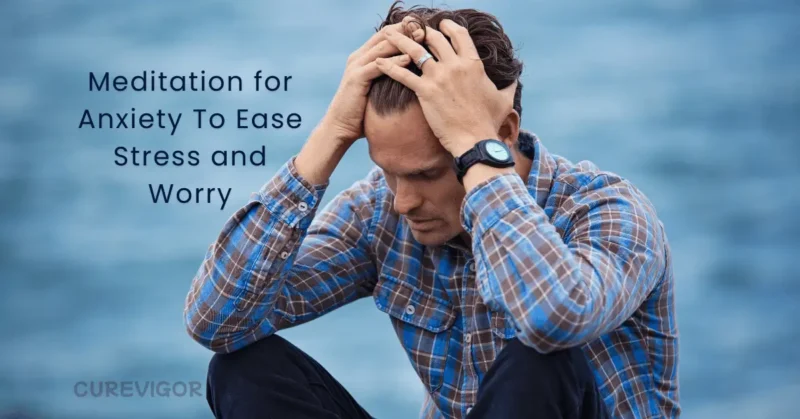
Anxiety does not always look dramatic from the outside. Sometimes it is just a fast heartbeat, tight shoulders, poor sleep, racing thoughts, or a constant feeling that your mind will not switch off.
In daily life, that can make simple tasks feel harder than they should. This is why many people start looking for calm, practical tools they can use right away.
How to Use Meditation for Anxiety to Calm Stress Fast
Meditation for anxiety can be one of those tools. It is not about forcing your mind to be blank or pretending you feel peaceful when you do not.
It is about training your attention, calming your body, and learning how to respond to stress with more steadiness.
When practiced simply, meditation can help reduce worry, improve self-awareness, and support a calmer nervous system.
Quick Summary
- Meditation for anxiety is a simple way to ease stress, worry, and mental overload.
- Breathing exercises, grounding methods, and mindfulness can help calm the mind and body fast.
- Techniques like 4-7-8 breathing and the 5-4-3-2-1 method are easy for beginners.
- Daily practice may improve emotional resilience, focus, and nervous system regulation.
- Micro-meditations can fit into busy routines and still provide real value.
- For intense or ongoing anxiety, meditation should be used alongside professional support.
What Is Meditation for Anxiety?
Meditation for anxiety is a practice that helps you notice your thoughts, emotions, and body sensations without getting pulled too deeply into them.
Instead of chasing every fearful thought, you learn to pause, observe, and return to something steady, such as your breath, your body, or your surroundings.
That small shift can make anxious moments feel less overwhelming.
This is important because anxiety often pulls the mind into the future. You start thinking about what could go wrong, what might happen next, or what you might have forgotten to do.
Meditation gently brings you back to the present moment. That does not solve every problem at once, but it often reduces the intensity of the spiral and gives you more control over your next step.
How Meditation Changes the Anxious Brain
When anxiety rises, the body moves into a stress state often called “fight or flight.” Your breathing becomes shallow, your muscles tighten, and your mind starts scanning for danger.
Meditation helps shift the body toward a calmer state, often known as the rest-and-digest response.
This state is linked to the parasympathetic nervous system, which supports relaxation, recovery, and steadier breathing.
This calming effect is one reason meditation is often used for stress, worry, and emotional overload. Slow breathing, mindful awareness, and body-based relaxation can help reduce the sense of immediate threat.
Over time, regular practice may also support better nervous system regulation, which means your body becomes less reactive and more able to return to balance after stress.
The Amygdala, Prefrontal Cortex, and Stress Response
The amygdala is often described as the brain’s alarm system. It helps detect danger, but during anxiety, it can become overactive/
Even when the threat is not immediate. The prefrontal cortex helps with attention, decision-making, and self-control.
Meditation helps strengthen the link between awareness and regulation, so you are less likely to react automatically to every anxious thought.
This is where neuroplasticity becomes useful. Neuroplasticity means the brain can change through repeated experience.
When you practice meditation often, you are not just having a calm moment. You are teaching the brain a different pattern.
That does not mean anxiety vanishes forever, but it does mean your stress response can become more flexible and less intense.
The Function of Cortisol and the Vagus Nerve
The vagus nerve is sometimes called the brake pedal of the nervous system. It helps the body slow down after stress.
Deep breathing, especially with a longer exhale, may help stimulate vagal activity and send a calming signal back to the brain.
That is why breathing-based meditation often feels like the fastest way to settle a stressed mind.
Cortisol, often called the stress hormone, is part of the body’s natural alert system. When stress becomes constant, cortisol patterns can take a toll on sleep, mood, and energy.
Meditation is not a cure for all stress, but it can support healthier stress regulation. In simple words, it helps the body spend less time stuck in alarm mode.
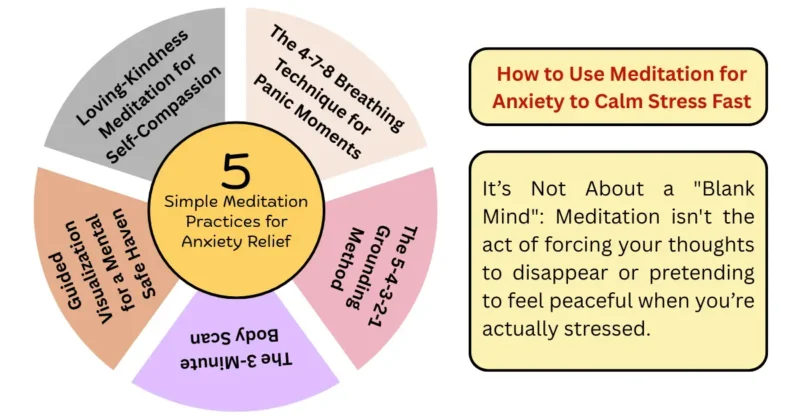
5 Simple Meditation Practices for Anxiety Relief
The best meditation for anxiety is usually not the most advanced one. It is the one that feels doable when your mind is busy, and your body is tense.
Many people quit meditation because they think they are failing if their thoughts wander.
That is not failure. That is normal. Meditation is the practice of returning, again and again, with less judgment.
These methods are practical, beginner-friendly, and realistic for real-world humans. You can use them at home, at work, before sleep, or during stressful moments in the day.
Some take only a minute or two, but they can still make a meaningful difference when used regularly.
1. The 4-7-8 Breathing Technique for Panic Moments
The 4-7-8 breathing method is one of the easiest ways to calm the body when anxiety feels sharp.
It gives the mind a simple rhythm to follow and helps slow down the breath. This can be especially helpful when your chest feels tight or your thoughts are racing.
Here is how to do it:
- Inhale for four seconds via your nose.
- Gently hold your breath for seven seconds.
- For eight seconds, gently exhale through your mouth.
- Repeat for 3 to 4 rounds, then return to normal breathing.
What makes this method useful is the long exhale. A slower, softer exhale can help signal safety to the nervous system.
If the breath hold feels too hard at first, shorten it a little. The goal is not perfect timing. The goal is to help your body slow down.
2. The 5-4-3-2-1 Grounding Method
When anxiety pulls you deep into fear, grounding brings you back to what is real in this moment. The 5-4-3-2-1 method is a sensory meditation that gives your mind something concrete to focus on.
You can see five things, feel four things, hear three things, smell two things, and taste or see one thing in your mouth.
This method works well because it does not ask you to become calm first. It simply asks you to reconnect with your environment.
That makes it useful during overthinking. anxious spirals, or the early signs of a panic episode.
It is a gentle way to remind the brain that you are here, now, and not trapped inside every fear.
3. The 3-Minute Body Scan
Anxiety often lives in the body long before you fully name it. You may notice a tight jaw, raised shoulders, stomach knots, or restless legs.
A body scan meditation helps you slow down and notice these signals without adding more fear to them. That awareness alone can reduce tension and help the body soften.
Start at the top of your head and move your attention downward. Notice each area without trying to force it to change.
If you find tightness, breathe into that spot and let the exhale feel longer and softer. You will learn to respond to stress with awareness instead of automatic bracing.
4. Guided Visualization for a Mental Safe Haven
Guided visualization is helpful for people who find silent meditation too difficult. In this method, you imagine a place that feels safe, calm, and steady.
It could be a quiet beach, a peaceful garden, a room filled with soft light, or any place that gives your mind a sense of ease. The goal is not escape. It is emotionally settling.

Try to make the image as real as possible. Notice the light, the sounds, the temperature, and the feeling of the ground beneath you.
When your mind has a safe place to rest, the body often follows.
When the nervous system feels overburdened at night or after a demanding day, this kind of meditation can be very helpful.
5. Loving-Kindness Meditation for Self-Compassion
Anxiety is often mixed with self-criticism. Many people are not just worried. They are also angry at themselves for being worried.
Loving-kindness meditation, also known as metta, helps soften that inner pressure.
You repeat simple phrases such as, “May I be safe. May I be calm. May I be well. May I meet this moment with kindness?”
This may feel unusual at first, but it can be deeply healing over time. When the mind is used to fear and pressure, self-compassion becomes a powerful counterbalance.
This practice supports emotional resilience by teaching you to respond to hard moments with care rather than punishment.
Clinical Approaches: MBSR and MBCT Explained Simply
If you search deeply into meditation for anxiety, you will often see two terms: MBSR and MBCT. MBSR means Mindfulness-Based Stress Reduction. MBCT means Mindfulness-Based Cognitive Therapy.
Both are evidence-based approaches that use mindfulness, but they are designed with slightly different goals.
MBSR is often used for general stress, burnout, body tension, and chronic worry. It includes practices such as mindful breathing, body-scan meditation, and gentle awareness of the present moment.
MBCT combines mindfulness with cognitive therapy, making it especially useful for people who get stuck in repeating thought loops and negative mental patterns.
| Feature | MBSR | MBCT |
| Primary Goal | General stress reduction and self-awareness | Breaking cycles of negative thought |
| Best For | Physical stress, tension, burnout, broad worry | Anxiety, rumination, chronic worry |
| Key Technique | Body scan, mindful breathing, awareness | Cognitive defusion, thought awareness |
| Main Focus | Calming the system | Changing your relationship with thoughts |
A useful term here is cognitive defusion. It means learning to see thoughts as thoughts, not as facts.
Instead of thinking, “Something bad will happen,” you learn to say, “I am having the thought that something bad will happen.”
That small change can reduce the power of fear and make anxious thinking feel less absolute.
How to Build a Meditation Habit When You Feel Too Busy
Making meditation an excessive habit is one of the main reasons people quit. They think they need twenty quiet minutes, a perfect routine, or a special setting. Real life usually does not work that way.
A shorter practice that fits into your actual day is much more useful than a long practice you keep postponing.
Start by making it easy. Choose one small time in your day when meditation can naturally fit.
This could be after brushing your teeth, before opening your laptop, while sitting in your parked car, or before sleep. When the habit is simple and specific, it is far easier to repeat.
Micro-Meditations and the 60-Second Reset
A micro-meditation is a very short practice that helps interrupt stress before it builds. Close your eyes if that feels comfortable.
Relax your jaw, loosen your shoulders, and take one slow breath in.
Then take a longer breath out. Repeat that for 1 minute, keeping your attention on the feeling of the exhale.
This kind of 60-second reset is small, but it can be surprisingly effective. It works well because it is repeatable.
You can use it many times a day without needing special conditions. In anxiety work, repetition matters because the nervous system learns through small, steady signals of safety.
Habit Stacking for Real-World Consistency
Habit stacking means attaching meditation to something you already do every day.
After I wash my face, I will take five calm breaths. After I sit at my desk, I will do a one-minute grounding check.
After I turn off the light, I will do a short body scan. This method works because it removes guesswork and uses an existing habit as a trigger.
This makes meditation easier for busy people because you no longer have to search for the perfect time. The time is already there.
You are simply linking a new calming action to an old routine. Over time, this makes meditation feel less like a task and more like a natural part of your day.
What to Do When Meditation Feels Hard
Meditation can feel uncomfortable at first, especially if your mind is racing. That does not mean you are doing it wrong.
It usually means you are noticing the speed of your internal world more clearly than before. For many people, this is the first real step toward change.
If sitting still feels too intense, try a different version. Keep your eyes open, sit in a chair instead of on the floor, or try walking slowly while paying attention to each step.
The goal is not to copy a perfect image of meditation. The goal is to find a form that helps your body and mind feel steadier.
When Thoughts Will Not Stop
Anxious people often say, “My mind will not stop racing.” That is very common. Meditation does not require thoughts to disappear.
It teaches you how to notice them without following each one all the way into panic.
When a thought comes up, label it gently as worry, planning, memory, or fear, then return your focus to the breath or the body.
This is where progress often begins. Not in silence, but in the moment you stop treating every thought like an emergency.
With practice, that creates more space in the mind. Over time, that space can make daily anxiety easier to manage.
When to Get Professional Support
While meditation can be beneficial, a person may require other forms of support.
It’s advisable to consult a qualified mental health professional if anxiety is interfering with your ability to function, sleep, work, relate, or eat.
This is particularly crucial if you have severe dread, frequent panic episodes, or symptoms that are too severe for you to handle on your own.
The most helpful approach is often a combined one. Meditation can support therapy, healthy habits, and stress management, but it should not replace professional care when care is clearly needed.
Think of meditation as a strong support tool, not as pressure to handle everything on your own.
FAQs About Meditation for Anxiety
Q. How to reduce anxiety fast?
To reduce anxiety fast, start with your body first. Slow your breathing, relax your jaw and shoulders, and bring your attention to what is around you right now.
Simple grounding, a short walk, or a few minutes of calm breathing can lower the intensity of the moment and help your mind stop racing.
Mindfulness, exercise, and stress-management skills can also help reduce anxiety symptoms over time.
Q. What is the 5 4 3 2 1 anxiety method?
The 5-4-3-2-1 method helps you escape an anxious spiral by returning to the present moment and using your senses.
Meditation and mindfulness may help reduce anxiety and stress, and even a few minutes can be a good start. You can use it when your worries seem to outweigh the circumstances.
Q. What is the 3-3-3 rule for anxiety?
The 3-3-3 rule is another quick grounding tool for anxious moments. You look around and name 3 things you can see, then 3 sounds you can hear, and then move 3 parts of your body, such as your fingers, shoulders, or toes.
The goal is to shift attention away from fear and back to the present. It is useful in the moment, but it is not a substitute for treatment if anxiety is severe or ongoing.
Q. How to meditate to reduce stress and anxiety?
To meditate for stress and anxiety, keep it simple. Sit comfortably, breathe slowly, and place your attention on the breath as it moves in and out.
When your mind wanders, gently bring it back without judging yourself.
Even a few minutes of mindfulness and meditation can be a good start.
Q. How to calm anxiety in 5 minutes?
A 5-minute reset can work well when anxiety spikes. Try slow breathing for the full five minutes, or combine it with a grounding exercise like 5-4-3-2-1.
The NHS specifically recommends gentle, regular breathing for at least 5 minutes to relieve stress.
It will not solve every cause of anxiety, but it can calm the body enough to help you think more clearly.
Q. What are 12 ways to deal with stress?
Twelve solid ways to deal with stress are:
- Slow breathing
- Meditation
- Exercise
- Better sleep
- Healthy meals
- Limiting caffeine
- Staying connected to supportive people
- Keeping routines
- Writing down worries
- Making a practical plan
- Engaging in relaxing hobbies
- Focusing on what you can control.
These work because stress usually improves when you calm the body, steady your routine, and reduce mental overload.
You do not need all 12 at once; even two or three done consistently can help.
Q. What vitamins help reduce stress?
There is no single vitamin that reliably “fixes” stress for everyone. The smarter answer is to correct a real deficiency.
Because low vitamin B12 or folate can affect the nervous system, deficiency symptoms may overlap with low mood or anxiety-like problems.
Evidence for supplements for stress and anxiety is mixed.
It is better to focus on a balanced diet and to consult a clinician before taking high-dose vitamins or supplements.
Q. How can I reduce my stress in 5 minutes?
In five minutes, the fastest options are usually breathing, muscle relaxation, or a short mindfulness exercise.
Breathe in gently, breathe out slowly, and keep the breath steady instead of deep and forced.
You can also unclench your hands, lower your shoulders, and notice what you see and hear around you.
Short calming practices are small, but they can interrupt the stress cycle before it builds.
Q. What are the home remedies for anxiety?
Helpful home approaches for anxiety include breathing exercises, meditation, grounding techniques, exercise, sleep routines, less caffeine, and time with supportive people.
Some people also try yoga, music-based relaxation, or other mind-body approaches.
These can help many people cope, but natural does not always mean risk-free, and supplements or herbs can still cause side effects or interact with medicines.
Final Thoughts
Meditation for anxiety does not need to be perfect to be helpful. You do not need to sit like a monk, clear every thought, or force yourself into long silent sessions.
What matters is learning how to return to your breath, your body, and the present moment in a way that feels realistic for your life.
A call to action
Start small and stay consistent. Use 4-7-8 breathing when panic starts building. Use grounding when your thoughts race too far ahead.
Use a body scan when stress becomes physical. Over time, these simple practices can help you feel calmer, more aware, and more able to move through stress without getting lost in it.
If anxiety has been making your days feel heavier, start with one simple practice today.
Try a short breathing exercise, a quick grounding method, or a 3-minute body scan and notice how your mind and body respond.
Small steps done regularly can lead to real change over time.
For more practical wellness tips, calming routines, and beginner-friendly mindfulness guides, explore our related resources and keep building habits that support a calmer, steadier life.
Note: I am a wellness coach and writer, not a medical professional. This article is for informational purposes only and does not replace medical advice, diagnosis, or treatment.
If your anxiety is severe, persistent, or getting worse, speak with a qualified medical or mental health professional.
Read more articles on Health & Balance.
You might like: