

Learn what financial health means, how to measure it, common warning signs, and practical steps to improve your money and financial well-being.
Your income is only one part of your financial health.
You can earn a good salary and still feel financially stressed if debt is growing, savings are low, or unexpected expenses keep knocking your plans off track.
On the other hand, someone with a more modest income may feel financially secure because they have manageable expenses, emergency savings, clear goals, and control over their money.

That is why financial health is about more than how much you earn.
It looks at how well your money supports your everyday needs, protects you from financial shocks, and helps you work toward the future you want.
The good news is that financial health can improve. You do not have to fix everything at once. A clear assessment, a realistic plan, and consistent small actions can make your financial life more manageable.
Read time: 10–11 minutes
Quick Summary
- Financial health describes how securely and effectively you manage your money.
- Income, savings, debt, spending, financial goals, and financial confidence can all affect your financial well-being.
- No single number can fully describe everyone’s financial health.
- The CFPB Financial Well-Being Scale provides a research-based way to measure financial well-being, but it is designed for specific use and should not be treated as a universal financial-health score.
- A healthy financial life includes control over everyday finances and the ability to handle unexpected expenses.
- Budgeting, emergency savings, debt management, appropriate saving and investing, and financial education can help improve financial health.
- Review your financial health regularly because your income, expenses, family responsibilities, and goals can change.

What Is Financial Health?
Financial health is the overall condition of your personal finances and how well they support your life.
In simple terms, it means managing your current financial responsibilities while making progress toward future goals.
The CFPB uses the related concept of financial well-being and describes it through four important areas:
- Having control over day-to-day and month-to-month finances.
- Being able to absorb a financial shock.
- Being on track to meet financial goals.
- Having the financial freedom to make choices that allow you to enjoy life.
This definition is useful because it shows why financial health is more than your bank balance.
Financial Health vs. Wealth
Financial health and wealth are related, but they are not the same.
Wealth generally refers to the value of what you own after subtracting what you owe.
Financial health considers how well your overall financial situation works for you.
For example, someone may have valuable assets but struggle with high debt and monthly cash-flow problems. Another person may have fewer assets but manageable expenses, emergency savings, and a clear financial plan.
A healthy financial position is therefore not simply about becoming wealthy. It is about creating greater financial security and control.

Key Elements of Financial Health
No single official list of financial health components applies to everyone. However, several areas provide a useful practical framework.
Income and Cash Flow
Your income needs to cover your essential expenses and leave enough room for priorities such as savings, debt repayment, or future goals.
Look at both the amount and stability of your income.
Spending and Budgeting
Healthy finances require awareness of where your money goes.
A budget helps you compare income with expenses and identify areas that may need attention.
Emergency Savings
Unexpected expenses are unavoidable.
Having accessible savings can reduce the need to rely on expensive debt when something goes wrong.
Debt
Debt is not automatically a sign of poor financial health. What matters includes the type of debt, interest costs, repayment burden, and whether payments fit comfortably within your finances.
High-cost debt deserves particular attention.
Saving and Investing
Long-term financial health involves preparing for future needs rather than focusing only on this month’s expenses.
Saving and investing can support longer-term goals, although investments involve risk and are not guaranteed to grow.
Financial Security and Protection
Insurance, secure financial accounts, appropriate risk management, and planning for major life events can help protect your financial position.
Financial Knowledge and Confidence
Financial literacy involves more than knowing financial terms. The OECD describes financial literacy as a combination of awareness, knowledge, skills, attitudes, and behaviors that support sound financial decisions and individual financial well-being.

How to Measure Financial Health
Start with a simple personal financial health check.
Look at these questions:
Can I cover my regular expenses?
If your essential bills regularly exceed your income, your cash flow needs attention.
Could I handle an unexpected expense?
Consider whether an emergency would force you to borrow money or miss essential payments.
Is my debt manageable?
Review balances, interest rates, and monthly payments.
Am I saving regularly?
Even a small, consistent savings habit can help.
Am I making progress toward important goals?
Your financial plan should support goals such as education, housing, retirement, family needs, or business plans.
Do I feel in control of my finances?
Financial well-being also includes your sense of security and freedom of choice, not just financial numbers.
Financial Health Score: What It Means
You may see websites offering a “financial health score.”
Be careful with these numbers.
No single universal financial health score applies to everyone.
The CFPB has developed a research-based Financial Well-Being Scale. It uses 10 questions and produces a score from 0 to 100. The scale measures financial well-being through people’s financial circumstances and their sense of security and freedom of choice.
The CFPB provides ranges from very low to very high, but it specifically explains that the score should be interpreted carefully and that experiences can vary within each range.
Importantly, the CFPB developed its scoring system using U.S. adults. It should therefore not be presented as a universal benchmark for every country or household.
Is a Higher Score Always Better?
Within the CFPB scale, a higher score indicates higher measured financial well-being.
But your personal financial health should not be reduced to one number.
A useful assessment should also consider your actual income, expenses, debt, savings, financial goals, family responsibilities, and circumstances.
A Simple Financial Health Check-Up
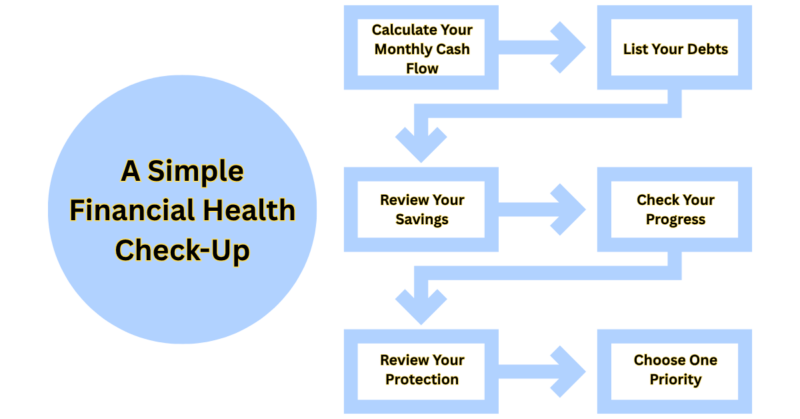
You can perform a basic review without using a complicated financial calculator.
Step 1: Calculate Your Monthly Cash Flow
Add your regular income and subtract essential and discretionary expenses.
If the result is consistently negative, identify the biggest pressure points.
Step 2: List Your Debts
Write down each balance, interest rate, minimum payment, and due date.
This makes expensive debt easier to identify.
Step 3: Review Your Savings
Separate emergency savings from money intended for short-term purchases or long-term goals.
Step 4: Check Your Progress
Ask whether you are moving toward your most important financial goals.
Step 5: Review Your Protection
Consider whether your insurance and other financial protections still fit your circumstances.
Step 6: Choose One Priority
Don’t try to fix everything at once.
You might begin with emergency savings, high-interest debt, spending, or income growth.
7 Practical Ways to Improve Financial Health
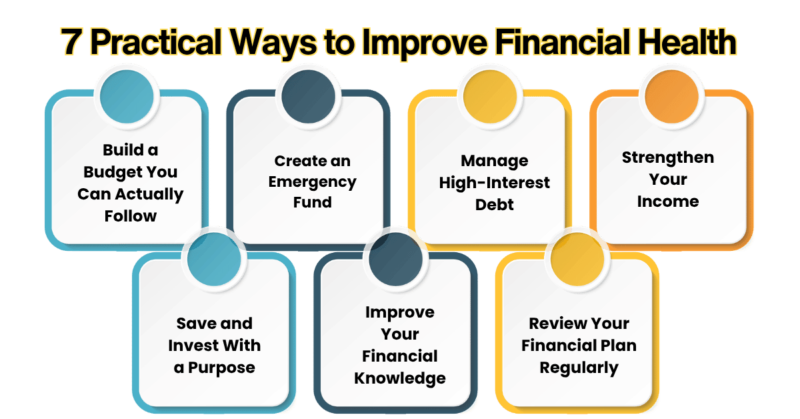
1. Build a Budget You Can Actually Follow
A useful budget should reflect your real life.
Track your income and expenses, identify essential spending, and make room for savings and financial goals.
Do not create a budget so restrictive that you abandon it after a few weeks.
2. Create an Emergency Fund
Emergency savings can help you deal with unexpected expenses without immediately turning to debt.
No single emergency-fund amount works for everyone. Consider your income stability, essential expenses, dependents, health needs, and other risks.
If saving a large amount feels impossible, start with a smaller target and build gradually.

3. Manage High-Interest Debt
High-interest debt can consume money that could otherwise support savings or long-term goals.
List your debts and create a repayment strategy that fits your budget.
Avoid taking on new expensive debt while working on existing balances where possible.
4. Strengthen Your Income
Financial health is not just about cutting expenses.
Increasing your earning potential may provide more room for saving and long-term planning.
Consider improving professional skills, pursuing qualifications, negotiating compensation where appropriate, or developing an additional income source that fits your circumstances.
5. Save and Invest With a Purpose
Give your money different jobs.
Short-term needs may call for accessible savings, while longer-term goals may allow for investment strategies that match your time horizon and risk tolerance.
Do not treat investing as a guaranteed way to make money. Investments can lose value.
6. Improve Your Financial Knowledge
Learn the basics of budgeting, interest, debt, saving, investing, insurance, taxes, and financial scams.
The OECD’s 2026 financial literacy framework emphasizes knowledge, skills, attitudes, and behaviors as important parts of financial literacy and financial well-being.
Better knowledge can help you ask better questions and make more informed decisions.
7. Review Your Financial Plan Regularly
Financial health is not a one-time project.
Review your finances when your income changes, you take on new debt, your family grows, you change jobs, or your long-term goals shift.
A short monthly check-in can help you stay aware.

How Financial Health Connects With Overall Well-Being
Money problems can affect more than your bank account.
Financial uncertainty may influence daily stress, relationships, lifestyle choices, and your sense of control.
That does not mean every financial problem causes a health problem or that money alone determines well-being.
It simply shows why financial health deserves a place in broader life planning.
A healthier financial position gives you more room to handle unexpected situations and make decisions based on your priorities, not constant financial pressure.
Financial Health at Different Life Stages
Your financial priorities naturally change over time.
In Your 20s
You may focus on building financial knowledge, managing expensive debt, building savings, and growing your earning potential.
In Your 30s
Housing, family responsibilities, career growth, and long-term savings may take priority.
In Your 40s
You may need to balance current family expenses with retirement and other long-term goals.
In Your 50s and Beyond
Retirement preparation, healthcare costs, debt management, and protecting accumulated assets may become larger priorities.
There is no perfect timeline. Your circumstances matter more than your age alone.
Financial Health for Women
Women may face financial challenges linked to differences in earnings, career interruptions, unpaid care responsibilities, and access to economic opportunities.
For this reason, financial health planning can include building personal savings, understanding workplace benefits, developing career skills, planning for retirement, and maintaining financial knowledge.
Financial independence is not simply about earning more. It also means having the financial resources and decision-making ability to support your goals.
Financial Health on a Low Income
A limited income does not mean financial planning is pointless.
In fact, a clear plan can be especially useful when money is tight.
Start with the essentials:
- Know your monthly income.
- Prioritize essential bills.
- Track spending.
- Avoid unnecessary high-cost debt.
- Build savings gradually when possible.
- Look for realistic ways to increase income.
- Use available community or government resources where eligible.
- Set one manageable financial goal at a time.
Don’t judge your financial health by comparing your situation with someone else’s.
Common Financial Health Red Flags
Some warning signs deserve attention:
- Regularly spending more than you earn
- Using debt to cover basic expenses
- Missing or making late payments
- Having no emergency savings
- Depending on one source of income without a backup plan
- Avoiding financial statements because they cause anxiety
- Having no clear financial goals
- Making investments you do not understand
- Falling for “guaranteed” high-return opportunities
- Never reviewing your financial situation
One red flag does not automatically mean your finances are unhealthy. Look at the overall picture.
What About the 3-6-9 Rule in Finance?
The 3-6-9 rule is not a universally accepted financial-health standard.
You may see different versions online, particularly rules suggesting different emergency-savings amounts based on income, employment, or life circumstances.
Because these versions are inconsistent, it is better not to treat “3-6-9” as an official measure of financial health.
Instead, build an emergency reserve based on your actual expenses, income stability, responsibilities, and financial risks.

What Are the 7 Pillars of Financial Health?
There is also no single universally accepted set of seven pillars of financial health.
For practical purposes, you can think about financial health through seven useful areas:
- Income and cash flow
- Spending and budgeting
- Emergency savings
- Debt management
- Long-term saving and investing
- Financial protection
- Financial knowledge and confidence
This framework is a practical way to organize a personal review, not an official universal standard.
A Practical Financial Health Checklist
Use this checklist every few months:
☐ I know how much money comes in each month.
☐ I understand where most of my money goes.
☐ My essential expenses are manageable.
☐ I know how much debt I have.
☐ I know the interest rates on my important debts.
☐ I am building emergency savings.
☐ I have clear short- and long-term financial goals.
☐ I am making progress toward those goals.
☐ I understand the investments or financial products I use.
☐ I review my financial situation regularly.
☐ I know where to find trustworthy financial information.
☐ I have a plan for major changes in my life.
You don’t need to check every box today. Use the list to identify your next step.
When Should You Re-Evaluate Your Financial Health?
Review your finances periodically, but also do a more detailed check when something significant changes.
Examples include:
- Starting a new job
- Losing income
- Getting married
- Having a child
- Buying a home
- Taking on major debt
- Starting a business
- Receiving a large financial windfall
- Approaching retirement
- Experiencing a major health or family change
Your financial plan should evolve as your life does.

When Should You Consider Professional Help?
Some financial situations are too complicated to handle without professional guidance.
Consider speaking with a qualified financial professional when you need help with complex investments, retirement planning, taxes, estate planning, business finances, or major financial decisions.
Check the professional’s qualifications, fees, services, and potential conflicts of interest before working with them.
Be especially cautious of anyone promising guaranteed high returns or pressuring you to invest immediately.
FAQs About Financial Health
Q. What is financial health in simple terms?
Financial health is how well your financial situation supports your current needs, protects you from unexpected financial problems, and helps you make progress toward your future goals.
Q. What is a good financial health score?
There is no universal good financial health score. The CFPB Financial Well-Being Scale produces scores from 0 to 100 and provides ranges, but the tool was developed for measuring financial well-being in specific contexts and should not be treated as a universal standard.
Q. How often should I do a financial health check-up?
A simple monthly review can help you monitor spending, savings, and debt. A more detailed review is useful when your income, expenses, family circumstances, debt, or financial goals change.
Q. What is the difference between financial health and wealth?
Wealth generally describes the value of what you own after subtracting what you owe. Financial health is broader and considers cash flow, debt, savings, financial security, goals, and your ability to manage financial challenges.
Q. How do you measure financial health?
Start by reviewing income, expenses, debt, savings, emergency reserves, financial goals, and your ability to handle unexpected costs. You can also use a research-based tool such as the CFPB Financial Well-Being Scale while recognizing its specific purpose and population.
Q. What are the main areas of financial health?
A practical framework includes income and cash flow, budgeting, emergency savings, debt, long-term saving and investing, financial protection, and financial knowledge. No single official list of “seven pillars” applies to everyone.
Final Thoughts
Financial health is not about having a huge bank balance or never making a financial mistake.
It is about having enough control and understanding to manage today’s needs while preparing for tomorrow.
Start with a simple financial check-up. Look at your income, spending, debt, savings, goals, and ability to handle unexpected expenses.
Then choose one area to improve.
Maybe you need to create a budget. Maybe you need to build emergency savings. Maybe debt is your biggest priority. Or perhaps your next step is learning more about investing.
You do not have to solve everything in one day.
Financial health improves through informed decisions, consistent habits, and regular reviews.
Read more articles on Health and Wellness.
You might like: