

Learn 7 habits for a highly productive life without burnout. Improve focus, manage time, prioritize tasks, and protect your energy with practical daily strategies.
Being busy all day does not always mean you are making progress.
You may answer dozens of emails, attend meetings, complete small tasks, and still finish the day feeling that your most important work remains unfinished.
This is the productivity trap: filling your hours instead of focusing on meaningful results.

Real productivity is not about working longer or pushing yourself harder. It is about choosing the right tasks, protecting your concentration, managing your energy, and knowing when to stop.
The following seven habits can help you work more effectively while protecting your time, health, and mental well-being.
What Are the Best Habits for a Productive Life Avoiding Burnout?
The best habits for a productive life help you prioritize important tasks, organize your schedule, reduce distractions, manage your energy, review your progress, keep learning, and maintain healthy work boundaries.
Together, these habits make it easier to achieve meaningful results without depending on constant overtime or sacrificing recovery.
7 Powerful Habits for a Productive Life
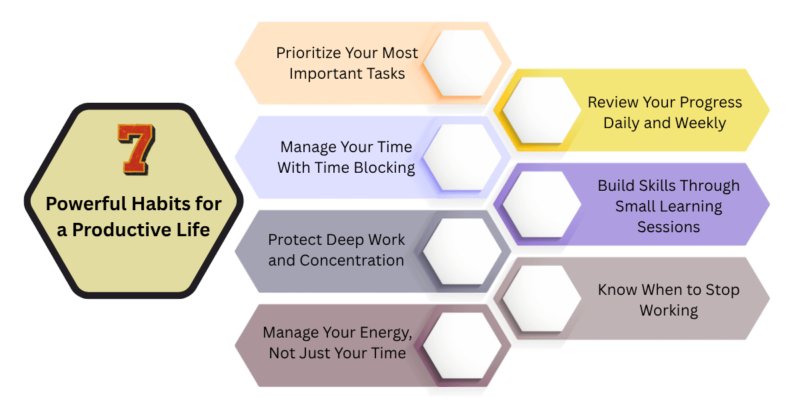
1. Prioritize Your Most Important Tasks
A long to-do list can make you feel productive, but completing easy tasks does not always move your important goals forward.
Start each day by identifying your Big 3: the three tasks that would make the biggest difference if you complete them.
For example:
- Finish an important client project.
- Prepare a presentation for an upcoming meeting.
- Complete a key business decision.
Once you identify your priorities, use the Eisenhower Matrix to decide what deserves your attention.
| Task category | What to do |
|---|---|
| Urgent and important | Do it first |
| Important, not urgent | Schedule it. |
| Urgent, not important | Delegate when possible. |
| Neither urgent nor important | Remove or reduce it. |
This simple framework helps you distinguish meaningful work from distractions that create activity without results.
Practical tip: Before accepting a new task, ask yourself whether it supports your current priorities. If it does not, decide whether it can wait, be delegated, or removed.
2. Manage Your Time With Time Blocking
Without a clear schedule, your day can quickly become a series of interruptions. Time blocking gives important tasks a dedicated place on your calendar.
Instead of writing down everything you need to do, assign specific periods to different activities.
For example:
| Time | Activity |
|---|---|
| 9:00–10:30 | Focused project work |
| 10:30–10:45 | Short break |
| 10:45–11:30 | Emails and messages |
| 11:30–12:30 | Meetings or collaboration |
| 1:30–2:30 | Second priority task |
| 2:30–3:00 | Administrative work |
Adjust these periods to match your responsibilities and energy levels.
You can also try the Pomodoro technique. Work with focus for 25 minutes, take a five-minute break, and repeat. After four rounds, consider taking a longer break.
The exact timing is flexible. Some people work better in 45- or 60-minute sessions.
Practical tip: Leave a little empty space in your calendar. Unexpected requests and delays are normal, so scheduling every minute can create unnecessary pressure.
3. Protect Deep Work and Concentration
Constant notifications, emails, and task switching make it difficult to concentrate. Every time you move between unrelated activities, you must redirect your attention.
Deep work means giving an important task your full attention without unnecessary interruptions.
Try these simple steps:
- Silence nonessential notifications.
- Close unrelated browser tabs.
- Keep your phone away during focus sessions.
- Set a specific time to check emails.
- Choose a quiet workspace when possible.
- Tell colleagues when you need uninterrupted time.
You can also batch similar tasks. For example, answer emails together, make phone calls in one session, and handle administrative work at a scheduled time.
This reduces the need to switch between different types of work throughout the day.
Practical tip: Start with one uninterrupted 30-minute focus session. Once you become comfortable, gradually increase the time.

4. Manage Your Energy, Not Just Your Time
You may have eight hours available for work, but your mental energy doesn’t stay the same throughout the day.
Some people feel most alert in the morning, while others concentrate better later. Understanding your natural patterns can help you plan demanding tasks more effectively.
Try this approach:
- High-energy periods: Handle complex decisions, writing, planning, or problem-solving.
- Moderate-energy periods: Attend meetings, collaborate, or complete regular tasks.
- Low-energy periods: Organize files, review simple documents, or complete routine administration.
Sleep, food, hydration, stress, and physical activity can also affect your energy.
Take short movement breaks, eat balanced meals, drink water regularly, and avoid relying on caffeine to push through every tired moment.

If you work night shifts or rotating schedules, your peak concentration hours may differ from a traditional daytime worker’s. Plan demanding tasks around your actual waking hours and alertness rather than following a standard office timetable.
Practical tip: For one week, notice when you feel most focused and when your energy drops. Use that information to adjust your schedule.
5. Review Your Progress Daily and Weekly
Working without reviewing your progress can lead to repeated mistakes, forgotten priorities, and unrealistic schedules.
A short daily review helps you understand what you completed and what still needs attention.
At the end of your workday, spend about 10 minutes answering:
- What important task did I complete today?
- What remains unfinished?
- What interrupted my concentration?
- What are tomorrow’s three priorities?
Then conduct a weekly review. Look at your completed projects, upcoming deadlines, workload, and any recurring problems.
For example, if you regularly spend too much time answering messages, you may need to schedule email sessions instead of checking your inbox throughout the day.
Use your review to make practical adjustments instead of criticizing yourself for unfinished tasks.
Practical tip: Keep your daily review simple. A notebook, calendar, or basic digital checklist is enough.
6. Build Skills Through Small Learning Sessions
Productivity isn’t only about completing today’s work. Improving your skills can make future tasks easier and more efficient.
You do not need to spend hours taking courses. Set aside 15–30 minutes when practical to develop one useful skill.
Depending on your work, you could:
- Learn a new software feature.
- Improve your writing or communication.
- Practice problem-solving.
- Study a better project-management method.
- Learn how to automate repetitive tasks.
- Read professional material related to your field.
Choose skills that solve real problems in your daily work. For example, learning spreadsheet shortcuts may save time if you regularly manage data.
Keep learning manageable. A short, focused session that you can repeat is often more realistic than an ambitious study plan that competes with your recovery time.
Practical tip: Choose one skill each month and practice it through small, useful tasks.
7. Know When to Stop Working
One of the most important productivity habits is knowing when your workday is finished.
If you constantly extend your working hours, check messages late at night, or think about unfinished tasks during personal time, you may leave yourself too little opportunity to recover.
The World Health Organization describes occupational burnout as a result of chronic workplace stress that has not been successfully managed.
It is associated with exhaustion, increased mental distance or negativity toward work, and reduced professional effectiveness.
Protecting your recovery time is therefore an important part of sustainable productivity.
Try these boundaries:
- Set a realistic end-of-day time.
- Avoid checking nonurgent work messages after hours.
- Write down unfinished tasks before leaving.
- Prepare your priorities for the next workday.
- Make time for sleep, relationships, and personal interests.
If your workload regularly makes these boundaries impossible, consider discussing deadlines, staffing, and responsibilities with your manager. Burnout prevention is not only an individual responsibility; workplace conditions matter too.
Practical tip: Create a simple closing ritual. Review your progress, write tomorrow’s priorities, close your work applications, and mentally finish the day.
How to Overcome Common Productivity Blockers
Even with good habits, some days are difficult. Procrastination, interruptions, and mental fatigue can prevent you from completing important work.
Beat Procrastination With a Small Start
Large projects often feel difficult because the first step is unclear. Instead of thinking about the entire project, identify one action you can complete in five minutes.
For example, if you need to write a report, start by opening the document and listing the main headings.
Other helpful strategies include:
- Break large tasks into smaller steps.
- Set a short starting timer.
- Remove distractions before beginning.
- Focus on progress instead of perfection.
- Give yourself a clear first action.
Starting is often easier when the task feels manageable.
Reduce Task Switching for a Productive Life
Moving between emails, meetings, messages, and projects can leave you mentally tired.
Try grouping similar activities together. Check messages at planned times, complete related tasks in one session, and protect short periods for focused work.
When an interruption is unavoidable, write down where you stopped and what you need to do next. This makes it easier to return to the task.
Recognize Cognitive Fatigue
Cognitive fatigue can make ordinary tasks feel harder. You may reread the same information, struggle to make decisions, or lose concentration.
Rather than forcing yourself to continue, take a short break. Walk around, drink water, get some fresh air, or step away from your screen.
If tiredness continues, review your sleep, workload, and recovery habits. Persistent exhaustion deserves attention, not another productivity technique.
FAQs on 7 Habits for a Highly Productive Life
Q. What Is the Most Effective Time Management Framework for Busy Schedules?
Time blocking is a useful framework for busy schedules because it assigns specific periods to important tasks, meetings, and breaks.
Combine it with the Eisenhower Matrix to decide which tasks deserve priority. If your schedule changes frequently, use flexible time blocks and leave room for unexpected responsibilities.
Q. How Do I Maintain Focus When My Workday Is Constantly Interrupted?
Identify the interruptions you can control and reduce them. Silence unnecessary notifications, schedule email checks, batch similar tasks, and protect short focus sessions.
For unavoidable interruptions, keep a brief note of your next step so you can return to your work more easily.
Q. What Is the Difference Between Prioritization and Time Management?
Prioritization means deciding which tasks matter most and should receive attention first. Time management means organizing when and how you complete those tasks.
Prioritization helps you choose the right work, while time management helps you fit it into your available schedule. Both are necessary for sustainable productivity.
Q. What Are the Signs That My Habits for a Productive Life Are Causing Burnout?
Common warning signs include constant exhaustion, difficulty concentrating, feeling detached or negative about work, and reduced effectiveness.
If you regularly feel overwhelmed despite working longer hours, review your workload, recovery time, and workplace expectations. Do not treat persistent exhaustion as a lack of discipline.
Q. How Can I Stay Productive Without Working Overtime?
Set three daily priorities, schedule focused work periods, and reduce unnecessary meetings and interruptions. Take short breaks and establish a realistic stopping time.
If your workload consistently exceeds your available hours, discuss priorities and deadlines with your manager instead of relying on daily overtime.
Q. Is Multitasking Good for Productivity?
Multitasking is not always efficient, especially when tasks require concentration. Switching repeatedly between emails, meetings, and complex projects can increase mental effort and make mistakes more likely.
Try completing similar tasks together and giving one important activity your full attention at a time.
Final Words on 7 Habits for a Highly Productive Life
Being productive does not mean filling every minute, answering every message immediately, or working until you are exhausted.
It means knowing what matters, giving important tasks your attention, managing your energy, and allowing yourself enough time to recover.
Start with one habit. Choose your Big 3, protect a short focus session, or set a realistic end-of-day boundary. Practice it consistently before adding another.
Remember: Sustainable productivity is not about doing more every day. It is about doing meaningful work without sacrificing your well-being.
Read more articles on Health and Life-Balance for practical ways to support your energy, focus, and everyday well-being.
References
- World Health Organization (WHO). Burn-out an occupational phenomenon: International Classification of Diseases. Explains the three dimensions of occupational burnout and its connection to chronic workplace stress.
https://www.who.int/standards/classifications/frequently-asked-questions/burn-out-an-occupational-phenomenon - World Health Organization (WHO). (2022). WHO Guidelines on Mental Health at Work. Guidance on workplace mental health and the importance of addressing work-related risks.
https://www.who.int/publications/i/item/9789240053052 - American Psychological Association (APA). (2023). Employers need to focus on workplace burnout: Here’s why. Discusses workplace conditions and approaches to preventing burnout.
https://www.apa.org/topics/healthy-workplaces/workplace-burnout - National Institute for Occupational Safety and Health (NIOSH). What burnout is and is not. Educational material explaining occupational burnout and its characteristics.
https://www.cdc.gov/niosh/learning/publichealthburnoutprevention/module-2/outline.html
Read more articles about Health & Wellness Tips.