

Learn the top 10 skills financial analysts need, from financial modeling and Excel to data analysis, risk management, communication, and AI.
Financial analysts do much more than work with numbers.
They examine financial statements, study markets and businesses, build forecasts, assess risk, interpret data, and turn complex information into insights that can support business or investment decisions.
That means a successful financial analyst needs a combination of technical finance skills and human skills.

Excel and financial modeling still matter, but today’s analysts also need strong data skills, critical thinking, communication, and the ability to use new technologies without blindly trusting their output.
Current guidance from the CFA Institute highlights this combination of technical expertise, AI and coding knowledge, strategic judgment, communication, and decision-making.
Whether you are studying finance, starting your career, or strengthening your existing skills, understanding what employers expect can help you focus your professional development.
Read time: 9–10 minutes
Quick Summary
The most useful skills for financial analysts include
- Financial analysis
- Financial modeling
- Data analysis and interpretation
- Excel and financial software
- Valuation and forecasting
- Risk analysis
- Critical thinking and problem-solving
- Attention to detail
- Communication and presentation
- Ethics, business awareness, and professional judgment
Technology is changing financial analysis, but it has not removed the need for human judgment. CFA Institute’s 2026 employer research found that employers increasingly want professionals who can combine AI and coding capabilities with financial analysis, decision-making, communication, and critical thinking.
What Does a Financial Analyst Do?
Financial analysts research and evaluate financial information, study business and economic trends, forecast future performance, and prepare reports or presentations.
Depending on the role, they may analyze companies, investments, markets, financial risks, or business performance.
The U.S. Bureau of Labor Statistics says financial analysts may research investments, evaluate historical and current financial data, examine economic and business trends, analyze financial statements, and prepare written reports and presentations.
The exact skills required can vary by role.
An investment analyst may spend more time on valuation and market research, while a corporate financial analyst may focus more heavily on budgeting, forecasting, and business performance.
Top 10 Skills Financial Analysts Need to Master
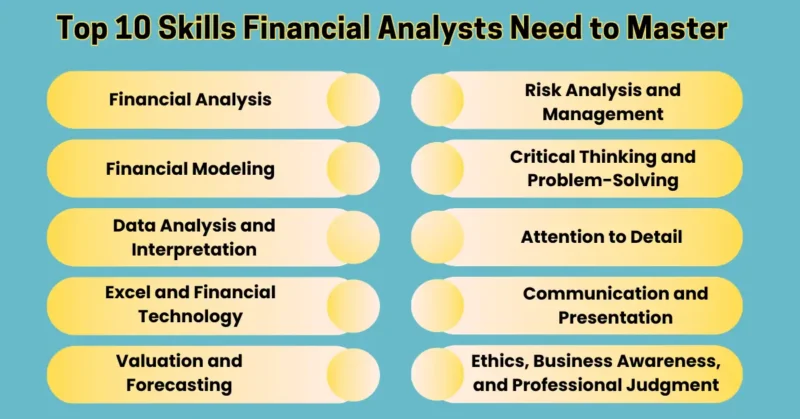
1. Financial Analysis
Financial analysis is central to the profession.
Analysts need to understand financial statements and determine what the numbers say about a company’s performance and financial position.
This includes working with information such as
- Revenue
- Expenses
- Profitability
- Cash flow
- Assets and liabilities
- Debt
- Financial ratios
- Historical performance
Good analysis goes beyond reading individual numbers.
An analyst needs to understand how different financial measures connect and what they may indicate about a business.
CFA Institute’s current financial-analysis guidance emphasizes examining multiple financial ratios and considering industry-specific measures rather than relying on a single metric.

2. Financial Modeling
Financial modeling turns financial information and assumptions into a structured model for forecasting and decision-making.
Analysts may use models to estimate future revenue, expenses, cash flow, earnings, valuation, or different business scenarios.
Excel remains an important tool for this work.
CFA Institute describes financial modeling as a core skill used across areas such as investment banking, asset management, corporate finance, and equity research.
A strong financial model should be:
- Logical
- Accurate
- Transparent
- Easy to review
- Flexible when assumptions change
3. Data Analysis and Interpretation
Modern financial analysts work with large amounts of information.
The ability to collect, organize, analyze, and interpret data helps analysts identify trends and support better decisions.
But data analysis is not simply about producing charts.
An analyst must ask:
What does this data actually tell us?
Is the information reliable?
What patterns matter?
What might the numbers be missing?
These questions help turn raw data into useful financial insight.

4. Excel and Financial Technology
Excel remains one of the most practical tools for financial analysis.
Analysts may use spreadsheets for financial models, forecasts, calculations, scenario analysis, data organization, and reporting.
However, the modern financial technology toolkit extends beyond Excel.
Depending on the role, analysts may also encounter:
- Python
- SQL
- Data visualization tools
- Statistical software
- Financial databases
- AI-assisted analytical tools
CFA Institute’s 2026 research found that employers still value Excel while placing increasing importance on AI, machine learning, data science, Python, and related technical skills.
The goal is not to learn every tool.
It is to understand which tools solve the problem you are trying to solve.
5. Valuation and Forecasting
Financial analysts often need to estimate what a business, security, or financial asset may be worth or how its performance could change.
This requires an understanding of valuation methods, financial assumptions, and forecasting techniques.
Analysts may examine:
- Revenue growth
- Profit margins
- Cash flow
- Capital requirements
- Industry conditions
- Economic trends
- Company-specific risks
Forecasts are not guarantees.
They are estimates based on available information and assumptions. A strong analyst understands both a forecast’s potential value and its limitations.
CFA Institute identifies forecasting and valuation as important analytical skills used in finance.

6. Risk Analysis and Management
Every financial decision involves some level of uncertainty.
Analysts need to identify potential risks and understand how those risks could affect financial outcomes.
Depending on the role, this may include examining:
- Market risk
- Credit risk
- Business risk
- Liquidity risk
- Operational risk
- Regulatory risk
- Economic changes
Risk analysis is not about predicting every problem.
It is about asking what could go wrong, how significant the impact could be, and what information would help decision-makers respond.
Financial risk specialists, for example, use quantitative analysis and models to measure exposure to credit and market risks.
7. Critical Thinking and Problem-Solving
Numbers do not automatically provide answers.
An analyst may receive incomplete information, conflicting data, or several possible explanations for the same result.
Critical thinking helps determine which information deserves attention.
A strong analyst asks questions such as
- Does this conclusion make sense?
- What assumptions are behind it?
- Could there be another explanation?
- What information is missing?
- How sensitive is the result to changing assumptions?
CFA Institute’s 2026 research emphasizes that employers still value human judgment and critical thinking, even as AI becomes more capable.
8. Attention to Detail
A small error in a financial model can produce a very different result.
That is why accuracy matters.
Financial analysts may work with large spreadsheets, financial statements, databases, reports, and multiple information sources. They need to notice inconsistencies and check calculations carefully.
The U.S. Bureau of Labor Statistics specifically identifies being detail-oriented as an important quality for financial analysts because small issues can have significant implications.
Attention to detail does not mean spending all day checking every number manually.
It means developing reliable processes for reviewing important information.
9. Communication and Presentation
An analyst can produce excellent research and still struggle professionally if they cannot explain it clearly.
Financial information often needs to be communicated to managers, clients, executives, investors, or colleagues who may not have the same technical background.
Strong communication includes:
- Clear writing
- Concise reports
- Effective presentations
- Data storytelling
- Explaining assumptions
- Communicating uncertainty
- Separating facts from opinions
CFA Institute identifies communication and report writing as critical skills for research analysts.
The BLS also lists communication skills as important because analysts need to explain their research and recommendations clearly.
10. Ethics, Business Awareness, and Professional Judgment
Financial analysis can influence important decisions.
That makes professional ethics essential.
Analysts need to communicate information honestly, recognize limitations, avoid misleading claims, and distinguish evidence from personal opinion.
CFA Institute’s professional standards emphasize communicating relevant limitations and risks and distinguishing fact from opinion in investment analysis and recommendations.
Business awareness is also important.

An analyst should understand that financial results do not exist in isolation. Industry changes, regulations, economic conditions, competition, technology, and geopolitical events can all affect businesses and markets.
Good judgment brings these factors together without losing sight of the underlying evidence.
Technical Skills vs. Soft Skills: Which Matter More?
Financial analysts need both.
Technical skills help you perform the analysis:
- Financial statements
- Financial modeling
- Excel
- Valuation
- Statistics
- Data analysis
- Forecasting
- Risk analysis
Human skills help you use that analysis effectively:
- Communication
- Critical thinking
- Decision-making
- Attention to detail
- Collaboration
- Professional judgment
- Ethics
Treating these as competing categories misses the point.
A technically strong analyst who cannot explain their findings may struggle to influence decisions. A strong communicator without sufficient financial knowledge may struggle to produce reliable analysis.
The combination is what makes the skill set valuable.
How AI Is Changing Financial Analyst Skills
AI is becoming increasingly relevant to financial work.
It can assist with tasks such as processing information, identifying patterns, generating initial analyses, writing code, or organizing large datasets.
But AI output still requires human review.
CFA Institute’s 2026 employer research reports growing demand for AI, machine learning, data science, and Python skills while emphasizing the continued need for professionals who can validate and interpret AI-generated outputs.
This means future analysts may benefit from learning not only how to use AI tools but also how to question them.
Useful questions include:
- Where did this information come from?
- Is the source reliable?
- Are the assumptions reasonable?
- Could the output contain an error?
- What important context is missing?
- Can I reproduce or verify the result?
Technology can make analysis faster. It does not remove the responsibility to make sure the analysis makes sense.
How to Develop Financial Analyst Skills
You do not need to master everything at once.
A practical learning path might look like this:
Start with accounting and financial statements.
Understand the income statement, balance sheet, and cash-flow statement.
Strengthen Excel.
Learn formulas, data organization, financial modeling, and scenario analysis.
Practice financial analysis.
Choose real companies and study their financial statements and business performance.
Learn valuation and forecasting.
Understand how assumptions affect financial outcomes.
Add data skills.
Depending on your career goals, explore SQL, Python, statistics, or data visualization.
Practice communication.
Write short summaries of your analysis and explain the key findings in plain language.
Develop professional judgment.
Question assumptions, check sources, and learn to recognize uncertainty.
CFA Institute’s practical analyst training similarly focuses on industry and company research, forecasting, identifying mispricing, and making recommendations based on analysis.
What Qualifications Do Financial Analysts Need?
Requirements vary by employer and role.
The U.S. Bureau of Labor Statistics says financial analysts typically need a bachelor’s degree, often in finance or a related field such as business. Internships can also help students gain practical experience. Some positions require licenses, while certifications can strengthen professional standing.
For investment-related careers, some professionals pursue additional qualifications such as the CFA Program.
However, qualifications alone do not replace practical skills.
Employers also need analysts who can apply financial knowledge to real problems.
Career Opportunities for Financial Analysts
Financial analysis skills can be used across several areas of finance.
Depending on experience and specialization, analysts may work in:
- Investment management
- Corporate finance
- Banking
- Insurance
- Risk management
- Equity research
- Financial planning and analysis
- Consulting
- Portfolio management
The BLS projects overall employment of financial analysts to grow 7% from 2025 to 2035 in the United States, with about 32,000 additional jobs over that period. These figures are U.S.-specific and should not be treated as a forecast for every country.
FAQs About Financial Analyst Skills
Q. What are the most important skills for a financial analyst?
Key skills include financial analysis, financial modeling, data analysis, Excel and financial technology, valuation, risk analysis, critical thinking, attention to detail, communication, and professional judgment.
Q. Do financial analysts need strong Excel skills?
Excel remains an important tool for many financial analysts, particularly for financial modeling, analysis, forecasting, and reporting. Current industry research also shows growing demand for complementary skills such as Python, data science, and AI.
Q. Is financial modeling important for financial analysts?
Yes. Financial modeling helps organize financial information, forecast performance, test scenarios, assess risks, and support business or investment decisions.
Q. Do financial analysts need coding skills?
Not every financial analyst role requires coding. However, Python, SQL, data visualization, and other technical skills are becoming increasingly relevant in parts of the finance industry. The value of these skills depends on the specific role and employer.
Q. What qualifications are needed to become a financial analyst?
Financial analysts typically need a bachelor’s degree in finance, business, or a related field. Some roles may require licensing, while professional certifications can be useful depending on the career path. Internships can also provide valuable practical experience.
Q. Are communication skills important for financial analysts?
Yes. Analysts must often explain complex financial information through reports, presentations, and discussions. Clear communication helps decision-makers understand what the analysis means and its limitations.
Final Thoughts
A successful financial analyst needs more than an ability to work with numbers.
The profession combines financial knowledge, modeling, data analysis, technology, risk awareness, critical thinking, communication, and professional judgment.
Excel and financial modeling remain valuable, but the role is evolving. AI, Python, data science, and other technologies are becoming more important, while human judgment remains essential for checking information, understanding context, and communicating conclusions.
If you are building a career in financial analysis, focus on developing a balanced skill set.
Learn the numbers.
Understand the business.
Question the assumptions.
Use technology intelligently.
And, most importantly, learn how to turn complex financial information into clear, useful insight.
Read more about financial health.