
Starting a weight loss journey at home is simpler than you think. Eat in a calorie deficit, do daily bodyweight workouts, and track progress weekly, not daily.
A calm, honest guide for anyone who’s ready to begin, without the overwhelm, the guilt, or the gym membership.
Before you begin:
Starting a weight-loss journey can feel overwhelming. There’s so much conflicting advice, so many “perfect” plans online, and this quiet fear that you’ll try again and fall short again. That feeling is valid, and it’s also not the whole story.
Most people don’t fail at weight loss because they lack willpower. They fail because they start too fast, change too much at once, and expect results that take months to appear in just a few weeks.
The good news is that you do not need a personal trainer, pricey equipment, or a drastic change in your lifestyle to lose weight sustainably.
Your kitchen and your living room are enough. What matters more is understanding a few basics and then building habits you can actually keep.
This guide walks you through four practical steps. Each one is grounded in evidence, not hype. Start wherever you are.
What Starting a Weight Loss Journey at Home Really Means
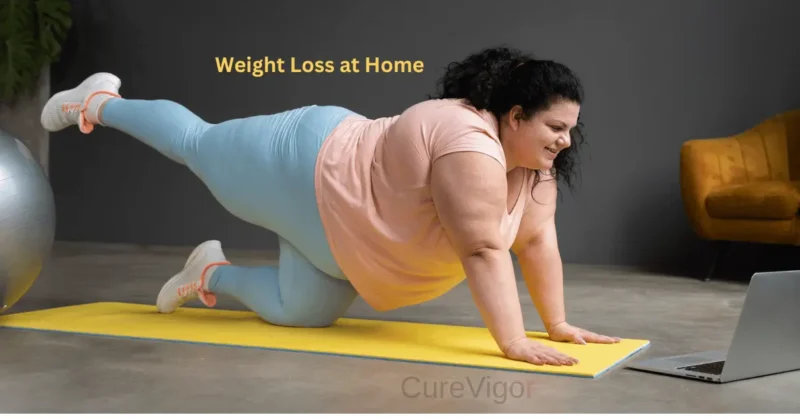
The basic idea behind weight loss is calories in versus calories out. When your body uses more energy than you consume, it draws on stored fat for fuel. That’s it. No magic, no mystery.
But that simple principle plays out in complex, human ways. Sleep affects hunger hormones.
Stress triggers cravings. Skipping meals often leads to overeating later. This is why the “just eat less, move more” advice sounds right but often fails, because it ignores the full picture.
Home-based weight loss works well because it gives you control over your environment. You choose what’s in the fridge.
You set the workout schedule. You build a rhythm around your actual life, your job, your kids, and your budget.
A gym membership is genuinely not required. Consistency, however, is.
| 42% of U.S. adults have obesity (CDC, 2023) | 80% of people who set vague goals fail within 6 months | 1–2 lbs per week is the clinically safe rate of weight loss |
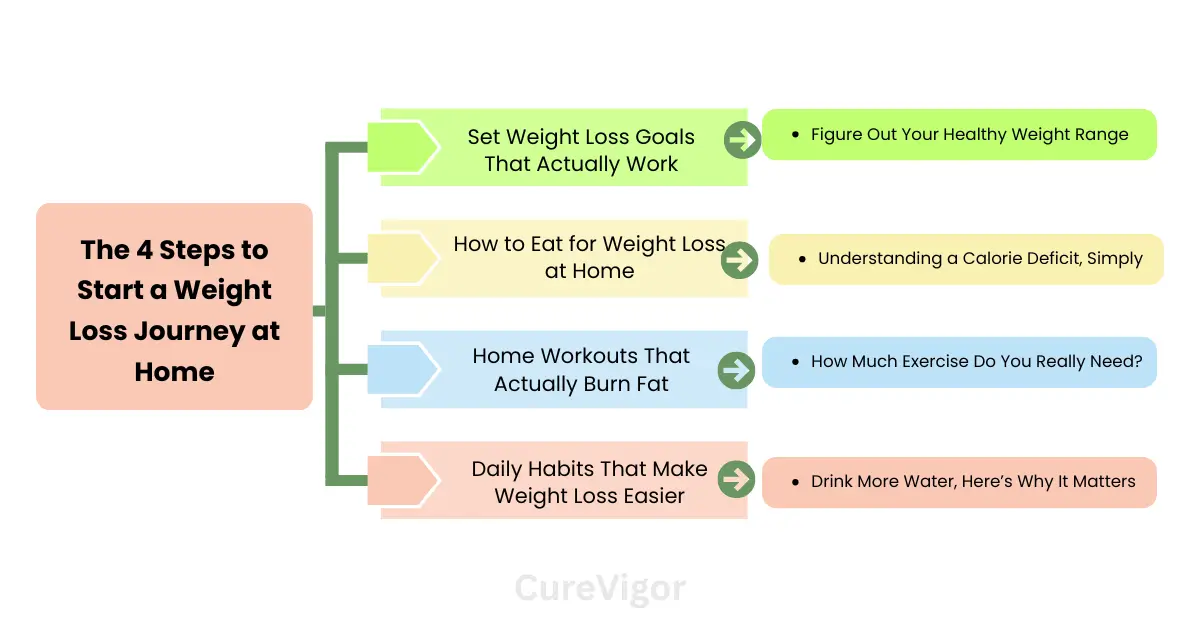
The 4-Step Guide to Start a Weight Loss Journey at Home
Step One
Set Weight Loss Goals That Actually Work
Figure Out Your Healthy Weight Range
Before setting a goal, it helps to know where you’re aiming. Body Mass Index (BMI) is an imperfect tool, but it’s a useful starting reference. For most adults, a BMI of 18.5 to 24.9 is considered healthy.
If you have 50 pounds to lose, trying to hit that in three months is a setup for burnout.
At the clinically recommended pace of 1–2 pounds per week, the same goal becomes achievable in six to seven months. That timeline feels longer, but the results actually stick.
Set Goals That Are Specific and Measurable
“I want to lose weight” is an example of a vague aim that gives your brain nothing specific to work toward. Specific goals do.
SMART Goal Examples
- Weak goal: “Lose weight this month.”
- Strong goal: “Walk for 30 minutes after dinner, five days a week, for the next four weeks.”
- Weak goal: “Eat healthier.”
- Strong goal: “Swap one processed snack per day with fruit or nuts.”
The second version works because it tells you exactly what to do. There’s no room to wonder, no excuse to delay.
Research from Dominican University found that people who write down specific goals are 42% more likely to achieve them.
Track Progress Without Obsessing Over the Scale
The scale is one tool, not the whole picture. Weight naturally fluctuates by 2–4 pounds in a single day, depending on water retention, digestion, and hormones.
Weighing yourself every morning and letting those numbers control your mood is a recipe for anxiety.
Measure progress with a fuller set of signals. Take photos from the same angle every two weeks.
Track your waist and hip measurements. Notice how your clothes fit. These markers often show change before the scale does.
If you weigh yourself once a week, on the same day and at the same time, before eating, you get the most accurate reading.
Step Two
How to Eat for Weight Loss at Home
Understanding a Calorie Deficit, Simply
When you eat fewer calories than your body burns each day, you have a calorie deficit.
For most adults, a deficit of 300–500 calories per day leads to steady, sustainable loss without triggering the intense hunger that derails most diets.
You don’t need an app or a calculator to start. Simple portion awareness goes a long way.
A serving of protein (chicken, eggs, or lentils) should be roughly the size of your palm. Carbohydrates like rice or pasta, about the size of a cupped hand. Vegetables? Fill half the plate.
Foods That Support Weight Loss at Home
Certain foods help more than others, not because they’re magic, but because they keep you full longer and cost fewer calories.
High Protein
Eggs, Greek yogurt, chicken breast, lentils, cottage cheese
High Fiber
Oats, apples, broccoli, beans, brown rice
Budget-Friendly
Frozen vegetables, canned tuna, bananas, chickpeas, sweet potatoes
Smart Snacks
Almonds, carrot sticks, boiled eggs, hummus, plain popcorn
Particular consideration should be given to protein. Higher protein intake dramatically decreases hunger and enhances feelings of fullness, making it easier to eat less without feeling deprived, according to a review published in The American Journal of Clinical Nutrition.
“Eating more protein is the single most important change most people can make to lose weight without tracking calories obsessively.” — Dr. Spencer Nadolsky, obesity physician and nutrition researcher.
Foods That Slow Progress
Liquid calories are the most overlooked obstacle. A single large sweetened coffee drink can contain 400–600 calories. Fruit juice, soda, energy drinks, and alcohol add up fast with almost no satiety benefit.
Hidden sugars in “healthy” products, such as flavored yogurts, granola bars, and protein shakes, are another common trap. Reading labels for added sugar (aim for under 10g per serving) makes a real difference.
Treats don’t have to disappear. A planned piece of chocolate or a small dessert is far better than swearing off sugar and then binge-eating a whole packet at 11 pm. The goal is a lifestyle, not a punishment.
Easy Recipes for Beginners
5-minute breakfasts: Two eggs scrambled with spinach and a slice of whole-grain toast. Or Greek yogurt layered with berries and a tablespoon of oats.
No-cook lunches: A can of tuna mixed with lemon juice and diced cucumber over lettuce. Or a whole-wheat wrap with hummus, turkey, and whatever vegetables are in the fridge.
Simple dinners: Sheet pan chicken thighs with roasted sweet potato and broccoli. Seasoning and a hot oven do the work. Lentil soup made in one pot lasts three days and costs almost nothing.
Step Three
Home Workouts That Actually Burn Fat
How Much Exercise Do You Really Need?
For overall health, the CDC suggests 150 minutes of moderate exercise per week. That equates to roughly 20 to 30 minutes a day, six days a week, for weight loss.
That number feels manageable because it is. A long walk after dinner counts. Twenty minutes of bodyweight exercises count. The biggest mistake is waiting to have a full hour before starting, because that hour often never comes.
Short, consistent sessions beat long, occasional ones every single time.
Cardio You Can Do at Home Without Equipment
Walking: It’s still one of the most effective fat-burning exercises available. 30 minutes of vigorous walking reduces cortisol, the stress hormone that encourages fat storage, and burns 150–200 calories.
Make it more effective by adding hills or light inclines, or by increasing the pace for one-minute intervals.
Beginner HIIT: High-Intensity Interval Training alternates short bursts of effort with recovery. A simple living room circuit might look like this: 20 seconds of jumping jacks, 10 seconds rest, 20 seconds of high knees, 10 seconds rest.
Repeat six times. That’s four minutes. Do three rounds and you’ve done more in 12 minutes than most people accomplish in 40 minutes of slow cardio.
Other options: Stair climbing for 10 minutes burns roughly the same calories as a 30-minute walk. Dancing to music, actual dancing, not a choreographed class, works the whole body and doesn’t feel like exercise at all.
Strength Training at Home (No Weights Needed)
Cardio burns calories during the session. Muscle burns calories all day. That’s why building strength is one of the smartest long-term investments in weight loss.
“Resistance training is not just for athletes. It’s the most powerful tool we have for changing body composition over time.” — Dr. Wayne Westcott, Exercise Science, Quincy College.
Bodyweight exercises are enough to build real muscle, especially for beginners. Start with these three:
Beginner Strength Exercises
- Squats: Stand with feet shoulder-width apart and lower until thighs are parallel to the floor. Three sets of 10–15 reps.
- Push-ups: Start on knees if needed. Focus on form over speed. Three sets of 8–12 reps.
- Plank: Hold a straight body position on forearms and toes for 20–40 seconds. Three sets.
For added resistance, fill two water bottles with sand. Use a backpack loaded with books. A chair can support step-ups and tricep dips. Equipment is optional; effort is not.
A Sample 7-Day Workout Plan
| Monday | Brisk walk + bodyweight strength | 35 min |
| Tuesday | Beginner HIIT cardio | 20 min |
| Wednesday | Light walk or yoga stretch | 25 min |
| Thursday | Strength training (squats, push-ups, planks) | 30 min |
| Friday | Dance session or stair workout | 25 min |
| Saturday | Longer walk or outdoor activity | 45 min |
| Sunday | Full rest or gentle stretching | — |
The schedule is a starting point, not a rule. Adjust it around work shifts, school runs, and real life. What matters is showing up most days.

Step Four
Daily Habits That Make Weight Loss Easier
Drink More Water, Here’s Why It Matters
Hunger is often confused with dehydration. The craving usually goes away in 10 minutes if you have a glass of water before reaching for food.
Adults who take 500ml of water prior to meals consumed substantially fewer calories and lost 44% more weight over a 12-week period than those who did not, according to a 2010 study published in Obesity.
A simple daily target: eight glasses. To make it easier, keep a water bottle on your desk, add lemon or cucumber if plain water feels boring, and drink a glass before every meal as a default rule.

Sleep and Weight Loss
Poor sleep disrupts ghrelin and leptin, the two hormones that regulate hunger and fullness. When sleep-deprived, the body craves high-calorie foods and has less energy to exercise. It’s not a willpower problem. It’s biology.
Aim for 7-9 hours of sleep each night. Small bedroom habits help: dim the lights an hour before bed, keep the room cool, and keep your phone out of reach. These changes feel minor but compound over time.

Stress, Emotional Eating, and What to Do Instead
Emotional hunger comes on suddenly and targets specific foods, usually salty, sweet, or crunchy. Physical hunger develops gradually and can be satiated by nearly any nutrient-dense diet.
The pause between a stressful moment and opening the fridge is everything. A five-minute technique: step outside, take ten slow breaths, drink a glass of water, then check in with yourself. Often, the craving fades.
Other quick stress relievers that don’t involve food: a short walk, stretching for three minutes, calling someone you trust, or writing down what’s bothering you.
These aren’t replacements for therapy when it’s needed; they’re circuit-breakers for everyday stress-eating.

How to Stay Consistent When Motivation Runs Out
Motivation is unreliable. It peaks at the start and drops around week three. Habit is what carries you through.
Habit stacking attaches new behaviors to existing ones. If you always make coffee in the morning, do ten squats while it brews.
If you always sit down for lunch, drink a full glass of water first. These micro-habits add up without requiring extra willpower.
After a bad day of eating, and there will be bad days, the response matters more than the slip. One off-day doesn’t undo a week of effort.
The mistake isn’t eating the pizza. It’s deciding the whole plan is ruined and skipping workouts for the rest of the week.
Arrange your home environment to make the healthy choice easier. Put fruit at eye level in the fridge. Keep workout clothes visible. Move snacks out of easy reach. Your surroundings shape behavior more than motivation does.
Common Mistakes to Avoid When Losing Weight at Home
- Skipping meals to cut calories faster. This usually leads to intense hunger later and overeating that cancels any deficit created. Eating regular meals stabilizes blood sugar and makes controlled eating far easier.
- Only doing cardio and skipping strength training. Cardio helps, but muscle tissue raises your resting metabolism. A mix of both produces significantly better body composition results than cardio alone.
- Expecting results within two weeks. Visible body changes typically take four to eight weeks of consistent effort. Giving up at week three, which is when most people quit, means missing the results entirely.
- Not planning for weekends and social events. Weekdays go well, then Friday arrives. Have a loose plan: eat before events, choose one or two things you genuinely enjoy, and avoid the all-or-nothing mindset.
Frequently Asked Questions
Q. How can a novice begin exercising at home and quickly reduce weight?
Begin with 20–30 minutes of daily movement, brisk walking, bodyweight squats, or a beginner HIIT routine done in your living room.
Pair exercise with a moderate calorie deficit of 300–500 calories per day by eating more protein and fewer processed foods.
Consistency matters more than intensity at the start. Showing up daily for three to four weeks builds the habit that produces real results.
Q. Write 4 tips on how to start a weight loss journey once again.
Restarting is not failure, it is the smartest thing you can do. These four steps make the second attempt far more effective than the first:
- Reset your goal: Set one specific, small habit instead of a sweeping overhaul — like walking 20 minutes after dinner every day.
- Fix your environment first: Clear out trigger foods, prep healthy snacks, and lay out workout clothes the night before.
- Track what you eat for three days: Most people underestimate daily intake by 30–40%. Awareness alone drives better choices.
- Give yourself a 30-day window: Visible results take four to eight weeks. Commit to the process before judging the outcome.
Q. What are some quick tips for starting a weight loss journey?
Small, consistent actions outperform dramatic short-term plans. Start here:
- Drink a full glass of water before every meal to reduce unnecessary hunger.
- Swap one ultra-processed item per day for a whole-food alternative, fruit, eggs, or nuts.
- Even if it is simply a walk around the block, make time each day to move your body for at least twenty minutes.
- Sleep seven to nine hours; poor sleep raises hunger hormones and significantly stalls fat loss.
These four habits, done consistently, create a measurable calorie deficit without requiring a strict diet plan.
Q. How to lose weight fast naturally and permanently?
Natural, permanent weight loss comes from building a moderate calorie deficit through real food, high protein, high fiber, low added sugar, combined with daily movement.
Avoid extreme restriction or crash diets; they trigger metabolic adaptation and nearly always lead to regain within months.
The most effective approach is losing 1–2 pounds per week through sustainable habits, better sleep, stress management, and regular exercise, so the body adapts without rebelling.
Q. What is the 3-3-3 rule for losing weight?
The 3-3-3 rule is a simple framework: eat 3 balanced meals per day, allow no more than 3 hours between meals to prevent blood sugar crashes, and stop eating 3 hours before bedtime.
Following this structure helps regulate hunger hormones, prevents late-night snacking, which accounts for a large portion of excess calories for many people, and supports better sleep quality.
It is not a strict diet but a timing guideline that reduces impulsive eating and creates natural portion control without calorie counting.
Q. Can I lose 5kg in 2 weeks?
Losing 5kg of actual body fat in two weeks is not realistically achievable or safe; it would require a daily deficit of roughly 2,500 calories, which is unsustainable for most people.
You may see the scale drop by 2–3kg in two weeks if much of the initial loss is water weight from cutting refined carbs and sodium, but true fat loss takes longer.
A safe, realistic target is 0.5–1kg per week, meaning 2kg over two weeks, which protects muscle mass, keeps metabolism healthy, and produces results that actually last.
Q. How to lose 20 kg without exercise?
Losing 20kg without exercise is possible but requires a well-managed calorie deficit through diet alone, prioritizing protein at every meal, cutting liquid calories, and eliminating ultra-processed foods.
Without exercise, the process is slower, and the risk of losing muscle alongside fat is higher, which can lower your resting metabolism and make long-term maintenance harder.
Non-exercise movement, walking during calls, taking stairs, and doing household chores actively can meaningfully increase daily calorie burn and support the deficit without formal workouts.
Your Weight Loss Journey Starts Today
Four steps. That’s the whole framework. Set a real goal. Eat in a gentle calorie deficit with more protein and whole foods. Move your body daily, even if it’s just a walk. Build sleep, hydration, and stress management into your routine.
You don’t need to do all four perfectly starting tomorrow. Pick one habit and start it in the next 24 hours. Just one. Everything else can follow.
Consistency beats perfection. Always. The person who walks 20 minutes every day will always outpace the person who plans an elaborate gym program and never begins.
What’s the one habit you’re starting first? Drop a comment below, share your experience, or tell someone close to you what you’re beginning. Saying it out loud makes it real.
Read more health and wellness tips.
You might like: