
Find out a practical 5-minute mindfulness practice for exhausted caregivers. Find calm in chaos, reduce stress, and reclaim moments of peace without adding to your to-do list.
Your hands are full. Your mind is racing through the next three tasks, the medication schedule, the appointment next Tuesday, and the sharp worry that you haven’t called your own doctor in months. You are a caregiver, whether by profession or by love, and the weight you carry is immense.
The world tells you to practice “self-care,” which often feels like one more impossible item on an already crushing to-do list.
When you are having trouble finding 60 seconds to sip a cup of coffee while it is still hot, the proposal of a 60-minute yoga class or a weekend retreat may even seem offensive.
So let’s discard the grand, unattainable visions of self-care. You don’t need another obligation. You need a parachute: a tool so small, flexible, and effective that it slips into the cracks of your chaotic day and gives you an instant foothold of calm.
This is what a fantastic 5-minute mindfulness practice offers. This is not about clearing your mind of thoughts; it’s about stepping beside them for just 300 seconds so they don’t run you over.
You will learn how to build a personal practice that requires no special cushion, app, or quiet room, just your breath and the intention to reclaim a small, sacred slice of peace.
The 5-Minute Mindfulness Anchor
What does a 5-minute mindfulness practice for a stressed-out caregiver actually look like?
It looks like a portable three-step check-in. First, ground your body by feeling your physical connection to a surface, such as your feet on the floor or your back against a chair. Second, follow the natural rhythm of five conscious breaths to downshift your nervous system.
Third, you gently notice the most prominent feeling in your body or emotion in your mind without judging it, simply labeling it (“tightness,” “fear,” or “exhaustion”) and letting it be there.
This isn’t about fixing anything; it’s about creating gentle awareness that interrupts the automatic stress spiral. You can do this standing in a hallway, sitting in a parked car, or hiding in a bathroom.
The Caregiver’s Reality: Why Your Brain Needs This
You operate in a constant state of hyper-vigilance, your nervous system perpetually scanning for the next need, the next crisis, the next sound from the other room.
Your body is overloaded with cortisol and adrenaline due to this persistent stimulation of your sympathetic nervous system, often known as your “fight-or-flight” reaction.
Over time, this isn’t just exhausting; it is corrosive, contributing to what researchers identify as caregiver burnout, a state of physical, emotional, and mental depletion marked by detachment and a reduced sense of personal accomplishment.
This is why your typical “just breathe” advice can feel hollow. You are not weak for struggling; you are a human being with a nervous system running a marathon with no finish line. A fantastic 5-minute practice is not a luxury. It is a targeted neurological intervention.
By consciously shifting your attention to the present moment using grounding and breath, you activate your parasympathetic nervous system, the “rest-and-digest” response.
You are manually flipping a switch from high alert to calm repair. You are not trying to become a Zen master. You are giving your exhausted brain a brief, powerful pit stop.
Building Your Fantastic 5-Minute Framework

You cannot rely on finding a perfect, quiet moment; it won’t come. Instead, build a practice around the moments that already exist.
This framework rests on three pillars:
- Stealing Time
- Anchoring in the Senses
- Releasing the Judgment
The goal is not a silent mind, but a mindful, connected one.
1. Steal Time: The Art of the Micro-Moment
Caregivers don’t “find” time; they strategically steal it back. This requires a mindset shift from “I’ll practice when I have a break” to “I will turn this transition into a break.” Your day is filled with hidden portals to the present moment; you simply need to recognize them as entry points.
Your Hidden Practice Spaces (No Cushion Required)
You should scan your daily routine for what we’ll call “threshold moments,” the brief pauses between tasks. These are your new practice studios.
- The Handwashing Ritual: While scrubbing up after a care task, focus completely on the sensation of the water temperature, the sound of the splash, and the scent of the soap. This is a 30-second practice.
- The Hallway Commute: Every time you walk from one room to another, take one conscious breath. Let the hallway be a bridge where you drop your mental load and reconnect with your feet touching the floor.
- The Grocery Line or Pharmacy Wait: Instead of scrolling your phone, plant both feet evenly, unclench your jaw, and take three slow breaths. This stolen moment transforms depleting “wait time” into restorative “me time.”
- The Boiling Kettle: As you wait for the water to boil, instead of running through your worry list, rest your hand on the counter and feel the cool surface, the appliance’s hum, and the steam’s warmth.
2. The 5-Minute Practice: Your Step-by-Step Guide
When you can secure a solid five-minute block, perhaps after you’ve helped your loved one settle, in your car before walking into a shift, or briefly locked in a bathroom, use this structured practice. It is designed to be a complete neurological reset.
Step-by-Step 5-Minute Mindfulness Practice: The S.T.O.P. Anchor Method
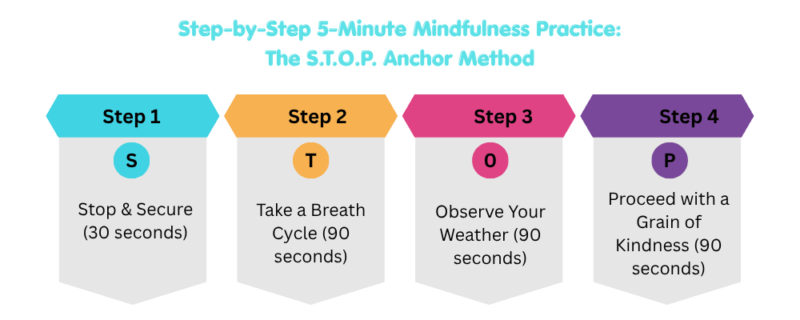
This modified version of the classic mindfulness tool is tailored specifically for the high-stress caregiver environment.
Step 1: S – Stop and Secure (30 seconds)
Literally stop moving. If you are standing, feel your feet rooted to the ground. If you are sitting, feel the chair supporting your weight. Place one hand flat on your chest and one on your abdomen.
This physical self-touch is a powerful grounding signal to your nervous system. Say internally, “I am stopping now. For these five minutes, there is nothing to do but be here.”
Step 2: T—Take a Breath Cycle (90 seconds)
Shift all your attention to your breathing. Do not try to change or deepen it. Simply ride the wave of one full breath cycle: the cool air entering your nostrils, the brief pause, the warm air leaving.
Count five complete cycles like this. If your mind spirals back to your to-do list, this is not a failure. The act of noticing you have drifted and gently returning to the breath is the entire workout.
Your mind wanders a hundred times; you gently bring it back a hundred and one times. This is the practice.
Step 3: O – Observe Your Weather (90 seconds)
Now broaden your attention from the breath to your entire inner landscape. Ask yourself: “What is my internal weather pattern right now?” Don’t analyze it. Just observe. Is there tightness in your shoulders?
A lump in your throat? Is your mental sky stormy with anxiety, foggy with fatigue, or heavy with sadness? Label the most prominent sensation or emotion with the gentleness of a curious scientist, not a critic.
You might silently say, “Ah, there is the tight band of anxiety around my chest. There is the lump of sadness.” By naming the feeling, you step out of being consumed by it and into observing it.
Step 4: P – Proceed with a Grain of Kindness (90 seconds)
Before you open your eyes or return to your day, place your hand on your heart. Feel the warmth of your own touch. Offer a single phrase of acknowledgment for the incredible difficulty of your journey.
This is not a positive thinking gimmick; it’s a self-compassion break. You can silently repeat a phrase like “This is a moment of struggle.
Struggle is part of caregiving. May I give myself the kindness I so freely give others.” This final step is the shield you carry back into the fray.
3. Release the Judgment: The New Rules of Your Practice
Your mindfulness practice will be ugly, messy, and completely un-Instagrammable, and that’s precisely how it should be. Establish new, compassionate rules for this practice to survive the reality of your life.
How do I stop feeling guilty when taking a break as a caregiver?
Reframe a self-compassion break as a critical component of care, not an escape from it. When you notice guilt, acknowledge it with the phrase, “This is the guilt talking.”
It is a sign of how much I care, not a sign I am doing wrong.”Remind yourself that a reset pause isn’t selfish; it’s a strategic equipment check. An exhausted, depleted caregiver is a compromised caregiver. By refilling your own cup for five minutes, you are ensuring you can pour safely and effectively for your loved one.
- Rule 1: A Mindful Moment is Not a Failure. If your five minutes are interrupted, you haven’t “failed.” The thirty seconds of presence you snatched before the interruption were a success. Acknowledge it and move on.
- Rule 2: You Cannot Do This Wrong. A wandering mind is not an enemy; it is standard operating procedure for a stressed human. The practice is the gentle return, not the perfect blank slate.
- Rule 3: Acknowledge the Voice of Guilt, Then Step Past It. When the thought “You should be doing something productive” arises, label it. Say to yourself, “Ah, there is the guilt.” You are not required to board that train of thought. Stand on the platform, watch it pass, and hold your breath.
Real-Life Application: Three Fantastic 5-Minute Scenarios
This practice is not theory. It is a field manual for the most stressful moments of your day. Here is how to deploy it.
Scenario 1: The Overwhelming Morning (Before Getting Out of the Car)
You’ve arrived for your shift, or you are about to walk back into the house to start the morning care routine. The weight is already crushing you.
Your 5-Minute Plan: Before you turn off the engine, you are in a protected bubble.
- Press your back into the seat (stop).
- Take five long, slow exhales through pursed lips, as if blowing through a straw (take).
- Observe the knot of dread in your stomach.
- Don’t fight it. Say, “Dread is here” (observe).
- Place a hand on your chest and set a one-word intention for the day, not like “be perfect” but “gentleness” or “patience” (proceed).
Scenario 2: The Emotional Spike (The Mid-Task Reset)
A caregiving task has gone sideways. Your loved one is upset, you’re frustrated, and you feel a flash of anger or a wave of grief about to spill over. You can’t leave the room. Your 5-Minute Plan: You transition to a micro-practice in plain sight.
Verbally state, “I just need to take a few deep breaths for myself.” Feel your feet inside your shoes, pressing hard into the floor.
This physical grounding is a stop signal. Look around the room and name five specific things you can see: the blue vase, the sunlight on the wall, and the grain of the wood on the bedside table (observe).
This yanks you out of your emotional brain and into the present moment. Take three slow, audible breaths (take), physically signaling calm to both your nervous system and your loved one.
Scenario 3: The End of a Long Day (The Decompression Threshold)
You’re off the clock, or your loved one is finally asleep. Your mind is a highlight reel of every difficult moment. You’re physically still, but your brain is spinning.
Your 5-Minute Plan: Sit in a chair near a window or a quiet corner, but do not immediately turn on the TV or open social media.
This is a crucial S.T.O.P. threshold. Close your eyes. Listen to the hum of the refrigerator, the distant traffic, and the sound of the house settling (observe your soundscape). Imagine your swirling thoughts are like silt in a jar of water, slowly settling to the bottom.
You don’t force them down; you just watch them settle (proceed). This practice creates a boundary between your role as a caregiver and your identity as a human being who needs rest.
Why 5 Minutes is Enough: The Science of the Micro-Break
You may wonder if such a short period can truly help. It’s a valid question. The power is not in the duration but in the consistency and the neurological mechanism it triggers.
A single five-minute practice of non-judgmental awareness activates your prefrontal cortex, the rational, calming part of your brain, while down-regulating the amygdala, your brain’s panic button. You are forging a new neural pathway.
The practices described above are rooted in widely accepted principles of neuroplasticity.
With consistent, brief, and repeated practice, you are literally rewiring your brain to default to a calmer baseline. Think of it like doing a single bicep curl. One curl does nothing.
But five minutes of curls every day for a year will transform your arm. Your brain is the same.
A fantastic 5-minute practice performed daily is a compound investment. It’s not the length of the session that heals you; it’s the frequency of the pause that rewires you.
Customizing Your 5-Minute Mindfulness Practice for Different Caregiving Moments
Not every day feels the same. You can adapt the practice to match your energy and situation.
Comparison Table: 5-Minute Mindfulness Variations
| High anxiety/panic | Breath-focused grounding | Counting breaths 1–4 | Before difficult conversations |
| Physical exhaustion | Body scan with gentle movement | Noticing tension and releasing | After lifting or transfers |
| Emotional overwhelm | Loving-kindness & gratitude | Phrases of self-compassion | When guilt or grief surfaces |
| Waiting (doctor’s office) | Sensory awareness | Name 5 things you can see/hear | During appointments |
| End of day | Reflection & release | Letting go of what you could not control | Before trying to sleep |
You can improve results by choosing the variation that best matches your current state rather than forcing the same script every time.
The Easiest 5-Minute Mindfulness Practice
Caregivers can drastically reduce stress with a 5-minute daily practice that combines breathwork, a body scan, and sensory grounding. This quick, restorative routine interrupts the anxiety spiral, lowers cortisol, and helps you return to your caregiving duties with renewed patience and focus.
Structure Your 5-Minute Caregiver Practice.
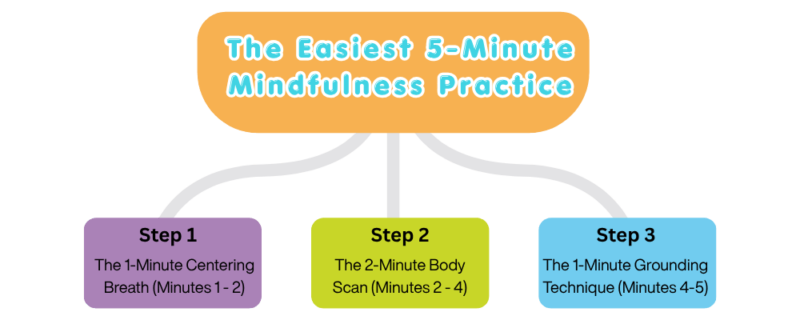
1. The 1-Minute Centering Breath (Minutes 1 – 2)
- Find a comfortable seated position or stand where you are.
- Close your eyes if you feel safe doing so, or soften your gaze toward the floor.
- Take long, slow inhales through your nose, letting your belly expand.
- Exhale gently through your mouth, making your exhales slightly longer than your inhales to actively calm your nervous system.
2. The 2-Minute Body Scan (Minutes 2 – 4)
- Bring your attention to the very top of your head, and slowly move down to your toes.
- Actively release any tension you are holding in your jaw, shoulders, and stomach.
- Notice how your body feels without judging it, and allow the muscles to soften.
3. The 1-Minute Grounding Technique (Minutes 4-5)
- Gently open your eyes and reconnect with your immediate environment.
- Use the 5-4-3-2-1 method: List five things that you can see, four that you can touch, three that you can hear, two that you can smell, and one that you can taste.
- Finish by taking a final deep breath, thanking yourself for taking this intentional time, and gently returning to your day.
Tips to Make It a Daily Habit
- Use Transitions: Try this practice in the gaps between tasks, such as in your car before walking inside or while waiting for a doctor’s appointment.
- Remove Judgment: Understand that your mind will wander. When it does, do not criticize yourself; simply acknowledge the thought and guide your attention back to your breath.
- Keep It Convenient: If you struggle to sit still, explore walking mindfulness to incorporate presence into active moments.
FAQs About 5-Minute Mindfulness for Caregivers
Q. I can’t stop my thoughts at all. Am I doing it wrong?
Absolutely not. A mind that produces thoughts is not a broken mind; it’s a functioning one. The goal of mindfulness is never to blank out your mind. The goal is to change your relationship to your thoughts.
Think of your thoughts like a rushing river. You are not trying to dam the river. You are practicing sitting on the bank, watching the water rush by, without being pulled into the current. Every time you notice “I am thinking” and gently return your attention to your breath, you are executing a perfect mental rep.
Q. What if a real emergency happens during my 5 minutes?
Your practice should never put anyone at risk. A fantastic practice is built on a foundation of safety. If you are the sole caregiver for someone who needs constant supervision, your practice should occur when they are safely settled and asleep or when you are using a baby monitor.
In a true, immediate emergency, you stop the practice and respond. Years of practice teach you not to seek composure from perfection but to respond to the emergency from a slightly less reactive, more centered place. The skill is in returning to your anchor faster afterward.
Q. How is this different from just sitting down and doing nothing?
Sitting down and zoning out, often paired with doom-scrolling on your phone, is passive; it can be a dissociative escape that leaves you feeling more drained. A fantastic 5-minute mindfulness practice is an active, engaged training of your attention.
You are not mentally checking out; you are checking in. You are intentionally guiding your nervous system from a state of fight-or-flight to rest-and-digest. This is a skill-based, active form of rest that produces a measurably different physiological outcome than simple distraction.
Q. I feel more anxious when I focus on my breath. What should I do?
For some stressed individuals, especially those carrying trauma, interoception (internal body focus) can initially feel agitating. If this is your experience, immediately pivot from a body-anchored practice to an external anchor.
Do not follow your breath. Instead, become a deep listener to the sounds around you. Listen to the farthest sound you can hear, then the closest.
Or practice tactile grounding by holding a cold glass of water, feeling the smooth texture of a stone, or pressing your fingers into your palm one by one. The anchor is irrelevant; the intentional focus is everything.
Q. How can I do this if I am a professional caregiver constantly on call?
Your practice must become invisible and fluid, woven into your movements. You practice while walking down the hospital corridor, feeling each footfall. You practice while washing your hands between patients.
You practice a single, deep, centering breath before you knock on a patient’s door. The S.T.O.P. acronym is your portable tool. No one needs to know you are meditating; you simply look like you are pausing to think. This is your secret weapon, worn invisibly.
Q. Will this work if I am skeptical about “mindfulness” as a concept?
Yes, and you don’t need to buy into any philosophy for it to work. Strip away the word “mindfulness” if it bothers you.
Call it “brain training,” “stress inoculation,” or a “focused reset.” You are engaging in a simple, scientifically validated physiological technique to regulate your nervous system, similar to how you would do a physical stretch to release a muscle knot.
Your belief in it is not a prerequisite for its effectiveness. A skeptical brain that does the exercise will still receive the neurological benefit.
Q. How do I shift from a 5-minute practice to handling a full day of stress?
The 5-minute practice is not just a break; it’s a training ground for life. Use it to build your “mindful muscle,” then deploy it in micro-doses. The real goal is to bring mindful awareness to the everyday moments.
When a stressful interaction happens, you will have trained the skill of the “O” in S.T.O.P., Observe, so you can notice the rising tide of anger or frustration before it floods you.
You can then take a single conscious breath in the gap between a trigger and your reaction. That single, mindful breath is the true, practical, full-day payoff of your fantastic 5-minute practice.
Conclusion About 5-Minute Mindfulness for Caregivers
You became a caregiver to provide, to heal, to support, and to love. That role does not require you to self-destruct in the process, even though it often feels that way.
A fantastic 5-minute mindfulness practice is your invisible anchor in the storm, a skill that can be learned in a single sitting and deployed for a lifetime of chaotic days.
You do not need to be a naturally calm person, and you certainly do not need more time; you need a different kind of tool, one that meets you exactly where you are.
Start right now where you sit. Before you stand up and return to your duties, plant your feet on the ground, let your jaw go slack, and take one, single, full, conscious breath. That’s it. You’ve just begun.
Tomorrow, see if you can steal a full five minutes using the S.T.O.P. method. Be patient with your wandering mind, and be fiercely kind to the heart that carries so much.
The calm you cultivate in these small moments is not a retreat from caring; it is the very fuel that allows you to keep going wholeheartedly without losing yourself in the process.
Take your first five minutes right now, or schedule a single S.T.O.P. break into your day tomorrow. Your calm is not a luxury; it’s a caregiver’s most essential tool.
Read more about night shift workers’ health.
You might like: