

Have you ever made a decision that looked right on paper but still did not feel right inside?
Sometimes the problem is not that you lack direction. You may simply be living by expectations, habits, or other people’s priorities instead of your own values.
Your values can act like an internal compass. They can help you understand what matters to you, make difficult decisions, set healthier boundaries, and choose actions that feel more meaningful.

But finding your true values takes more than picking a few attractive words from a list.
This guide walks you through 7 practical steps to identify your personal values and use them in everyday decisions.
Quick summary: Personal values are the principles and qualities that matter to you and influence how you want to live. The goal is not to find a perfect list of values. It is to identify what genuinely matters to you and turn those values into everyday actions.
What Are Personal Values?
Personal values are the qualities, principles, and priorities that you consider important in life.
They can influence how you treat people, spend your time, make decisions, approach work, handle relationships, and respond to challenges.
Examples include:
- Honesty
- Family
- Freedom
- Kindness
- Growth
- Creativity
- Security
- Respect
- Health
- Responsibility
- Learning
- Compassion
- Independence
- Faith
- Community
- Adventure
- Balance
No universal list of values applies to everyone.
What matters deeply to one person may matter less to another.
In psychology, values are often considered in relation to meaningful action and motivation. For example, Acceptance and Commitment Therapy focuses on clarifying personally chosen values and taking action that is consistent with them.
Values Are Not the Same as Goals
This distinction can make your values exercise much easier.
A goal is something you can achieve.
A value is an ongoing direction that can continue to guide your behavior.
For example:
Goal: Get a promotion.
Value: Growth, learning, or contribution.
Goal: Exercise three times a week.
Value: Health and self-care.
Goal: Spend Saturday with your family.
Value: Connection and family.
You can achieve a goal and move on. A value can keep shaping how you live.
Why Are Personal Values Important?
Knowing your values does not automatically make every decision easy. However, it can give you a clearer framework for deciding what deserves your time and energy.
Values clarification is commonly used to help people identify what matters to them and connect those values with meaningful actions.
Your values may help you:
Make More Meaningful Decisions
When two choices seem equally attractive, asking which option better reflects your values can provide another perspective.
Set Healthier Boundaries
If you value family, rest, or personal well-being, you may become more comfortable saying no to commitments that consistently leave you exhausted.
Understand Yourself Better
Sometimes frustration comes from repeatedly doing things that conflict with what matters to you.
Reduce “Should” Thinking
You may have absorbed ideas about what you should want from family, friends, culture, social media, or society.
Values clarification gives you an opportunity to ask:
“But what actually matters to me?”
Create More Consistent Actions
Knowing a value is only the beginning. The real benefit comes from translating it into small, observable actions.
How Knowing Your Values Can Change Your Behavior
Imagine that you say health is one of your most important values.
That value becomes more useful when it affects what you actually do.
You might:
- Make time for regular movement.
- Protect your sleep.
- Prepare nourishing meals.
- Schedule health appointments.
- Take breaks when you are overwhelmed.
The value has become a direction for action.
The same principle applies to other values.
If you value connection, you might call someone you love instead of repeatedly postponing the conversation.
If you value learning, you might spend 20 minutes reading or practicing a new skill.
If you value kindness, you might consciously choose a compassionate response during a difficult conversation.
The goal is not perfection. It is alignment between what you say matters and how you gradually choose to live.
Personal Values Examples
Before beginning the exercise, look through this list and notice which words create the strongest response for you.
Relationships:
Love, family, friendship, loyalty, trust, connection, compassion
Personal growth:
Learning, curiosity, courage, creativity, achievement, wisdom
Lifestyle:
Freedom, balance, adventure, simplicity, stability, independence
Character:
Honesty, integrity, patience, responsibility, kindness, fairness
Well-being:
Health, peace, rest, self-care, vitality, emotional balance
Contribution:
Service, community, generosity, leadership, justice
You do not need to choose all of them.
In fact, choosing too many can make the exercise less useful.
The aim is to identify the values that feel genuinely important to you.
The 7-Step Personal Values Assessment Exercise
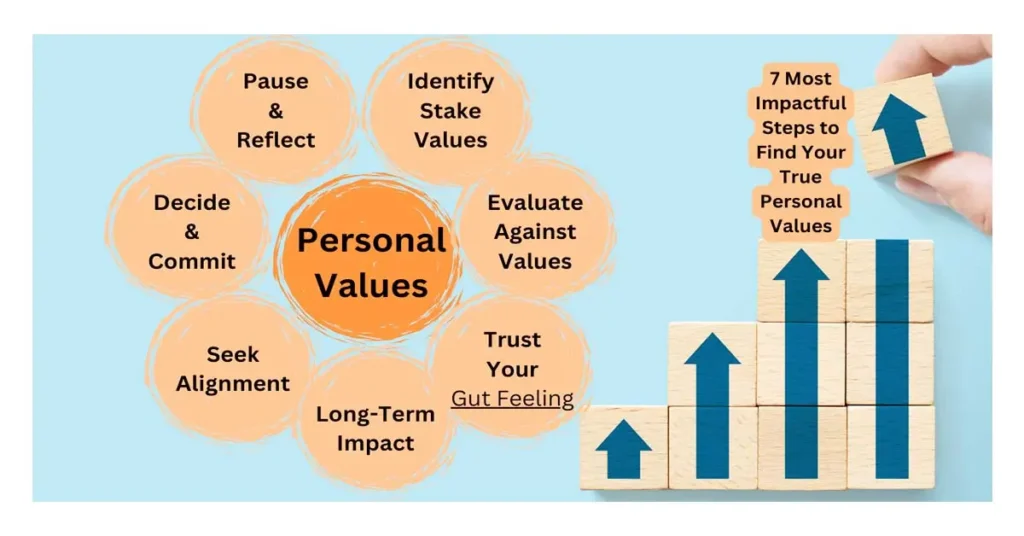
Now comes the practical part.
Take a notebook or open a blank document and work through these seven steps.
1. Pause and Reflect
Before choosing your values, slow down.
Ask yourself:
- What moments in my life have felt most meaningful?
- When have I felt most like myself?
- What activities make me feel engaged?
- What qualities do I admire in other people?
- What situations make me feel uncomfortable or frustrated?
- What do I wish I had more time for?
Do not rush to find the “right” answers.
Your first answers do not have to be perfect.
You are looking for patterns.
For example, if you repeatedly think about spending more time with loved ones, connection or family may be important values.
If you repeatedly wish you had more freedom, independence may deserve a place on your list.
2. Identify Your Core Values
Now create a list of around 10 values that seem important to you.
Do not worry about ranking them yet.
You might write:
- Family
- Health
- Freedom
- Honesty
- Growth
- Creativity
- Security
- Kindness
- Learning
- Balance
Then ask yourself:
“Would I still choose this value if nobody else knew about it?”
This question helps because some values get mixed up with social expectations.
You may say you value success because you have been taught that success is important.
But perhaps what you genuinely value underneath success is security, independence, contribution, or learning.
Values clarification often involves separating personally chosen values from expectations or goals others impose.
3. Evaluate Your Choices Against Your Values
Look at your current life.
Ask:
“Does the way I spend my time reflect what I say matters to me?”
Consider:
- Your work
- Relationships
- Health
- Finances
- Free time
- Online habits
- Personal growth
- Daily routines
For example, perhaps you identify family as one of your top values, but you regularly give your best energy to work and have very little time left for the people you care about.
That does not mean you are failing.
It simply shows you where there may be a gap between your values and your current behavior.
That gap can become useful information.

4. Trust Your Gut Feeling—But Check the Reason Behind It
Your first emotional response can sometimes tell you something important.
Think about a major decision you are facing.
Then ask:
“What feels uncomfortable about this choice?”
The problem may not be the decision itself.
Perhaps it conflicts with something you value.
For example:
You receive a high-paying job offer, but the schedule would leave almost no time for your family.
The question is not simply:
“Is this a good job?”
It could also be:
“Does this opportunity fit the life I want to build?”
At the same time, don’t treat intuition as infallible.
Strong emotions can come from fear, past experiences, stress, or assumptions.
So use your gut feeling as a signal to explore, not automatic proof that a decision is right or wrong.
5. Think About the Long-Term Impact
Some decisions feel good immediately but create problems later.
Others are difficult now but support the person you want to become.
Ask:
“If I continue making choices like this for the next year, where might I end up?”
Then ask:
“Would that direction reflect my values?”
Consider both short-term and long-term consequences.
For example:
- Saying yes to every request may feel helpful today but conflict with your value of balance.
- Avoiding every difficult conversation may feel comfortable now but conflict with honesty or connection.
- Never taking time to rest may appear productive but conflict with health.
This step encourages you to look beyond the immediate reward.
6. Seek Alignment
Now choose your most important values and compare them with your daily life.
Create a simple table:
| Value | How I Live It Now | One Change I Could Make |
|---|---|---|
| Health | I walk occasionally | Schedule regular movement |
| Family | I call when I have time | Protect one family evening |
| Learning | I save articles | Read for 20 minutes daily |
| Creativity | Rarely make time | Start one small project |
| Balance | Work often spills into evenings | Set a clearer stopping time |
The goal is not to redesign your entire life overnight.
Start with one small adjustment.
Research and practice around values-based approaches emphasize translating clarified values into concrete actions rather than treating values as abstract labels.
7. Decide and Commit
Once you understand your values, choose one small action that reflects your top value.
Make it specific.
Instead of:
“I want to prioritize my health.”
Try:
“I will take a 20-minute walk after dinner three evenings this week.”
Instead of:
“Family is important to me.”
Try:
“I will put my phone away during dinner tonight.”
Instead of:
“I value learning.”
Try:
“I will spend 15 minutes learning something useful before checking social media.”
Small actions make values visible.
You do not have to transform your personality or lifestyle overnight.
You simply need to keep asking:
“What is one thing I can do today that reflects what matters to me?”

Are You Living Your Core Values?
After completing the seven steps, check your alignment.
Give yourself a simple score from 1 to 5 for each important value:
1 = rarely reflected in my life
3 = sometimes reflected
5 = strongly reflected
For example:
| Value | Score |
|---|---|
| Family | 3 |
| Health | 2 |
| Learning | 4 |
| Honesty | 5 |
| Balance | 2 |
The numbers are not a psychological diagnosis or a measure of your worth.
They are simply a way to notice patterns.
If an important value scores low, ask:
“What is one realistic change that could move this from a 2 to a 3?”
That question is often more useful than demanding a complete transformation.
How to Use Your Values to Make Decisions
When you face a difficult choice, try this five-question check:
1. What matters most to me here?
Identify the value behind the decision.
2. Am I choosing this because I genuinely want it?
Or am I responding mainly to pressure, fear, guilt, or expectations?
3. Which option better reflects my values?
There may not be a perfect choice.
4. What are the long-term consequences?
Look beyond today’s emotions.
5. What small action can I take?
Turn the decision into something concrete.
This process does not guarantee that every decision will feel comfortable.
Sometimes living according to your values means doing something difficult.
Courage, honesty, responsibility, and compassion can all require uncomfortable choices.
What If Your Values Conflict?
This is completely possible.
You might value:
- Career success and family time
- Freedom and financial security
- Adventure and stability
- Helping others and personal rest
The answer is not necessarily to eliminate one value.
Instead, ask which value needs greater attention in this particular situation.
You can also look for a solution that respects several values at once.
For example, instead of choosing completely between career and family, you might look for ways to pursue professional growth while setting clearer boundaries around family time.
Values are not always competing enemies. Sometimes they simply need better balance.
Your Personal Values Can Change
Your values don’t necessarily stay exactly the same throughout your life.
A person in their twenties may prioritize exploration and independence.
Later, family, stability, health, contribution, or community may matter more.
Life experiences can also change how you understand your priorities.
That does not mean your previous values were fake.
It may simply mean that you are learning more about yourself.
Instead of asking:
“What are my values forever?”
Try asking:
“What matters deeply to me at this stage of my life?”
That question can feel much more realistic.
A Simple 10-Minute Values Exercise
If the full seven-step exercise feels overwhelming, try this shorter version.
Set a timer for 10 minutes.
Write answers to these questions:
- What do I want more of in my life?
- What do I want less of?
- Who do I admire, and what qualities do they have?
- When do I feel most like myself?
- What would I regret ignoring for the next five years?
- What kind of person do I want to be when life becomes difficult?
- What is one action I can take this week that reflects that person?
Look for repeated themes.
Those themes may point toward your core values.
FAQs About Personal Values
Q. What are the most common personal values?
Common personal values include honesty, family, health, freedom, kindness, security, independence, growth, creativity, responsibility, connection, learning, and compassion. However, there is no universal ranking. Your values are personal.
Q. How do I know if a value is truly mine?
Ask yourself whether you would still choose that value if you were not trying to impress, please, or satisfy anyone else. Also look at your meaningful experiences and the qualities you genuinely admire.
Q. Can personal values change?
Yes. Your priorities may change as your circumstances, relationships, responsibilities, and understanding of yourself change. Values clarification can be revisited at different stages of life.
Q. What is the difference between values and goals?
A goal is something you can achieve, while a value is an ongoing direction. For example, “finish a degree” is a goal, while “learning” may be the value behind it.
Q. Can personal values help with decision-making?
They can provide a useful framework for evaluating choices. Instead of asking only what is easiest or most rewarding immediately, you can ask which option better reflects what matters to you.
Q. What if I cannot identify my values?
Do not force an answer. Start by thinking about meaningful experiences, people you admire, situations that frustrate you, and things you wish you had more time for. Patterns often become clearer when you reflect without rushing.
Final Thoughts
Your Values Are a Direction, Not a Perfect Rulebook
Finding your personal values is not about creating a perfect list of impressive words.
It is about becoming more aware of what matters to you and how your everyday choices reflect it.
Start by pausing and reflecting. Identify the values that genuinely matter. Compare them with your current behavior. Consider your gut response while also checking the facts. Think about the long-term impact, look for greater alignment, and then commit to one small action.
You do not need to change your entire life today.
Sometimes the most meaningful change starts with a simple question:
“What matters to me—and what can I do today that reflects it?”
Values-based approaches such as ACT place emphasis on chosen values and committed action, making the process less about finding a perfect identity and more about repeatedly taking meaningful steps in the direction you choose.
Read more articles on health and wellness.
You might like to read: