

How to Use the Pomodoro Technique for Better Work–Life Balance?
Do you ever feel like your workday is a marathon with no finish line, bleeding into your evenings and stealing your peace?
You’re not chasing deadlines; they’re chasing you, leaving little room for life’s simple joys.
What if you could transform this relentless race into a rhythmic dance of focused sprints and restorative pauses?

Short Summary:
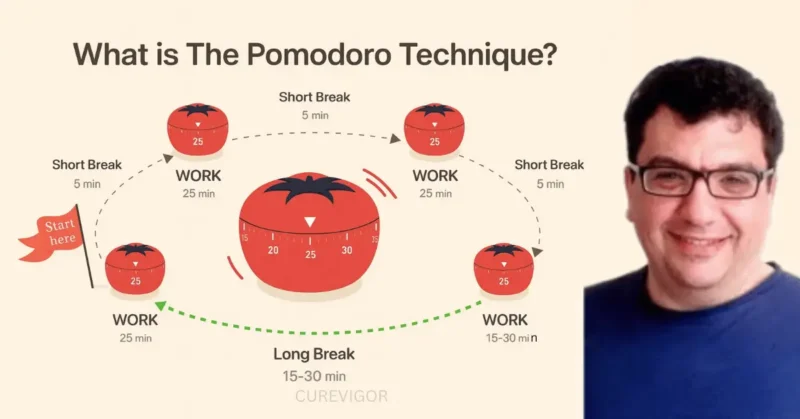
The Pomodoro Technique is a straightforward yet effective time management strategy that involves working in concentrated 25-minute bursts (referred to as “Pomodoros”) interspersed with 5-minute breaks.
You take a lengthier 15- to 30-minute break after four Pomodoros. This cycle boosts deep focus, prevents burnout, and creates clear boundaries between work and personal time, fundamentally improving your daily balance and well-being.
Definition: How Pomodoro Was Developed
Francesco Cirillo created the Pomodoro Technique, a time management strategy, in the late 1980s.
Its name comes from the Italian word for “tomato,” inspired by the tomato-shaped kitchen timer Cirillo used as a university student.
At its core, the technique is a structured system of working with time, not against it.
It operates on a simple principle: you break down your work into short, timed intervals of focused effort, separated by short breaks.
This structure leverages the brain’s natural attention span and need for recovery, turning vast, overwhelming tasks into manageable bursts of progress.
It’s not just about getting more work done; it’s about working smarter, reducing mental fatigue, and consciously reclaiming time for rest and life outside of work.
Understanding the Pomodoro Technique and Its Benefits
What is the Pomodoro Technique, and how does it work?
The technique is beautifully mechanical in its simplicity. You don’t need complex apps or tools to start—just a timer, a task list, and a commitment to the process.
The basic framework is a five-step cycle:
- Choose a Task: Decide on a single task to accomplish.
- Set the Timer: Set a timer for 25 minutes—this is one “Pomodoro.”
- Work on the Task: Focus exclusively on that task until the timer rings. If a distraction pops up, note it down and return to your work.
- Take a Short Break: When the timer rings, stop working immediately. Take a mandatory 5-minute break. Step away from your workspace.
- Repeat and Rest: After completing four Pomodoros, take a longer break of 15-30 minutes. This longer break is crucial for cognitive recovery and maintaining stamina throughout the day.
Your brain learns to achieve a state of profound concentration during work periods and to truly disengage during breaks through this rhythmic alternation between attention and rest, which is a fundamental ability for attaining balance.
Benefits of Using the Pomodoro Technique for Work-Life Balance
The Pomodoro Technique does more than improve productivity; it actively architects a more balanced life.
Creates Tangible Time Boundaries
In today’s “always-on” culture, work and personal life blur into one exhausting continuum. The Pomodoro Technique acts as a built-in boundary system.
- Work Time is Sacred: During a Pomodoro, you are at work. This focused intent often means you accomplish more in 25 minutes than in an hour of distracted, multi-tasking effort.
- Break Time is Non-Negotiable: When the timer rings, work stops. This forces you to step away, preventing the “just five more minutes” trap that turns into 90 minutes of unpaid overtime.
These breaks become moments for life—making a cup of tea, chatting with a family member, or simply stretching.
Reduces Overwhelm and Mental Fatigue

A giant project feels paralyzing. A 25-minute commitment to one small part of it feels doable.
- The Psychology of Small Wins: Each completed Pomodoro is a concrete victory. This steady stream of achievements builds momentum and positivity, combating the anxiety that comes from looming, undefined workloads.
- Prevents Decision Fatigue: By planning your Pomodoros, you eliminate constant, energy-draining decisions about “what to do next.” You simply follow the schedule you set for yourself.
Enhances Focus and Preserves Mental Energy for Personal Life
Constant context-switching and digital distractions drain our mental batteries dry, leaving nothing for hobbies, family, or ourselves.
- Trains Monotasking: By committing to one task per Pomodoro, you strengthen your focus muscle. You learn to resist the ping of notifications and the urge to check email constantly.
- Energy in Reserve: Because you work with your brain’s natural rhythm (focus, then rest), you finish your workday less mentally depleted.
You have preserved cognitive and emotional energy to enjoy your evening, engage meaningfully with loved ones, or pursue a personal passion.
The Pomodoro Technique Implementation in Your Daily Routine
Setting Up Your Pomodoro Technique Schedule
Start simple. Don’t try to schedule a perfect 8-hour Pomodoro day on your first attempt.
- The Night-Before Preview: Spend 10 minutes each evening reviewing the next day. Identify 3-5 critical tasks.
- Assign Pomodoros: Estimate how many 25-minute sessions each task might need. Be generous at first. A report draft might be “3 Pomodoros.”
- Block Time in Your Calendar: Schedule your Pomodoro blocks and longer breaks. Treat these calendar appointments with the same respect as a meeting with your boss. This visual plan is your roadmap to a balanced day.
- Include Life Admin: Schedule Pomodoros for personal tasks too! “Plan weekly meals” or “Organize finances” can be a Pomodoro, granting them the same focus and closure as work tasks.
Actionable Steps:
- Gather Tools: Choose a simple timer (phone, dedicated app, or physical timer).
- Create a “To-Do Today” & “Parking Lot” List: One list for tasks for your Pomodoros, one for distracting thoughts that arise.
- Start Small: Aim for 4-6 successful Pomodoros on your first day, not 12.
Tips for Staying Focused with the Pomodoro Technique
The biggest challenge is protecting your focus during those 25 minutes.
1. Engineer Your Environment for Success
- Pre-Pomodoro Tidy: A clear desk minimizes visual clutter and decision-making.
- Notification Armageddon: Turn off all non-essential notifications. Use “Do Not Disturb” mode.
- Communicate Boundaries: If in a shared space, signal you’re in a focus session. A simple note or a pair of headphones can work.
2. Master the “Parking Lot” Method
- The moment an unrelated thought arises—”I need to book a dentist appointment”—write it down on your “Parking Lot” notepad. This acknowledges the thought without letting it hijack your focus. You can address it during your break.
3. Ritualize Your Start and End
- Starting Ritual: Take a deep breath, state your task goal (“In this Pomodoro, I will write the introduction for the report”), and start the timer. This creates a clear cognitive shift into work mode.
- Ending Ritual: When the timer rings, physically step away from your workstation. This signals to your brain that focus time is over and break time has begun.
Customizing the Pomodoro Technique for Your Needs
Adapting the Pomodoro Technique for Different Tasks and Projects
The classic 25/5 split is a starting point, not a rigid rule. Your attention span varies with task type.
- For Deep, Creative Work (Writing, Coding, Design): The standard 25 minutes is often perfect. You might even extend to 50-minute Pomodoros with 10-minute breaks if you find a deep flow state.
- For Shallow, Administrative Tasks (Email, Data Entry): You might use shorter “sprint” Pomodoros of 15 minutes to power through tedious work without burning out.
- For Learning and Study: Adhere strictly to the breaks. Consolidation of information occurs during these rest periods. Use break time to walk around, not check social media.
- For Meetings: Try a “Pomodoro Meeting.” Set an agenda for a 25-minute focused discussion. You’ll be amazed at how much more efficient meetings become.
Using the Pomodoro Technique for Personal Goals and Self-Care
This is the secret to true work-life balance: applying the same structured focus to your life.
- Tackling Home Projects: “Clean the garage” is overwhelming. “Spend one Pomodoro sorting tools” is achievable.
- Dedicated Learning: Always wanted to learn guitar? Schedule a personal Pomodoro twice a week for practice.
- Guilt-Free Self-Care: Schedule a Pomodoro for “Read fiction in the garden” or “Take a long bath.” By timing it, you give yourself full permission to enjoy that activity without the nagging feeling you “should” be working.
This reframes self-care as a necessary, scheduled appointment, not an indulgence.
A Personal Insight:
I used to feel guilty reading a novel on a weekday afternoon, thinking of all the “productive” things I could be doing.
Now, I schedule a “Reading Pomodoro.” When the timer starts, I dive into my book with zero guilt.
The timer permits me to fully enjoy my leisure time, and when it rings, I often feel refreshed and ready to tackle the next work session with renewed clarity.
The technique taught me that balanced time isn’t found; it’s deliberately designed.
Overcoming Common Challenges with the Pomodoro Technique
Dealing with Distractions and Interruptions
Interruptions will happen. The key is having a protocol.
- The Internal Interruption (Your Own Brain): Use the “Parking Lot” notepad. Jot it down and return to your task instantly.
- The External Interruption (A Colleague/Kid): If possible, politely say, “I’m in the middle of a focused session, can I circle back with you in about 15 minutes?”
If it’s urgent, stop your timer, deal with the interruption, and then restart a fresh Pomodoro when you return. Don’t try to salvage a fragmented session.
Staying Motivated with the Pomodoro Technique
Motivation wanes. The system provides its own motivation through structure and tracking.
- Track Your Pomodoros: At the end of the day, simply count how many you completed. This tangible number is incredibly satisfying and proves your effort, regardless of how you felt the day went.
- Review and Celebrate: At week’s end, review your completed Pomodoros. What did you accomplish? Celebrate the progress, not just the completion of massive projects.
- Pair with a Reward: Link your longer break to a small reward. “After these four Pomodoros, I’ll enjoy my favorite coffee and look out the window for 20 minutes.”
Practical Checklist for Your First Pomodoro Day
- Choose 3 main work tasks for tomorrow.
- Estimate Pomodoros needed for each (1 Pomodoro = 25 mins).
- Schedule Pomodoro blocks and breaks in your digital/paper calendar.
- Set up your physical space: a clean desk, a water bottle, and a “Parking Lot” notepad.
- Set your phone/computer to “Do Not Disturb” for your first focus block.
- Commit to stopping work immediately when the break timer sounds.
- Use your first long break for something genuinely restorative (a walk, not social media).
Common Mistakes to Avoid
- Skipping the Breaks: This defeats the entire purpose. The breaks are when your brain processes information and recharges. Skipping them leads to faster burnout.
- Not Planning Break Activities: If you don’t plan your break, you’ll default to scrolling on your phone, which isn’t restorative. Plan to stretch, make tea, or look out the window.
- Being Too Rigid: Life happens. If an urgent matter disrupts your Pomodoro, stop the timer, handle it, and begin a new one later. Don’t guilt-trip yourself.
- Choosing the Wrong Tasks: Don’t use a Pomodoro for a task that requires deep, uninterrupted creative flow for 2 hours. Learn what tasks fit the structure best.
- Ignoring the Long Break: The 15-30 minute break after four Pomodoros is non-negotiable. It prevents cumulative fatigue. Use it to move your body and disconnect mentally.
Your 5-Step Action Plan to Start Today
- Gear Up: Get a timer (your phone is fine). Get a notebook for your task list and “Parking Lot.”
- The First Batch: Today, choose ONE important task. Commit to just one 25-minute Pomodoro on it.
- Eliminate Distractions: Silence notifications. Close irrelevant browser tabs. Tell anyone nearby you’ll be unavailable for 25 minutes.
- Work & Stop: Start the timer. Work only on that task. When the timer rings, STOP. Even if you’re in a groove. Get up and take a true 5-minute break.
- Reflect: After your break, ask yourself, “How did that feel?” What distracted me? What was good? Use this insight to plan your next Pomodoro.
Frequently Asked Questions
Q. What if my work naturally requires long, uninterrupted flow states? Can I still use the Pomodoro Technique?
Absolutely. The technique is a framework, not a prison. For tasks like writing or coding, where you might enter a “flow state,” you can modify it.
Try a “Double Pomodoro”—a 50-minute focused session followed by a 10-15 minute break.
The core principle remains: after a period of intense focus, you must take a deliberate, timed break to recharge.
The technique ensures you don’t lose track of time and work for 3 hours straight without hydration or movement, which leads to burnout.
Q. I work in an open office with constant interruptions. How can I possibly use this method?
This is a common challenge. The Pomodoro Technique can actually help you manage these interruptions. First, use clear signals: put on headphones (even without music) or a small “In Focus Session” sign.
When interrupted, politely use your break as a boundary: “I’m wrapping up a timed task, can I find you in about 10 minutes during my break?” This sets a clear expectation.
Also, communicate your new method to your team; they may be intrigued and adopt it themselves!
Q. Don’t the frequent breaks just disrupt momentum and make you less productive?
It feels counterintuitive, but the science of ultradian rhythms suggests our brains can only maintain peak focus for about 90-120 minutes at a time.
The Pomodoro’s shorter cycles prevent the gradual decline in focus quality that happens after about 20-30 minutes of sustained effort.
The break is a strategic reset. It feels like you’re stopping, but you’re actually preventing the steep productivity drop-off that occurs during mental fatigue, making your next 25-minute session just as effective as your first.
Q. How do I estimate how many Pomodoros a task will take?
At first, you’ll be guessing—that’s okay. For a new task, give it your best estimate. After you complete it, note down how many Pomodoros it actually took. This creates a personal database for future planning.
You’ll soon learn that “writing a project update email” is 1 Pomodoro, while “creating the monthly sales deck” is 6. This historical data is invaluable for realistic planning and reducing the stress of underestimating your workload.
Q. Can I use the Pomodoro Technique for household chores and personal errands?
Yes, and this is where it becomes a true life-balance tool. “Tackle the mountain of laundry” is demoralizing. “One Pomodoro to fold and put away clothes” is manageable.
Use it for meal prep, cleaning, budgeting, or even for dedicated time to work on a hobby.
Applying the structure to personal tasks prevents them from feeling like endless, unpaid labor and gives you the satisfaction of completion.
Q. What are the best apps or tools to use for the Pomodoro Technique?
You can start with just the clock app on your phone. For dedicated apps, Forest is great if you want a visual incentive (you grow a tree for each Pomodoro).
Focus Keeper and Be Focused are simple, classic timers. For a browser-based option, MarinaraTimer.com is excellent.
However, a physical timer you can wind up has a uniquely satisfying tactile element and keeps your phone out of your hand, reducing temptation.
Final Thoughts on How to Use the Pomodoro Technique for Better Work–Life Balance
Mastering the Pomodoro Technique isn’t about becoming a productivity machine that never stops. It’s about becoming the compassionate architect of your own time and energy.
It’s a gentle, rhythmic reminder that you are human—designed for bursts of wonderful focus, yes, but also for necessary pauses, for breath, and for life beyond the to-do list.
This simple practice hands you back the reins, showing you that balance isn’t a distant goal to achieve “someday,” but a series of small, intentional choices you can make today, one 25-minute segment at a time.
Be patient with yourself as you learn its rhythm. You’re not just managing minutes; you’re cultivating a more peaceful and purposeful way of living.
Ready to reclaim your focus and your time?
Don’t just read about it—experience it. Set a timer for 25 minutes right now and give your full attention to the most important thing on your mind.
When the timer rings, step away and take 5 guilt-free minutes just for you.
Notice how it feels. That small shift is the first, powerful step toward a more balanced tomorrow.
Read more blogs on Health and Balance.
You might like: