
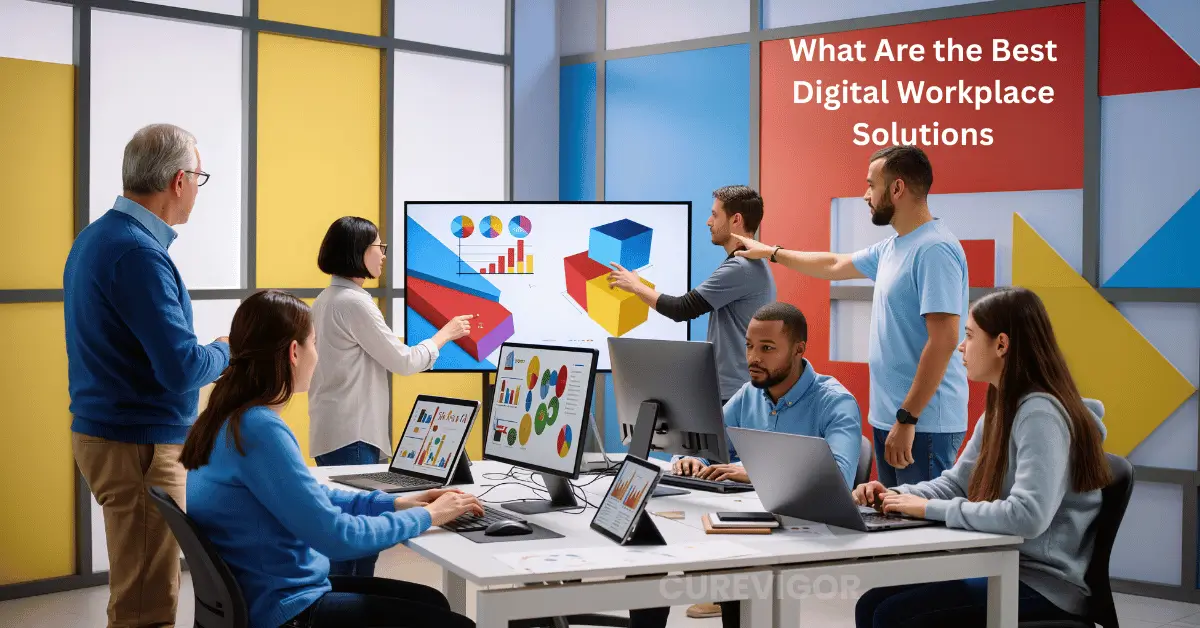
Explore powerful Digital Workplace Solutions that simplify work, improve collaboration, and help modern teams thrive in hybrid and remote environments.
Teams are scattered. Tools are everywhere. And many employees feel busy—but not productive.
If you’ve ever thought, “We have so many tools, yet work feels harder,” you’re not alone.
That’s precisely why digital workplace solutions have become one of the most critical business conversations today.
Workplace Digitalization: A Fully Digital Workplace
A digital workplace is not just “working online.”
It’s a complete shift in how work happens.
In a fully digital work environment:
- Meetings happen virtually by default.
- Files live in shared, searchable spaces.
- Collaboration happens in real time.
- Knowledge is documented, not hidden.
- Outcomes, not hours, measure work
An example
Imagine a new employee joining your company.
In a traditional workplace, they might:
- Ask five people for the same file.
- Search old emails for instructions.
- Sit through unnecessary meetings.
In a digital workplace:
- Everything they need is in one place.
- Processes are documented
- Communication is clear and searchable.
That’s the real power of Digital Workplace Solutions—they remove friction from daily work.
Quick Summary Box (For Skimmers)
Topic: Digital Workplace Solutions
Who it’s for: Business leaders, HR teams, IT managers, growing companies
Main goal: Improve productivity, collaboration, employee experience, and hybrid work
Key takeaway: The right digital workplace simplifies work instead of complicating it
Unlock the Power of Digital Workplace Solutions
Digital Workplace Solutions are transforming how organizations operate in today’s fast-paced, technology-driven world.
From enabling remote work to improving the employee experience, these solutions bring people, processes, and technology together in a single digital environment.
Businesses that adopt digital workplace solutions enjoy higher productivity, stronger collaboration, and faster digital transformation.
At their core, Digital Workplace Solutions combine productivity tools, collaboration software, and employee engagement platforms into a unified digital ecosystem.
This allows employees to work smarter—whether they are in the office, at home, or halfway across the world.
What Are Digital Workplace Solutions?
Digital Workplace Solutions are integrated tools and platforms that help people work effectively in a digital-first environment.
They bring together communication, collaboration, productivity, knowledge sharing, and employee experience into one connected system.
Instead of employees juggling emails, chats, files, apps, and meetings across dozens of tools, a digital workplace provides a single, cohesive work environment—accessible from anywhere.
Think of it as the digital version of your office, designed for how people actually work today.
Why Digital Workplace Solutions Matter Today
In the age of remote work and hybrid teams, organizations need solutions that support flexibility and efficiency.
Digital Workplace Solutions reduce silos, improve decision-making, and create a connected employee experience.
According to Microsoft, companies using digital collaboration tools report higher employee satisfaction and productivity.
What Are the Key Components of a Modern Digital Workspace?
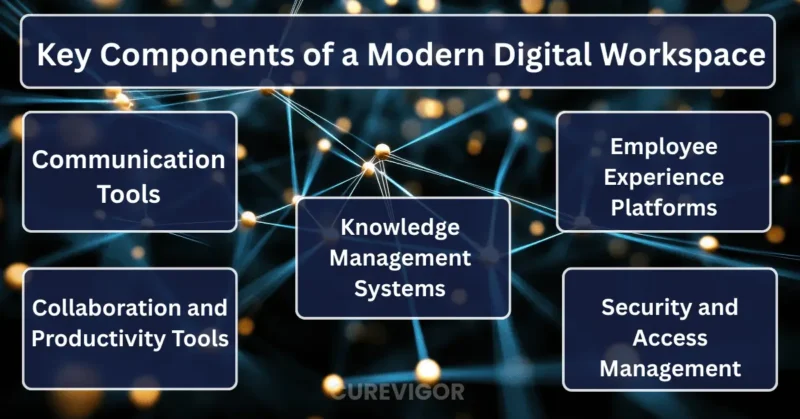
1. Communication Tools
Clear communication is the backbone of any digital workplace.
Examples:
- Microsoft Teams
- Slack
- Zoom
What good communication tools do:
- Reduce email overload
- Support real-time and async conversations.
- Keep discussions searchable
Personal insight: Teams that move conversations out of inboxes instantly feel lighter and faster.
2. Collaboration and Productivity Tools
This is where real work happens.
Examples:
- Microsoft 365
- Google Workspace
- Notion
Key benefits:
- Real-time document editing
- Version control
- Shared ownership of work
Collaboration tools turn work into a team sport, not a solo struggle.
3. Knowledge Management Systems
Knowledge should not live in people’s heads.
Examples:
- SharePoint
- Confluence
- Notion
Why this matters:
- Reduces repeated questions
- Supports new hires
- Protects institutional knowledge
If someone leaves your company with critical knowledge, your digital workplace is incomplete.
4. Employee Experience Platforms
Work is not just tasks—it’s feelings.
Examples:
- Workplace by Meta
- Yammer
- Employee portals
These tools:
- Build connection
- Encourage engagement
- Strengthen culture in digital spaces.
People don’t disengage from work.
They disengage from how work feels.
5. Security and Access Management
Flexibility without security is risky.
A strong digital workplace includes:
- Secure logins
- Role-based access
- Data protection
Employees should feel trusted—but systems should stay protected.
Top Digital Workplace Solutions for Productivity
Microsoft 365: A Comprehensive Digital Workplace Solution
Microsoft 365 is one of the most widely used digital workplace solutions globally. It brings together Word, Excel, PowerPoint, Outlook, OneDrive, and Teams into a single productivity ecosystem.
Key Productivity Features
- Real-time document collaboration
- Secure cloud storage
- Seamless integration across devices
Best Use Cases
For businesses that need enterprise-level productivity tools, organized workflows, and robust security, Microsoft 365 is perfect.
Google Workspace: A Cloud-Based Digital Workplace Solution
Google Workspace is a cloud-native digital workplace solution built for speed and simplicity. Tools like Gmail, Google Docs, Sheets, Meet, and Drive support real-time collaboration.
Collaboration and Productivity Benefits
- Instant document sharing
- Easy version control
- Strong support for remote work
Ideal Business Scenarios
Google Workspace is perfect for startups and fast-moving teams that value flexibility and ease of use.
Digital Workplace Solutions for Collaboration and Communication
Slack: A Digital Workplace Solution for Team Communication
Slack is a powerful collaboration software designed for real-time communication. It replaces long email chains with organized channels and instant messaging.
Why Slack Excels in Remote Work
Slack integrates with hundreds of productivity tools, making it a favorite digital workplace solution for distributed teams.
Microsoft Teams: A Digital Workplace Solution for Team Collaboration
Microsoft Teams combines chat, video meetings, file sharing, and app integration into a single platform.
Teams vs Slack: Quick Comparison
| Feature | Microsoft Teams | Slack |
| Video Meetings | Built-in | Limited |
| Office Integration | Excellent | Moderate |
| Best For | Enterprises | Agile teams |
Why Are Digital Workspace Solutions at the Heart of Hybrid Work Now?
Hybrid work is no longer a trend. It’s the default.
But here’s the truth many organizations miss:
Hybrid work fails without strong digital workplace solutions.
Why hybrid work depends on digital workspaces
When teams are split between office and remote:
- Information gaps grow
- Communication becomes uneven
- Visibility drops
- Trust erodes
Digital Workplace Solutions solve this by:
- Creating equal access to information
- Supporting asynchronous work
- Making collaboration location-independent
- Keeping everyone aligned
Personal observation
Teams don’t struggle with remote work.
They struggle with poor systems.
When digital tools are transparent and connected, hybrid teams often perform better than fully in-office teams.
Digital Workplace Solutions for Employee Experience
Workplace by Facebook: Employee Engagement Made Simple
Workplace by Facebook focuses on social interaction and company culture. It feels familiar, making adoption easy and boosting employee engagement.
Yammer: Strengthening Employee Connection
Yammer is designed for internal communication and knowledge sharing, helping employees feel connected across departments.
What Is a Digital Workspace Solution, in Practical Terms?
Let’s make this very practical.
A digital workspace solution is not one tool.
It’s an ecosystem that includes:
- Where people communicate
- Where work happens
- Where knowledge lives
- Where employees feel supported
In daily work, it looks like this:
- Starting your day with clarity, not confusion
- Finding files in seconds, not minutes
- Knowing where to ask questions
- Having fewer meetings, but better ones.
If a tool reduces stress and saves time, it belongs in your digital workplace.
If it adds noise, it doesn’t.
How Digital Workplace Solutions Enable Remote Work
Digital Workplace Solutions make remote work seamless by offering secure access to files, communication tools, and collaboration platforms from anywhere.
They also support hybrid work models, improving employees’ work-life balance and reducing burnout.
Choosing the Right Digital Workplace Solutions
Factors to Consider
- Business size and goals
- Security and compliance needs
- Integration with existing systems
- Employee experience and usability
Best Practices for Implementation
- Start with clear objectives.
- Train employees effectively
- Encourage leadership adoption
- Measure performance and feedback.
Benefits of Digital Workplace Solutions That Actually Matter
Higher Productivity Without Burnout
Digital workplace solutions reduce:
- Context switching
- Tool overload
- Unclear priorities
People spend more time doing real work—and less time figuring out how to work.
Better Collaboration Across Teams
With shared tools:
- Teams collaborate across locations.
- According to IR, a digital workplace strategy allows employees to connect and share ideas more easily, fostering community, collaboration, and innovation while helping to overcome barriers created by distance.
Stronger Employee Experience
When work feels organized and supportive:
- Stress drops
- Engagement rises
- Retention improves
Happy systems create happier employees.
Scalable Growth
Digital workplace solutions grow with you.
- Easy onboarding
- Repeatable processes
- Consistent communication
Growth becomes manageable—not chaotic.
Best And Powerful Digital Workplace Solutions (Proven Tools)
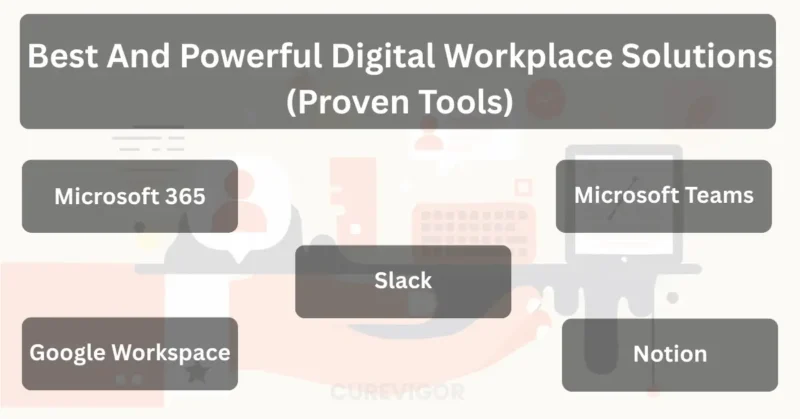
Microsoft 365
Best for structured, enterprise-grade digital workplaces.
Google Workspace
Best for fast-moving, cloud-first teams.
Slack
Best for real-time communication and collaboration.
Microsoft Teams
Best all-in-one collaboration solution.
Notion
Best for knowledge management and flexible workflows.
Tip: The “best” solution is the one your people actually use.
Strategies for Implementing Digital Workplace Solutions Successfully
Strategy 1: Start With People, Not Tools
- Ask employees what slows them down.
- Identify pain points
- Choose tools that solve real problems.
Strategy 2: Simplify Before You Add
- Remove unused tools
- Reduce overlap
- Create clear guidelines
Strategy 3: Train and Support
- Offer short training sessions.
- Share quick guides
- Lead by example
Strategy 4: Measure What Matters
- Productivity trends
- Engagement feedback
- Tool adoption rates
Practical Checklist: Is Your Digital Workplace Working?
- Employees know where to communicate.
- Files are easy to find.
- Meetings have a clear purpose.
- Knowledge is documented.
- Tools are integrated.
- Employees feel supported
If you checked fewer than four, improvements are needed.
What to Avoid When Building a Digital Workplace
- Too many tools
- No clear communication rules
- Ignoring employee feedback
- Forcing tools without training
- Treating digital work like office work
Technology should adapt to people—not the other way around.
Action Plan: How to Improve Your Digital Workplace in 30 Days
Week 1: Audit tools and workflows
Week 2: Gather employee feedback.
Week 3: Simplify and standardize
Week 4: Train, document, and review
Small steps create significant change.
Is There a Future for Digital Workspace Solutions With AI and Context?
Absolutely—and it’s already happening.
AI-powered digital workplaces will:
- Anticipate employee needs
- Surface relevant information automatically.
- Reduce manual tasks
- Personalize work experiences
Imagine logging in and seeing exactly what matters—no searching, no noise.
The future digital workplace won’t just support work; it will enable it.
It will understand it.
FAQs About Digital Workplace Solutions
Q. What are digital workspace solutions?
Digital workspace solutions are integrated platforms that help employees work, communicate, and collaborate in a digital environment.
They bring together productivity tools, collaboration software, and communication systems in one place. These solutions support remote work, hybrid teams, and in-office employees.
Digital workspace solutions improve efficiency by providing secure access to files and applications from anywhere.
They also enhance employee experience through seamless workflows. Overall, they help organizations adapt to modern work styles.
Q. What are examples of digital solutions?
Examples of digital solutions include Microsoft 365, Google Workspace, Slack, Zoom, Salesforce, and Trello.
These tools help businesses manage communication, productivity, customer relationships, and projects.
Digital solutions can also include cloud storage systems, HR platforms, and automation tools. They are used across industries to improve efficiency and reduce manual work.
Many digital solutions are cloud-based, making them scalable and flexible. Together, they support digital transformation initiatives.
Q. What is an example of a digital workplace?
An environment where workers use digital technologies to complete their daily responsibilities is known as a “digital workplace.”
For example, a company using Microsoft Teams for meetings, SharePoint for document management, and Outlook for communication has a digital workplace. Workers can work remotely, share files, and collaborate in real time.
Access to systems is secure and centralized. This setup supports flexibility and productivity. It replaces traditional office-bound work models.
Q. What is the difference between a workplace and a digital workspace?
A traditional workplace is a physical office where employees work on-site. Conversely, a digital workspace is an online setting where workers can operate from any location.
Digital workspaces rely on cloud-based tools and collaboration software. They offer greater flexibility and support for remote work.
While workplaces focus on location, digital workspaces focus on access and connectivity. Both aim to support employee productivity, but in different ways.
Q. Which seven categories of digital marketing exist?
Search engine optimization (SEO), content marketing, social media marketing, email marketing, pay-per-click advertising (PPC), affiliate marketing, and influencer marketing are the seven categories of digital marketing.
Each type focuses on reaching audiences through digital channels. SEO improves website visibility in search engines.
Content marketing builds trust through valuable information. Together, these strategies help businesses grow online and engage customers effectively.
Q. What are the big five digital companies?
The big five digital companies are Google (Alphabet), Apple, Microsoft, Amazon, and Meta (formerly Facebook). These companies dominate the global digital and technology landscape.
They lead innovation in cloud computing, software, hardware, e-commerce, and social media. Their platforms influence how people work, communicate, and consume content.
Many digital workplace and marketing tools come from these companies. They play a significant role in shaping the digital economy.
Conclusion: Driving Workplace Transformation with Digital Workplace Solutions
Digital Workplace Solutions are no longer optional—they are essential for modern workplace transformation.
Businesses can boost employee satisfaction, increase productivity, and maintain competitiveness in a world that prioritizes digital technology by selecting the right solutions.
Investing in proven digital workplace solutions now lays the groundwork for future success.
Final Thoughts: A More Human Way to Work
Digital Workplace Solutions are not about technology.
They’re about making work feel easier, more transparent, and more human.
When systems support people, people do their best work.
If your workplace feels busy, fragmented, or overwhelming—start small.
Review your tools. Listen to your people. Simplify one process.
That’s how powerful digital workplaces begin.
Read more Health and Balance articles.
You might like: