

Stop overthinking and boost your focus in just 5 minutes! Learn quick methods to reset your mind, calm stress, and improve decision-making. Start living stress-free today.
Introduction: How to Stop Overthinking
Overthinking is a trap many of us fall into when managing tasks on our to-do lists. A seemingly never-ending list of obligations can easily overwhelm us, leading us to spend more time contemplating our chores than actually finishing them.
If you’ve ever found yourself paralyzed by the sheer volume of things to do, you know the feeling of being stuck in a loop of indecision and stress.
Effective time management is crucial in today’s hectic environment, and you can become more productive and less stressed by learning to avoid overanalyzing your to-do list.
Overthinking is widespread in work environments where expectations are high and deadlines are looming.
This article will show you how to break the cycle of overthinking, reset your mindset, and regain control of your productivity in just 5 minutes.
Benefits of Stopping Overthinking: How I Took Control of My To-Do List
Overthinking used to be my constant companion when managing my to-do list. I’d spend hours going over every detail, analyzing tasks from every possible angle, and in the process, I’d end up feeling drained and less productive.

I thought I was being “productive” by constantly thinking about what needed to be done, but it only kept me stuck in a cycle of inaction.
It wasn’t until I began implementing strategies to reduce overthinking that I saw the benefits. Here’s how stopping overthinking has helped me and can help you, too:
1. Boosts Productivity
I used to believe that thinking about a task constantly would make it easier when it was time to do it.
But what I found was that the more I thought about it, the less I actually did. Once I stopped overthinking, I realized that focusing on simply completing tasks led to steady progress.
For example, when I tackle a project now, instead of analyzing every potential outcome, I just get started. I used to spend hours crafting the perfect outline before writing an article.
Now, I jump in and start writing, trusting that I’ll figure out the details along the way. That shift in mindset has allowed me to actually do rather than just think about doing.
2. Reduces Stress
Overthinking always led me to stress. It felt like I was carrying a mental weight, constantly processing a million thoughts at once. The pressure to get everything perfect or analyze every possible outcome was overwhelming.
But when I began taking quick breaks to reset my mind, I noticed my stress levels dropped significantly.
For instance, I used to stress about whether a blog post would rank well on Google before even finishing it. Now, I allow myself to focus solely on writing the best content I can without obsessing over every minute detail.
The result? I feel much more at ease, and surprisingly, the work turns out better when I stop overthinking.
3. Improves Decision-Making
Overthinking made me indecisive. I’d go back and forth between different options, wasting time trying to pick the perfect one. As a result, I’d delay decisions and miss opportunities.
For example, in my business, I’d hesitate before deciding which product to feature or which marketing strategy to implement.
Now, I trust my judgment more and make quicker decisions. I learned that perfection isn’t the goal—progress is.
By eliminating overthinking, I make decisions faster and, more importantly, take action sooner.
4. Enhances Focus
When I was stuck in the cycle of overthinking, my mind would jump from one task to another, leaving me scattered and unfocused.
I would be thinking about a deadline for one project while simultaneously worrying about another.
By focusing solely on one task at a time, I find that my work quality has improved significantly.
For example, when I’m writing an article, I block out distractions and focus only on that task. No multitasking, no jumping between projects.
This shift has helped me complete tasks with better results in less time because my mind isn’t divided among competing thoughts.
5. Fosters a Sense of Accomplishment
Overthinking often led me to procrastinate. I would delay starting a task because I was worried it wouldn’t be perfect.
But once I took control and started implementing the 5-minute reset, I noticed that completing even small tasks gave me a sense of accomplishment.
This momentum built, and I began tackling larger tasks with greater confidence.
For example, when I focused on a single task per day, I felt more accomplished by the end of the day. The feeling of checking items off my list became addictive, and I found myself more motivated to keep going.
Common Mistakes to Avoid with Overthinking
How I Learned from My Own Pitfalls
When I started learning how to stop overthinking, I made many mistakes. In fact, it wasn’t until I recognized and corrected these common pitfalls that I made real progress. Here’s what I learned:
1. Overcomplicating Simple Tasks
I used to overcomplicate simple tasks, making them feel like monumental challenges.
For example, when I had to respond to an email or schedule a meeting, I’d spend an unreasonable amount of time figuring out the perfect wording or the best time slot.
Tip: I now break down tasks into smaller, manageable steps. For instance, I set aside just 10 minutes to draft an email and then move on.
That’s all I need to get started, and often, the task is much more straightforward than I initially thought.
2. Setting Unrealistic Expectations
I often set myself up for failure by expecting everything to be perfect. I thought every task, whether content creation or project organization, had to be flawless.
But I quickly realized that striving for perfection only made me feel more overwhelmed and led to more overthinking.
Tip: I shifted my mindset to focus on progress rather than perfection. Instead of thinking “This has to be the best presentation ever,” I now remind myself that it’s okay to make mistakes along the way as long as I’m moving forward.
This approach has helped me stop overthinking about how everything should be.
3. Focusing on Outcomes, Not Actions
I used to focus too much on the result of a task. Whether it was worrying about how many views my blog post would get or whether my client would approve a design, I’d get caught up in outcomes and miss the action steps required to get there.
Tip: I now focus on actions rather than results. For example, instead of worrying about how my article will perform, I focus on creating valuable content. The results will come naturally from taking consistent action.
4. Ignoring Your Mental Health
I didn’t realize how much overthinking affected my mental health until I started feeling burnt out. The constant mental chatter left me anxious and exhausted.
The stress of trying to think through everything was draining my energy.
Tip: Now, I prioritize my mental health by taking breaks throughout the day. I practice mindfulness techniques such as deep breathing and taking short walks outdoors.
These small actions allow me to recharge and return to my tasks with a clearer mind.
Best Actions for Stopping Overthinking Your To-Do List

Overthinking my to-do list was something I struggled with for years. I’d spend more time thinking about tasks than actually doing them, which created unnecessary stress and a sense of paralysis.
But over time, I discovered some simple yet effective actions that helped me break free from this cycle.
Here’s a step-by-step guide on how I reset my mindset and regained control over my productivity:
1. The 5-Minute Reset
The first thing I learned was the importance of stepping away from my to-do list, even if just for a few minutes. I used to think that if I wasn’t actively working, I wasn’t being productive.
But I realized that this mindset was only adding to my stress and overthinking. Now, when I feel myself getting stuck, I take a 5-minute reset. Here’s how I do it:
- I step away from my desk or workspace and either step outside or sit in a quiet space.
- I focus on my breathing—deep inhales and exhales —which immediately calms my mind.
- I intentionally clear my thoughts, allowing my brain a brief reprieve.
- After five minutes, I return to my tasks with a refreshed perspective.
This reset helps me return to my work with renewed energy and clarity, enabling me to tackle the next task without the overthinking cycle.
2. Prioritize Your Tasks
Once I’ve reset my mind, I prioritize my tasks. I used to think that everything on my to-do list was urgent, but that mindset just created overwhelm.
I now organize my tasks by priority, starting with the most urgent. Task completion:
- I review my list and ask myself, “What needs to be done today?” What can wait until tomorrow?
- I use the Eisenhower Matrix: I categorize tasks into four quadrants: urgent and important, important but not urgent, urgent but not necessary, and neither urgent nor essential.
- I then focus on tackling the “urgent and important” tasks first.
This simple step helps me avoid getting bogged down in trivial tasks and ensures I’m making progress on what truly matters.
3. Set Time Limits
Even the most basic chores, such as structuring a document or writing an email, used to be difficult for me. I would spend hours examining every aspect, believing that everything needed to be flawless.
I realized this was adding to my overthinking and creating unnecessary delays. At that point, I decided to set a time limit for each assignment.
Here’s how I do it:
- I allocate a specific time slot for each task. For example, I’ll give myself 30 minutes to write an email or 20 minutes to sort through a batch of documents.
- When the timer goes off, I stop, even if I haven’t completed the task perfectly. This helps me shift focus to the following item and prevents me from getting stuck in the details.
Setting time limits creates a sense of urgency and keeps me from spiraling into unnecessary overthinking.
4. Use a Task Management System
One of the best decisions I made was to implement a task management system. It wasn’t until I started using tools like Trello and Todoist that I realized how much clarity they could bring to my to-do list.
These tools let me visually organize my tasks, making it easier to focus on what’s important. I create lists for each project, breaking them down into smaller, actionable steps. Here’s how I use it:
- I create a “Today” list and add only the tasks I plan to tackle that day.
- I use labels to categorize tasks by urgency (e.g., “High Priority” or “Low Priority”).
- As I complete tasks, I check them off, which gives me a sense of accomplishment.
This system not only helps me stay organized but also keeps my mind from wandering or overthinking because I can visually see the progress I’m making.
5. Delegate and Collaborate
I used to think that I had to handle everything myself. But I quickly realized that overthinking escalates when I try to do too much on my own.
I actively seek opportunities to delegate or collaborate. Here’s how I approach it:
- When I’m working on a team project, I assign tasks based on each person’s strengths.
- I ensure I’m not carrying the entire workload and trust my colleagues to handle parts of the project.
- If I’m feeling overwhelmed by a particular task, I’ll ask a teammate for feedback or help to get a fresh perspective.
Delegating not only relieves the mental strain of overthinking but also ensures work is completed more efficiently.
Plus, collaboration often leads to better results, as multiple minds contribute to solving the problem at hand.
How I Rewired My Mindset
Over the years, I’ve realized that overthinking not only affects my productivity but also drains my mental and emotional energy.
By implementing these actions, I’ve been able to break free from the cycle of overthinking and reclaim control over my to-do list.
The key was to stop seeing every task as an insurmountable mountain. I learned to break them down into manageable steps, prioritize what really matters, and take action—even when I felt uncertain.
Overthinking will always try to creep in, but by following these simple steps, I’ve developed a strategy to prevent it from holding me back. It’s not about being perfect—it’s about being consistent and taking action.
These actions may seem small, but when done consistently, they’ll help you stop overthinking and start doing.
Give yourself permission to reset, prioritize, and take action. You’ll find yourself not only getting more done but also enjoying the process without the constant mental tug-of-war.
Pros and Cons of Stopping Overthinking Your To-Do List
Pros:
- More Productivity: Action is prioritized over indecision, resulting in faster task completion.
- Improved Focus: By eliminating distractions caused by overthinking, you can give your full attention to each task.
- Better Mental Health: Fewer stressful thoughts and better task management result in reduced anxiety.
- Increased Confidence: The more you overcome overthinking, the more confident you become in your ability to manage tasks effectively.
Cons:
- Initial Effort: It may take some time to train your brain to avoid overthinking. The initial reset can be challenging, especially if you’ve been overthinking for a long time.
- Risk of Rushing: While stopping overthinking can speed progress, there’s a risk of rushing through tasks without attention to detail.
- Requires Consistency: To see long-term benefits, you need to consistently practice focusing on tasks without letting your mind wander.
Comparisons: Overthinking vs. Productive Thinking
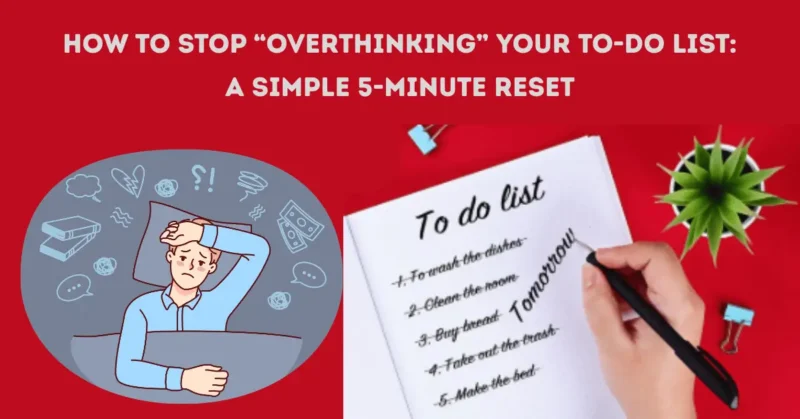
It’s important to differentiate between overthinking and productive thinking. Overthinking is when you dwell on details, often without taking any real action.
Productive thinking, on the other hand, involves clarity, planning, and progress toward a clear goal.
Productive thinking helps you decide on the best course of action and avoids getting stuck in endless loops of thought.
FAQs
Q. How to stop overthinking in 5 minutes?
To stop overthinking in 5 minutes, take a short break from your task. Step away from your work environment and find a quiet space. Inhale for four seconds, hold for four seconds, and then expel for four seconds while concentrating on your breathing.
This helps calm your nervous system. You can also try mindfulness techniques, like grounding yourself in the present moment by focusing on physical sensations.
After the reset, return to your task with a clear mind, and avoid getting caught up in unnecessary details. This quick mental reset can break the cycle of overthinking and refocus your energy.
Q. What is the 4-word sleep trick?
The 4-word sleep trick is “I’m going to sleep.” It’s a mental technique designed to ease anxiety around sleep and prevent overthinking. When you’re lying in bed, and thoughts keep racing, simply tell yourself these four words: “I’m going to sleep.”
This triggers your brain to focus on resting rather than on worrying about falling asleep. The simplicity of this mantra signals to your mind that it’s time to relax and let go of overactive thoughts, helping you transition into sleep with less resistance.
Q. How to reset overthinking?
To reset overthinking, start by acknowledging the thought patterns and permitting yourself to stop. Taking a break and doing something physical, like stretching or going for a walk, is a simple way to reset.
Shifting your focus from mental to physical tasks helps interrupt the cycle. You can also practice mindfulness by bringing your attention to the present moment—focus on your surroundings or perform a grounding exercise, like naming five things you can see.
This pause helps reset your mind, reducing the emotional charge of overthinking, allowing you to return to your tasks with a clear head.
Q. How to stop overthinking and just do things?
To stop overthinking and take action, break tasks into smaller, manageable steps. Start by setting small, time-limited goals (e.g., “I will work on this task for 20 minutes”).
Remove distractions and commit to doing rather than analyzing. Practice the “five-second rule,” where you count down from five and immediately start. This minimizes hesitation.
Remind yourself that perfection isn’t the goal—action is. By shifting your focus from potential outcomes to the immediate task at hand, you’ll avoid overthinking and start making progress.
Q. What is the 3-3-3 rule for overthinking?
The 3-3-3 rule for overthinking is a simple grounding technique to help redirect your thoughts when you’re feeling overwhelmed. It involves three steps:
- Look around you and identify three things you can see. This shifts your focus to the present moment.
- Listen carefully for three sounds you can hear, which help ground your awareness in your environment.
- Move your body by tapping three times or stretching three different body parts to help release built-up mental tension. This method enables you to regain focus and avoid spiraling into excessive thinking.
Q. What are the five telltale indications of stress?
Physical symptoms like headaches, frequently caused by tension, and muscle tightness, particularly in the shoulders or neck, are five typical indicators of stress.
Chronic stress may be indicated by sleep abnormalities, such as trouble falling or staying asleep. Even minor duties may leave you feeling emotionally agitated or overburdened.
Stress can cause mental anxiety and make it difficult to unwind. Lastly, changes in appetite—whether you eat too much or too little—are important indicators that stress is affecting your body.
Early detection of these symptoms can help you manage your stress before it escalates.
Conclusion: Regaining Control Over Your To-Do List
Overthinking your to-do list can hold you back from being as productive as you could be.
By implementing a simple 5-minute reset, prioritizing tasks, and focusing on actionable steps, you can stop the cycle of overthinking and take control of your day. Remember, productivity isn’t about thinking more; it’s about doing more.
By making small but consistent changes to your approach, you can reduce stress and get things done with confidence.
Final Thoughts: How to Stop Overthinking and Start Doing
Overcoming overthinking wasn’t a quick fix—it took time, trial, and error. But once I started applying these strategies, I noticed a significant shift in both my productivity and my overall well-being.
I no longer spend hours agonizing over every decision or task. Instead, I trust my process, take action, and address details as they arise.
If you’re struggling with overthinking, start small. Implement the 5-minute reset, prioritize tasks, and focus on doing rather than thinking.
It’s the key to breaking the cycle of overthinking and moving forward with confidence.
Take control of your thoughts today! Try our 5-minute reset to stop overthinking and start achieving more with less stress.
Read more Work-Life Balance articles.
You might like: