Feeling drained after work but still tense? These 10 low-energy hobbies help you unwind, reduce evening stress, and recharge—without forcing yourself to be productive.
You know that moment when the day is finally over… but your body feels heavy, and your mind is still running laps?
You’re too tired to “do something,” yet too wired to rest truly. And somehow, an hour of scrolling leaves you even more restless—like you didn’t get a break; you just lost time.
This post is for those evenings.
Not the “new me” kind of evening. The real kind: dinner dishes, half-charged energy, and a nervous system that wants peace.
Quick Summary Box
- Low-energy hobbies are gentle, low-prep activities that help you unwind, switch off stress, and recharge.
- You’ll find 10 options for different moods: foggy-brain, anxious, lonely, overstimulated, or simply tired.
- Each hobby includes why it helps, how to get started, its benefits and challenges, and a brief checklist.
- You’ll also get a simple evening routine, a stress-safe checklist, and 6 high-intent FAQs.
Why Low-Energy Hobbies Help Reduce Evening Stress
Evening stress is sneaky because it often shows up after the pressure ends. Your brain has been holding things together all day—tasks, conversations, responsibilities, decisions—and it doesn’t just “power down” because the clock says it’s time.
Low-energy hobbies help by providing a gentle transition between “doing” and “resting.”
What low-energy hobbies actually do for your nervous system
A good low-energy hobby gives you at least one of these:
- Gentle focus (so your mind stops looping)
- Soothing sensory input (sound, texture, warmth, light)
- A sense of completion (tiny wins that calm inner tension)
- Permission to be imperfect (no performance, no pressure)
When your evening activity is gentle and repeatable, your body begins to associate it with safety. And when the body feels safe, it can finally exhale.
Why “doing nothing” can feel hard
A lot of people aren’t afraid of rest—they’re afraid of what shows up in the quiet.
Sometimes, when we stop, we feel everything we postponed: worry, loneliness, anger, sadness, and uncertainty. Low-energy hobbies don’t “fix” those feelings, but they give them a kinder place to sit.
As a mother, I’ve felt this many times: the day ends, everyone else is finally calm, and that’s when my own stress tries to speak. I learned I didn’t need a perfect solution—just a gentle ritual that told my body, You’re safe now.
How to Choose the Right Low-Energy Hobby for Your Evening Routine
The best hobby isn’t necessarily the most impressive. It’s the one you’ll actually do when you’re tired.
A simple checklist: pick a hobby that fits your energy
Choose something that is:
- Low prep: you can start in under 2 minutes
- Low mess: cleanup doesn’t feel like another task
- Low stakes: no perfection required
- Repeatable: it works even on rough days.
- Comforting: it feels like relief, not “self-improvement homework.”
Match the hobby to the stress you’re feeling.
- Overthinking? Choose a hobby with gentle focus (puzzles, coloring, reading).
- Emotionally full? Choose a release (journaling, music, slow walk).
- Overstimulated? Choose simplicity and soft sensory input (tea ritual, stretching, plants).
- Lonely? Choose warmth and connection (a comforting book, music, or a calm craft).
- Restless? Choose a light form of movement (such as walking, yoga, or stretching).
The “2-minute start” rule (the fastest way to make it a habit)
Tell yourself: I’ll do this for 2 minutes.
If you stop after 2 minutes, you still win.
If you continue, it’s a bonus.
It keeps the hobby in the “safe” category—your brain won’t resist it as it would a chore.
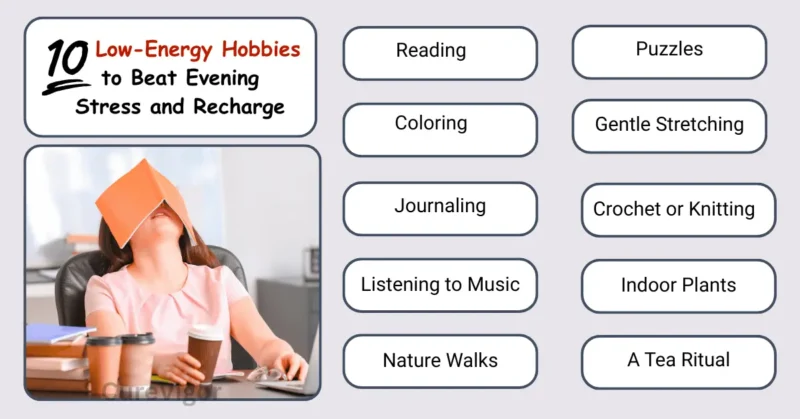
10 Powerful Low-Energy Hobbies for Stress Relief and Evening Calm
Below are 10 hobbies you can realistically do on weeknights—especially when you’re tired.
1. Reading: A Calm Low-Energy Escape from Stress
Reading helps because it gently pulls your attention out of your day and into a calmer world. Not a loud world.
Not a complicated one. Just a place where your brain can rest inside someone else’s sentences for a while.
How to start (low-energy version):
- Keep a book where you rest (so you don’t “go find it”).
- Choose easy-entry reading: short chapters, cozy fiction, essays, or rereads.
- Set a tiny goal: 10 pages or 10 minutes.
Benefits:
- Helps the mind slow down without forcing silence
- Can improve bedtime calm and reduce “spiraling thoughts.”
- Feels like emotional companionship on lonely evenings
Challenges (and stress-safe fixes):
- If you can’t focus, choose a reread or short stories.
- If your eyes are tired, increase the font size or try a print-friendly lighting setting.
- If you feel guilty reading, remind yourself—this is recovery.
Quick checklist:
- Book within reach
- Soft light
- Timer set for 10 minutes
- Phone facedown or in another room
2. Coloring: A Creative Low-Energy Hobby to Unwind
Coloring works because it’s a form of structured creativity. You don’t have to invent anything.
You just choose the colors and fill in the spaces. That gentle decision-making can be surprisingly soothing.
How to start:
- Use an adult coloring book, printable pages, or simple patterns.
- Choose 2–4 colors only (less thinking = more calm).
- Try slow breathing while you color.
Benefits:
- Reduces mental noise by giving the mind one simple task
- Offers a quiet sense of completion
- Great for anxious evenings when you need grounding
Challenges (and fixes):
- If you feel “silly,” remind yourself it’s a nervous-system tool, not a talent show.
- If perfection shows up, pick pages with larger shapes; avoid hyper-detailed designs.
- If your hand gets tired, switch to thicker pencils or markers.
Quick checklist:
- Coloring page ready
- 3 pencils or markers
- Calm playlist (optional)
- 5–15 minutes only
3. Journaling: A Reflective Hobby to Process Thoughts and Relax
Journaling isn’t about writing beautifully. It’s about unloading what’s stuck. When thoughts stay trapped in your head, they loop. When they land on paper, they often soften.
Two easy journaling styles (choose one):
- Brain dump: Write whatever is loud in your mind for 3–5 minutes.
- 3-line reset:
- What happened today
- What I’m feeling
- What I need tonight
Benefits:
- Creates emotional space and reduces rumination
- Helps you understand patterns (stress triggers, needs, boundaries)
- Can make bedtime feel lighter
Challenges (and fixes):
- If journaling intensifies feelings, keep it short and end with one grounding line:
- “Right now, I’m safe. Tonight, I rest.”
- If you don’t know what to write: start with “I don’t know what to write, but…”
Quick checklist:
- One notebook
- One pen
- 5-minute timer
- One kind closing sentence
4. Listening to Music: A Soothing Hobby That Calms the Mind
Music is one of the fastest ways to shift mood because it works through the body, not just the brain. It can slow you down, comfort you, or help you release tension without having to “talk about it.”
How to start:
- Make 2 playlists: Unwind and Sleep.
- Try instrumental, lo-fi, acoustic, or calm vocals.
- Listen actively for 1 song: notice the rhythm, the instruments, and the feeling.
Benefits:
- Helps regulate emotions gently
- Pairs well with other low-energy hobbies
- Creates a comforting evening atmosphere
Challenges (and fixes):
- If music makes you emotional, choose non-lyrical tracks.
- If you keep skipping songs, limit yourself to a short playlist you already love.
Quick checklist:
- Headphones or a soft speaker
- 10-song “unwind” list
- Dim lighting
- One slow breath per song
5. Nature Walks: A Peaceful Low-Energy Way to Recharge
A slow walk isn’t “exercise” in this context. It’s a transition ritual—proof to your body that the workday is over. Even 10 minutes outside can reset the internal pressure.
How to start (low-energy walk):
- Keep it short: 5–15 minutes.
- Walk slowly enough to notice details: trees, sky, air temperature.
- If you can’t go outside, walk indoors near a window or on a balcony.
Benefits:
- Helps discharge stress from the body
- Improves mood without draining energy
- Reduces the “stuck” feeling from sitting all day
Challenges (and fixes):
- If you’re too tired, walk to the end of the street and back. That counts.
- If safety is an issue, a daylight walk, indoor steps, or a short “porch pause” works too.
Quick checklist:
- Comfortable shoes
- No goal except gentle movement
- Phone on silent
- Return and drink water.
6. Puzzles: Relaxing Brain Games That Quiet Overthinking
Puzzles give your mind a single, solvable focus. That’s powerful when your thoughts feel messy. They create calm through gentle challenge—just enough to hold attention, not enough to drain you.
Low-energy puzzle ideas:
- Small jigsaw puzzles (100–300 pieces)
- Sudoku, crosswords, word searches
- Logic puzzle books
Benefits
- Interrupts rumination loops
- Creates a soothing sense of progress
- Easy to pick up and put down
Challenges (and fixes):
- If frustration rises, choose simpler puzzles or set a “one section only” goal.
- If time disappears, set a timer for 15–20 minutes.
Quick checklist:
- Puzzle ready on a tray/table
- Timer set
- Comfort drink nearby
- Stop while it still feels good.
7. Gentle Stretching or Yoga: A Low-Energy Body Reset Before Bed
When stress lives in the body, thinking doesn’t always solve it. Gentle stretching helps your nervous system get the message: we’re not in survival mode right now.
How to start (3–8 minutes):
- Neck rolls, shoulder circles, forward fold, child’s pose
- Slow, comfortable breathing
- Stay far away from “push through it” energy.
Benefits:
- Relieves muscle tension from work stress
- Helps the body shift toward sleep readiness
- Improves the feeling of being “back in yourself.”
Challenges (and fixes):
- If you feel stiff, do less, not more.
- If you don’t know what to do, repeat 3 stretches you like every night.
Quick checklist:
- Soft mat or rug
- Gentle music (optional)
- 5 minutes only
- Stop before straining.
8. Crochet or Knitting: Repetitive Crafts That Feel Like a Warm Blanket
This is one of the most underrated low-energy stress relievers. The repetition, the texture, the steady rhythm—it’s quietly therapeutic.
How to start (beginner-friendly):
- One hook or needle and one soft yarn
- One simple pattern (like a square, scarf, or coaster)
- Learn just one stitch first.
Benefits:
- Creates calm through repetitive motion
- Gives a satisfying sense of making something
- Great replacement for scrolling while watching TV
Challenges (and fixes):
- If learning feels hard, allow a “messy first week.” That’s normal.
- If your hands tire, limit it to 10–15 minutes and stretch your fingers after.
Quick checklist:
- Yarn and hook in a small bag
- One easy tutorial saved
- 10-minute practice
- Celebrate effort, not outcome.
9. Indoor Plants: Gentle Care That Grounds You
Plant care is a micro-hobby that feels nurturing without being demanding—especially if you choose low-maintenance plants. There’s something deeply calming about tending to a living thing slowly and kindly.
Low-effort plant actions:
- Check soil moisture
- Wipe leaves gently
- Rotate toward light
- Water only when needed
Benefits:
- Calming sensory routine (touch + sight + quiet focus)
- Builds a sense of steadiness and home comfort
- Small acts of care can improve mood.
Challenges (and fixes):
- If you “kill plants,” choose hardy ones and water less often than you think.
- If you forget, tie it to a day (e.g., plant check every Sunday evening).
Quick checklist:
- 1–3 easy plants
- Small watering can
- Weekly reminder
- Simple plant corner
10. A Tea Ritual (or Warm Drink Ritual): Cozy Self-Care That Signals “Safe Now.”
This isn’t about what you drink—it’s about creating a sensory cue that tells your body the day has ended. Warmth, scent, a mug in your hands, slower movement… It’s a gentle “off switch.”
How to start:
- Pick one drink you enjoy (tea, warm water with lemon, or decaf options).
- Make it intentionally slow: boil, pour, inhale the scent, sit.
- Pair it with something calm (reading, music, journaling).
Benefits:
- Helps transition from work mode to rest
- Comforts the body through warmth and routine
- Easy, repeatable, and low-prep
Challenges (and fixes):
- If you skip it when tired, keep supplies visible and accessible.
- If you use it to multitask, try sipping while doing nothing else for 3 minutes.
Quick checklist:
- Favorite mug
- Drink supplies ready
- Sit for 3 minutes
- One deep exhale
Benefits of Making Low-Energy Hobbies a Habit
When you consistently repeat a calming hobby—especially at the same time—your body begins to trust the evening again.
Better sleep support (without forcing sleep)
These hobbies reduce stimulation and give your brain a softer runway into rest. You’re not demanding sleep; you’re creating conditions where sleep is more likely to arrive.
Improved mood and emotional steadiness
Small soothing rituals reduce the feeling of “my life is only responsibilities.” Even 10 minutes of something gentle can return a sense of self.
A healthier relationship with rest
You stop seeing rest as something you must earn. You start treating it as something you need—and deserve.
Common Challenges (and How to Keep This Stress-Safe)
Even low-energy hobbies can feel hard when you’re depleted. Here’s how to stay kind to yourself.
“I don’t have energy for anything.”
Choose the smallest possible version:
- One song
- One page
- One paragraph
- One stretch
- Two minutes of coloring
Consistency grows when the barrier is low.
“I start, then feel guilty.”
Guilt often means you’re carrying an old belief: Rest must be justified.
Try this replacement thought: “Rest helps me return to my life with more softness.”
“I can’t focus in the evenings.”
Use hobbies that don’t require focus:
- Music
- Tea ritual
- Plant care
- Gentle stretching
- Very easy reading (re-reads)
“I keep grabbing my phone.”
Make the phone inconvenient, not forbidden:
- Put it across the room.
- Turn on Do Not Disturb
- Keep your hobby tools within reach.
A Simple Evening Routine to Unwind (Mix-and-Match)
You don’t need a complicated routine. You need a repeatable one.
The 10–10–10 Wind-Down Plan (30 minutes total)
- 10 minutes: low-energy hobby (reading, coloring, puzzle, craft)10 minutes: light reset (tidy one small area, prep for morning)
- 10 minutes: calm-down cue (music, stretching, tea ritual, journaling)
If 30 minutes is too much, do 10 minutes total. That still counts.
Low-Energy Hobby Checklist (Save This for Tired Nights)
- I will choose one hobby only.
- I will start for 2 minutes.
- I will keep it mess-free
- I will aim for comfort, not productivity.
- I will stop while it still feels good.
- I will end with one gentle cue: tea/stretch/music / dim lights.
Summary Before Conclusion (for readers who skim)
If your evenings feel heavy—tired body, busy mind—low-energy hobbies offer a gentle bridge between stress and rest.
You don’t need big motivation; you need small, comforting actions that fit real life.
The 10 best low-energy hobbies for evening stress relief are:
- Reading
- Coloring
- Journaling
- Listening to music
- Nature walks
- Puzzles (jigsaw/word/logic)
- Gentle stretching or yoga
- Crochet or knitting
- Indoor plant care
- A warm drink ritual (tea ritual)
Key benefits: calmer evenings, better sleep support, improved mood, less scrolling, and more self-care that actually sticks.
Key challenges: low energy, guilt, poor focus, and phone habits—solved by the 2-minute rule and keeping hobbies simple.
Best routine: a tiny daily wind-down (even 10 minutes) that signals to your body the day is done; you can soften now.
FAQs (High-Intent, Most Searched)
Q. What low-energy hobbies relieve stress?
Reading slows mental noise and gives your mind a safe place to rest.
Coloring and puzzles gently focus attention away from worry loops.
Journaling helps release thoughts that keep circling at night.
Music and tea rituals calm the body through soothing sensory cues.
Short nature walks help relieve stress without requiring much energy.
Q. What are the 5 hobbies everyone should have?
One calming hobby (reading, music, or coloring) for stress relief.
One moving hobby (walking or stretching) for body health and mood.
One creative hobby (crafts or journaling) for self-expression.
One social hobby (light community, calls, or groups) for connection.
One restorative hobby (tea ritual, plants, or quiet routines) for a reset.
Q. What are 6 hobbies that boost dopamine?
Small-win hobbies like puzzles can feel rewarding and satisfying.
Creative hobbies like coloring or crafts may add pleasure and motivation.
Movement hobbies like walking can support mood and mental energy.
Learning hobbies like crochet can build confidence through progress.
Music can quickly lift emotions and create a sense of comfort.
Note: dopamine is complex—these may help, but results vary by person.
Q. What hobbies help overcome stress?
Low-energy hobbies help by reducing overwhelm without adding pressure.
Journaling and reading calm the mind and lower mental clutter.
Stretching, walking, and breathing routines help relieve tension in the body.
Music and warm drink rituals provide comforting sensory grounding.
The best hobby is the one you’ll do consistently, even for 10 minutes.
Q. What are 5 interesting hobbies?
Reading genres you’ve never tried can feel fresh and surprising.
Puzzles and logic games keep the mind gently engaged.
Crochet or knitting turns quiet time into something comforting and useful.
Indoor plant care brings steady, nurturing calm into your space.
Coloring or lettering adds creativity without needing special skills.
Q. What is the 4-hobby rule?
The “4 hobby rule” is often shared as a guideline rather than a strict rule.
It suggests having hobbies for creativity, fitness, relaxation, and learning.
The goal is variety, so one hobby doesn’t carry all your emotional needs.
Your version can be simple: one calm, one move, one create, and one connect.
If that feels like too much, start with one—and let it grow naturally.
Conclusion
Evening stress doesn’t always need a big solution. Often, it needs a small, steady kindness—something that tells your mind and body, We can soften now.
Low-energy hobbies work because they’re gentle, realistic, and repeatable. They don’t demand energy you don’t have. They offer a way to unwind without losing yourself in screens or pressure.
Pick one hobby from this list. Start for two minutes. Let that be enough. Then, when you’re ready, let it become a small ritual you can come home to.
A gentle call to action
If you choose just one low-energy hobby for tonight, which one feels like the biggest relief—and why?
I’d love to read your answer in the comments (and if you want, tell me what your evenings usually feel like).
Read more Health and Balance articles.
You might like: