
Feel no motivation to do anything, but not depressed? Discover 7 surprising causes behind low drive and simple, science-backed steps to start feeling like yourself again.
You wake up. You have a to-do list. You know what needs to happen. And yet, nothing moves. Not because you’re sad. Not because you’re crying.
Not because you can’t get out of bed in the clinical sense. You just… don’t want to do the thing. Anything.
This feeling is far more common than people talk about. It doesn’t always look dramatic.
It looks like opening your laptop and closing it again. It looks like the fourth day in a row, with a task postponed. It seems like I want to try, but the spark isn’t there.
And the confusing part? It doesn’t feel like depression. You laugh at things. You enjoy conversations.
You can feel joy. You’re just not moving forward. And that gap, between knowing and doing, is exhausting in its own quiet way.
This article is for you if you find yourself stuck in that gap. We’ll walk through what unmotivation actually is, how it differs from depression and burnout, and, more importantly, the seven real causes that most people never consider. Some of these will surprise you. All of them are worth knowing.
Quick Summary
- Unmotivation is not the same as depression — knowing the difference matters.
- 7 evidence-linked causes: purpose, stress, sleep, nutrition, boredom, fear, and goal-setting
- Each cause comes with practical, realistic steps you can actually take
- Includes a self-reflection checklist, FAQ, and recap before the conclusion
Estimated read time: 12–14 minutes
What Does It Mean to ‘Be Unmotivated’ or ‘No Motivation’?
Unmotivation is the state of having reduced or absent drive to initiate, continue, or complete tasks, even ones that are important or that you previously enjoyed. It’s not laziness.
It’s not a character flaw. It’s a signal that something in your mental, physical, or environmental setup is out of alignment.
Definition
Unmotivation is a persistent reduction in the drive to take action, even when the ability and opportunity are present.
It differs from clinical depression in that mood, social function, and baseline enjoyment of life remain largely intact. It is often temporary and tied to specific, identifiable causes.
Common signs of unmotivation
People who are unmotivated often describe the same set of experiences: tasks feel heavier than they should, and starting anything feels like the hardest part.
And there’s a nagging sense that they should be doing more, but can’t quite get there. Procrastination increases. Focus drops. Even small decisions feel like an effort.
How is it different from depression?
Clinical depression is a mood disorder. It involves persistent low mood, loss of interest across most areas of life, changes in sleep and appetite, and often a distorted sense of self-worth. It can be disabling. It requires professional support.
Unmotivation is narrower. A person who lacks motivation may still feel genuine happiness, connect with people they love, discover humor in things, and experience moments of real engagement.
The absence is more specific; it’s the drive to work, create, or push forward that’s missing, not the capacity for joy or connection.
How is it different from burnout?
Burnout is what happens after sustained, unresolved stress, particularly in work environments. It involves emotional exhaustion, detachment, and a drop in professional efficacy.
Burnout is the result of having pushed too hard for too long. Unmotivation can appear without any prior period of high output. You can be unmotivated without ever having been burned out.
That said, if you’re experiencing any of these in combination, or if the feeling has lasted several weeks and is affecting your daily life significantly, speaking with a mental health professional is always worth considering.
7 Surprising Causes of Unmotivation
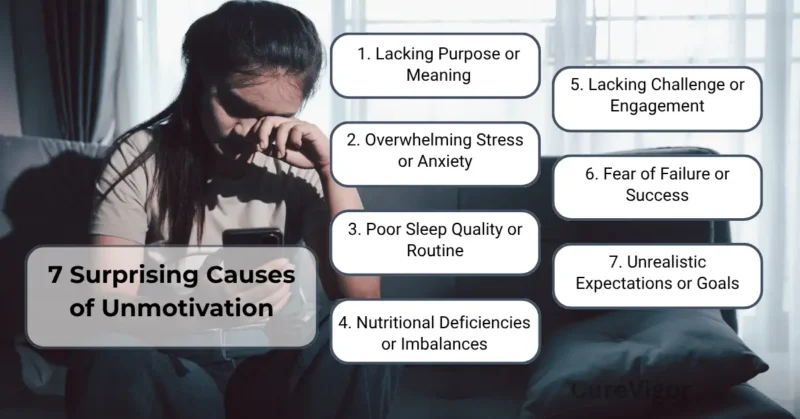
1. Lacking Purpose or Meaning
Humans are remarkably bad at sustaining effort toward goals that feel hollow. When you don’t understand why a task or role matters to you, not just in theory, the brain has little reason to generate drive toward it.
Psychologist Martin Seligman’s research on well-being found that meaning, a sense of belonging to something larger than yourself, is one of five core elements of flourishing. Without it, even competent, capable people experience persistent motivational decline.
Research Note
A 2019 study published in the Journal of Positive Psychology found that employees who reported a low sense of purpose at work were 2.4 times more likely to report low engagement and 1.8 times more likely to consider leaving their role, even when pay and conditions were satisfactory.
This isn’t just about a career. It applies to daily routines, relationships, and personal projects. When the “why” is vague or absent, the “how” becomes a grind.
What helps
Try writing down one answer to this question: “Who benefits when I do this task well?” It doesn’t have to be poetic. It just has to be real.
Connecting effort to a tangible outcome, even a small one, reactivates purpose-driven motivation faster than motivational content ever will.

2. Overwhelming Stress or Anxiety
When the brain perceives a threat, real or anticipated, it shifts resources toward survival rather than productivity.
Cortisol, the primary stress hormone, suppresses the prefrontal cortex’s ability to plan, initiate, and follow through. In plain terms, chronic stress physically reduces your capacity to start things.
Anxiety compounds the situation. Anxious thinking doesn’t just feel unpleasant — it occupies cognitive bandwidth.
When worry consumes mental energy, there’s less available for execution. Tasks that would normally take minimal effort start requiring conscious willpower just to begin.
Research Note
A 2021 study in Psychoneuroendocrinology found that people with high cortisol levels started tasks much less often during assessments, even when the tasks were familiar and well within their skill range.
What helps
Physical movement, even a 10-minute walk, is one of the fastest ways to lower cortisol levels.
It’s not a cure for anxiety, but it shifts the nervous system enough to make starting something possible.
Box breathing (four counts in, four hold, four out) also activates the parasympathetic response and can be done in under two minutes before any task.
3. Poor Sleep Quality or Routine
Sleep is not a passive recovery state. During deep sleep, the brain consolidates learning, regulates emotional responses, and restores the dopaminergic systems that drive motivation.
When sleep is consistently poor, whether in duration or quality, motivational drive is one of the first things to decline.
The connection is direct. The ventral tegmental area (VTA), which produces dopamine and plays a central role in goal-directed behavior, is highly sensitive to sleep deprivation.
Even one night of inadequate sleep measurably reduces dopamine receptor availability the following day.
Research Note
A 2012 study by researchers at UC Berkeley used PET scans to show that sleep-deprived participants had significantly reduced dopamine receptor binding in reward-related brain regions compared to well-rested participants, directly linking poor sleep to reduced motivation and reward sensitivity.
What helps
Consistency matters more than duration. Going to bed and waking up at the same time, including weekends, stabilizes your circadian rhythm and has a measurable effect on mood and drive within one to two weeks.
Reducing screen exposure an hour before bed and keeping your room cooler (around 18–20°C) are two evidence-backed adjustments that improve sleep quality without supplements or a significant lifestyle overhaul.

4. Nutritional Deficiencies or Imbalances
This one is consistently underestimated. The brain requires specific nutrients to produce the neurotransmitters that regulate mood, energy, and drive.
When those nutrients are low, even subclinically, motivation suffers.
Fatigue and apathy are the initial signs of iron insufficiency, the most prevalent dietary deficiency worldwide, and often manifest before anemia becomes noticeable.
Vitamin D directly impacts the production of dopamine and serotonin, performing more like a hormone than a vitamin.
B12 insufficiency causes bland affect and neurological sluggishness. Anxiety and exhaustion are associated with low magnesium levels.
Research Note
Vitamin D supplementation significantly improved depressive symptoms and fatigue scores in people with vitamin D deficiency, according to a 2020 meta-analysis published in Nutrients that examined 18 randomized controlled trials. These outcomes are closely related to motivational capacity.
What helps
If you’ve been persistently low on energy and unmotivated for several weeks, a basic blood panel is worth discussing with your doctor.
Focus on vitamin D, B12, iron/ferritin, and thyroid function (hypothyroidism is a frequently missed cause of motivational decline).
Food-first approaches, such as leafy greens, legumes, eggs, oily fish, and nuts, address multiple deficiencies simultaneously. Don’t start supplementing without testing first, as some nutrients can be harmful in excess.
5. Lacking Challenge or Engagement
Paradoxically, boredom is a real motivational killer. Mihaly Csikszentmihalyi’s flow research established that motivation peaks when task difficulty is just above the current skill level. Too easy, and the brain disengages.
Too hard, and anxiety replaces engagement. The sweet spot, which he called “flow”, requires challenge that stretches but doesn’t overwhelm.
Many people find themselves in roles or routines that have become too routine months or years ago. The tasks aren’t difficult. They’re just… flat. And flat tasks don’t generate drive. They generate scrolling.

Research Note
Csikszentmihalyi’s longitudinal research with workers and artists found that people reported their highest levels of motivation and engagement not during leisure but during challenging, structured activity that required skill.
Boredom and anxiety were both associated with lower well-being than challenge-engaged states.
What helps
Deliberately add friction or stakes to familiar tasks. Set a time constraint. Add a quality target.
Teach the skill to someone else. Pair it with a new constraint. The brain responds to novelty and challenge, even manufactured ones.
If your work or routine has no growth edge, motivation will keep declining regardless of how well-intentioned you are.
6. Fear of Failure or Success
It is one of the most commonly cited causes in clinical psychology and one of the least discussed in everyday life.
Fear of failure is reasonably well understood: if you don’t try, you can’t fail. The avoidance protects self-esteem, at least in the short term.
Fear of success is less discussed but equally real. It can look like self-sabotage just before a goal is reached or persistent procrastination on something you actually want.
The underlying mechanism often involves concerns about increased expectations, changed relationships, or a loss of the familiar identity you’ve built around not yet having achieved the thing.

Research Note
Research by psychologist Dena Gromet (Wharton) found that people with a high fear of failure were significantly more likely to avoid tasks with uncertain outcomes, even when the potential reward was high, and the probability of success was favorable.
The avoidance was about self-concept protection, not rational risk assessment.
What helps
Separate the act from the outcome. You cannot control whether a piece of work succeeds. You can control whether it gets made.
Shifting your internal definition of success from “it worked” to “I showed up and did the work” removes the threat of evaluation that triggers avoidance.
This is not toxic positivity; it’s a measurably effective cognitive reframing used in Acceptance and Commitment Therapy (ACT).
7. Unrealistic Expectations or Goals
One of the simplest ways to destroy motivation before it begins is to set goals that are too big, too ambiguous, or too unrelated to your available resources.
The brain evaluates effort relative to the probability of success.
When a goal looks impossible from where you’re standing, drive drops, even if you genuinely want the outcome.
This is different from ambition. Ambitious goals can coexist with realistic milestones.
The problem is when the entire goal sits at the “impossible” end of the effort-to-outcome ratio, with no intermediate wins available.
Research Note
Edwin Locke and Gary Latham’s Goal-Setting Theory, one of the most replicated frameworks in motivational psychology, found that specific, moderately challenging goals consistently outperformed vague or extreme goals in both persistence and performance.
The optimal difficulty level was “hard but achievable,” not easy and not aspirational to the point of being disconnected from reality.
What helps
Break every large goal into the smallest next physical action. Not “finish the report” but “open the document and write one sentence.”
The dopamine system responds to small wins. Each completed step generates just enough reward to make the next step easier to start.
This isn’t about thinking small, it’s about giving your brain a workable on-ramp to the work that actually matters.
Benefits of Understanding Your Unmotivation and the Challenges

What Understanding This Gives You!
- Replaces self-blame with actionable insight
- Helps you target the specific cause, not just the symptom
- Reduces the anxiety of “what’s wrong with me?”
- Makes treatment or change more precise and efficient
- Builds long-term self-awareness that prevents recurrence
Real Challenges to Watch For
- Multiple causes often overlap; one solution rarely covers all of them.
- Some causes (deficiencies and sleep disorders) need professional input.
- Awareness alone doesn’t create change — action is still required.
- Progress is nonlinear; there will be low-energy days regardless.
- Confusing unmotivation with depression can delay appropriate care.
“You are not broken. You are responding rationally to a system that is out of calibration. The goal is recalibration, not self-criticism.”
Practical Self-Check: What to Reflect On
- Do I understand why the things I need to do actually matter to me?
- Is my current stress level manageable, or has it been sustained for weeks?
- Am I consistently sleeping 7–9 hours with a regular schedule?
- When was the last time I had blood work done to check key nutrient levels?
- Do any of my current tasks actually challenge me, or have I outgrown them?
- Is there a specific goal I’ve been avoiding that I actually care about?
- Are my goals broken down into steps I can realistically take today?
- Have these feelings persisted for more than two to three weeks without change?
Frequently Asked Questions
Q. Why do I have no motivation to do anything, but I’m not depressed?
Feeling no motivation without being depressed is more common than most people realize.
It usually points to one or more specific causes of poor sleep, low nutrient levels, chronic stress, a lack of meaningful goals, or fear of failure.
Unlike depression, your mood and capacity for joy remain largely intact; it is the drive to initiate and follow through that is missing.
This is a functional issue, not a character flaw, and it typically has an identifiable cause worth investigating rather than pushing through.
Q. What is the main cause of a lack of motivation?
There is no single main cause, but research consistently points to a disconnection between effort and meaning as the most common underlying factor.
When people cannot clearly see why a task or goal matters to them personally, the brain has little reason to generate drive toward it.
Other frequent contributors include chronic stress, sleep deprivation, and nutritional deficiencies that directly affect dopamine and serotonin production.
Identifying the specific cause matters more than applying a general motivational fix.
Q. What is the biggest killer of motivation?
Chronic stress is one of the most documented motivation killers, because elevated cortisol physically suppresses the prefrontal cortex, the part of the brain responsible for planning, initiating, and follow-through.
Equally damaging is the absence of visible progress; Harvard researcher Teresa Amabile found that failing to see forward movement on meaningful work was the most consistent daily drain on motivation in her studies.
Perfectionism and fear of failure compound this further by making starting feel more threatening than staying stuck.
Q. How to stop anhedonia?
Anhedonia, the reduced ability to feel pleasure or reward, is best addressed by targeting its underlying cause, which may be depression, burnout, dopamine dysregulation, or a medical condition.
Evidence-based approaches include structured physical exercise, which increases BDNF and supports recovery of the dopamine system, and behavioral activation therapy, which gradually reintroduces rewarding activities even when motivation is absent.
Poor sleep and nutritional deficiencies can also blunt the reward system, so addressing these is an important first step.
If anhedonia has persisted for more than two weeks, a clinical assessment is strongly recommended.
Q. Should I wait until I feel motivated to start or start to feel motivated?
The research strongly supports starting first. Motivation follows action more reliably than action follows motivation. This is sometimes called the “action-motivation loop.”
Waiting to feel ready before you begin is a strategy that works occasionally and fails often.
A more reliable approach is to define the smallest possible starting action (open the document, put on your shoes, fill the water bottle) and do only that.
Momentum generates motivation in a way that waiting does not. The caveat: if you are genuinely exhausted or overwhelmed, rest first; pushing through depletion isn’t action, it’s attrition.
Q. When should I seek professional help for unmotivation?
If the feeling has persisted for three or more weeks without a clear trigger, if it’s accompanied by low mood, social withdrawal, disrupted sleep or appetite, or thoughts of hopelessness, these are signals to seek professional assessment.
A GP can rule out physical causes (thyroid, iron, B12, vitamin D). A psychologist or therapist can help identify whether anxiety, depression, ADHD, or burnout is a better fit for what you’re experiencing.
Seeking help early is not an overreaction; it’s the faster route to feeling better. There is no award for waiting it out.
What to Do Next
Before you close this tab, take thirty seconds. Think about the seven causes you just read. Which one landed? Which one felt like someone was describing you, not a hypothetical person, but actually you?
That recognition is nothing. Most people who feel chronically unmotivated spend months or years treating the surface symptom, trying harder, reading more productivity advice, and rewriting their to-do list without ever identifying what’s actually driving the stall.
The causes covered here are not complete. But they are among the most common, the most overlooked, and the most actionable.
You don’t have to fix all seven at once. You don’t have to fix any of them perfectly. You just have to start with the one that is most true for you right now.
If more than three of these causes feel applicable, or if you’ve been stuck for a significant period of time, please consider speaking with a professional. A GP is a reasonable first call for physical causes.
A psychologist or counselor is the right next step if the pattern feels more psychological in nature. Both are appropriate and worth pursuing sooner rather than later.
Quick Recap — The 7 Causes
- Lacking purpose or meaning — Without a genuine “why,” effort has no engine
- Overwhelming stress or anxiety — Chronic stress physically reduces the brain’s capacity to initiate
- Poor sleep quality or routine — Sleep deprivation suppresses the dopamine systems that drive motivation
- Nutritional deficiencies or imbalances — Iron, D, B12, and magnesium are all directly tied to energy and drive.
- Lacking challenge or engagement — Boredom is as demotivating as overwhelm — the brain needs a growth edge.
- Fear of failure or success — Avoidance is often self-concept protection disguised as procrastination.
- Unrealistic expectations or goals — Goals that feel impossible don’t generate drive — they generate paralysis
Conclusion
Being unmotivated isn’t a personality flaw. It isn’t evidence that you’re not cut out for the thing you want. It’s a signal, often a quite specific one, that something in your system needs attention.
The seven causes in this article are not exhaustive. But they represent some of the most common, under-recognized, and fixable reasons capable people find themselves stuck. And the fact that they have causes means they have addresses. That matters.
One thing worth sitting with: the shift from “I am unmotivated” (an identity) to “I am experiencing unmotivation” (a state with a cause) changes what becomes possible. States change. Identities feel fixed. You are not your current level of output.
Start with one cause. Take one action. See what moves. That is not a small thing — it’s the only thing that ever actually helps.
We Want to Hear From You
Which of these seven causes resonated most with where you are right now? Have you found something that helped you get moving again, or are you still figuring it out?
Drop a comment below. Your experience might be the thing someone else needed to read today. No pressure to have it figured out. Just share where you’re at—honesty is enough.
Read more articles on Health and Wellness.
You might like: