
Learn how to identify and repay your sleep debt with 5 proven, science-backed strategies. Enhance your productivity, work-life balance, and overall well-being today.
Thank you for reading this post, don't forget to subscribe!The quietest thief in your home doesn’t take your jewelry or your car; it takes your time, your patience, and your clarity. It is sleep debt.
As a teacher and a mother, I have often found myself bargaining with the clock, thinking I could “buy” an extra hour of productivity by “borrowing” an hour from my sleep. But the interest rates on that loan are high.
Eventually, the brain fog settles in, your work-life balance tips precariously, and your well-being begins to fray. To truly reclaim your life, you have to understand that sleep isn’t a luxury—it’s a biological debt that must be settled.
At a Glance: The Sleep Debt Recovery Guide
- What is Sleep Debt? The cumulative difference between the sleep you need and what you actually get.
- The Impact: It acts as a “productivity tax,” causing brain fog, emotional irritability, and long-term health risks, such as metabolic strain.
- The Recovery Rule: For every 1 hour of sleep lost, it takes roughly 4 nights of quality rest to fully recover.
- Top Strategy: Use the 15-minute incremental rule—go to bed 15 minutes earlier each night—rather than sleeping in on weekends.
- The Goal: Restoring work-life balance by aligning your internal clock with the 10-3-2-1-0 framework.
Understanding Sleep Debt and Its Impact on Your Life
Sleep debt is the cumulative difference between the amount of sleep you need and the amount you actually get. If your body requires eight hours to function but you’ve been surviving on six for the past week, you are carrying a 14-hour deficit.
In my work as a coach for the inner self, I often see people mistake chronic exhaustion for a lack of motivation. It’s rarely a character flaw; it’s a physiological shortage.
When you carry a high debt, your prefrontal cortex—the part of the brain responsible for logical thinking and emotional regulation—begins to dim.
You aren’t just tired; you are cognitively impaired. Understanding this is the first step toward reducing stress and improving sleep health.
The Hidden Cost: How Sleep Debt Sinks Your Productivity
We often stay up late to finish “just one more task,” believing we are being productive. However, science suggests the opposite.
The Cognitive Decline of the Tired Mind
When you are operating under a sleep deficit, your reaction times slow down to a level comparable to alcohol intoxication.
I’ve noticed in the classroom that when I haven’t slept well, my ability to pivot during a lesson or manage a complex psychological concept diminishes.
Your productivity isn’t measured by hours awake, but by the quality of focus you bring to those hours.
The Strain on Personal Relationships
This is where the debt hurts the most. Lack of sleep makes us “ego-depleted.” We lose the ability to hold space for our partners or children.
Being a mother has taught me that my “short fuse” on a Tuesday afternoon is almost always a symptom of a late Monday night.
When we repay our sleep debt, we aren’t just fixing our work; we are saving our relationships by bringing our best, most patient selves back to the dinner table.
Health Issues Associated with Sleep Debt
When we ignore our body’s biological need for rest, the consequences move far beyond simple yawning.
As someone who has studied physical education and nutrition, I’ve seen how chronic sleep deprivation acts as a systemic stressor. It isn’t just your brain that suffers; it’s every organ in your body.
The Cardiovascular and Metabolic Toll
When you carry a high sleep debt, your body remains in a state of “high alert,” keeping your cortisol (the stress hormone) levels elevated. Increased blood pressure and cardiac strain can result from this protracted “fight or flight” condition.
Sleep debt also impairs glucose metabolism. I frequently warn my coaching clients that you cannot “out-diet” inadequate sleep since it impairs your body’s ability to handle insulin, which raises your risk of Type 2 diabetes and unintended weight gain.
Immune System and Cognitive Vulnerability
Have you ever noticed that you catch a cold right after a stressful, sleepless week? Your immune system produces cytokines—proteins that help the body fight infection—primarily while you sleep.
Without enough rest, your internal defense force is weakened. Mentally, the “debt” leads to a buildup of neurotoxins in the brain that are normally flushed out during deep sleep via the glymphatic system.
Over time, this is linked to more serious neurological concerns and a general decline in mental resilience.
5 Proven Strategies to Repay Your Sleep Debt
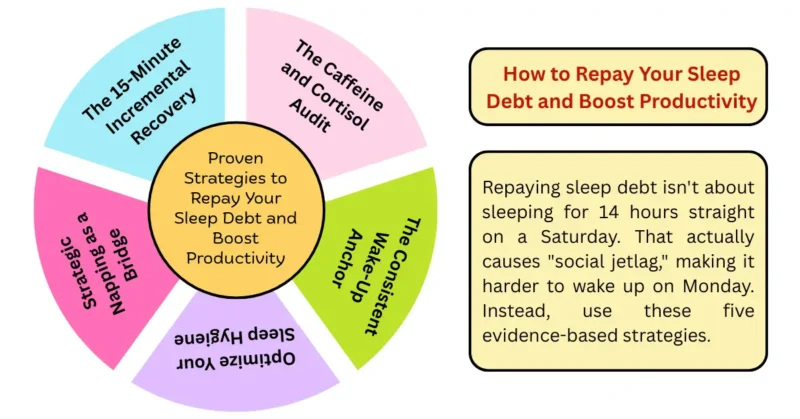
Repaying sleep debt isn’t about sleeping for 14 hours straight on a Saturday. That actually causes “social jetlag,” making it harder to wake up on Monday. Instead, use these five evidence-based strategies.
The 15-Minute Incremental Recovery
The most sustainable way to pay back your debt without shocking your system is the 15-minute rule. I plan my week by going to bed 15 minutes earlier each night until I hit my target.
This allows your circadian rhythm to adjust naturally. It’s a gentle, wellness-friendly approach that avoids the grogginess of oversleeping.
Strategic Napping as a Bridge
If your debt is high, a “NASA nap” (about 20 to 26 minutes) can restore productivity without interfering with your nighttime sleep.
As someone who studies nutrition and physical education, I recommend napping between 1:00 PM and 3:00 PM when the body’s core temperature naturally drops.
This is a bridge, not a permanent solution, but it helps clear the immediate mental fog.
Optimize Your Sleep Hygiene for High-Quality Recovery
Quantity matters, but sleep quality is the multiplier. To repay debt faster, you must sleep deeply. I’ve found that keeping the bedroom at 18°C (65°F) and removing all blue-light devices creates a “sanctuary effect.”
When your environment signals safety and coolness, your brain transitions into REM sleep more efficiently, helping you feel more restored in fewer hours.
The Caffeine and Cortisol Audit
To pay back debt, you must stop “spending” your energy unwisely. I suggest a caffeine cutoff at 2:00 PM. Caffeine has a half-life of about six hours; if you drink a cup at 4:00 PM, half of it is still buzzing in your brain at 10:00 PM.
By managing your nutrition and stimulant intake, you allow your natural adenosine levels to rise, making it effortless to repay sleep debt.
The Consistent Wake-Up Anchor
Even when you are trying to catch up, do not drift your wake-up time by more than an hour. If you usually wake up at 7:00 AM, don’t sleep until 11:00 AM on Sunday. Instead, go to bed at 9:00 PM on Saturday.
Keeping a consistent anchor helps your body’s internal clock stay aligned, ensuring the “repayment” sticks and supports your well-being over the long term.
How Long Does It Take to Recover From Sleep Debt?
One of the most common questions I get is whether a single weekend can “wipe the slate clean.” Unfortunately, biology doesn’t work that way.
The Timeline for Total Recovery
Science suggests that for every hour of sleep debt you accrue, it takes several nights of high-quality, consistent rest to fully recover. If you’ve lost 10 hours over a work week, one long sleep on Saturday won’t reset your cognitive baseline.
One hour of sleep loss can delay recovery by up to 4 days, according to research. For chronic debt, I plan for a “recovery season”—a period of 2 to 3 weeks where sleep is the non-negotiable priority.
How to Implement Gradual Sleep Extension
If you want to pay back your debt without triggering insomnia, you should use a method called Gradual Sleep Extension. This is the “people-first” way to transition your lifestyle.
A Step-by-Step Approach
- Step 1: Audit. Track your sleep for one week to see your true deficit.
- Step 2: The 15-Minute Shift. Move your bedtime 15 minutes earlier each of the next 2 nights. This slow transition allows your circadian rhythm to shift without the “jet lag” effect.
- Step 3: Monitor. Monitor your “Clarity Index.” You’ll find a “sweet spot” where you no longer need caffeine to start your day.
When Should You See a Doctor for Help?
While lifestyle changes solve most cases of sleep debt, there are times when professional medical intervention is necessary.
Red Flags to Watch For
If you give yourself an 8-hour window but still wake up feeling exhausted, you may be experiencing sleep apnea or Restless Legs Syndrome.
Furthermore, if your “debt” is fueled by an inability to quiet your mind (chronic insomnia) or if you feel a deep sense of hopelessness, a doctor can help determine if a mood disorder or a physical deficiency (like Vitamin D or Iron) is the root cause.
Benefits and Challenges of Balancing Your Sleep Budget
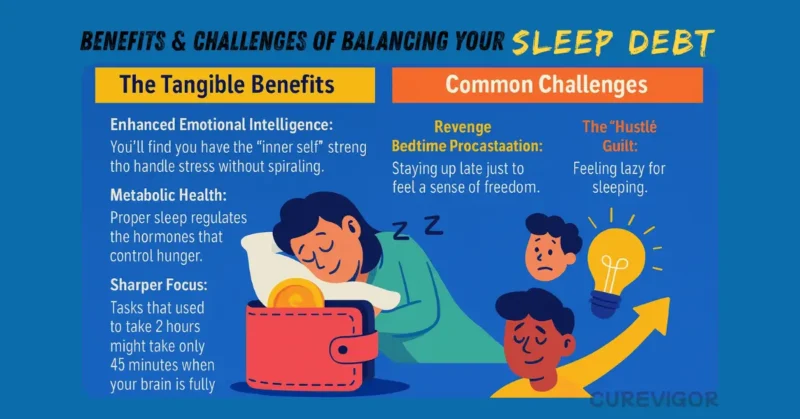
The Tangible Benefits
- Enhanced Emotional Intelligence: You’ll find you have the “inner self” strength to handle stress without spiraling.
- Metabolic Health: Proper sleep regulates the hormones that control hunger.
- Sharper Focus: Tasks that used to take 2 hours might take only 45 minutes when your brain is fully charged.
Common Challenges
- Revenge Bedtime Procrastination: Staying up late just to feel a sense of freedom.
- The “Hustle” Guilt: Feeling lazy for sleeping.
Your Sleep Debt Recovery Checklist
- Calculate your weekly deficit (Target hours vs. Actual hours).
- Set a “Digital Sunset” alarm 60 minutes before bed.
- Lower your thermostat to a cool, comfortable temperature (approx. 18°C).
- Prepare a light, magnesium-rich snack (such as almonds) to support relaxation.
- Commit to a consistent wake-up time for the next 7 days.
- Write down three things you’re grateful for to lower cortisol before sleep.
Frequently Asked Questions
Q. Can I really catch up on years of lost sleep?
While you cannot “undo” long-term health impacts overnight, you can absolutely resolve acute cognitive impairment. Your body is remarkably resilient.
By consistently prioritizing sleep health, your brain recovers plasticity, your mood stabilizes, and inflammatory markers begin to drop, allowing you to function at your peak again.
Q. Is sleeping in on weekends an effective way to repay debt?
It provides temporary relief but often causes “social jet lag.” When you sleep in late on Sunday, it’s harder to fall asleep Sunday night, starting the cycle of sleep debt all over again on Monday. It is far more effective to go to bed earlier while keeping your wake-up time stable.
Q. How do I know if my sleep debt is fully repaid?
The clearest sign is waking up naturally a few minutes before your alarm, feeling refreshed. Other indicators include a lack of a “mid-afternoon slump,” improved emotional patience, and the ability to focus on a single task without needing a quick sugar or caffeine fix.
Q. Does a 20-minute nap really help more than an hour nap?
Yes. A 20-minute nap keeps you in light sleep, providing alertness without “sleep inertia”—that heavy, groggy feeling that comes from waking up from deep sleep. If you sleep for an hour, you wake up mid-cycle, often feeling worse than before you napped.
Q. How does nutrition play into sleep debt recovery?
Nutrition is the fuel for sleep. High-sugar diets cause blood sugar spikes that wake you up at night. Conversely, foods rich in tryptophan or magnesium (like turkey, seeds, or leafy greens) support melatonin production. Think of nutrition as the “tuning” that allows your sleep engine to run smoothly.
Q. I’m a busy parent; how can I possibly find time to repay debt?
Focus on “micro-recovery.” If you can’t get two extra hours, aim for 20 minutes by streamlining your evening.
Involve your children in an early bedtime ritual; when they sleep better, you sleep better. Your children need a rested parent more than one who stayed up late with chores.
Q. How do you maintain a consistent sleep-wake schedule?
The key to a stable schedule is anchoring your wake-up time, even on weekends, to regulate your circadian rhythm. Your brain thrives on predictability, so aim to get into bed at the same time every night to signal your nervous system that it is safe to downshift.
As a coach, I advise setting a “reverse alarm” to remind you to begin your wind-down procedure thirty minutes before bed.
Maintaining consistency helps you regulate your circadian rhythm, facilitating natural sleep and wakefulness without the alarm-clock battle.
Q. How do you optimize your sleep hygiene and environment?
Think of your bedroom as a sanctuary for rest—it should be cool, dark, and incredibly quiet. I recommend keeping the temperature around 18°C and using blackout curtains to prevent light from disrupting your melatonin production.
Remove all electronics to eliminate the temptation of “one more scroll” and to reduce blue light exposure, which tricks your brain into thinking it’s daytime.
By investing in a comfortable mattress and clearing the clutter, you create a psychological “safe zone” that invites deep, restorative sleep.
Q. How can you utilize morning sunlight and daytime activity?
Stepping into direct sunlight within 30 minutes of waking up is like “resetting” your brain’s internal timer for the entire day. This morning, light exposure suppresses melatonin and boosts serotonin, which then convert back into sleep hormones once the sun goes down.
Pairing this with physical activity—even a simple 20-minute walk—increases your “sleep drive,” the biological urge to rest that builds throughout the day.
By being active during the day, you ensure your body is truly exhausted and ready for repair by the time you hit the pillow.
Q. What is the hidden cost of insufficient rest?
Beyond fatigue, the hidden cost of sleep debt is a significant decline in emotional intelligence and long-term metabolic health.
When you are sleep-deprived, your “emotional brakes” fail, leading to strained relationships and increased irritability with your children or colleagues.
It also places a heavy tax on your heart and immune system, making you more susceptible to chronic illnesses and weight gain.
Essentially, you aren’t just losing sleep; you are losing the ability to show up as your best, most patient, and most vibrant self.
Q. What is the best way to pay back your sleep debt?
The most effective way to settle your “sleep account” is through gradual sleep extension rather than binge-sleeping on your days off. Aim to add 30 to 60 minutes of extra rest each night by going to bed earlier, allowing your body to recover in smaller, more natural increments.
This method prevents “social jetlag” and keeps your circadian rhythm intact while slowly chipping away at your cumulative deficit. It requires patience and a commitment to your well-being, but it is the only way to ensure the recovery is permanent.
Q. What is the 10-3-2-1-0 rule for sleep?
This popular framework is a countdown to a perfect night’s rest: 10 hours before bed, stop all caffeine; 3 hours before, stop eating heavy meals or drinking alcohol; 2 hours before, stop all work tasks to let your brain decompress.
To help your natural melatonin levels rise, switch off all screens and blue-light-emitting devices an hour before bed. The “0” indicates how many times you should hit the snooze button in the morning to ensure you wake up with a clear, focused mind.
Q. What are 5 ways to improve sleep?
First, maintain a strict and consistent sleep-wake schedule to train your body’s internal clock.
Second, optimize your environment by keeping your bedroom cool, dark, and free of digital distractions.
Third, manage your nutrition by cutting out caffeine in the early afternoon and avoiding heavy, sugary snacks late at night.
Fourth, incorporate daily movement or sunlight exposure to strengthen your natural sleep-wake cycle.
Finally, practice a “brain dump” or gratitude journaling before bed to clear your mind of the day’s stressors and anxieties.
Q. What is the best way to get rid of sleep debt?
To truly eliminate sleep debt, you must transition from a “deficit mindset” to a “surplus strategy” by prioritizing rest over late-night productivity. This involves maintaining consistent early bedtimes and taking short, strategic afternoon power naps to bridge energy gaps.
You cannot rush the process; it takes roughly four nights of quality rest to recover from just one hour of lost sleep.
By making sleep a non-negotiable part of your work-life balance, you eventually reach a state where you wake up feeling naturally restored.
Conclusion
Repaying your sleep debt is an act of self-respect. It is the foundation of a balanced life, a flourishing career, and a happy home. When we choose to rest, we aren’t being “lazy”—we are sharpening the tool that is our mind.
As a teacher and coach, I’ve seen lives transform simply because someone decided that their well-being was worth more than an extra hour of late-night television. You deserve to wake up feeling capable, calm, and ready to face the world with a full heart.
What is the one thing that usually keeps you up at night, and which of these 5 strategies do you think would be easiest for you to try tonight?
I’d love to hear your thoughts and experiences in the comments below!
Read more Health and Balance articles.
You may like: