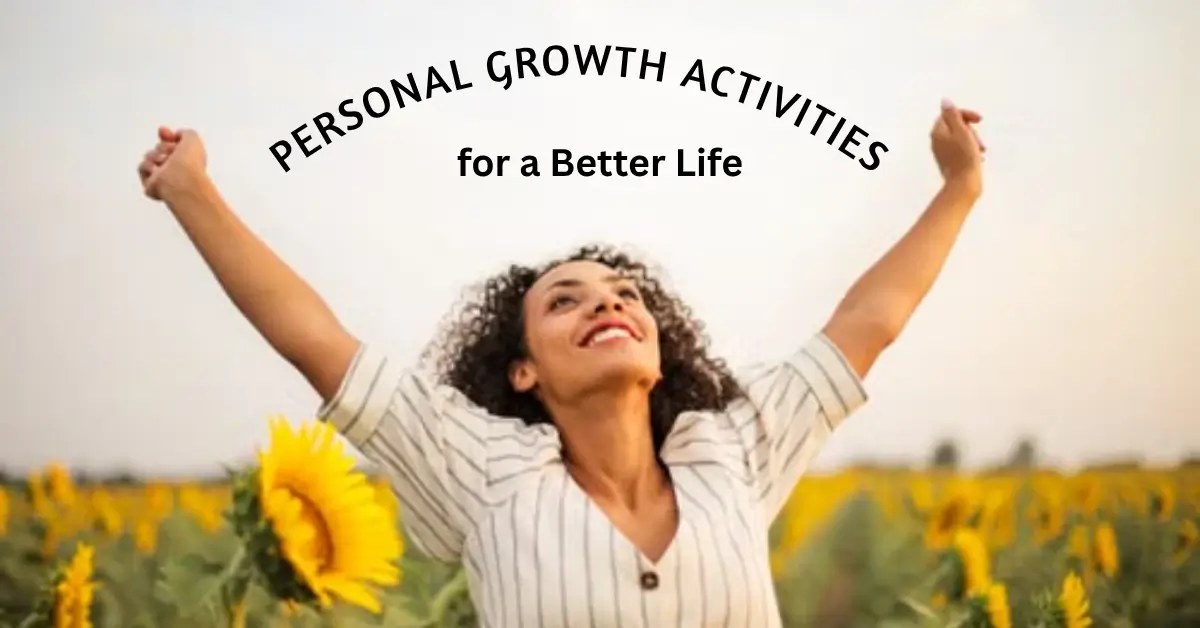
Explore 10 powerful personal growth activities for a better life, including exercise, reading, gratitude, mindfulness, journaling, learning, communication, volunteering, and time management.
Personal growth does not require changing your entire life overnight. Meaningful change often starts with small activities that help you understand yourself, manage your emotions, build better habits, and make choices that fit your values.
The best personal growth activities for a better life are practical enough to repeat and flexible enough to fit different personalities and lifestyles.

Journaling, mindfulness, learning, goal setting, exercise, healthy boundaries, meaningful relationships, and helping others can all become part of a realistic growth routine.
Personal growth also does not mean being positive every day. Difficult emotions, setbacks, uncertainty, and slow progress are normal parts of life.
The goal is not perfection. It is learning how to respond to life with greater awareness, confidence, flexibility, and self-compassion.
Setting clear SMART goals can turn personal growth intentions into specific, realistic actions and make progress easier to track.
What Are 10 Powerful Personal Growth Activities for a Better Life?
The most useful personal growth activities are practical habits that improve different areas of your life. They can help you become more self-aware, manage stress, build confidence, strengthen relationships, and use your time more intentionally.
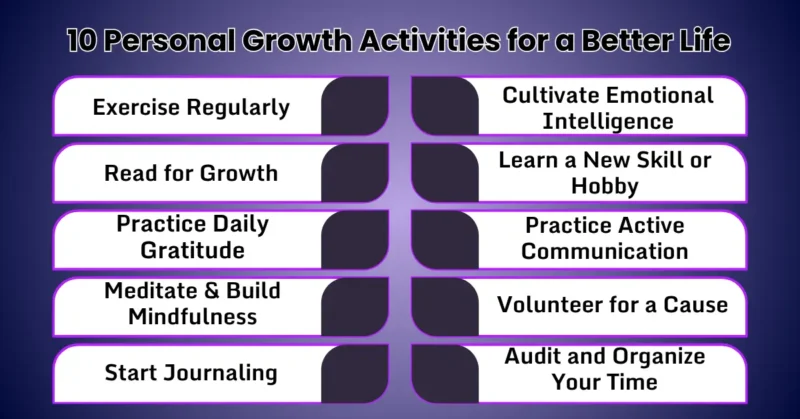
Here are 10 powerful personal growth activities to transform your daily life:
- Exercise regularly
- Read for growth
- Practice daily gratitude
- Meditate and build mindfulness.
- Start journaling
- Cultivate emotional intelligence
- Learn a new skill or hobby.
- Practice active communication
- Volunteer for a cause
- Audit and organize your time
You do not need to start all 10 at once. Choose one or two that match your current needs and build from there.
Why Personal Growth Activities Matter for a Better Life
Personal growth is about becoming better able to handle your everyday life, not becoming a completely different person.
Small improvements can shape how you handle stress, make decisions, communicate with others, and work toward meaningful goals.
Research on well-being interventions also suggests that activities such as exercise, mindfulness, and positive psychology practices can support adult well-being.
The key is consistency. Motivation may help you start, but habits make positive changes easier to maintain.
10 Powerful Personal Growth Activities for a Better Life
1. Exercise Regularly
What it is: Move your body through workouts, walking, dancing, cycling, swimming, or sports.
How to start: Aim for a realistic amount of movement you can repeat. Even a 20-minute walk can be a useful starting point.
Why it helps: Regular physical activity supports physical and mental well-being and can become a foundation for other healthy habits. Research comparing well-being interventions shows consistent benefits from exercise, though results vary by individual.
Personal growth benefit: Better energy, confidence, stress management, and discipline.
2. Read for Growth
What it is: Spend 15–30 minutes reading about psychology, history, biographies, personal development, career skills, or subjects you want to understand better.
How to start: Choose one useful book and read a few pages every day instead of trying to finish it quickly.
Why it helps: Reading exposes you to different ideas, experiences, and perspectives. It can also encourage you to question old assumptions and think more deeply.
Personal growth benefit: Greater knowledge, broader perspective, and continuous learning.
3. Practice Daily Gratitude
What it is: Write down or mentally identify three things you appreciate each day.
How to start: At the end of your day, answer:
- What went well today?
- Who helped me?
- What small thing made my day better?
Researchers have studied gratitude practices to support mental well-being, though results can vary depending on the type and length of the intervention.
Personal growth benefit: A more balanced mindset and greater appreciation for the positive parts of your life.
4. Meditate and Build Mindfulness
What it is: Spend a few quiet minutes focusing on your breathing and observing your thoughts without reacting immediately.
How to start: Begin with five minutes. Sit comfortably, breathe normally, and gently return your attention to your breath whenever your mind wanders.
Mindfulness-based programs have shown small to moderate improvements in psychological distress in research studies.
Personal growth benefit: Better self-awareness, emotional regulation, and ability to pause before reacting.
5. Start Journaling
What it is: Write down your thoughts, daily wins, challenges, goals, or lessons.
How to start: You do not need a perfect journal. Spend five minutes answering one question, such as:
What did I learn about myself today?
You can also use journaling to identify repeated worries, habits, and situations that affect your mood.
Personal growth benefit: Greater self-awareness, emotional processing, and accountability.
6. Cultivate Emotional Intelligence
What it is: Learn to recognize, understand, and manage your emotions while becoming more aware of how other people feel.
How to start: Before responding during a difficult conversation, pause and ask:
- What am I feeling?
- What caused this reaction?
- What might the other person be feeling?
- What response would actually help?
Personal growth benefit: Better emotional control, empathy, conflict management, and relationships.
Emotional intelligence does not mean hiding difficult emotions. It means recognizing them and responding thoughtfully rather than automatically.
7. Learn a New Skill or Hobby
What it is: Choose something outside your normal routine, such as learning a language, cooking, photography, coding, painting, gardening, or playing an instrument.
How to start: Give yourself 20–30 minutes a few times a week.
Do not choose something simply because it looks impressive. Choose something you genuinely want to understand or enjoy.
Personal growth benefit: Greater confidence, curiosity, adaptability, and a sense of accomplishment.
Learning also reminds you that being a beginner is normal. You don’t have to be good at something to enjoy it.
8. Practice Active Communication
What it is: Listen carefully before responding and express your thoughts clearly, respectfully, and honestly.
How to start: During your next conversation, put your phone away, avoid interrupting, and ask a follow-up question before sharing your own opinion.
You can also practice saying what you need without blaming the other person.
Instead of:
“You never listen to me.”
Try:
“I feel unheard when I cannot finish explaining my point.”
Personal growth benefit: Fewer misunderstandings, stronger relationships, greater empathy, and improved communication at work and home.
9. Volunteer for a Cause
What it is: Give some of your time, skills, or effort to a community organization, charity, school, religious organization, or local cause.
How to start: Start small. You might volunteer for one event, help someone in your community, mentor someone, or contribute a skill you already have.
Research has found associations between volunteering and outcomes such as well-being, life satisfaction, social connection, and purpose. However, the evidence is not uniform, and volunteering is not a guaranteed mental-health treatment.
Personal growth benefit: Greater empathy, connection, purpose, and awareness of needs beyond your own.
10. Audit and Organize Your Time
What it is: Look honestly at how you spend your day and decide whether your activities match your priorities.
How to start: For three days, write down where your time goes. Then identify:
- One activity to reduce
- One distraction to remove
- One important task to prioritize
- One healthy activity to schedule
You may discover that the problem isn’t a lack of time but too many competing priorities.
Personal growth benefit: Greater clarity, productivity, focus, and control over your daily routine.
Personal Growth Activities Comparison Table
| If you want to improve… | Try this activity | Start with |
| Physical and mental well-being | Exercise | 20-minute walk |
| Knowledge and perspective | Reading | 15 minutes daily |
| Positive mindset | Gratitude | List 3 good things |
| Stress and awareness | Mindfulness | 5 minutes of breathing |
| Self-awareness | Journaling | One question per day |
| Emotional control | Emotional intelligence | Pause before reacting |
| Confidence and learning | New skill | Practice 20 minutes |
| Relationships | Active communication | Listen without interrupting |
| Purpose and connection | Volunteering | Help with one local cause |
| Productivity and clarity | Time audit | Track 3 days |
Try This 30-Day Personal Growth Activities Challenge
You do not need to change your entire life in one week. Use the following 30-day challenge to introduce these personal growth activities gradually.
Week 1: Know Yourself
Day 1: Write three personal strengths.
Day 2: Journal about one area you want to improve.
Day 3: Write three things you appreciate.
Day 4: Try five minutes of mindfulness.
Day 5: Take a 20-minute walk.
Day 6: Read for 15 minutes.
Day 7: Review what you learned about yourself.
Week 2: Build Better Habits
Day 8: Choose one new skill to learn.
Day 9: Practice it for 20 minutes.
Day 10: Exercise or take a longer walk.
Day 11: Write down one difficult emotion you experienced.
Day 12: Practice responding instead of reacting.
Day 13: Read for 20 minutes.
Day 14: Review your progress.
Week 3: Improve Your Relationships and Well-Being
Day 15: Have one distraction-free conversation.
Day 16: Listen more than you speak during an important conversation.
Day 17: Write down three things you’re grateful for.
Day 18: Practice mindfulness for five to ten minutes.
Day 19: Do something kind for another person.
Day 20: Exercise in a way you enjoy.
Day 21: Write about the people who support you.
Week 4: Create More Purpose
Day 22: Track how you spend your time.
Day 23: Remove one unnecessary digital distraction.
Day 24: Identify your three most important priorities.
Day 25: Spend time learning your chosen skill.
Day 26: Find one way to volunteer or help someone.
Day 27: Journal about what gives your life meaning.
Day 28: Exercise and practice gratitude.
Day 29: Review your biggest changes.
Day 30: Choose three habits you want to continue.
The goal is not to complete the challenge perfectly. The goal is to discover which activities genuinely improve your daily life.
Common Mistakes That Can Block Personal Growth

Trying to Change Everything at Once
Starting ten new habits on Monday may feel exciting, but maintaining them can become overwhelming.
Choose one or two activities first. Once they become easier, add another.
Comparing Your Progress With Others
Personal growth is not a competition. Someone else’s career, fitness level, confidence, or lifestyle does not tell you how quickly you should progress.
Instead, compare your current habits with your previous ones.
Expecting Immediate Results
Some changes are noticeable quickly, while others take weeks or months. Give yourself enough time to build consistency.
Turning Self-Improvement Into Self-Criticism
Personal growth should not become another reason to feel inadequate.
You can work toward improvement while accepting that you are still learning.
How to Build a Daily Personal Growth Routine
You do not need to perform all ten activities every day. A simple routine is more sustainable.
Morning 15-Minute Mindset and Mindfulness Stack
Try this three-part routine:
- 5 minutes: Sit quietly and practice mindful breathing.
- 5 minutes: Write your most important task or intention for the day.
- 5 minutes: Identify one action that supports your physical or emotional well-being.
For example, your intention might be, “Today I will respond rather than react when I feel stressed.”
Weekly Reflection for Transformation and Habit Tracking
Choose one day each week to review your progress. Ask:
- What worked this week?
- What did not work?
- Which habit felt easy to maintain?
- What situation challenged me?
- What is one change I want to make next week?
Track behaviors rather than judging yourself. Missing one day does not erase your progress.
What Experts Say About Personal Growth
Psychology Research on Resilience, Self-Awareness, and Fulfillment
Psychology does not suggest that one activity will transform everyone’s life: individual circumstances, relationships, environment, personality, and mental health shape personal growth.
Research on resilience shows that people can develop adaptive coping skills and social resources. Research on self-compassion also suggests that treating yourself with greater understanding is not simply self-indulgence; it may support well-being and resilience.
Meaning and purpose are also important areas of psychological research. Positive psychology views relationships, meaning, engagement, accomplishment, and positive emotions as parts of well-being, rather than reducing a good life to constant happiness.

Therapist Perspective and Mental Health Disclaimer
A useful therapeutic perspective focuses on realistic, values-based change rather than demanding perfection from yourself.
If journaling, mindfulness, or goal setting brings up intense distress, trauma memories, persistent hopelessness, or overwhelming anxiety, self-help activities may not be enough.
If emotional problems are ongoing or interfere with relationships, employment, sleep, or day-to-day functioning, think about consulting a licensed mental health professional.
Medical and mental health disclaimer: This article provides general educational information and is not a substitute for diagnosis, treatment, or individualized advice from a qualified healthcare professional.
Personal growth activities can support well-being, but they should not replace professional care when it is needed.
FAQs: Personal Growth Activities for a Better Life
Q. What are 10 ways to improve my life?
- Exercise regularly to protect your physical and mental well-being.
- Read for growth and learn from new ideas and experiences.
- Practice gratitude to build a more positive mindset.
- Meditate and practice mindfulness to become more aware of your thoughts and emotions.
- Journal regularly to understand yourself and track your progress.
- Develop emotional intelligence to manage emotions and improve relationships.
- To build confidence and keep growing, pick up a new interest or skill.
- Practice active communication by listening carefully and expressing yourself clearly.
- Volunteer or help others to build connection, empathy, and purpose.
- Organize your time so your daily actions match your priorities.
Q. What are the 10 most important life skills?
The 10 most important life skills are communication, emotional intelligence, critical thinking, problem-solving, time management, adaptability, financial management, decision-making, self-awareness, and relationship-building.
Developing these skills can help you handle everyday challenges, make better decisions, and build stronger personal and professional relationships.
Q. What are 7 tips for personal growth?
- Know yourself and identify areas you want to improve.
- Set clear and realistic goals.
- Build small daily habits instead of seeking overnight change.
- Keep learning through books, courses, experiences, and new skills.
- Learn from mistakes rather than being discouraged by them.
- Surround yourself with supportive and positive people.
- Regularly assess your progress and modify your objectives as necessary.
Q. What are 5 self-care activities?
Five simple self-care activities are regular exercise, getting enough sleep, practicing mindfulness, spending time with people you care about, and taking breaks from digital devices.
Self-care doesn’t have to be expensive or complicated; the goal is to support your physical, emotional, and mental well-being regularly.
Q. What are the 10 Golden Rules of Life?
There is no single official list of the “10 Golden Rules of Life.” However, useful principles include:
- Treat others with respect.
- Be honest with yourself and others.
- Take responsibility for your choices.
- Keep learning throughout life.
- Protect your health and well-being.
- Use your time wisely.
- Learn from your mistakes.
- Set healthy boundaries.
- Help others when you can.
- Focus on what you can control, not what you cannot.
Q. What are the 7 life-changing habits?
Seven habits that can support meaningful long-term change are regular exercise, daily reading or learning, gratitude, mindfulness, journaling, healthy communication, and intentional time management.
The key isn’t doing them perfectly, but practicing them consistently until they become a natural part of your routine.
Final Takeaway on Personal Growth Activities
Small Activities, Big Better Life
A better life rarely comes from one dramatic decision. It is usually shaped by the small choices you repeat: reflecting on your experiences, caring for your body, protecting your boundaries, learning new things, nurturing relationships, and acting according to your values.
Choose one or two personal growth activities that genuinely fit your life. Give them time, adjust when necessary, and treat setbacks as information rather than failure.
Personal growth is not about becoming a different person overnight—it is about becoming more aware, capable, resilient, and intentional over time.
For personal growth, it is also important to join:
Online Courses and Workshops: Gaining Practical Skills
The digital age has made learning more accessible than ever. Online courses and workshops offer structured education in subjects ranging from technical skills to personal development.
Best Online Learning Platforms
edX: Features professional and academic courses from top universities.
Coursera: Offers university-level courses in business, technology, and the humanities.
Udemy: Provides affordable courses on many topics, from coding to creativity.
Skillshare: Focuses on creative skills like graphic design, writing, and photography.
LinkedIn Learning: Specializes in career-oriented courses, including leadership and communication.
Write more articles on Health and Wellness Tips.