

Working shifts can make healthy habits surprisingly difficult. Your workday may begin when everyone else is going to bed or finish just as the rest of the world is starting its morning.
That changing schedule can leave little room for exercise.
Cycling can offer a practical solution. You can ride outdoors when your schedule allows or use a stationary bike at home when you have only 10 or 20 minutes. Regular physical activity supports cardiovascular, mental, sleep, and metabolic health, and cycling can count toward your weekly aerobic activity.

For shift workers, however, the goal should not be to squeeze a hard workout into every spare minute. Sleep, recovery, and safety matter too. Recent research on exercise specifically in shift workers is promising, but the evidence is still developing, and individual responses vary.
Quick Summary
- Cycling can improve cardiovascular fitness.
- It can help you stay active despite a changing schedule.
- Indoor cycling can save valuable travel time.
- Regular activity may support sleep and mental well-being.
- Cycling can help with weight and metabolic health.
- Short rides can be useful when your schedule is packed.
- Don’t ignore sleep deprivation just to get a workout in.
What Is Cycling, and Why Is It Useful for Shift Workers?
Cycling is an aerobic exercise you can do on a traditional bicycle, stationary bike, or indoor cycling bike.
For shift workers, its biggest advantage may be flexibility.
You don’t have to wait for a gym class or spend an hour traveling to a workout. A stationary bike can be ready whenever you are. Even a short ride can help you replace some sedentary time with movement.
Cycling can also be adjusted easily. You might take a gentle 10-minute ride when you’re tired or do a longer, more challenging session when you have slept enough and feel energetic.
That flexibility matters when your work schedule changes from mornings to evenings or overnight shifts.
12 Cycling Benefits for Shift Workers
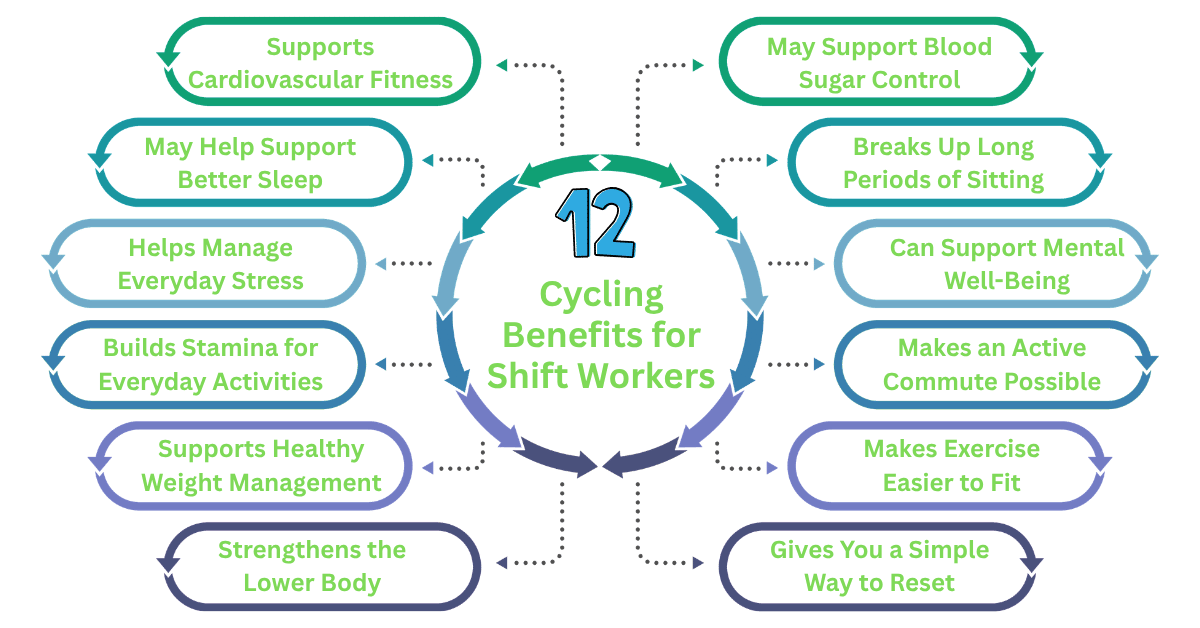
1. Supports Cardiovascular Fitness
Cycling gets your heart and breathing rate up without requiring complicated equipment.
Regular aerobic activity can strengthen cardiovascular fitness and contribute to overall heart health. The World Health Organization recommends that adults accumulate 150–300 minutes of moderate aerobic activity per week, or the equivalent amount of vigorous activity.
You don’t have to reach that amount immediately.
If you are currently inactive, start with manageable rides and gradually increase your time.
2. May Help Support Better Sleep
Sleep is one of the biggest challenges for many shift workers.
Exercise may help, although research specifically involving shift workers is still limited. A 2026 systematic review of randomized trials found that most included studies reported improvements in at least one sleep outcome, but the researchers also noted substantial differences between studies and concerns about bias.
Timing matters too.
A post-shift ride may work well for some people, while exercising immediately before intended sleep could make others feel more alert. Shift-worker sleep guidelines recommend regular exercise, timed to fit the person’s roster and lifestyle.
3. Helps Manage Everyday Stress
A demanding shift can leave your mind running long after work ends.
Cycling gives you a chance to step away from work for a while. An easy ride can provide a change of scenery and something to focus on besides your job.
Outdoor cycling may feel particularly refreshing after spending hours indoors.
You don’t need to ride hard to get this benefit. Sometimes a comfortable pace is exactly what you need.
4. Builds Stamina for Everyday Activities
Regular cycling can improve your ability to sustain physical activity.
That may be useful if your job involves standing, walking, lifting, or moving around for long periods.
Even office-based shift workers can benefit from building better general fitness.
Start slowly if you’re not used to exercise. Your body needs time to adapt, especially when your work schedule already strains your recovery.
5. Supports Healthy Weight Management
Irregular schedules can make healthy eating and regular exercise harder to maintain.
Cycling adds physical activity to your week and can contribute to energy expenditure. Over time, combining regular movement with a balanced eating pattern can support healthy weight management.
But don’t use cycling as a reason to severely restrict food.
Your body still needs enough energy and nutrients to cope with work, exercise, and recovery.
6. Strengthens the Lower Body
Cycling repeatedly works your legs, including the quadriceps, hamstrings, calves, and glutes.
Increasing resistance or riding uphill can make the muscles work harder.
Indoor cycling also lets you adjust resistance without worrying about traffic or road conditions.
For balanced fitness, however, don’t rely on cycling alone. Adding upper-body and core strength exercises can give you a more complete routine.
7. May Support Blood Sugar Control
Physical activity helps muscles use glucose for energy and can improve insulin sensitivity.
That makes regular movement an important part of a healthy lifestyle, particularly for people concerned about metabolic health.
Cycling after a meal may also be a practical way to add movement to your day when your schedule permits.
If you take insulin or medication that can cause low blood sugar, talk with your healthcare professional about exercising safely and monitoring your glucose.
8. Breaks Up Long Periods of Sitting
Not every shift worker has a physically demanding job.
Many people spend hours sitting at a desk, driving, monitoring equipment, or working at a computer.
Long-term sedentary behavior is linked to worse health outcomes; replacing some sitting time with activity can help.
A short indoor cycling session can be an easy way to add movement when you don’t have time for a full workout.
Even on busy days, something is often more realistic than nothing.
9. Can Support Mental Well-Being
Your mental health deserves attention when your work schedule is unpredictable.
In the overall adult population, physical activity is linked to improved mental health, including a decrease in anxiety and depressive symptoms.
Riding a bike might also provide you with time away from the demands of your job.
You might listen to music, enjoy the outdoors, or simply ride without distractions.
If you’re experiencing persistent low mood, severe anxiety, or other mental-health symptoms, exercise should complement, not replace, appropriate professional support.
10. Makes an Active Commute Possible
If you live close enough to your workplace and have a safe route, cycling can turn your commute into exercise.
Instead of finding extra time for a workout, you combine transportation with physical activity.
This can be especially useful for people who feel they have “no time” to exercise.
However, shift workers need to consider road visibility and fatigue carefully. Cycling home after a long overnight shift may not be safe if you are extremely sleepy.
Your safety comes first.
11. Makes Exercise Easier to Fit Around Rotating Shifts
A fixed workout schedule can be difficult when your working hours change every few days.
Cycling is easier to adapt to.
You can ride before a day shift, after an evening shift, or during a free period on a day off.
If your schedule changes frequently, think in terms of weekly activity rather than a perfect daily routine.
That approach gives you more flexibility without making exercise feel like another job.
12. Gives You a Simple Way to Reset After Work
A shift can leave you feeling mentally stuck in work mode.
A gentle cycle can help you transition between work and personal time.
For some people, a short ride after work provides enough space to unwind before returning home.
For others, especially after an overnight shift, sleep may be the better choice.
The right decision depends on your fatigue, shift timing, health, and normal sleep pattern.
Indoor Cycling Benefits and Disadvantages for Shift Workers

When time is limited, indoor cycling can be one of the most convenient options.
You don’t need to travel to a cycling route. You don’t have to wait for good weather. And you can exercise at home at almost any hour.
A stationary bike can also make short workouts practical. Ten or 15 minutes may be enough to get moving when a longer session simply isn’t possible.
Benefits of Indoor Cycling
- Saves travel time
- Works in almost any weather
- Can be used day or night
- Easy to adjust resistance
- Convenient for short workouts
- Provides privacy
- Can fit around rotating shifts
- Makes it simpler to keep up a regular exercise routine
Disadvantages of Indoor Cycling
- Buying a bike can be expensive
- Repeated sessions may feel boring
- You miss the outdoor scenery
- Some people find stationary cycling less motivating
- It can be tempting to exercise too intensely when you’re already exhausted
For shift workers, the biggest advantage is simple: the bike is available when your schedule is not predictable.
What Is the Best Time to Cycle When You Work Shifts?
No single cycling time works for every shift worker.
Your best time depends on your roster, sleep period, commute, fitness level, and how your body feels.
Day-Shift Workers
You might cycle before work if you wake feeling rested. An after-work ride can also work well if exercise doesn’t interfere with your evening routine.
Evening-Shift Workers
A morning or early-afternoon ride may give you more time before work.
Avoid sacrificing sleep simply to fit in a workout.
Night-Shift Workers
You may prefer to exercise after waking and before your shift. This can give you time to move while you’re relatively fresh.
A post-shift ride may work for some people, but if you’re extremely sleepy, heading home safely and getting adequate sleep should take priority.
Rotating-Shift Workers
Instead of forcing the same workout time every day, adjust your cycling around each shift.
Shift-worker sleep guidance recommends prioritizing sleep and fitting exercise around your actual roster and lifestyle.
How Long Should a Shift Worker Cycle?
You don’t need to begin with a long ride.
Try this simple approach:
10 minutes: A useful option for a very busy day.
15–20 minutes: A realistic short indoor session.
20–30 minutes: A moderate workout when you have more time.
30–45 minutes: A longer session when you’re rested and ready.
Over time, you can work toward the general adult activity target of 150–300 minutes of moderate activity per week if that is appropriate for you.
But remember that more is not always better on a sleep-deprived day.
A Simple Cycling Plan for Shift Workers
Your routine does not need to be complicated.
On a Busy Workday
Try a 10–15-minute easy-to-moderate indoor ride.
On a Normal Workday
Aim for around 20–30 minutes at a comfortable moderate intensity.
On a Day Off
If you’re well rested, you can take a longer outdoor ride or complete a more structured indoor session.
After Several Night Shifts
Give recovery serious attention.
If you are exhausted, prioritize sleep rather than trying to “make up” for missed workouts.
Recent research suggests that fatigue and irregular schedules are important barriers to exercise adherence among shift workers.
Cycling Safety for Shift Workers
Cycling while severely sleep-deprived deserves extra caution.
Fatigue can affect alertness and reaction time, which matters even more when you’re cycling in traffic.
Keep these points in mind:
- Wear a properly fitted helmet.
- Use front and rear lights when riding in darkness.
- Wear reflective clothing when visibility is poor.
- Choose safer routes whenever possible.
- Carry water for longer rides.
- Eat appropriately around longer sessions.
- Check the weather before outdoor rides.
- Avoid cycling if you are too tired to ride safely.
- Allow time to cool down and recover.
Night-shift workers should be especially careful when commuting home after a long shift.
If your eyes feel heavy, your concentration is poor, or you are struggling to stay alert, don’t turn fatigue into a safety risk just to complete a workout.
Common Cycling Mistakes Shift Workers Should Avoid
Trying to Exercise on Too Little Sleep
Don’t repeatedly sacrifice sleep for exercise.
Shift-worker sleep guidelines emphasize prioritizing adequate sleep and creating a schedule around the roster.
Doing Every Ride at Maximum Intensity
You don’t need hard workouts every time.
Mix easy rides with more challenging sessions.
Waiting for the “Perfect” Time
Your schedule may never be perfect.
A short ride can be a better option than waiting for a free two-hour block.
Ignoring Recovery
If your legs are tired and your sleep has been poor, an easy day may be exactly what your body needs.
Forgetting About Strength Training
Cycling is excellent aerobic exercise, but adding resistance training can help create a more balanced fitness routine.
Using Exercise to Compensate for Poor Sleep
A workout cannot erase chronic sleep deprivation.
Exercise and sleep should support each other, not compete.
When Should You Skip Cycling?
Some days, rest is the healthier choice.
Consider skipping or postponing your ride if you are severely sleep-deprived, unwell, injured, dizzy, unusually weak, or otherwise unable to exercise safely.
If you have a medical condition, have been inactive for a long time, or plan to begin vigorous exercise, speak with your healthcare professional about an appropriate starting point.
This is particularly important if you take medications that affect blood pressure or blood glucose.
FAQs About Cycling for Shift Workers
Q. Is cycling good for people who work night shifts?
Yes, cycling can be a useful way for night-shift workers to stay physically active. Regular exercise is associated with benefits for cardiovascular health, mental well-being, and sleep. However, studies on exercise in shift workers remain limited, so the routine should be individualized.
Q. Is it better to cycle before or after a night shift?
There is no universal answer.
Cycling before a night shift may suit someone who wakes feeling rested and wants to exercise before work. A post-shift ride may work for another person, but if you’re very sleepy, sleep and a safe journey home should take priority.
Q. Can cycling help shift workers sleep better?
It may help. A 2026 systematic review found that most of the randomized trials it examined reported improvement in at least one sleep outcome after exercise, although the studies were small and varied considerably.
Q. How long should a shift worker cycle each day?
No daily duration is necessary. Build your weekly exercise gradually, starting with what you can handle. The general adult recommendation is 150–300 minutes of moderate aerobic activity per week, but your personal starting point may be much lower.
Q. Is indoor cycling good for shift workers?
Yes. Indoor cycling can be particularly convenient because you can exercise without traveling to a cycling route or depending on weather. It also makes short sessions easier to fit around unpredictable work schedules.
Q. Can cycling help with weight gain caused by shift work?
Cycling can increase physical activity and energy expenditure, which may support weight management when combined with an appropriate eating pattern. However, many factors influence weight changes, including sleep, diet, medications, genetics, and overall activity.
Final Thoughts
Shift work can make healthy routines feel harder than they need to be.
Your schedule changes. Your sleep may be interrupted. Some days you may have plenty of energy, while other days you may simply want to get home and sleep.
Cycling gives you flexibility.
You can ride outdoors, use an indoor bike, cycle for 10 minutes, or take a longer ride when your schedule allows. The important thing is not to turn exercise into another source of pressure.
Ride when you can, recover when you need to, and build a routine that respects your work schedule and your sleep.
For a shift worker, consistency does not have to mean doing the same workout at the same time every day. It can simply mean finding realistic opportunities to move.
Read more health tips.