
Before I sat down to write this very post, I felt a sudden, overwhelming urge to go do laundry. The hamper was right there. It felt urgent.
Thank you for reading this post, don't forget to subscribe!I also experienced a heavy feeling in my stomach and a small pressure in my chest.
My brain was whispering that I needed a snack, or maybe I should just check my email really quickly.
We have all been there. You sit down to do something that matters, and suddenly, every other task in the world feels incredibly important. You feel paralyzed by a heavy “ugh” feeling.

It is okay to feel stuck. If you are a high achiever, a tired parent, a creative person, or someone who is just plain worn out from the grind, you probably know this feeling well.
You might think this resistance means you are lazy or broken.
But what if resistance is not your enemy? What if it is actually a compass?
Read Time: ~15 minutes
Quick Summary
That “ugh” feeling is not your enemy.
Resistance often shows up when something matters.
You don’t need to fight it. You can sit with it.
Small steps beat big pressure.
Kindness works better than force.
The Quiet Truth About That “Ugh” Feeling
There’s a moment I know too well. I sit down to work, everything is ready, and suddenly I feel like doing anything else.
Checking my phone. Making tea. Cleaning something that didn’t matter five minutes ago.
It used to make me feel lazy, as if something were wrong with me, but over time I realized that what we often call laziness is actually just a reluctance to do things because of the effort involved, as Neel Burton explains.
This feeling didn’t show up during easy tasks. According to a report by Elena Torres, developing a resilient mindset, considered the foundation of warrior philosophy, became the key for me when the work truly mattered.
That realization changed everything for me. Resistance isn’t a flaw. It’s often a signal. It shows up when you’re stepping outside comfort, not when you’re staying safe.
So instead of fighting it, I started doing something different. I began to sit with it.
A New Way to See Resistance
Most of us were taught to push harder. We were told that discipline solves everything.
And sometimes it does, but it comes at a cost, especially if you’re already tired.
There’s another way. A quieter one. Instead of forcing yourself through resistance, you can learn to understand it.
This doesn’t make you weak. It makes you aware. And awareness changes how you work, how you feel, and how you move forward.
The Top 5 Zen Secrets to Befriending Your Inner Resistance
I have ranked these five secrets from the most basic physical step to the most advanced mindset shift. I invite you to read them slowly.
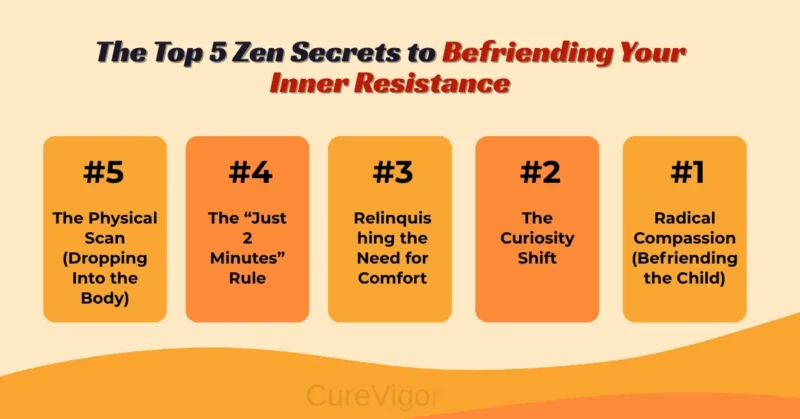
Notice which one makes you take a deep breath. That is probably the one you need most right now.
We’ll start simple and move deeper. You don’t need to master all of these. Just try one at a time.
#5 The Physical Scan (Dropping Into the Body)
Most people try to fight resistance in their heads. They use logic. They tell themselves, “I have to do this to get paid,” or “If I finish this now, I can relax later.”
But resistance does not live in your logical brain. It lives in your body.
Zen teaches us to drop out of our racing thoughts and into our physical form. When you feel the urge to run away from your task, your body gives you clues.
For me, it is a tightness in my chest. For you, it might be a knot in your stomach, shallow breathing, or a tense jaw.
The Benefit: When you locate the feeling in your body, you stop the mental spiral. You move from “I am terrible at this” to “I am noticing a tight feeling in my chest.”
The Challenge: It feels very uncomfortable to sit still while a bad feeling persists. Your brain will beg you to pick up your phone or walk away.
Practical Advice: The next time you feel the urge to check your phone instead of working, stay still for just 30 seconds. Do not look at the screen.
Do not think about the task. Just feel the physical urge to leave. Where is it? Is it hot or cold? Does it have a shape? Just watch it. You do not have to fix it.
#4 The “Just 2 Minutes” Rule
Resistance thrives on the size of your task. If you look at a huge project, you see resistance building a massive wall in front of it. It makes the task look monstrous and impossible.
When I sat down to “write a blog post,” I immediately encountered opposition. The task was too big. My brain didn’t know where to start, so it chose to do nothing.
The Benefit: Making the task incredibly small removes the fear. It lowers the barrier to entry so much that your scared brain cannot find a reason to argue with it.
The Challenge: Your inner high-achiever might tell you that two minutes is pointless. You might think, “Why even bother if I cannot finish it all right now?”
Practical Advice: Shrink the task until it feels tiny. Do not “write a blog post.” Just open the document and write one single sentence.
Do not “clean the whole kitchen.” Just put away three forks. The goal is not to finish the project. The goal is simply to break the seal.
Once you start, the resistance often evaporates on its own, and you might naturally keep going. If you stop after two minutes, that is a complete success.
#3 Relinquishing the Need for Comfort
This secret is a big mindset shift. We often resist starting because we have a hidden rule.

We believe we need to feel good, inspired, or energized to do our work. We think, “I will start as soon as I feel like it.”
But the truth is, you will rarely feel like doing hard things. Waiting for comfort is a trap.
The Benefit: When you let go of the need to feel good, you free yourself from waiting. You can take action even when you feel tired, grumpy, or bored.
The Challenge: Accepting discomfort runs counter to our modern culture. We are taught to seek comfort at all times. Feeling bad on purpose feels very wrong at first.
Practical Advice: When you sit down to work and feel that heavy “ugh” feeling, try using a simple mantra.
Say to yourself, “I am experiencing discomfort, and that is okay.” You do not need the discomfort to go away to start working.
You can let the discomfort sit in the room with you while you type or make that phone call. You are bigger than the discomfort.
#2 The Curiosity Shift
When resistance shows up, our first reaction is usually anger. We say, “I hate this feeling,” or “Why am I like this?” This just creates more tension.
Instead of getting mad, we can shift into a state of curiosity. We can approach our resistance like a gentle scientist observing an interesting bug.
The Benefit: Curiosity turns an enemy into a puzzle. It creates space between you and the feeling. You are no longer the feeling; you are the person studying the feeling.
The Challenge: It is hard to be curious when you are frustrated. It takes practice to pause your anger and choose wonder instead.
Practical Advice: When the wall of resistance appears, ask it a question. Ask, “What are you trying to tell me?”
Is it a fear of failure? Is it a fear of being judged by others? Is it just plain tiredness? Once you figure it out, name it.
I often say out loud, “Ah, there is my fear of not being perfect showing up again. Welcome back.” Naming it takes away its power.
#1 Radical Compassion (Befriending the Child)
This is the most advanced and powerful secret. The writer Leo Babauta often talks about the resisting mind as a childish mind. It is not trying to ruin your life.
It is just a young, scared part of you that wants to stay safe and avoid hard things.
Think about a real child who is scared to jump into a swimming pool. You would not scream at them. You would not call them lazy. You would kneel down, offer your hand, and comfort them.
The Benefit: Kindness melts resistance faster than any “hustle” tactic ever could. When you comfort yourself, your nervous system actually calms down. Your body stops fighting.
The Challenge: High achievers are usually very hard on themselves. Giving yourself a “mental hug” might feel silly, weak, or unnatural at first.
Practical Advice: When you notice yourself avoiding a task, pause. Imagine the scared part of you is a small child tugging on your shirt. Give yourself a mental hug.
Acknowledge that doing hard things is brave. Tell yourself, “I know you are scared of messing this up. It is okay to be scared.
I am going to do this with you.” This radical softness changes everything. You stop being a boss cracking a whip, and you become a kind leader holding a hand.
A Small Story
I didn’t feel like writing this article. There was a moment where I almost walked away to “check something.” You know how that goes.
Instead, I paused. I noticed the tension in my chest. I told myself I only had to write one sentence.
That sentence turned into another. Then another. Not because I pushed harder, but because I stayed.
Sometimes that’s all it takes.
Benefits of Befriending Resistance
When you stop fighting resistance, work feels lighter. Not easy, but less heavy.
You waste less energy judging yourself. Starting becomes easier. And over time, you begin to trust yourself more.
That quiet trust matters more than motivation.
The Challenges
This approach sounds calm, but it isn’t always easy. You will forget. You will fall back into old habits.
Some days, you will still avoid things. That’s part of being human.
The goal is not perfection. It’s returning again and again.
A Gentle Path Forward: Your Befriending Checklist
You do not need to do all of these secrets at once. I invite you to pick just one to experiment with this week. Here is a simple checklist to help you remember the steps when resistance visits.
- Notice your resistance at least once.
- Pause, even briefly.
- Make the task smaller.
- Allow discomfort instead of fighting it.
- Speak to yourself with some kindness.
- Notice the physical feeling in your body and stay still for 30 seconds.
- Shrink your task to just two minutes to break the seal.
- Tell yourself it is okay to feel uncomfortable while you work.
- Get curious and name what the resistance is actually afraid of.
- Offer a mental hug to the scared part of your mind.
If you do even one of these, you’re moving forward.
A Quick Recap
Resistance is not your enemy.
It often shows up when something matters.
Feel it instead of fighting it.
Start small to reduce pressure.
Allow discomfort.
Choose curiosity over judgment.
Practice kindness toward yourself.
The Gentle Start
Resistance doesn’t disappear. It comes back again and again.
But your relationship with it can change. You begin to perceive it as something you can sit with rather than as a wall.
Success is not about removing resistance. It’s about moving forward while it is still there.
Finally, if you’ve been feeling stuck, slow, or quietly frustrated with yourself, there’s nothing broken here. This is what it feels like to be human when something matters.
We often think the answer is more pressure. More discipline. More pushing. But if you’ve tried that, you already know where it leads. It works for a while, then it drains you.
What changes things is not force. It’s understanding.
When you pause and notice your resistance, you create space. When you make your work smaller, you make it possible.
When you allow discomfort, you stop waiting for the “perfect feeling” that never comes.
And when you treat yourself with even a little kindness, something softens. Not instantly. Not perfectly. But enough to take the next step.
That’s all this is really about.
Not becoming someone who never struggles.
Not removing resistance forever.
But learning how to stay… even when part of you wants to leave.
Some days you’ll forget all of this. You’ll scroll, delay, and avoid. That’s fine. The practice is not about getting it right every time.
It’s about returning.
Again and again.
So today, don’t try to fix everything. Don’t try to become a new person.
Just sit down.
Notice what you feel.
And take one small step anyway.
That’s how change actually happens. Quietly. Gently. And in a way that lasts.
FAQs
Q. What is inner resistance?
Inner resistance is the feeling that makes you avoid something you know matters. It can show up as procrastination, fear, doubt, or that heavy “I don’t feel like it” mood. It’s not laziness. It’s usually your mind trying to protect you from discomfort, risk, or change.
Q. How to deal with inner resistance?
Start by noticing it instead of fighting it. Pause, take a breath, and feel where it shows up in your body. Then make your task smaller so it feels easier to begin. Kindness works better than pressure, so speak to yourself gently and just take one small step.
Q. What is internal resistance in a person?
Internal resistance is the mental or emotional pushback you feel when facing a task or change. It comes from fear, uncertainty, or the need to stay comfortable. Even when you want to grow, this part of you tries to hold you back, keeping things safe.
Q. How to let go of inner resistance?
You don’t really “remove” it. You learn to sit with it. Accept that discomfort is part of doing meaningful things. When you stop fighting the feeling and let it be, it loses its hold, and you can move forward more easily.
Q. How to test internal resistance?
You can see it in your behavior. If you keep delaying, overthinking, or distracting yourself, resistance is likely present. You can also check your body for tension or unease when starting a task. These are simple signals that resistance is active.
Q. Is stress an internal resistance?
Stress and resistance are related but not the same. Stress is a broader feeling of pressure or overload. Resistance is more specific. It’s the urge to avoid something. Stress can increase resistance, but resistance can also exist without high stress.
Q. What reduces internal resistance?
Small actions help the most. Breaking tasks into tiny steps lowers pressure. Accepting discomfort instead of avoiding it also reduces resistance. Self-compassion, rest, and clear focus all make it easier to move forward without feeling stuck.
Q. What are five causes of internal stress?
Fear of failing, fear of being judged, overwhelm from too many duties, lack of clarity, and perfectionism are common factors. These create pressure inside the mind, which often leads to stress and resistance working together.
Q. What are the 4 types of internal forces?
In a simple sense, internal forces inside a person can be seen as thoughts, emotions, beliefs, and desires. Thoughts shape how you see things, emotions affect how you feel, beliefs guide your reactions, and desires push you toward or away from action.
Conclusion: Holding Hands with the Hard Stuff
I want to be honest with you. You will have to do this every single day. Resistance does not go away forever. Even after years of practising these Zen secrets, I still felt the urge to fold laundry before writing this post.
But my relationship with that feeling has completely changed. I no longer see it as a monster. I see it as a scared friend. I notice the tightness in my chest; I let it be there and gently start typing anyway.
You do not need to crush your procrastination today. You do not need to force yourself to work. You just need to soften.
Take a deep breath. Let your shoulders drop. Invite your resistance to sit next to you. Success is not the absence of resistance; it is the ability to act while holding resistance by the hand.
I would love to hear from you. Which of these five secrets felt like exactly what you needed to hear today?
Have you ever noticed where your resistance lives in your body? Drop a comment below and let us chat.
What does your resistance feel like these days? Share your experience below.
Read more Health and Productivity articles.
You might like: