

Learn how the 80 20 Rule can help you achieve a balanced life by focusing on what truly matters. Learn actionable steps to prioritize, reduce stress, and improve productivity with the Pareto Principle.
Thank you for reading this post, don't forget to subscribe!The Power of the 80 20 Principle
Why Being “Busy” is Often a Form of Laziness
We all know people who seem to be busy all the time yet never make meaningful progress. They rush from task to task, juggling work, family, and personal obligations.
Yet when you look more closely, most of their activities don’t move the needle much.
Being “busy” doesn’t necessarily mean being productive. In fact, it might just be a form of laziness—a way of avoiding the hard work of focusing on what truly matters.
The 80 20 Rule for Life Balance: How to Focus on What Truly Matters
This is where the Pareto Principle, or the 80 20 Rule, comes in. It teaches us that we can achieve more by focusing on less. By understanding the 80/20 Rule, we can eliminate the non-essential tasks and focus on the 20% of activities that yield 80% of the results.
Introducing the Pareto Principle (80% of Outcomes Come from 20% of Inputs)
The 80/20 Rule implies that 20% of causes account for 80% of outcomes. This principle, named after Italian economist Vilfredo Pareto, is found in countless areas of life, from business and economics to personal productivity and time management.
Whether it’s sales, customer satisfaction, or even your daily routine, the Pareto Principle applies everywhere.
For instance, 80% of your most meaningful relationships may come from just 20% of the people you interact with regularly. Likewise, the vast majority of your stress might come from just a few sources.
The Objective: Shifting from “Doing Everything” to “Doing the Right Things” for a Better Life Balance
The goal of applying the 80/20 Rule is simple: shift your focus from doing everything to doing the right things.
By focusing on the few activities that truly matter, you can achieve a better work-life balance, reduce stress, and become more productive—all while achieving greater happiness.
Understanding the 80 20 Rule for Life Balance
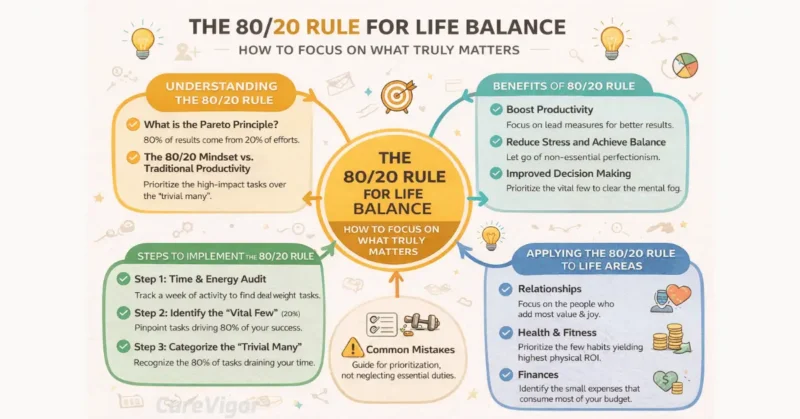
What is the Pareto Principle?
A Brief History and Why It’s a Universal Law of Nature and Business
The Pareto Principle was discovered in 1896 by Italian economist Vilfredo Pareto. He noticed that 80% of Italy’s land was owned by 20% of the population.
Over time, this principle was expanded to various industries and sectors, including business, economics, and productivity.
Today, it is widely applied across different fields, especially in business, where it has become a fundamental law of productivity. It suggests that, in nearly every situation, a minority of inputs or actions are responsible for the majority of results.
The 80 20 Mindset vs. Traditional Productivity
Why Traditional Time Management Often Fails by Treating All Tasks as Equal
Traditional time management and productivity strategies often treat all tasks as equally important. However, not all tasks are created equal.
Some tasks contribute significantly to your goals, while others are simply distractions.
The 80/20 mindset encourages us to focus on the small number of tasks (the 20%) that generate the majority of results (80%).
This change in viewpoint enables you to focus your energy on what really matters rather than squandering it on pointless activities.
Advantages of Living by the 80 20 Rule
Boost Productivity with the 80 20 Rule
How Focusing on “Lead Measures” Produces Exponential Results
When you apply the 80 20 rule, you’re focusing on the tasks that provide the highest returns.
By zeroing in on “lead measures”—activities that directly impact your results—you can produce exponential growth in both your personal and professional life.
For example, in business, focusing on the 20% of clients who generate 80% of your revenue is a classic application of the Pareto Principle.
The same applies to personal life—if exercise and diet are the 20% of activities that give you 80% of your health benefits, prioritize those.
Reduce Stress and Achieve Better Life Balance
Non-essential Perfectionism and Mental Health
The 80/20 rule’s capacity to reduce stress is one of its main advantages. By focusing on the activities that truly matter and letting go of perfectionism, you can stop over-committing yourself to unnecessary tasks.
This will help improve your overall mental health and allow for better life balance.
If you let go of trying to do everything perfectly and focus on what actually moves the needle, you will experience less overwhelm and more fulfillment.
Improved Decision Making
Using Prioritization to Clear the Mental Fog of Over-Commitment
Prioritizing the vital few (the 20%) over the trivial many (the 80%) clears your mental fog. With fewer, more impactful tasks on your plate, making decisions becomes easier.
You’ll spend less time weighing the trivial and more time focusing on the things that matter most.
6 Steps to Implementing the 80 20 Rule in Daily Life

Step 1: Conduct a Time and Energy Audit
The first step to mastering the 80 20 rule is taking stock of how you currently spend your time and energy. Start by tracking all your activities for a full week—everything from professional tasks to personal errands.
Use a time-tracking app or a simple journal to log every activity, noting the time spent and how much energy you feel you expended.
At the end of the week, take a close look at your entries. Which tasks made you feel productive and energized?
Which activities drained your energy without yielding significant results? These “dead weight” tasks can often be a hidden source of stress, leaving you exhausted without making meaningful progress.
Once you identify these, you’ll be in a much better position to shift focus.
Step 2: Identify Your “Vital Few” (The 20%)
After evaluating your time and effort, it’s critical to identify the 20% of tasks that yield 80% of your results. These activities align with your core values, long-term goals, and overall life satisfaction.
Whether it’s the hours you spend building a business, exercising, or spending quality time with loved ones, identify what truly drives your success and happiness.
The vital few are often not the most urgent tasks, but the ones that are strategically important for achieving your bigger goals. This is where the real value lies, so it’s crucial to give them the attention and resources they deserve.
Step 3: Categorize the “Trivial Many”
Now that you’ve identified your vital few, it’s time to recognize the trivial many—the 80% of tasks that consume your time but provide little value.
These are often tasks that might seem urgent but are actually distractions, such as replying to an endless stream of emails, attending unproductive meetings, or scrolling through social media.
While it’s impossible to eliminate all trivial tasks, categorizing them can help you understand which ones you can delegate, automate, or simply stop doing altogether.
For example, consider setting email filters or scheduling specific times to check messages. Recognizing and minimizing the time spent on these trivial tasks frees you up to focus on what truly matters.
Step 4: Practice Ruthless Prioritization
With your vital few and trivial many clearly defined, it’s time to put ruthless prioritization into action.
The 80/20 lens helps you see what truly deserves your attention and what can be let go. This is where most people falter: they continue to take on tasks that seem important in the moment but don’t significantly contribute to their long-term well-being or success.
Say “no” to tasks that don’t align with your goals. Create a habit of evaluating every new commitment by asking, “Will this help me achieve my priorities?” and “Is this part of my 20%?”
By focusing only on high-impact tasks, you prevent your time and energy from being scattered across meaningless activities. Over time, this discipline will lead to greater clarity and progress in all areas of your life.
Step 5: Optimize Your Environment for Deep Work
A significant aspect of applying the 80 20 Rule is optimizing your environment to support deep, uninterrupted work.
Create a setting that minimizes distractions and fosters focus. This could mean decluttering your workspace, turning off notifications, or setting up a designated time for deep work.
Time-blocking is a great technique to apply here—dedicate specific time blocks each day to work on your vital few tasks.
For instance, reserve your most productive hours in the morning for high-priority work, and limit access to emails or social media during these times.
By doing so, you will protect the precious time you allocate to your most important activities and avoid distractions that pull you away from meaningful progress.
Step 6: Weekly Review and Calibration
The final step to mastering the 80 20 Rule is committing to a weekly review and calibration. This is a key part of maintaining focus on your vital few and keeping your priorities aligned with your goals.
At the end of each week, review your activities and assess your progress. Did you focus on your vital few tasks? Were there new distractions that crept in? What worked well, and what needs adjustment?
This self-reflection process helps you stay on track and recalibrate as needed. If you notice that your time has been hijacked by trivial tasks again, this is your opportunity to adjust your strategy.
Keep your goals in sight and adjust your methods for the following week based on your observations. By consistently reviewing your time and tasks, you will build a habit of focusing on the most impactful actions.
Applying the 80 20 Rule to Different Life Areas
80 20 in Relationships
Focusing on the People Who Provide the Most Support and Joy
In relationships, the 80/20 rule can help you focus on the people who bring the most joy and support to your life.
Instead of overextending yourself to keep up with every acquaintance or connection, focus on building deep connections that genuinely enhance your life.
80 20 in Health and Fitness
Prioritizing the Few Habits (Sleep, Whole Foods, Consistency) That Yield the Most Physical ROI
The Pareto Principle might help you focus on behaviors that yield the best return on investment for fitness and health. Prioritize good sleep, whole foods, and regular exercise—these three areas will give you the most physical benefit.
80 20 in Finances
Identifying the Small Number of Expenses That Eat Most of Your Budget
In personal finance, the 80 20 rule helps you focus on eliminating the few expenses that eat up most of your budget. Identify your largest expenses, such as housing, transportation, and dining, and look for ways to optimize or eliminate them.
Common Mistakes with the 80 20 Rule
Avoid Misapplying the 80 20 Rule
One of the most common mistakes is misapplying the 80/20 rule. It’s important to remember that this rule is a guide—not a reason to neglect necessary tasks.
While you should prioritize the most impactful activities, don’t ignore the essential (but less exciting) responsibilities.
Over-Optimization and the Perfectionist Trap
Trying to 80/20 your 80/20 can lead to analysis paralysis. The goal is to simplify and prioritize, not over-optimize every aspect of your life. Don’t fall into the perfectionist trap of constantly seeking the “perfect” balance.
FAQs
Q. In practical life, what does the 80/20 rule mean?
It is said that in real life, 80% of your results come from 20% of your actions. Practically speaking, this means that most of your results come from a small percentage of your time, effort, or resources.
In personal finance, for instance, 20% of your expenses can account for 80% of your total spending.
Understanding this pattern enables you to focus on the areas that have the greatest influence on your life, improving your ability to set priorities and accomplish more without feeling overburdened by unimportant tasks.
Q. What is the 80-20 rule in life?
According to the 80-20 rule of life, also known as the Pareto Principle, 20% of your connections or behaviors account for 80% of your fulfillment, success, and pleasure.
This idea is applicable to many facets of life, including interpersonal connections and professional achievement. By identifying the activities or people that bring you the most satisfaction, you can focus more on them and reduce time spent on less rewarding pursuits.
This rule encourages efficiency and helps create a more balanced, meaningful life by prioritizing what matters most.
Q. How may the 80/20 principle be applied to critical thinking in the most effective way?
To apply the 80/20 approach to critical thinking, focus on identifying the crucial elements that most significantly influence your choices.
Rather than overloading yourself with too many pieces of information, look for the 20% of data, arguments, or insights that will help you solve the problem or make a well-informed decision.
By filtering out less significant details and zeroing in on the most essential aspects, you can streamline your thought process, avoid analysis paralysis, and reach a more effective, efficient conclusion.
Q. Does the 80/20 rule really work?
Yes, the 80/20 rule has been proven to work across various domains, from business and economics to personal productivity.
While the exact ratio may not always be 80/20, the principle that a small portion of causes leads to the majority of effects holds true in most situations. In business, it’s often observed that 20% of customers generate 80% of the revenue.
Similarly, in personal life, focusing on the few actions or relationships that yield the most value can dramatically improve your effectiveness and overall satisfaction.
A useful strategy for setting priorities and producing significant results is the 80/20 rule.
Q. What is the 7-8-9 rule?
The 7-8-9 rule is a productivity concept that suggests a balanced approach to work and life. It encourages spending 7 hours sleeping, 8 hours working, and dedicating the remaining 9 hours of your day to personal time, relationships, and activities that contribute to your well-being.
The idea behind this rule is that managing these three essential areas in harmony leads to greater productivity, better mental health, and greater overall satisfaction.
You can prevent burnout and preserve a positive work-life balance by following this well-balanced structure.
Q. What are 5 examples of the 80/20 rule?
- Business Revenue: In many businesses, 20% of the clients generate 80% of the revenue. Focusing on these high-value clients can maximize profitability.
- Personal Relationships: 20% of your relationships might provide 80% of your emotional support and happiness. Cultivating these meaningful connections can lead to a more fulfilling life.
- Productivity: 20% of your daily tasks are responsible for 80% of your results. Identifying and prioritizing these tasks can significantly increase your efficiency.
- Health: 20% of your fitness habits (like regular exercise and a balanced diet) account for 80% of your health benefits.
- Social Media: 20% of your social media posts may generate 80% of your engagement. You may focus on producing more of what works by understanding which material appeals to your audience.
These examples demonstrate how the 80/20 rule can be used to focus on the most important aspects of life, making it easier to maximize success and minimize unnecessary effort.
Conclusion: Focus on What Truly Matters
Reclaiming your time, increasing productivity, and leading a balanced life can all be achieved with the 80/20 rule.
By focusing on the vital few tasks that contribute the most to your goals and well-being, you can eliminate distractions and reduce stress.
Final Call to Action (CTA): Which 20% of your tasks will you focus on tomorrow? Share your top priority in the comments below.
Read more articles on Life-Balance.
You might like: