
Think about the last time you stood in a grocery line or sat in a waiting room without reaching for your phone. If the mere thought makes you twitch, you aren’t alone.
We’ve been conditioned to view “boredom” as a flaw—a productivity gap that must be filled with a notification, a scroll, or a podcast. But what if that restless silence is actually exactly what your brain is screaming for?

The truth is, your brain loves boredom. When you stop feeding it constant data, it switches into the “Default Mode Network”—a powerful neurological state in which deep processing, problem-solving, and self-reflection occur.
By constantly distracting ourselves, we aren’t just staying busy; we’re accidentally starving our best ideas. It’s time to stop fearing the quiet and start using it as a competitive advantage.
Here is why leaning into the “nothing” might be the most productive thing you do all day.
In my own life, I used to think boredom was a waste of time. Whenever I had a quiet moment, I would fill it with my phone, short videos, or random scrolling.
But I gradually noticed that my mind was becoming more crowded and my focus was weakening.
Later, I started giving myself a few minutes of quiet time without any screens, and that simple habit helped me feel lighter, think more deeply, and even come up with better ideas when I returned to my work.
Why Your Brain Loves Boredom?
Most people do not let their minds stay empty for long. The second life slows down, the hand reaches for the phone. A short wait in a line becomes scrolling time.
A quiet moment on the sofa becomes video time. A dull task becomes a reason to open another tab. We have trained ourselves to fear empty space, as if silence is wasted time.
But the brain does not work best when it is fed all day long. It also needs space. It needs moments with less noise, less input, and less pressure. That is where boredom comes into play.
Not the heavy kind that lasts for days and drains your mood. Not the painful kind that makes life feel flat. This article is about small, healthy moments of “nothing” that give the mind room to breathe.

That kind of boredom is often misunderstood. People think boredom means laziness, lost time, or lack of ambition. In reality, short periods of low stimulation can do something useful.
They can help the brain sort thoughts, join ideas, calm mental overload, and return to what matters. In a world full of alerts, clips, and endless updates, that may be one of the most valuable skills you can build.
This is also why the topic matters now more than ever. Modern life is designed to keep attention busy. Your phone, apps, and feeds are always ready to remove even the smallest hint of stillness.
The problem is that when every empty second gets filled, your mind loses the chance to rest in its own way. You become informed, amused, distracted, and drained at the same time.
So does the brain love boredom? Not exactly. It does not enjoy discomfort for no reason. But it does seem to need quiet, low-input time.
That is different from suffering through long, dull hours. Healthy boredom is not about doing less with your life. It is about giving your brain enough room to do its deeper work.
The Science of Why Your Brain Craves Boredom
Your brain does not stay inactive when life gets quiet. During downtime, it shifts into a different mode that supports reflection, memory, and mental reset.
This is where the Default Mode Network helps the mind recharge and process thoughts more deeply.
When you stop focusing on a task, your brain does not turn off. It changes gears. One of the most talked-about systems in this shift is called the Default Mode Network.

This network becomes more active when you are resting, daydreaming, remembering, reflecting, or letting your mind wander. In simple words, it helps the brain do inner work when the outside world gets quieter.
That inner work is more important than many people realize. During quiet moments, the brain can review past events, imagine future ones, test ideas, and connect thoughts that seemed unrelated before.
This is part of why people often get ideas in the shower, on a walk, or while staring out of a window. The brain is not idle in those moments. It is active in a softer, less forced way.
This network also plays a role in your sense of self. It is linked with memory, reflection, and the story you tell yourself about your life. That means downtime is not only useful for creativity.
It can also help you understand what you feel, what you want, and what is bothering you. When the outside noise decreases, the inner voice becomes easier to hear.
There is another side to this science as well. Attention is not meant to stay stretched tight all day. Focus takes energy.
Mental control takes effort. If your brain is always pushed from one input to another, it has less chance to reset.
This is one reason constant stimulation can feel tiring even when you are not doing hard physical work. Too much input can leave the mind full but not refreshed.
Boredom also works like a signal. It tells you that the current moment isn’t providing your brain with enough meaning, challenge, or engagement.
That signal is not always bad. Sometimes it is useful information. It may be telling you that a task needs a new approach, that your environment is too noisy, or that your mind needs a change in rhythm.
Boredom is not always a flaw in the moment. Sometimes it is feedback.
That is why healthy boredom deserves a second look. It is not magic, and it is not always pleasant. But it may create the mental space for reflection, recovery, and fresh thinking.
In a life built around constant reaction, that quiet space has become rare. The brain may not “love” boredom in the way people love fun or comfort. Still, it may depend on small doses of it more than we think.

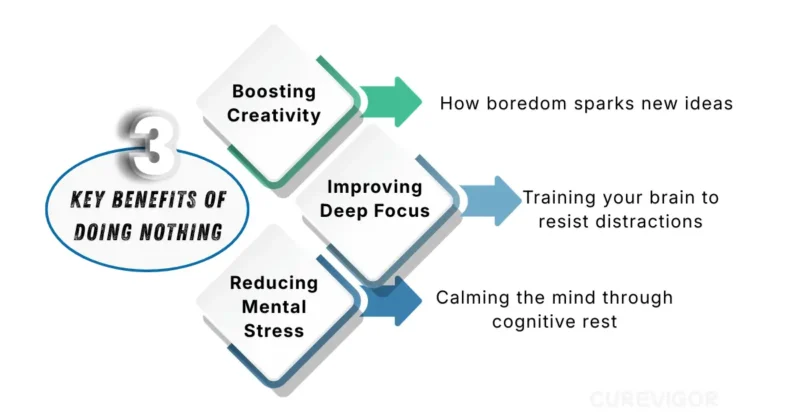
3 Key Benefits of Doing Nothing
Doing nothing may look unproductive, but it can help the brain in powerful ways. Small moments of boredom can boost creativity, sharpen focus, and reduce mental overload. In the right amount, quiet time becomes a tool for better thinking.
Boosting Creativity: How boredom sparks new ideas
Creativity does not only happen when you sit down and force it. Often, the best idea comes after you stop trying so hard.
It shows up while walking, waiting, cleaning, or doing simple household work. That is because creativity often flourishes in loose mental states, when the brain has enough space to move freely among memory, imagination, and problem-solving.
When you are constantly taking in content, your mind has less room to play with its own thoughts. It becomes a receiver, not a maker. Short moments of boredom can change that.
They remove some of the outside demand and allow your own thoughts to rise. A memory connects with a problem. A random thought joins with a new idea. A better sentence appears. A stuck answer starts to form.
This is one reason boring moments can quietly support original thinking. They do not hand you ideas on a plate.
They make room for ideas to arrive. Many people think they need more inspiration, but what they really need is less interruption.
When the brain is no longer busy reacting to the next clip, ping, or post, it can start exploring on its own.
That matters far beyond art or writing. Creativity helps in parenting, study, teaching, business, healing, and daily life.
It helps you solve problems, notice patterns, and find a better way forward. If you never allow your mind to wander, you may end up repeating the same thoughts again and again. Healthy boredom breaks that loop.
It gives the brain permission to think sideways, not just straight ahead.
There is also a simple truth here. New ideas need room. They rarely appear in a crowded mind. If every pause is filled, the mind stays full of borrowed noise.
But if you let yourself be a little bored, even for just 10 quiet minutes, the brain gets a chance to create rather than just consume. That shift is small, but it can change the quality of your thinking over time.
Improving Deep Focus: Training your brain to resist distractions
At first, boredom and focus seem like enemies. One feels restless and unpleasant. The other feels steady and strong. Yet boredom can actually help build focus.
This happens because every time you resist the urge to grab a quick distraction, you are training your attention. You are teaching the brain that not every moment of discomfort needs a fast reward.
Modern distraction habits are powerful because they work fast. A single moment of dullness leads to a screen check. A hard paragraph leads to a swipe. A quiet pause leads to another app.
These habits may seem small, but they teach the brain to expect novelty constantly.
Over time, that makes deep focus feel harder. The moment a task becomes slow, the mind starts begging for escape.
Healthy boredom interrupts that pattern. It helps you practice staying present when nothing flashy is happening. That skill matters because deep work is rarely exciting from start to finish.
Reading, writing, studying, planning, coding, and building all include slow parts. If your brain cannot handle those slow parts, it will keep looking for an exit before the real payoff begins.
This is why downtime can become attention training. Waiting without your phone is not just patience. Walking without audio is not just silence. Sitting with one task and no second screen is not just discipline; it’s a way of life.
These small acts help the brain grow stronger at staying with one thing. They widen your tolerance for low stimulation, which is one of the hidden keys to strong concentration.
In a practical sense, this means boredom can help you become less reactive. You start to feel the itch for distraction, but you don’t give in right away.
That is a big shift. It gives you more control over your attention, rather than letting your habits decide for you. Deep focus is not only about trying harder. It is also about not breaking your own attention every few minutes.
If you want a brain that can read longer, think deeper, and stay with meaningful work, then a little boredom may be part of the training.
Not because boredom is fun, but because it teaches endurance. It helps the mind stop panicking when the excitement level drops. That calm endurance is where real focus begins.
Reducing Mental Stress: Calming the mind through cognitive rest
Many people think rest only counts if it looks special. They think it must be a vacation, a spa day, or a perfect hour of peace. But the brain often responds well to much simpler things.
A few quiet minutes can lower the pressure created by nonstop input. When your mind is no longer handling messages, clips, updates, and tiny choices every second, it can slow down.
This matters because modern stress is not always loud. Sometimes it is hidden in mental clutter. You may not feel “stressed” in the classic sense, but your attention stays split all day.
One part is on work, another on your phone, another on unfinished tasks, and another on what you forgot to reply to. That scattered state can feel normal, yet it quietly drains you.
Healthy boredom can reduce this kind of overload. It gives the brain fewer things to process. It lets thoughts settle rather than stack up.
It creates a gentle form of cognitive rest, which means the mind is still awake but not under constant demand.
That kind of rest is useful because it is easy to fit into normal life. You do not need a perfect setting for it to work.
It is also important to say what this does not mean. Quiet time is not a cure for anxiety, burnout, or depression. It is not a replacement for mental health care.
And in the long term, painful boredom can be harmful rather than healing.
But small periods of nothing can still support mental balance. They can help you step out of reaction mode and return to a calmer baseline.
Think of the difference between being surrounded by noise all day and then sitting outside for ten silent minutes. The second moment may not solve everything. Still, it can change your state.
Your breathing gets slower. Your thoughts become easier to track. The mental heat starts to come down. Sometimes that is exactly what the brain needs most.
There is a quiet power in simple rest. Not all healing looks dramatic. Sometimes it begins when you stop feeding the mind so much and let it settle on its own.
In that sense, boredom can become a gentle reset. It creates enough stillness for stress to loosen its grip, even if only for a little while.
Practical Ways to Embrace Boredom
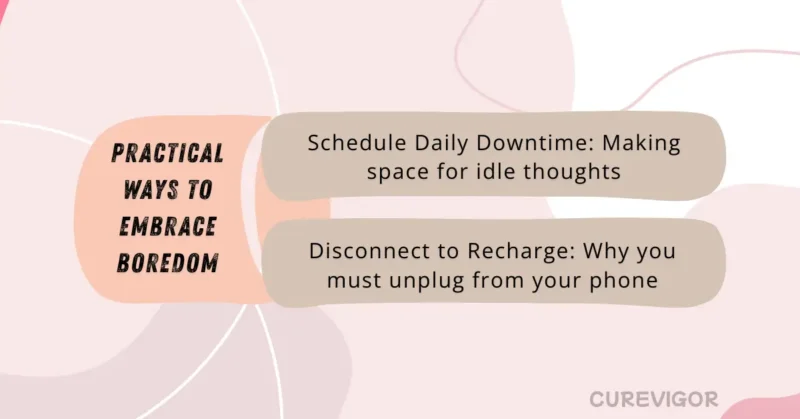
Healthy boredom does not happen by accident anymore. You often need to create space for it by stepping back from constant noise and digital distractions.
A few simple habits can help you make room for more calm and mental clarity.
Schedule Daily Downtime: Making space for idle thoughts
If you do not make space for quiet time, it usually disappears. Modern life will gladly fill every open minute for you. That is why planned downtime works best. It does not need to be long.
Ten or fifteen minutes can be enough to start. The key is that nothing is trying to entertain you during that time.
This can be harder than it sounds. Many people are so used to constant input that silence feels awkward at first. They sit down for two minutes and feel the urge to check something.
That is not a sign that the practice is failing. It is proof that your attention has been trained to expect stimulation. Noticing that urge is part of the work.
The best kind of downtime is low-pressure. It should not feel like another task to perform well. You do not need to chase a perfect empty mind. You do not need to force a wise thought.
Just let the moment stay plain. Sit with tea. Fold clothes. Water plants. Look outside. Walk slowly. Let your thoughts move without trying to control them too much.
This kind of quiet is useful because it protects your mental space. It gives the brain a brief window when it does not have to react, answer, compare, or consume.
That is where idle thoughts can begin to surface. And idle thoughts are not useless thoughts. Very often, they become the bridge to insight, memory, planning, or emotional clarity.
It also helps to anchor this downtime to a part of the day. Some people do well with a few quiet minutes in the morning before the world gets loud.
Others need it after work to reset their mind before home life begins. The exact time matters less than the habit itself. When quiet time becomes normal, the brain starts to trust that space rather than resist it.
Over time, daily downtime becomes less strange and more natural. The mind stops treating silence like a threat. It begins to settle faster.
You may notice better ideas, deeper breathing, or clearer thinking. You may also notice nothing dramatic at all, and that is fine.
The value is not always flashy. Sometimes the gain is simply that your mind no longer feels crowded every hour of the day.
Disconnect to Recharge: Why you must unplug from your phone
If boredom is a doorway, the phone is often what closes it. Most people do not pick up their phone because of a true need.
They pick it up because there is a gap. A quiet second appears, and the reflex takes over. That habit is now so common that many people do it without noticing.
The problem is not only the time it takes for phones. It is what they do to the rhythm of attention. They teach the brain that even the smallest dull moment should be fixed at once.
Over time, that can make normal life feel too slow. A walk feels empty. A meal feels incomplete. A wait feels unbearable.
The mind starts expecting a stream of novelty, and anything less feels like a problem.
Unplugging helps reset that pattern. It teaches the brain that not every open second needs to be filled. This can start with small choices.
Leave the phone in another room while you work. Take a short walk without it. Keep it away during meals. Sit in a waiting room without reaching into your pocket.
These are simple acts, but they can have a strong effect on your attention.
Phone-free time also changes the quality of your thoughts. When you are not checking for updates, your mind gets longer stretches of continuity.
That means thoughts can deepen instead of breaking apart every few minutes. You can finish an idea. You can feel a feeling all the way through.
You can notice what is really on your mind instead of pushing it away with one more scroll.
This does not mean phones are evil. They are useful tools. The problem begins when they become the automatic answer to every tiny spark of boredom.
Then the brain never gets a chance to build stillness, patience, or inner reflection. It stays trained for reaction, not depth.
Unplugging, even in short pockets, gives you something valuable back. It returns ownership of your attention. It helps the mind lower its need for constant reward.
It also makes normal life feel richer again. The sky, the room, the walk, the conversation, the pause between tasks—all of it becomes easier to notice when the phone is not taking the lead.
Using Boredom as a Tool for Growth
Boredom is not always something to avoid. It can be a signal that your mind is ready for change, reflection, or a fresh idea.
When used well, quiet moments can support both personal growth and deeper self-understanding.
Fueling Innovation: Seeing boredom as an opportunity, not a burden
People usually treat boredom like a dead end. They assume it means nothing useful is happening. But boredom can also be a turning point. It can tell you that your mind is ready for a shift.
Maybe the task needs a better method. Maybe the routine has gone stale. Maybe a deeper question has been ignored for too long. Boredom can be a signal that change is due.
This is why boredom can fuel innovation. It creates friction, and friction often prompts people to seek a better way.
A student finds a smarter study system. A business owner sees that a process is too slow. A writer notices that the same approach no longer works.
A parent realizes the family rhythm needs to change. These moments often start with discomfort, not excitement.
In that sense, boredom can be a useful form of feedback. It asks whether the current moment has enough meaning, challenge, or direction. That question is powerful. When answered honestly, it can lead to better choices.
The brain does not always need more stimulation. Sometimes it needs more purpose. Sometimes it needs more depth. Sometimes it needs a fresh problem worth solving.
Short periods of inaction also support innovation by allowing ideas to incubate. You stop pushing, but the mind keeps working in the background. It turns things around quietly.
It tests shapes and connections without forcing them. This is often why a good answer comes to you after you step away from the problem for a while. The quiet made room for the solution to form.
The important thing is to stop seeing all boredom as failure. Some boredom is telling you something useful. It may be saying that you are under-challenged, over-stimulated, or disconnected from meaning.
If you silence that signal too fast, you miss the message. If you stay with it for a little while, you may discover where growth needs to happen next.
Innovation is not always loud and dramatic. Sometimes it begins in a plain moment when the mind is no longer entertained and starts asking better questions.
That is why healthy boredom can be a tool, not a burden. It opens the door to change by refusing to let stale patterns feel fully comfortable.
Enhancing Self-Awareness: Connecting with your internal dialogue
One of the deepest gifts of boredom is self-awareness. When the outside world gets quieter, you begin to hear your own mind more clearly. That can be uncomfortable at first.
Many people do not avoid boredom because they hate silence. They avoid it because silence brings them back to thoughts they have been trying not to face.
But this is exactly why quiet time matters. It helps you notice what is going on inside. You may realize you are more tired than you thought. You may notice that a certain conversation is still bothering you.
You may see that your schedule is packed, but your mind feels empty. These are important signals, and they usually do not surface when you are drowning them in content.
Self-awareness grows when you stop running from your own thoughts. This does not mean sitting for hours in deep reflection every day.
It simply means allowing enough inner space for your mind to speak. That might happen during a walk, a quiet commute, or a few calm minutes before sleep.
The form is simple, but the value is deep.
This process also helps you understand your habits. You begin to see how fast you reach for distraction.
You notice which feelings make you want noise. You learn which type of quiet helps you and which feels heavy.
Over time, this awareness gives you more choice. Instead of acting on autopilot, you can respond with more honesty and intention.
Boredom can also reconnect you with values. In busy seasons, people often lose touch with what matters because they are always reacting to what is urgent.
Quiet moments slow that cycle down. They let you ask bigger questions. What kind of life am I building?
What am I giving too much energy to? What have I been ignoring? These questions do not always arrive in loud ways. Often, they show up in stillness.
There is something deeply human about being able to sit with yourself without panic. That ability is easy to lose in a noisy world. Yet it is one of the strongest signs of inner maturity.
When you can face a little boredom without escaping at once, you build a better relationship with your own mind. And that relationship shapes everything else in life.
Conclusion
So, does your brain love boredom? The honest answer is more balanced than a simple yes-or-no.
The brain does not love misery, long emptiness, or the painful kind of boredom that drains life of meaning. But it does seem to benefit from small periods of low stimulation.
Those quiet stretches can support reflection, creativity, focus, emotional sorting, and mental recovery.
That is why “nothing” time matters. It gives the brain something modern life rarely offers anymore.
It gives space. Not dead space, but living space. Space for thoughts to join, for stress to ease, for attention to recover, and for the inner voice to become easier to hear.
In many cases, what looks like doing nothing is actually the mind doing some of its most important work.
If you want a calmer mind, deeper focus, and better ideas, you may not need more input. You may need less. A few screen-free pauses. A short, quiet walk. A wait without scrolling. A moment by the window.
These simple acts may look small from the outside, but they can have a powerful effect on how your brain feels and functions.
The goal is not to romanticize boredom. The goal is to use it wisely. Let it become a tool instead of a threat.
Let it teach your mind that every pause does not need to be filled. In a loud world, that lesson is rare. It may also be one of the healthiest things you can give your brain.
Start with 10 minutes of “nothing” today. No phone, no noise, no distractions—just space for your brain to breathe, reset, and think.
Is boredom actually good for your brain?
Boredom is not always pleasant, but small periods of low stimulation can be useful. They may support reflection, idea-making, and mental recovery.
That is very different from chronic boredom, which can be linked with stress, lower well-being, and other problems.
What is the Default Mode Network in simple words?
It refers to a group of brain regions that are more active during wakeful rest and inward thinking. It is linked with self-reflection, memory, future planning, and mind wandering.
In simple terms, it helps the brain do internal work when the outside world becomes quieter.
Can boredom make you more creative?
It can help in some situations. Research suggests that mind wandering and incubation can support creative thinking, especially when the brain gets a short break from constant input.
Boredom does not guarantee great ideas, but it can create space for new connections to form.
Why does my phone make me feel more distracted?
Smartphones often train the brain to expect quick stimulation. Research has found that notifications and digital interruptions can impair attention.
And newer studies suggest that heavy digital media use can even worsen boredom by increasing the brain’s need for constant novelty.
How can I add more “nothing” time to my day?
Start small. Try ten minutes without your phone, music, or video. A short walk, a quiet tea break, or sitting without a screen can all work. The goal is not to force silence. The goal is to stop filling every open moment with input. This kind of pause fits well with research on rest and attention recovery.
Should I link to studies in every paragraph?
Usually no. For blog readers, that often feels heavy and unnatural. It is better to use a few strong links in the body and then place the rest in a short source section at the end.
That keeps the article readable while still showing trust and research depth. Google recommends clear sourcing and natural, descriptive links rather than awkward or stuffed linking.
Read more Life Balance articles.
You might like: