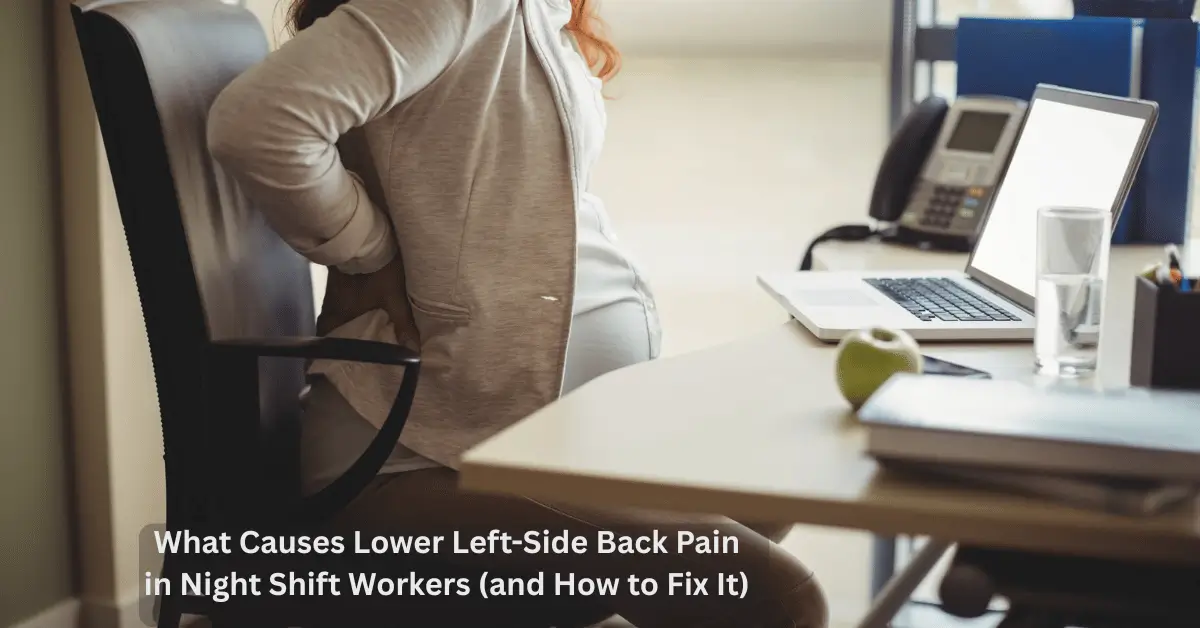
Learn what causes lower-left-side back pain in night shift workers and how to fix it with targeted solutions like lower back support, ergonomic adjustments, and sleep optimization for pain relief. Stay pain-free on the night shift.
Working the night shift is a challenging endeavor that demands resilience, adaptability, and an incredible amount of stamina.
While the world sleeps, nocturnal professionals keep hospitals running, supply chains moving, and communities safe. However, this inverted schedule often takes a hidden toll on the body.
If you are struggling with lower left-side back pain, you are not alone; night-shift workers often face unique physiological and environmental challenges that make this discomfort surprisingly common.
Waking up in the mid-afternoon with a stiff back or powering through a 3:00 AM slump with a sharp ache in your left lumbar region is more than just an annoyance; it is a signal from your body. But why is it centralized on the left side? And why does working overnight seem to amplify the pain?
In this thorough guide, we will delve into the biochemical, environmental, and anatomical factors that cause your pain. More importantly, we will provide actionable, science-backed strategies for long-lasting back pain relief tailored specifically to the nocturnal lifestyle.
Understanding the Anatomy: Why the Lower Left Side?
Before we can fix the pain, we need to understand where it is coming from. The lumbar spine, commonly known as the lower back, is a complex network of muscles, ligaments, discs, and vertebrae. Isolated discomfort, particularly in the lower left, typically indicates asymmetrical tension or a localized problem.
Muscular and Structural Causes
For most night-shift workers, unilateral (one-sided) back pain is muscular or structural. Some of the most common culprits include the following:
- Quadratus Lumborum (QL) Strain: The QL is a deep abdominal muscle on either side of your lumbar spine. It helps stabilize your pelvis and spine. If you tend to lean to the left while sitting, or if you repeatedly lift heavy items with your dominant right side (which can overstretch the left QL), you will likely develop tightness and pain here.
- Sacroiliac (SI) Joint Dysfunction: Your pelvis and lower spine are joined by the SI joint. Inflammation of the left SI joint can cause sharp, stabbing pain in the lower left back that sometimes extends to the buttocks.
- Herniated Discs: Long hours of poor posture can compress the spinal discs. If a disc bulges to the left, it can pinch the nerve roots exiting that side of the spinal cord, leading to left-sided pain and sciatica.
Internal and Systemic Causes
It is also crucial to rule out internal issues. A common question medical professionals hear is: Is lower left back pain related to kidney strain?”
The short answer is yes, it can be. Your kidneys sit toward the back of your abdominal cavity, just below the rib cage.
A kidney infection, kidney stones, or severe dehydration (which is incredibly common among highly caffeinated night shift workers) can present as a deep, throbbing ache in the left flank or lower left back.
How to tell the difference: Musculoskeletal pain usually worsens with movement, stretching, or prolonged sitting. Kidney pain tends to be constant, regardless of your physical position, and may be accompanied by fever, nausea, or painful urination. If you suspect kidney issues, seek medical attention immediately.
The Chronobiology of Pain: The Night Shift Connection
Many nocturnal employees notice that their discomfort peaks in the middle of the night. If you have ever wondered why lower back pain worsens during overnight shifts, the answer lies deep within your biology.
1. The Circadian Rhythm Impact on Musculoskeletal Inflammation
Human beings are diurnal creatures, meaning we are biologically hardwired to be awake during the day and asleep at night. This biological clock, or circadian rhythm, dictates everything from our digestion to our hormone production.
One of the key functions of the circadian rhythm is regulating inflammation. During normal nighttime hours, the body increases the production of certain pro-inflammatory cytokines while simultaneously dropping cortisol levels (cortisol acts as a natural anti-inflammatory).
When you force yourself to stay awake and active during these hours, you are fighting your body’s natural inflammatory cycle.
The profound impact of circadian rhythm on musculoskeletal inflammation means that a minor left-sided muscle tweak you might not even notice during the day can throb painfully at 3:00 AM.
2. Vitamin D Deficiency’s Impact on Persistent Back Pain
Workers on night shifts sleep during the day and work at night. Our main source of vitamin D, exposure to natural sunshine, is severely reduced as a result.
Strong bones and muscles depend on vitamin D. The medical literature has extensively documented the significance of vitamin D insufficiency in chronic back discomfort; a deficiency of this essential nutrient impairs calcium absorption, leading to bone softening, muscle weakening, and widespread lumbar pain.
If you work nights, supplementing with vitamin D3 (after consulting your doctor) is almost mandatory for spinal health.
3. Melatonin, Sleep Quality, and Tissue Repair
Melatonin is the “sleep hormone,” produced in darkness. When you sleep during the day, light seeping through your windows or the glow of screens disrupts melatonin production.
Low melatonin doesn’t just make you groggy; it impairs your body’s ability to repair micro-tears in your lower back muscles. We will discuss later how to hack your sleep environment to fix this.
Workspace Hazards: Triggers for Nocturnal Employees
Your environment plays a massive role in unilateral back pain. Let’s break down the triggers based on the type of night shift work you do.
The Desk Worker (Dispatchers, IT Support, Call Centers)
If you sit at a desk all night, your posture is likely the primary antagonist. Fatigue sets in faster during night shifts, causing you to slump, lean, and cross your legs. Leaning on your left elbow for hours on end puts massive unilateral stress on the left side of your spine.
Solutions for Desk Workers: To address this, you must prioritize an ergonomic workspace setup.
- Monitor Height: To avoid stooping forward, the top third of your screen should be at eye level.
- Symmetrical Setup: Ensure your mouse and keyboard are centered so you aren’t constantly reaching to one side.
- Chair Mechanics: Knowing how to improve spinal alignment during prolonged sitting is crucial. Keep your hips pressed all the way to the back of your chair, your knees at a 90-degree angle, and your feet flat on the ground.
- Use Lower Back Support: If your chair lacks built-in lumbar support, use a rolled-up towel or a dedicated lumbar cushion. Place it right in the curve of your lower back to maintain the natural lordosis (inward curve) of your spine.
The Industrial and Warehouse Worker
Night shift warehouse workers, forklift drivers, and factory line workers face a completely different set of challenges. The physical demands of moving heavy objects combined with nocturnal fatigue are a recipe for left-sided muscle strains.
Solutions for Industrial Workers:
- Proper Lifting: A comprehensive guide to proper lifting techniques for warehouse staff cannot be overstated. Never bend at the waist. Squat with your knees, keep your chest up, and hold the load as close to your body as possible. Crucially, do not twist your spine while lifting. Move your feet to turn. Twisting while lifting is the number one cause of herniated discs and QL strains.
- Equipment Support: For forklift drivers or heavy machinery operators who endure whole-body vibration, utilizing lumbar support cushions for industrial shifts can absorb shock and prevent the steady compression of the lumbar discs.
The Active Patroller (Nurses and Security Personnel)
Late-night security guards and healthcare workers spend hours walking on hard floors. Standing for extended periods requires immense core endurance. When fatigue sets in, people tend to shift their weight onto one leg, often the dominant leg, which pulls the pelvis out of alignment and causes sharp pain in the opposite (left) lower back.
Solutions for Active Workers:
- Footwear: Invest in high-quality, shock-absorbing insoles.
- Weight Distribution: Be mindful of “hanging on your hip.” When you are motionless, distribute your weight equally between both feet.
Immediate Strategies for Back Pain Relief During Your Shift
When the pain strikes at 2:00 AM and you still have hours left on your shift, you need immediate, actionable relief. Here is a step-by-step approach to managing acute flare-ups.
1. Heat Therapy Versus Cold Compresses for Muscle Spasms
One of the most debated topics in pain management is heat therapy versus cold compresses for muscle spasms. Which one should you use in the break room?
- When to use cold (ice): If the lower left back pain is sharp, sudden, and recent (within the last 48 hours), it is likely an acute strain. Ice constricts blood vessels, reducing swelling and numbing the area. For fifteen to twenty minutes, apply a towel-wrapped ice pack to the lower left back.
- When to use Heat: If the pain is a dull, chronic, stiff ache that has been bothering you for weeks, heat is your best friend. Heat dilates blood vessels, bringing healing oxygen to tight muscles and relaxing severe spasms. A stick-on heating pad applied under your uniform can provide excellent back pain relief throughout a long shift.
- The Contrast Method: Try applying ice for 15 minutes, then heat for 15 minutes, to induce a “pumping” effect in the local blood vessels to relieve persistent spasms.
2. Targeted Stretching on the Clock
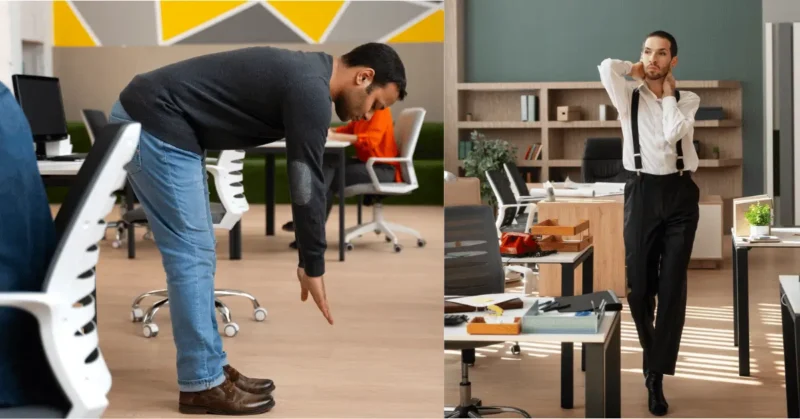
You do not need a yoga mat to stretch your lower back. Specifically, we want to target the left side. Here are effective quadratus lumborum stretches for chronic back stiffness that you can do anywhere:
- Standing Side Stretch: Place your feet shoulder-width apart and stand upright. Raise your right arm directly to the ceiling. Slowly bend your torso to the left, sliding your left hand down your left leg. You will feel a deep stretch along the right side. To stretch the left side, raise your left arm and bend to the right. Hold for 30 seconds.
- Seated Spinal Twist: Sit sideways in a chair. Keep your feet flat on the ground. Twist your torso toward the back of the chair, using your hands to gently pull yourself deeper into the stretch. Hold for 20 seconds on each side.
- Standing Hamstring Stretch: Tight hamstrings pull down on your pelvis, flattening your lower back and causing pain. Put your left heel on a chair or low step. Keeping your back straight, hinge forward at the hips until you feel a stretch at the back of your leg.
Long-Term Solutions: Sleep Optimization for Nocturnal Workers
You cannot cure lower left-side back pain without addressing your recovery. For night-shift workers, daytime sleep is the biggest hurdle to tissue repair.
Mastering Your Sleep Position
How you lie in bed for 7-8 hours dictates how your spine feels when you wake up. Let’s compare side sleeping vs. back sleeping for lumbar pain relief.
- Side Sleeping: This is generally the best position for unilateral back pain. If your pain is on the left side, try sleeping on your right side to open up the joints on the painful side. Crucial step: Place a thick, firm pillow between your knees. Without a pillow, your top leg drops down, pulling your pelvis out of alignment and twisting your lower spine.
- Back Sleeping: Sleeping on your back distributes weight evenly, but it can exacerbate the arch in your lower back. To fix this, place a rolled-up towel or a wedge pillow under your knees. This flattens your lower back against the mattress, removing pressure from the lumbar discs.
- Stomach Sleeping: Avoid this entirely. Sleeping on your stomach forces your neck to rotate 90 degrees and forces your lower back into a deep, painful arch.
Protecting Your Melatonin
Because you sleep while the sun is up, your brain struggles to produce melatonin, the hormone necessary for deep REM sleep and muscle recovery.
- Blackout Curtains: Make your bedroom look like a cave. Use high-quality blackout curtains and cover any LED lights on electronics.
- Temperature Control: A cooler room (around 65°F / 18°C) mimics the natural nighttime temperature drop, signaling to your body that it is time to sleep.
- The Screen Problem: When you finish your shift in the morning, do not stare at your phone in bed. The benefits of blue light blocking for muscle recovery are immense. Blue light suppresses melatonin production. Wear blue-light-blocking glasses during the last hour of your shift and on your morning commute in the light. This stimulates your recovery hormones before your head even touches the pillow by tricking your brain into believing the sun is setting.
Strengthening and Stabilization:
Stretching and ice only provide temporary relief. To eliminate lower-left-side back pain for good, you must build a resilient core. The spine is like a mast on a ship; the core muscles are the ropes holding it stable. If the ropes on one side are weak, the mast will tilt, causing pain.
Strengthening Exercises for Unilateral Lower Back Weakness
When the left side of your lower back hurts, it often means the supporting muscles are either overworked or weak. Here is a progressive routine to balance your muscular strength:
- The Bird-Dog: The gold standard for lower back stabilization.
- How to do it: Get on your hands and knees (quadruped position). Keep your spine neutral. To backward-extend your left leg and forward-extend your right arm, slowly bring them parallel to the floor. Squeeze your core and hold for 3 seconds. Slowly lower them and switch sides.
- Reps: 3 sets of 10 repetitions per side.
- Why it works: It trains the muscles on opposite sides of the spine to work together without compressing the lumbar discs.
- Side Planks: Excellent for targeting a weak quadratus lumborum.
- How to do it: Lie on your side, propped up on your elbow. Raise your hips off the floor so that your entire body is in a straight line from head to toe.
- Reps: Hold for 20-30 seconds per side. Do 3 sets.
- Why it works: If you notice that holding the side plank on your left elbow is significantly harder than on your right, you have found a unilateral weakness that is likely contributing to your pain.
- Glute Bridges: Your glutes support your lower back. Weak glutes lead to back pain.
- How to do it: Bend your knees and place your feet flat on the ground while lying on your back. Contract your glutes and lift your hips toward the ceiling to form a straight line from your knees to your shoulders. For two seconds, hold at the top.
- 15 repetitions in three sets.
Core Stabilization Routines for Late-Night Security Personnel
For workers who spend hours on their feet, static core strength is more important than doing crunches.
- The Pallof Press: Use a resistance band attached to a sturdy pole. Stand parallel to the pole, hold the band with both hands against your chest, and press it straight out in front of you. The band will try to twist you toward the pole; use your core to resist the twist. Do 10 reps, then turn around and work the other side. This anti-rotation exercise is incredible for building a spine that can endure 12-hour walking shifts.
- Farmer’s Carries: Grab a heavy dumbbell or kettlebell in one hand. Maintain perfect, upright posture and walk for 30 seconds. Switch hands. This unilateral carry forces the opposite side of your core (especially the QL) to fire aggressively to keep you upright.
When Self-Care Isn’t Enough: Seeking Professional Help
While the strategies outlined above will resolve the majority of lower left-sided musculoskeletal back pain among night-shift workers, there comes a point when professional intervention is necessary. You cannot push through pain indefinitely.
Red Flags That Require Immediate Medical Attention
Do not attempt to stretch or foam roll your way out of the following symptoms. Consult a physician immediately if your lower left back pain is accompanied by the following:
- Loss of bowel or bladder control.
- Numbness, tingling, or weakness radiating down your left leg, especially past the knee.
- A fever, chills, or unexplained weight loss.
- Significant stomach pain or blood in the urine, which strongly suggests kidney stones or a serious infection.
- Pain that is unrelated to your typical shift’s wakefulness awakens you from a deep slumber.
Physiotherapy Techniques for Nocturnal Spinal Strain
If your doctor clears you of internal issues but the pain persists, a physical therapist can offer specialized treatments.
Because nocturnal workers deal with chronic, low-grade inflammation driven by circadian disruption, physical therapists often employ specific physiotherapy techniques for nocturnal spinal strain:
- Manual Therapy: Hands-on mobilization of the left sacroiliac joint or lumbar vertebrae to restore proper joint mechanics that become stiff during long, sedentary night shifts.
- Dry Needling: Inserting tiny, acupuncture-like needles into hyper-irritable trigger points in the left QL or erector spinae muscles to force the muscle to twitch and release tension.
- Spinal Decompression Therapy: Using a specialized table to gently pull the spine, creating negative pressure within the lumbar discs. This allows bulging discs to retract and brings nutrient-rich fluids back into the disc space—crucial for night shift workers whose discs are compressed by sitting or standing for 10-12 hours straight.
- TENS Therapy: Transcutaneous Electrical Nerve Stimulation (TENS) machines stimulate the release of endorphins by delivering low-level electrical impulses through the skin, helping override pain signals sent to the brain.
The Holistic Nocturnal Lifestyle Audit
Fixing lower-left-side back pain requires a holistic view of your life. It is not just about what you do during your shift; it is about how you treat your body during your off hours. Consider doing a quick “nocturnal audit” of your lifestyle.
- Hydration: Are you drinking enough water? Coffee and energy drinks are staples of the night shift, but they are diuretics. Dehydration causes the spinal discs (which are primarily water) to lose their shock-absorbing capacity, leading to friction and pain. Aim for at least 80-100 ounces of water during your shift.
- Diet and Inflammation: Eating heavy, processed meals at 2:00 AM spikes your blood sugar and increases systemic inflammation. Combine this with the circadian disruption we discussed earlier, and your joints will ache. Opt for anti-inflammatory snacks during your shift—berries, nuts, lean proteins, and leafy greens.
- Active Commuting: After sitting all night, getting into a car and sitting for another 45 minutes on the drive home locks up your hip flexors, which then yank on your lower back. Take 5 minutes to do a brisk walk and stretch your hips before getting into your vehicle.
Conclusion
Experiencing lower left-side back pain, night-shift workers know all too well, can feel like an inescapable part of the job. The unique combination of ergonomic stress, physical exhaustion, circadian rhythm disruption, and daytime sleep difficulties creates a perfect storm for localized spinal distress.
However, you do not have to accept chronic pain as the price of working overnight. By understanding the root causes, whether it is an overused Quadratus Lumborum, improper lifting mechanics, or poor desk ergonomics, you can take targeted action.
Start small. Implement the heat and ice protocols during your next shift. Adjust your chair and monitor right now. Add the bird-dog exercise to your daily routine, and invest in blackout curtains and blue-light-blocking glasses to optimize your sleep and hormone recovery.
By proactively managing your spinal health, prioritizing proper lower back support, and respecting your body’s need for high-quality daytime recovery, you can silence the aches on your left side. You owe it to yourself to make your nights as pain-free, energetic, and productive as possible.
Stay safe, stay strong, and protect your spine.
Read more about night shift workers’ health.
You might like: