Find out the long-term health risks for night shift workers, from heart disease to cancer, and get expert-backed strategies to protect your well-being.
Working the night shift may seem like a practical choice for career flexibility or higher pay, but the long-term health risks for night shift workers go far beyond short-term fatigue.
Research shows that disrupted circadian rhythms, poor sleep quality, and irregular eating patterns can increase risks of cardiovascular disease, diabetes, cancer, and mental health challenges.
How to Explore Long-Term Health Risks for Night Shift Workers
If you work the night shift, you already know the immediate challenges: fighting fatigue, staying alert, and maintaining a social life when the rest of the world is asleep.
But beyond the short-term exhaustion lies a more serious concern that many workers underestimate, the long-term health risks for night shift workers.
Decades of scientific research have shown that regularly working against your body’s natural 24-hour clock can have far-reaching consequences for nearly every major system.
From cardiovascular disease and shift work to increased cancer risk, on night shifts, the evidence is compelling and continues to grow with each new study.
This guide is designed to help you understand these risks in depth, recognize your personal vulnerability, and take actionable steps to protect your long-term health.
Such knowledge can help you make well-informed decisions about your well-being, regardless of your level of experience working the graveyard shift.
Why Night Shift Work Affects More Than Just Sleep
How circadian rhythm disruption changes your body’s 24-hour clock
Your body operates on a roughly 24-hour internal clock called the circadian rhythm. This master clock, located in the suprachiasmatic nucleus of your brain, regulates essential functions including sleep-wake cycles, hormone production, body temperature, digestion, and metabolism.
Light is the primary cue that keeps this clock synchronized with the external day-night cycle.
When you work night shifts, you’re exposed to artificial light at night and often sleep during daylight hours. It creates a mismatch between your internal clock and your environment, a phenomenon known as circadian rhythm disruption.
Over time, this misalignment can desynchronize the timing of various physiological processes, leading to a cascade of negative health effects.
The difference between short-term tiredness and long-term health risks for night shift workers
It’s normal to feel tired after a night shift or during a period of schedule adjustment. Short-term tiredness is usually reversible with adequate rest.
However, the long-term health risks for night shift workers are chronic conditions that develop gradually after months or years of repeated circadian disruption and sleep debt.
These include serious illnesses like heart disease, type 2 diabetes, and certain cancers, conditions that can persist even if you eventually return to a regular schedule.
Who’s most at risk: years worked, rotating vs. fixed schedules, and age factors.
Not every night shift worker faces the same level of risk. Several factors can increase your vulnerability:
- Duration of exposure: Research suggests the risk for many conditions increases with the number of years spent working night shifts. For example, some studies show a noticeable rise in breast cancer risk after 10–15 years of shift work.
- Schedule type: Rotating shifts (especially those that change frequently) tend to be more disruptive than fixed 3rd-shift schedules, as they don’t allow your body to adapt to a consistent rhythm fully.
- Age and individual factors: Older workers may have less robust circadian systems and be more susceptible to the health risks of shift work. Pre-existing health conditions and lifestyle habits can also compound the danger.
The Science: How Night Shift Work Impacts Your Body
Circadian Rhythm Disruption and Hormone Imbalance
Melatonin suppression from light at night
Melatonin, a powerful antioxidant that helps control sleep, especially at night, is produced by the pineal gland. Melatonin production is suppressed by nighttime light exposure, particularly blue light from screens and office lighting.
Numerous health problems, including the elevated risk of cancer linked to working nights, have been linked to chronic melatonin suppression, according to epidemiological studies.
Cortisol, insulin, and leptin changes linked to shift work health risks
Circadian misalignment also affects other key hormones:
- Cortisol: Normally peaks in the morning to promote alertness; night shift work can disrupt this rhythm, contributing to stress and metabolic problems.
- Insulin: Glucose metabolism is time-dependent. On the graveyard shift, eating at night, when insulin sensitivity is lower, might raise blood sugar levels and increase the risk of diabetes.
- Leptin and ghrelin: These hunger-regulating hormones follow circadian patterns. Disruption can increase appetite and cravings for high-calorie foods, fueling obesity and night shift weight gain.
Sleep Debt and Shift Work Sleep Disorder Over Time
Why chronic sleep loss compounds into bigger health problems
Most night-shift workers get less sleep than their day-shift counterparts and often experience poorer sleep quality due to daytime noise and light.
Chronic sleep debt is associated with systemic inflammation, impaired glucose tolerance, and higher blood pressure, all precursors to chronic disease.
How poor sleep quality triggers inflammation
Persistent sleep disruption activates inflammatory pathways in the body. Over time, low-grade chronic inflammation is a common denominator in many shift work health risks, including cardiovascular disease, metabolic syndrome, night shift, and neurodegenerative conditions.
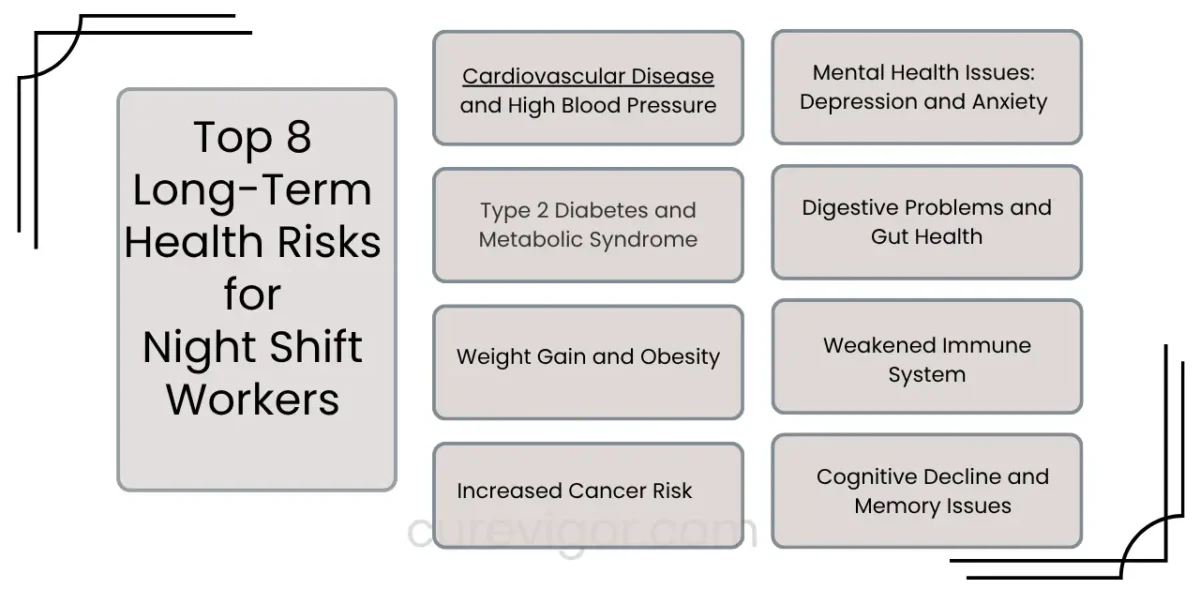
Top 8 Long-Term Health Risks for Night Shift Workers
| Risk | Evidence |
|---|---|
| Cardiovascular disease | 11–22% higher risk of heart events in long-term night workers. |
| Type 2 diabetes | 40–58% higher risk after 10–20 years of rotating shifts. |
| Obesity | 36% higher risk of metabolic syndrome; appetite hormones disrupted. |
| Cancer | IARC classifies night shifts as “probable carcinogens”; breast cancer risk rises 36% after 30 years. |
| Mental health | 49% higher odds of depression; social isolation worsens anxiety. |
| Digestive problems | IBS, reflux, and ulcers are more common due to eating at “wrong” times. |
| Immune weakness | Chronic sleep loss lowers immune response, increasing infections. |
| Cognitive decline | Memory impairment after 10+ years, equivalent to accelerated brain aging. |
Risk 1: Cardiovascular Disease and High Blood Pressure
Numerous studies have connected the health concerns associated with working nights to a higher risk of heart disease and stroke.
For instance, compared to day workers, shift workers are substantially more likely to develop coronary heart disease, according to meta-analyses.
One explanation is that third-shift workers’ blood pressure tends to remain elevated for extended periods due to stress and circadian disruption, placing additional strain on the cardiovascular system.
Risk 2: Type 2 Diabetes and Metabolic Syndrome
The combination of circadian misalignment, poor diet timing, and reduced physical activity contributes to metabolic syndrome night shift, a cluster of conditions including high blood sugar, excess abdominal fat, high blood pressure, and abnormal cholesterol.
This dramatically increases the risk of developing type 2 diabetes. Research consistently shows higher rates of diabetes among night shift workers compared to those on regular schedules.
Risk 3: Weight Gain and Obesity
Obesity and night shifts often go hand in hand. Disrupted hunger hormones (elevated ghrelin and reduced leptin) can lead to increased appetite, particularly for sugary and fatty foods.
Irregular meal patterns and limited access to healthy food options during night hours further exacerbate weight gain, especially around the abdomen, a known risk factor for metabolic disease.
Risk 4: Increased Cancer Risk
The International Agency for Research on Cancer (IARC) designated shift employment that disrupts circadian rhythms as a possible human carcinogen (Group 2A) in 2007.
Since then, a growing body of evidence has associated night shift work with an increased cancer risk, most notably breast cancer in women, as well as prostate and colorectal cancers in some studies. Melatonin suppression is believed to play a key role in these associations.
Risk 5: Mental Health Issues: Depression and Anxiety
The connection between mental health and the night shift is well-documented. Chronic sleep loss, social isolation due to odd hours, and limited exposure to natural daylight can contribute to mood disorders.
According to studies, shift workers had greater rates of anxiety and depression than day workers, and the risk rises over time.
Risk 6: Digestive Problems and Gut Health
Working nights can wreak havoc on your digestive system. Common night shift health effects include acid reflux, irritable bowel syndrome (IBS), ulcers, and constipation.
Eating at biologically inappropriate times can disrupt gut motility and the microbiome, leading to chronic gastrointestinal discomfort.
Risk 7: Weakened Immune System
Your immune system follows a circadian rhythm, with certain immune responses peaking at specific times of day. Chronic sleep disruption and circadian misalignment can impair immune function, making night shift workers more susceptible to infections, slower to recover from illness, and potentially less responsive to vaccines.
Risk 8: Cognitive Decline and Memory Issues
Long-term health risks of shift work extend to brain health. Persistent sleep debt and circadian disruption have been linked to difficulties with attention, reaction time, decision-making, and memory.
Some longitudinal studies suggest a possible association between prolonged shift work and increased risk of cognitive decline or dementia later in life, though more research is needed.
Factors That Increase Your Personal Risk Level
- Duration: Risks rise sharply after 5+ years and even more after 15+ years.
- Rotating vs Fixed Shifts: Rotating schedules are worse for circadian disruption.
- Lifestyle Factors: Smoking, poor diet, and inactivity multiply risks.
Duration: How Many Years on Night Shift Matters
Cumulative exposure to night-shift work is a critical factor. Epidemiological data indicate that the risk for conditions like breast cancer and cardiovascular disease tends to rise after 5–10 years of shift work and becomes more pronounced after 15 or more years of graveyard shift work. This underscores the importance of early preventive measures.
Rotating Shifts vs Fixed 3rd Shift Schedule
Fixed night shifts may allow some circadian adaptation over time, though complete adaptation is rare for most people. In contrast, rotating schedules force your body to readjust constantly, leading to greater disruption of the circadian rhythm and a higher overall risk. If possible, minimizing rapid shift rotations is advisable.
Lifestyle Factors You Can Control
Lifestyle choices can significantly amplify or mitigate the health risks associated with night shifts. Smoking, a diet high in processed foods and sugar, physical inactivity, and excessive alcohol consumption all compound the negative effects of shift work. Conversely, adopting healthier habits can help buffer some of the risks.
How to Reduce Long-Term Health Risks for Night Shift Workers
Protect Your Sleep and Circadian Rhythm
- Create a sleep sanctuary: Use blackout curtains, eye masks, and a white noise machine to keep your bedroom as dark and quiet as possible during daylight hours.
- Keep a regular schedule: Try to head to bed and wake up at the same times on workdays and as close as possible on days off to help maintain your circadian rhythm.
Control light exposure: If at all possible, obtain bright light (natural or artificial) when you need to be attentive, especially at the beginning of your shift, and use blue-light-blocking glasses in the hours before bed.
Eat for Metabolic Health on Night Shift
- Plan meal timing: Aim for a balanced meal before or at the start of your shift, and avoid heavy, high-sugar meals late in your shift or right before sleep.
- Prioritize nutrient-dense foods: To maintain steady energy and blood sugar levels, focus on lean proteins, whole grains, fruits, vegetables, and healthy fats.
- Limit caffeine and sugar late: While caffeine can help with alertness, avoid it in the last few hours of your shift to prevent sleep interference later.
Move Your Body to Fight Heart and Metabolic Risks
- Incorporate regular physical activity: Aim for at least 150 minutes of moderate-intensity exercise per week. Short walks, bodyweight exercises, or resistance training can be effective even with limited time and energy.
- Time it wisely: Some evidence suggests that exercising after waking (before or after your shift starts, as it fits) may be beneficial, but avoid vigorous workouts immediately before sleep.
Mental Health Support for 3rd Shift Workers
- Build social connections: Try to keep in touch with your loved ones by setting up phone conversations or get-togethers during your free time.
- Seek sunlight exposure: Try to get natural daylight during your waking hours to help regulate mood and circadian rhythms.
- Know when to get help: If you’re experiencing persistent feelings of depression, anxiety, or hopelessness, speak with a mental health professional who understands shift work challenges.
Medical Checkups Night Shift Workers Shouldn’t Skip
Regular screenings are essential for early detection of shift work-related health issues:
- Blood pressure: Monitor at least annually (or more often if elevated).
- Blood glucose and HbA1c: Screen for diabetes risk, especially with a family history or weight gain.
- Lipid profile: Check cholesterol levels regularly.
- Cancer screenings: Follow age-appropriate guidelines and discuss any increased risk factors with your doctor (e.g., breast cancer screening considerations for long-term night shift workers).
- Sleep assessment: If you suspect shift-work sleep disorder, consider a sleep evaluation.
When discussing your schedule with your healthcare provider, be explicit about How many years you’ve worked nights and the type of schedule you have. This context can help guide appropriate screening and preventive advice.
Employer and Workplace Strategies That Help
Creating a healthier environment for night shift workers benefits both employees and organizations. Key strategies include:
- Optimized lighting: Use brighter, cooler light during night shifts to promote alertness while minimizing unnecessary exposure before sleep.
- Ergonomic break schedules: Provide regular, short breaks to reduce fatigue and support circulation.
- Schedule design: Where feasible, limit consecutive night shifts, avoid rapid back-to-back rotations, and provide sufficient recovery time between shifts.
- Workplace wellness programs: Offer resources tailored to shift workers, such as nutrition counseling, fitness programs, and sleep education.
- Policy advocacy: Employees can ask HR about policies that support night shift health, including access to health screenings, flexible scheduling options when possible, and education on prevention strategies for the night shift.
FAQs: Long-Term Health Risks for Night Shift Workers
Q. Can you reverse health damage from years of night shift work?
While some effects of circadian rhythm disruption and sleep debt can improve after returning to a regular schedule, certain long-term health risks for night shift workers, such as established cardiovascular disease or some metabolic changes, may not be fully reversible.
However, adopting healthy lifestyle habits and receiving appropriate medical care can significantly reduce further progression and improve overall health outcomes. Early intervention is key.
Q. Is the night shift more dangerous than the day shift?
Epidemiological evidence consistently shows that night shift work is associated with a higher risk of a range of chronic conditions compared with day shift work, even after adjusting for other factors.
These include cardiovascular disease, type 2 diabetes, obesity, and certain cancers. That said, individual risk varies based on duration, schedule type, and personal health habits.
Q. How soon do health risks start after working nights?
Some physiological changes can occur relatively quickly. For example, circadian misalignment and sleep disruption can begin affecting glucose metabolism and blood pressure within days to weeks of starting night shifts.
However, the development of serious chronic diseases like heart disease or cancer typically occurs after several years of consistent exposure.
Q. What’s the safest way to work the night shift long-term?
There is no completely risk-free way to work night shifts long-term. Still, you can minimize harm by using a fixed schedule if possible, limiting the number of consecutive nights, prioritizing consistent sleep and light management, maintaining a healthy diet and exercise routine, and getting regular medical checkups tailored to shift work. Advocating for supportive workplace policies also helps.
Q. Do all night shift workers develop these health problems?
No, not all night shift workers will develop serious health issues. Genetics, age, lifestyle, and the specific nature of their schedule all play a role. Many people work night shifts for years without major problems by being proactive about their health. Awareness and prevention are crucial.
Q. How can I talk to my doctor about my night shift schedule?
Be open and specific. Tell your doctor how many years you’ve been working night shifts, whether it’s fixed or rotating, and how many shifts per week.
Mention any symptoms you’re experiencing (sleep problems, weight changes, mood issues) and ask for screenings relevant to shift-work health risks, such as blood pressure, glucose, and lipid levels, as well as appropriate cancer screenings. Bringing this up ensures your care plan accounts for your work schedule.
Take Control of Your Health Starting Now
Because you want to avoid long-term health risks.
Understanding the long-term health risks for night shift workers is the first step toward protecting yourself.
While you can’t always change your work schedule, you have considerable control over many risk factors. Knowledge doesn’t have to be paralyzing; it can be empowering.
Start small this week: try to establish a more consistent sleep routine, plan one or two healthier meals for your next shift, or take a short walk during a break.
These small adjustments over time can provide significant protection for your heart, metabolism, mental health, and general well-being.
Don’t hesitate to advocate for yourself in the workplace and with your healthcare provider. By staying informed and proactive, you can navigate the challenges of night shift work while safeguarding your long-term health.
If you’re concerned about your specific risk, consider scheduling a comprehensive health evaluation with a clinician familiar with shift work sleep disorder and occupational health.
Read more about night shift workers’ health.
You might like: