

Working three 12-hour night shifts each week can give nurses several days off, but those long nights can still take a toll on sleep, energy, meals, and recovery.
The simplest way to master a 3-day night shift schedule is to stop treating each shift as a separate battle. Instead, build a repeatable routine around three priorities: anchor your sleep, front-load your energy, and protect your recovery days.
A typical 3×12 schedule may look like 7 p.m. to 7 a.m., three nights in a row. Exact hours vary by hospital, but the same basic strategy can work across many schedules.
This guide focuses on practical habits, not medical treatment. If persistent sleep problems, severe daytime sleepiness, or other symptoms are affecting your safety or daily life, speak with a qualified healthcare professional.
What Does a 3-Day Night Shift Schedule for Nurses Look Like?

For nurses, a three-day night shift schedule means working three consecutive 12-hour shifts, commonly from 7:00 PM to 7:00 AM, then getting four days off.
Then show something like:
| Monday | 7 p.m.–7 a.m. |
| Tuesday | 7 p.m.–7 a.m. |
| Wednesday | 7 p.m.–7 a.m. |
| Thursday | Recovery day |
| Friday | Day off |
| Saturday | Day off |
| Sunday | Day off |
Typical Weekly Structure (3-On / 4-Off)
- Day 1 (First Shift): Sleep normally the night before, take an afternoon nap (2 to 4 hours), and work from 7:00 PM to 7:00 AM.
- Day 2 (Second Shift): Work the second shift from 7:00 PM to 7:00 AM after sleeping from about 8:00 AM to 3:00 or 4:00 PM and waking up to eat and prepare.
- Day 3 (Third Shift): Get off-shift sleep in the morning/afternoon, and wake up for the final night shift of the week.
- Days 4–7 (Recovery & Off Days): Use the first day off to recover and reset the circadian rhythm, leaving three full days of free time.
Shift Flow (An Example Night)
- 7:00 PM – 8:00 PM: Receive handover report, check safety equipment, and assess patients.
- 8:00 PM – 11:00 PM: Administer evening medications, complete initial assessments, and chart vitals.
- 11:00 PM – 3:00 AM: Routine monitoring, turning non-independent patients, and handling mid-shift medication passes or new admissions.
- 3:00 AM – 4:00 AM: Draw early morning lab work and process initial results.
- 4:00 AM – 6:00 AM: Complete the final round of vital signs, morning hygiene care, and room restocking.
- 6:00 AM – 7:00 AM: Finalize charting, write nursing notes, and prepare the handover report for the incoming day shift.
Why 12-Hour Night Shifts 3 Days a Week Are So Tough
A 3-day schedule can sound attractive because it leaves four days off. The challenge is that each shift is long, and night work goes against the body’s normal sleep-wake rhythm.
Night workers may struggle to get enough daytime sleep, especially because daylight, household noise, family responsibilities, and normal daytime activity can interfere with rest. NIOSH notes that night workers often get less and poorer-quality sleep than day workers.
The final part of the night can be especially difficult. The early morning hours, from 2 to 6 a.m., are difficult for alertness because of the body’s strong natural sleep drive.
There is also a cumulative effect. Three consecutive 12-hour shifts can create more fatigue than a single night shift, which is one reason NIOSH recommends considering two rest days after three consecutive 12-hour shifts.
The goal, therefore, isn’t to force yourself through every shift with caffeine or willpower. It is to reduce unnecessary fatigue before, during, and after work.
The 3 Rules for Mastering a 12-Hour Night Shift
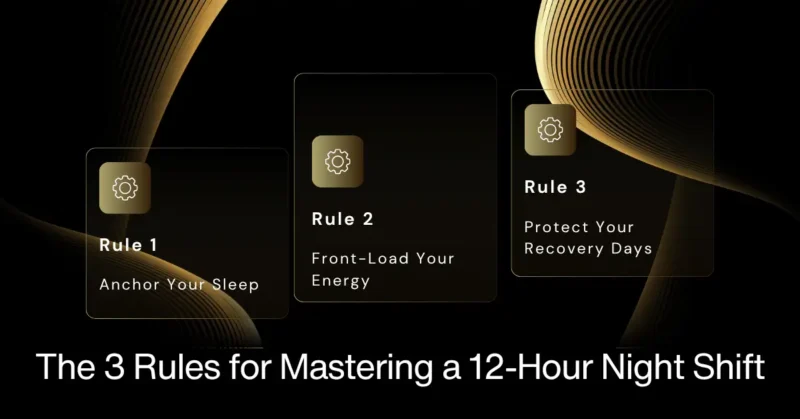
Rule 1: Anchor Your Sleep
Your priority is protecting a reliable block of daytime sleep.
For example, a nurse finishing at 7 a.m. might aim for a core sleep window around 8 a.m. to 3 p.m., depending on personal needs and circumstances.
You do not have to copy this exact timing. The key is to create a repeatable sleep period that gives you enough time to rest.
NIOSH recommends going to bed soon after arriving home rather than using the early morning for chores and errands.
Make your bedroom as sleep-friendly as possible:
- Keep the room dark.
- Reduce noise where possible.
- Keep the room comfortably cool.
- Put your phone on a quiet or do-not-disturb setting.
- Tell household members when your protected sleep period is.
- Avoid turning the first hours after work into your main time for socializing or chores.
If you need to catch up on sleep, a nap before your next shift may also help. Planned naps are one strategy recognized in shift-work guidance for improving alertness.
Rule 2: Front-Load Your Energy
Do not wait until 3 a.m. to think about energy.
Your best strategy is to prepare before work and maintain steady energy during the first half of the shift.
That means:
- Eat a sensible meal before work.
- Hydrate throughout the shift.
- Plan food before hunger becomes extreme.
- Use caffeine strategically if you tolerate it.
- Take appropriate breaks.
- Use movement to break up long periods of standing or sitting.
Caffeine can temporarily improve alertness, but it should not replace adequate sleep. The 2025 AASM guideline also cautions that caffeine used too close to daytime sleep may interfere with sleep.
Rule 3: Protect Your Recovery Days
Four days away from the hospital does not necessarily mean four days of unrestricted activity.
After three 12-hour nights, your first day off may need to be a recovery day, not a day packed with errands, appointments, overtime, housework, and social commitments.
NIOSH specifically recommends considering two rest days after three consecutive 12-hour shifts.
Think of your days off as part of the schedule—not something that happens after the schedule.
A Simple 7 p.m.–7 a.m. Night Shift Schedule for Nurses
| Day | Work Schedule |
| Monday | 7 p.m.–7 a.m. |
| Tuesday | 7 p.m.–7 a.m. |
| Wednesday | 7 p.m.–7 a.m. |
| Thursday | Recovery day |
| Friday | Day off |
| Saturday | Day off |
| Sunday | Day off |
This is an example, not a prescription. A nurse with a different commute, family schedule, shift start time, or sleep requirement may need to move each block.
3–4 Hours Before the Shift: Prepare Your Body
The shift really starts before you enter the hospital.
After waking, drink some water and give yourself enough time to eat, get ready, and mentally switch into work mode.
A balanced meal before work can help prevent arriving at the hospital already hungry.
This is also a good time to prepare food for the night. Packing your own meal and snacks makes it easier to avoid relying entirely on vending machines, cafeteria food, or whatever is available during a busy shift.
If you use caffeine, consider having most of it earlier in the shift rather than drinking it continually toward morning. Individual tolerance varies, and caffeine too close to daytime sleep may make it harder to sleep after work.
7 p.m.–11 p.m.: Start Strong
The first few hours are your opportunity to establish a steady pace.
Rather than starting the night with a large amount of caffeine or sugary food, focus on staying hydrated, eating a planned meal, and taking regular breaks when your workplace allows them.
You may also find it easier to manage your energy if you don’t wait until you are extremely hungry or exhausted before taking a break.
NIOSH guidance emphasizes the value of regular breaks during demanding work, with additional attention to breaks for evening and night workers.
11 p.m.–2 a.m.: Maintain Energy
This is a good time to avoid the common mistake of treating the shift like a series of emergencies.
Continue drinking fluids regularly. Eat your planned meal or snack instead of grazing continuously on sweets.
If possible, include a combination of foods such as:
- Protein-rich foods
- Whole grains or other carbohydrate sources
- Fruit or vegetables
- Nuts or seeds
- Yogurt or another convenient option
The goal is not a special “night shift diet.” It is simply to make your food predictable enough that hunger does not dictate every decision at 2 or 3 a.m.
2 a.m.–6 a.m.: Survive the Night-Shift Red Zone
For many night workers, this is the hardest part of the shift.
Your body naturally pushes you toward sleep, even though you still have several hours of work ahead.
This is when practical strategies matter most.
If your workplace permits it, use your scheduled break to:
- Get away from your workstation briefly.
- Drink some water.
- Walk or stretch.
- Eat a planned snack if needed.
- Get appropriate light exposure in your work environment.
- Reset mentally before returning to your duties.
AASM research supports planned naps and appropriately timed light exposure as strategies that can improve alertness during night work.
Do not interpret tiredness as a signal to push harder. If you become dangerously sleepy or unable to perform your duties safely, follow your workplace’s fatigue and safety procedures and tell the appropriate supervisor.
6 a.m.–7 a.m.: Finish Safely
The end of a 12-hour night shift is not the time to switch off mentally.
You may be tired, and the journey home can occur during a period when alertness is naturally low.
Finish essential tasks, hydrate, and prepare for the trip home.
If you are too sleepy to drive safely, do not treat caffeine as a guaranteed solution. Use a safer transportation option or follow an appropriate fatigue-management plan.
What to Do Immediately After a 12-Hour Night Shift
One of the biggest mistakes is turning the period after work into a second shift.
You arrive home at 7:30 or 8 a.m. and suddenly remember:
- Laundry needs doing.
- Groceries need buying.
- Emails need answering.
- The house needs cleaning.
- Someone needs a favor.
If you do everything before sleeping, your sleep opportunity can disappear.
NIOSH specifically advises night nurses to go straight to bed when they get home and avoid using the early morning for chores or errands.
A simple post-shift routine might look like this:
7:30 a.m. — Arrive home
Drink some water and keep your environment calm.
7:45 a.m. — Small snack if genuinely hungry
If you have not eaten for several hours, a small meal or snack may be more comfortable than going to bed extremely hungry. NIOSH gives a small protein-and-carbohydrate meal as an example.
8:00 a.m.—Wind down
Keep lights and stimulation low.
8:30 a.m. — Sleep
Treat this period as protected time.
The less unnecessary activity you place between the end of your shift and your bed, the easier it may be to protect your sleep opportunity.
The Best Sleep Strategy Between Three Consecutive Night Shifts
Suppose your shifts are:
Monday night → Tuesday morning
Tuesday night → Wednesday morning
Wednesday night → Thursday morning
A practical sleep pattern could look like this:
| Day | Sleep & Recovery Plan |
| Monday | Wake around 2–3 p.m.; optional pre-shift nap; work 7 p.m.–7 a.m. |
| Tuesday | Sleep around 8 a.m.–3 p.m.; prepare for the next shift. |
| Wednesday | Sleep around 8 a.m.–3 p.m.; prepare for the next shift. |
| Thursday | Sleep after the final shift; keep the rest of the day focused on recovery. |
| Friday | Gradually return to your preferred days-off sleep routine. |
| Saturday | Normal sleep and daily activities |
| Sunday | Prepare for the next night-shift block. |
Again, the clock times are examples. Your sleep needs and circumstances may require a longer sleep window, a different wake time, or an extra nap.
NIOSH recommends keeping sleep timing as consistent as practical and warns that repeatedly switching completely between daytime and nighttime schedules can make adjustment difficult.
Your First Day Off: Recover, Don’t Overload Yourself
The first day after your final night shift is different from an ordinary day off.
You have just completed three long nights.
Instead of scheduling everything you could not do during the workweek, give yourself room to recover.
A Practical First-Day-Off Schedule
| Time | What to Do |
| 7–8 a.m. | Arrive home |
| 8–8:30 a.m. | Have a light snack if needed. |
| 8:30 a.m.–2 or 3 p.m. | Main sleep period |
| 3 p.m. | Wake up, hydrate, and eat. |
| 4–6 p.m. | Light activity or essential errands |
| Evening | Relax and prepare for your next sleep period |
You don’t have to force yourself to stay awake all day just because it is your first day off.
NIOSH warns against staying awake for an excessively long period after the final night shift because prolonged wakefulness can increase short-term safety risks.
Your Second Day Off: Recovery + Real Life
The second day off can be your more flexible day.
This is a good time for:
- Family activities
- Shopping
- Appointments
- Exercise
- Meal preparation
- Household tasks
- Social activities
You can gradually move your sleep schedule toward the routine you want for your days off, rather than making an extreme switch overnight.
Some nurses may prefer to maintain more nighttime sleep on their days off. Others may find a compromise schedule easier.
NIOSH describes a compromise approach in which some daytime sleep hours remain consistent while off days shift partly toward nighttime living.
No single schedule works equally well for every nurse.
Your Third Day Off: Prepare for the Next 3×12 Block
Don’t let your third day off become another stressful workday.
Use part of it to prepare for the next block:
- Pack work meals.
- Refill your water bottle.
- Prepare comfortable work clothes.
- Check your upcoming shifts.
- Finish essential errands.
- Organize transportation.
- Plan your sleep window.
- Set aside time for a pre-shift nap if you use one.
Preparation removes small decisions from the next three nights.
That matters because a tired nurse should not have to solve every problem at 6 p.m. before heading to work.
What to Eat on a 12-Hour Night Shift
There is no magic night-shift menu.
The practical goal is to make meals predictable, satisfying, and easy to manage during a long shift.
Pre-Shift Meal
Have a normal meal before leaving for work.
For example:
Option 1: Chicken, rice, and vegetables
Option 2: Eggs, whole-grain toast, fruit, and yogurt
Option 3: Beans, vegetables, and a whole-grain carbohydrate
Option 4: A sandwich with a protein filling plus fruit
The exact meal matters less than having something you can tolerate comfortably before a long shift.
Overnight Meal and Snacks
Instead of waiting until 3 a.m. and eating whatever is available, pack your food ahead of time.
A simple overnight combination could include:
- Yogurt and fruit
- Nuts and fruit
- A whole-grain sandwich
- Cheese and whole-grain crackers
- A small rice or grain bowl with protein
- Cut vegetables with a suitable dip.
Try not to make large sugary snacks your primary source of overnight energy. A more balanced meal or snack may provide steadier fuel than repeatedly reaching for highly sugary foods.
Post-Shift Snack
If you are hungry after work, keep the meal relatively simple.
A small snack containing protein and carbohydrates can be an option before sleep. NIOSH specifically gives a small protein-and-carbohydrate meal as an example when hunger would otherwise interfere with sleep.
If you are not hungry, you do not need to force yourself to eat simply because the shift has ended.
Caffeine, Light, Movement, and Hydration: Your Energy Toolkit
Think of these as tools—not substitutes for sleep.
Caffeine
Caffeine can help alertness during night work, but timing matters.
If you drink caffeine throughout the entire night, you may still have significant amounts in your system when you are trying to sleep in the morning.
The AASM’s 2025 shift-work guidance notes that caffeine can improve alertness in some circumstances while also warning that caffeine too close to daytime sleep can disturb sleep.
Light
Light is one of the strongest signals affecting the body’s circadian system.
Appropriately timed light exposure can support nighttime alertness, while reducing morning light exposure may make it easier for some night workers to transition toward daytime sleep.
For personal treatment of a sleep or circadian disorder, however, discuss light therapy with an appropriate healthcare professional rather than treating it as a one-size-fits-all solution.
Movement
You do not need a full workout during every shift.
Short periods of walking, stretching, or gentle movement during appropriate breaks can help you avoid remaining in one position for too long.
You can do your main exercise session on a day when you have more energy and time to recover.
Hydration
Keep water accessible and drink regularly, based on your needs and workplace conditions.
Don’t wait until you are extremely thirsty to think about fluids.
At the same time, avoid drinking so much right before bed that frequent bathroom trips interrupt your daytime rest.
The 7 things that can ruin a 3-day night shift schedule
1. Flipping Your Sleep Schedule Completely Every Few Days
A dramatic change from daytime sleep to nighttime sleep can make the transition harder.
A compromise schedule may be easier for some people than repeatedly switching between two completely different sleep patterns.
2. Staying Awake All Day Before the First Night Shift
This may seem like a way to “prepare” for working overnight, but it can leave you awake for too many hours.
Consider getting normal sleep and, if it works for you, using a pre-shift nap instead.
3. Using Caffeine All Night
More caffeine is not always better.
Too much or poorly timed caffeine can disrupt daytime sleep, creating a cycle of poor sleep followed by greater reliance on caffeine.
4. Making 3 a.m. the Main Meal
A huge meal in the middle of the night may leave some people uncomfortable or sluggish.
Plan your main meal and overnight snacks instead of letting extreme hunger decide what you eat.
5. Turning Every Day Off Into a Workday
Four days off can tempt you to accept overtime, complete every household task, and fill every available hour.
Recovery is also productive.
6. Ignoring Breaks
A 12-hour shift is not a test of how long you can go without sitting down, drinking water, or eating.
Where workplace conditions allow, take your scheduled breaks. NIOSH emphasizes regular breaks to reduce fatigue-related risks.
7. Driving Home When You Are Dangerously Sleepy
This may be the most serious mistake to avoid.
If you are struggling to keep your eyes open or feel unable to drive safely after a night shift, do not simply assume you can “push through.”
When possible, arrange a safer way home.
How to Prevent Burnout and Overtime Fatigue
Burnout is not solved by one perfect sleep schedule.
A better approach is to reduce the number of things constantly competing for your limited recovery time.
Start by looking at your week as a whole.
If you work three 12-hour nights, ask:
Where is my sleep?
Where is my recovery?
Where is my family time?
Where is my exercise?
Where are my meals prepared?
Where are my genuinely free hours?
If every hour outside work is already occupied, the problem may not be your productivity. You may not have enough recovery time.
NIOSH notes that long shifts and long stretches of work can build fatigue and recommends considering ‘What Does a 3-Day Night Shift Schedule for Nurses Look Like?’
Then show something like:
| Monday | 7 p.m.–7 a.m. |
| Tuesday | 7 p.m.–7 a.m. |
| Wednesday | 7 p.m.–7 a.m. |
| Thursday | Recovery day |
| Friday | Day off |
| Saturday | Day off |
| Sunday | Day off |
Three straight 12-hour shifts are followed by two rest days.
If possible, avoid repeatedly adding overtime immediately after a demanding block of night shifts.
When Night-Shift Fatigue Is More Than Normal Tiredness
Some tiredness is expected after a long night shift.
However, persistent or severe problems deserve attention.
If you frequently have issues like these, think about consulting a healthcare provider:
- Extreme sleepiness despite having enough opportunity to sleep
- Repeated difficulty falling or staying asleep during the day
- Unintentional dozing at work or while travelling
- Regularly feeling unsafe to drive home.
- Persistent problems concentrating
- Fatigue that continues to interfere with normal life
Do not try to diagnose yourself from an article.
Shift work can interact with sleep disorders, medications, mental health, medical conditions, and other factors. A healthcare professional can help determine whether something beyond a difficult work schedule may be contributing.
Tools That Make 12-Hour Night Shifts Easier
You do not need dozens of products to manage a night shift.
A small toolkit is often enough.
Sleep Toolkit
- Blackout curtains or another way to darken the bedroom
- Comfortable eye mask if useful
- Earplugs or white noise if appropriate
- Do-not-disturb settings
- A consistent sleep routine
Work Toolkit
- Reusable water bottle
- Packed meals
- Planned snacks
- Comfortable shoes suitable for your workplace
- Small movement or stretching routine
- Caffeine plan if you use caffeine
Planning Toolkit
Keep a simple weekly schedule showing:
Work nights → Sleep → Meals → Exercise → Recovery → Personal commitments
Seeing the entire week on one page can make it easier to notice when you are scheduling too much activity around three demanding shifts.
Daily Routine for Work Days
- 8:00 AM – 3:30 PM: Core sleep (7.5 to 8 hours in a dark, cold room)
- 4:00 PM – 6:00 PM: Get up, have a healthy breakfast, do some mild exercise, or do some housework.
- 7:00 PM – 7:00 AM: Work shift (hydrate, eat protein-rich snacks, take a quick nap if permitted)
- 7:00 AM – 8:00 AM: Commute home wearing sunglasses to limit exposure to bright morning light.
Tips for Managing Days Off
- Avoid the full flip: On your first day off, sleep for only 3 to 4 hours, then stay awake until a normal bedtime or go to bed slightly early. Switching between a daytime schedule and a night schedule every week causes severe sleep fatigue.
- Block your shifts: Keep your three work days grouped so your body gets used to a rhythm and your 4-day break remains truly restful.
FAQ: How to Master the 12-Hour Shift 3x a Week
Q. How much sleep should nurses get between 12-hour night shifts?
No single sleep duration works for every adult, but nurses should protect enough time for adequate sleep rather than treating daytime sleep as optional.
NIOSH recommends protected off-duty time that allows workers to obtain 7–8 hours of sleep and emphasizes getting enough sleep regularly.
Q. Should I stay on a night-shift sleep schedule on my days off?
Not necessarily. Some nurses find a mostly consistent night-oriented schedule easier, while others use a compromise schedule to spend more time with family and participate in daytime activities.
NIOSH warns that repeatedly switching completely between night work and daytime living can make adjustment difficult.
Q. How do you avoid burnout working 3×12 nights?
Protect sleep first, avoid filling every day off with obligations, prepare meals and work items in advance, use breaks, and give yourself genuine recovery time after the final shift.
Three consecutive 12-hour shifts can build fatigue, so treat recovery as part of the schedule.
Q. What is the best meal timing for a 12-hour night shift?
A practical approach is to eat a normal meal before work, use a planned meal or snacks during the shift, and have a small post-shift snack only if you are hungry before sleeping. Individual food needs vary, so focus on meals you tolerate well and can maintain consistently.
Q. How can nurses stay awake during the 2 a.m. to 6 a.m. fatigue period?
Plan rather than waiting until you are exhausted. Use scheduled breaks, appropriate light exposure, hydration, movement, and carefully timed caffeine if you use it.
A pre-shift nap can also help some night workers. Evidence summarized by the AASM supports planned naps and appropriately timed light exposure to improve alertness during night work.
Q. What is the ideal daily schedule for employees who work nights?
The optimal daily schedule for night shift workers starts with a rigid 8-hour sleep block, anchors energy with well-planned meals, naps before work, and total darkness.
A workable schedule for a typical shift of 11 PM to 7 AM or 7 PM to 7 AM follows this structure.
A Simple 3×12 Night Shift Blueprint
If you want one simple system to remember, use this:
BEFORE WORK
Sleep → Wake → Hydrate → Eat → Prepare → Optional nap → Work
DURING WORK
Meal → Hydrate → Break → Work → Planned snack → Break → Manage the 2–6 a.m. fatigue period
AFTER WORK
Commute safely → Small snack if hungry → Wind down → Sleep → Protect your recovery.
AFTER THE THIRD SHIFT
Recover first → Gradually return to your preferred days-off routine → Handle normal life → Prepare for the next 3×12 block.
This is the basic operating system behind a sustainable night-shift routine.
Conclusion on Mastering a 3-Day Night Shift Schedule for Nurses
A 3-day night shift schedule for nurses can work well when you don’t treat the four days away from work as four extra days to fill.
The real goal is to make the entire week work together.
Anchor your sleep. Front-load your energy. Plan your meals. Use breaks. Prepare for the 2–6 a.m. fatigue period. Protect your first recovery day. And avoid turning every day off into another workday.
No perfect 3×12 routine fits every nurse. Your shift time, commute, family responsibilities, sleep needs, workplace demands, and personal preferences all matter.
Start with a simple schedule, test what works for you, and adjust it without sacrificing the basics: adequate sleep, safe work, sensible meals, and enough recovery time.
Read more about night shift workers’ health.