

Find the best exercises for nurses to stay fit on shifts, boost energy, protect your back, and recover better, even during long 12-hour shifts.
Nursing is physically demanding. Nurses spend hours walking, standing, bending, lifting, pushing equipment, and helping patients move. With 12-hour, rotating, or night shifts, finding time for a traditional workout can be difficult.
You don’t need a long gym session. Short, functional exercises can support strength, mobility, posture, energy, and recovery without adding unnecessary fatigue.
A few minutes of movement during breaks, strength training on days off, and proper recovery can create a practical fitness plan for nurses.
Long hours can increase fatigue and reduce recovery time, while shift work can disrupt sleep and circadian rhythms. NIOSH warns that fatigue can affect focus, reaction time, memory, and judgment, increasing safety concerns.
The goal is not to train like an athlete. It is to build the strength, mobility, cardiovascular fitness, and recovery needed for demanding shifts.
What Are the Best Exercises for Nurses to Stay Fit on Shifts?
The best exercises are short, practical, and easy to do with little or no equipment. Good options include wall angels, squats, lunges, standing core exercises, calf raises, brisk walking, stair climbing, gentle stretches, and controlled breathing.
Choose exercises based on your energy and recovery. After a poor night of sleep, gentle mobility or walking may be better than an intense workout.
Best exercises = short, functional, low-equipment for energy and posture on 12-hour shifts
Think of your fitness routine as a toolkit, not one workout. Nurses need:
- Leg strength for walking and standing.
- Core strength for stability.
- Shoulder mobility for reaching and caring for patients.
- Cardiovascular fitness for physical endurance.
- Mobility and recovery to manage demanding shifts.
Exercises such as squats, lunges, wall angels, marching, calf raises, and core movements are easy to adjust to your fitness level.
Even a two-minute movement break can help break up long periods of standing, sitting, or repetitive movements. NIOSH also includes exercise and stretching among activities nurses can use during appropriate rest breaks.
The goal is functional fitness—feeling stronger and moving better without making the rest of your shift harder.
Quick Exercises for Nurses During Shift in 30 Seconds
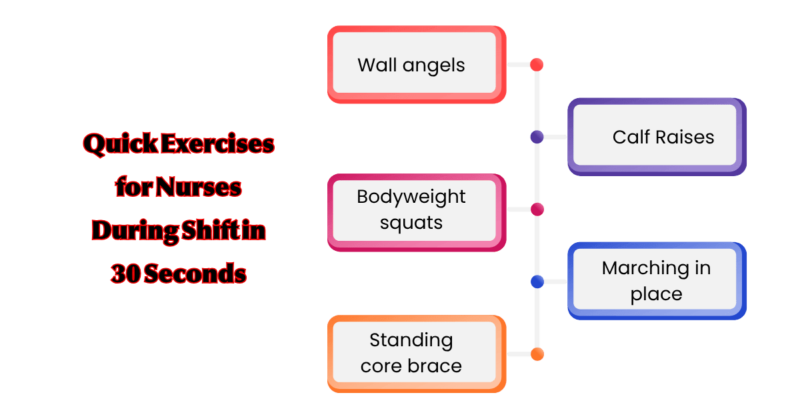
If you only have 30 seconds to decide what to do, start with these five:
- Wall angels: open the chest and move the shoulders.
- Bodyweight squats: strengthen the legs and hips.
- Standing core brace: improves trunk stability.
- Calf raises: activate the lower legs after long periods of standing.
- Marching in place: raise your heart rate without needing equipment.
For a longer break, combine them into a five-minute routine. Keep the movements controlled rather than rushing through them.
The aim is to leave the break feeling more mobile and alert, not exhausted.
Posture and Stretching Breaks
- Neck and Shoulder Tilts: To relieve charting-related tension, gently turn your ear toward your shoulder and hold for 20 seconds.
- Upper Back Stretch: To stretch tight muscles and round your upper back, interlace your fingers in front of your chest and press your arms forward.
- Brisk Walking: Take short, fast walks down the hospital hallway or use the stairs when time permits.
Recovery on Days Off
- Strength Training: Focus on full-body strength workouts (like glute bridges, planks, and light deadlifts) 2 to 4 times a week for 30 minutes.
- Prioritize Rest: Avoid punishing your body with intense cardio if you are exhausted from 12-hour shifts; opt for light mobility or yoga instead.
Why Nurses Need a Special Shift Work Fitness Strategy
- Nurses may work day, evening, night, weekend, overtime, or rotating shifts.
- Unlike regular daytime workers, nurses may not have a consistent time for exercise.
- Long hours and shift work can reduce recovery time and disrupt sleep and circadian rhythms.
- NIOSH links long work hours and shift work with fatigue, discomfort, unhealthy habits, and safety risks.
- For this reason, nurses’ shift-work fitness should be flexible.
- Choose workouts based on your sleep, energy, workload, and recovery rather than following the same routine every day.

How 12-hour shifts affect fatigue, circadian rhythm, and metabolism
- Your circadian rhythm controls your body’s natural sleep-wake cycle.
- Night shifts require you to stay alert when your body may naturally prepare for sleep.
- Daytime sleep may also be shorter or less restful for some night-shift workers.
- A 12-hour shift leaves less time for commuting, meals, family responsibilities, exercise, and sleep.
- NIOSH reports higher risks of accidents and errors with night work and extended shifts.
- Regular exercise can still support fitness, but exercise intensity should match your recovery.
- After good sleep, a short strength workout may be suitable.
- After poor sleep, choose light walking, mobility, or recovery instead.
- Exercise cannot replace sleep. When you are very tired, prioritize sleep, hydration, food, and recovery.
Common Nurse Injuries: Back Pain, Posture, Burnout, and Lack of Energy
- Back, neck, and shoulder problems are common concerns among nurses.
- A 2024 review of more than 21,000 nursing staff in China estimated a 79% prevalence of work-related musculoskeletal disorders.
- Common risk factors include patient handling, awkward positions, repetitive movements, workload, and workplace ergonomics.
- Exercise can be part of a broader strategy to reduce discomfort and improve physical fitness.
- A 2024 review found that exercise programs can help reduce low back pain among nursing staff.
- Build strength and mobility gradually rather than pushing through pain or severe fatigue.
- Exercise should support, not replace, safe patient handling, proper equipment, rest, and workplace safety practices.

7 Best Exercises for Nurses to Stay Fit on Shifts
These exercises target common nursing demands: prolonged standing, walking, reaching, bending, lifting, and maintaining control when tired.
They are not intended to diagnose or treat an injury. If an exercise causes sharp pain, unusual weakness, dizziness, numbness, chest pain, or worsening symptoms, stop and seek appropriate medical advice.
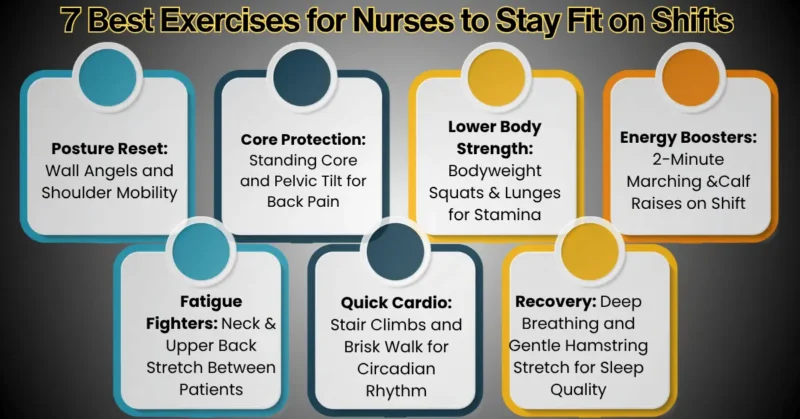
1. Posture Reset: Wall Angels and Shoulder Mobility
Stand with your back against a wall if comfortable. Keep your ribs relaxed rather than forcing your lower back flat, then slowly move your arms upward and downward like you’re making a snow angel. Don’t force your hands or elbows against the wall.
Try 6–10 slow repetitions.
Wall angels are useful because nursing can involve prolonged forward-reaching positions, charting, computer work, patient care, and repeated shoulder movements.
The exercise gives you a simple way to move the shoulders through a controlled range of motion.
You can also add gentle shoulder rolls between patients or during an appropriate break.
Think of this as a posture reset, not a punishment for having “bad posture.” You don’t need to maintain a single perfect posture all day. Regularly changing position and moving comfortably is often more practical.
If you have shoulder pain or a known shoulder condition, reduce the range of motion and ask a physiotherapist for individualized guidance.
2. Core Protection: Standing Core and Pelvic Tilt for Back Pain
A strong core isn’t just about visible abdominal muscles. For nurses, it means keeping the trunk stable while the rest of the body moves.
For a simple standing version, stand tall with your feet about hip-width apart.
Gently tighten your abdominal muscles as though preparing for a light tap to the stomach, breathe normally, hold for 5–10 seconds, and release. Repeat 5–8 times.
You can also practice gentle pelvic tilts when appropriate and comfortable.
Do not brace so aggressively that you stop breathing. The goal is controlled support, not stiffness.
Exercise programs that include back and trunk training have shown potential benefits for nurses with low back pain, but the correct exercise depends on the individual and the cause of the pain.
If back pain travels down the leg, is accompanied by numbness or weakness, follows a significant injury, or is severe or persistent, don’t simply add more core exercises. Get assessed by a qualified healthcare professional.
3. Lower Body Strength: Bodyweight Squats and Lunges for Stamina
Nurses spend a tremendous amount of time on their feet. Strong hips and legs can make everyday movement feel less demanding.
Stand with your feet about shoulder-width apart. Bend your knees, push your hips back, and lower only as far as you can manage comfortably. Next, press through your feet to stand.
Start with 8–12 repetitions.
If lunges feel comfortable, try a small reverse lunge instead of stepping forward. Step one foot backwards, lower slightly, and return to standing. Hold onto a stable surface if balance is an issue.
These movements train the hips, thighs, and glutes. You can also progress them later with resistance bands, dumbbells, or other equipment on an off-day.
You don’t need to do squats in the middle of a busy clinical area. Use them during an appropriate break or as part of your off-duty training.
4. Energy Boosters: 2-Minute Marching and Calf Raises on Shift
When you have been standing in one position or sitting for documentation, gentle movement can be an easy reset.
March in place for 30–60 seconds, keeping the movement comfortable. Follow it with 10–20 controlled calf raises, lifting your heels and slowly lowering them again.
Repeat once if you have time.
This is one of the easiest quick workouts for nurses on shift because it needs almost no space or equipment. You can also modify it: walk down a corridor at a purposeful pace, take stairs when appropriate, or change position and move your ankles and legs.
Keep in mind that being active at work does not guarantee that you are getting enough exercise overall.
According to WHO guidelines, adults should do muscle-strengthening exercises at least twice a week, in addition to at least 150 minutes of moderate-intensity aerobic activity or an equivalent amount of vigorous activity.
Small bouts can contribute, but your overall weekly pattern matters.

5. Fatigue Fighters: Neck and Upper Back Stretch Between Patients
Neck and upper-back tension can build quietly during a long shift. You may not notice it until your shoulders feel heavy or your neck becomes stiff.
For a gentle stretch, sit or stand tall and slowly tilt your head toward one shoulder without lifting the opposite shoulder. Hold for about 10–20 seconds, then return to neutral. Repeat on the other side.
For the upper back, clasp your hands in front of you and gently reach forward, letting your upper back round slightly. Do not force the stretch.
These movements should feel mild. Stretching should not create sharp pain, tingling, or numbness.
This is especially useful during a scheduled break, when you can briefly step away from clinical tasks. NIOSH recommends protecting rest breaks because adequate breaks can reduce injury and error risks, with additional attention needed for evening and night-shift workers who may have poorer sleep.
6. Quick Cardio: Stair Climbs and Brisk Walk for Circadian Rhythm
Walking is one of the most practical forms of cardiovascular exercise available to nurses. You don’t need special equipment, a gym membership, or an hour of free time.
During an appropriate break, a brisk 5–10-minute walk can provide useful movement. If your workplace permits it and you are adequately rested, climbing stairs can add intensity.
But don’t confuse a temporary increase in alertness with treatment for severe fatigue. Exercise cannot make it safe to continue working when you are dangerously sleepy.
For night-shift nurses, the timing also matters. If vigorous exercise makes you feel stimulated when you are preparing for daytime sleep, choose a gentler walk or mobility session instead.
The broader goal is to build cardiovascular activity across the week, not to turn every work break into a cardio test.
7. Recovery: Deep Breathing and Gentle Hamstring Stretch for Sleep Quality
After a demanding shift, your body may still feel as though it is “on duty.” A recovery routine can help you transition from work mode to rest mode.
Sit or stand comfortably. Take slow breaths, letting your abdomen and lower ribs expand naturally, without forcing a huge inhale. Then do a gentle hamstring stretch with your knee slightly bent, rather than aggressively reaching for your toes.
Spend 2–5 minutes moving slowly.
This is particularly useful after a night shift when your priority is often recovery rather than another hard workout. It does not guarantee better sleep, but it can become a consistent wind-down habit.
And remember: if you are severely sleep-deprived, sleep takes priority over exercise. NIOSH emphasizes that fatigue can impair reaction time, concentration, memory, and judgment, which makes fatigue management a workplace safety issue rather than simply a fitness issue.
5-Minute On-Shift Workout Routine for Nurses
You don’t need a full gym session to build movement into a shift.
A simple five-minute routine can look like this:
| Time | Exercise | Purpose |
| 1 minute | March in place | Warm up and increase movement. |
| 1 minute | Wall angels | Shoulder mobility and posture |
| 1 minute | Squats | Leg and hip strength |
| 1 minute | Calf raises + standing core brace | Lower-leg and trunk strength |
| 1 minute | Gentle breathing + upper-back stretch | Reset and recovery |
The routine should feel easy to moderate, not exhausting. If your unit is busy and patient needs come first, do exercises only during an appropriate break and in a safe area.
Before the shift activation routine
Before starting a shift, spend a few minutes preparing the joints and muscles you will use most.
Try 10 shoulder rolls, 10 gentle bodyweight squats, 20 seconds of marching, 5 standing core braces, and several ankle movements.
If you are starting a night shift after adequate sleep, this can be a useful activation routine. If you are already exhausted before arriving at work, don’t interpret that exhaustion as something you must “exercise away.”
Your pre-shift routine should prepare you, not drain you.
During shift, do micro-workouts for energy and posture
The easiest way to make shift-work exercises sustainable is to attach them to existing breaks.
For example, after sitting for documentation, perform a few shoulder movements. After a meal break, walk briefly if appropriate. During longer rest periods, do a few squats and calf raises.
These micro-workouts are optional additions to genuine rest. They should never replace a meal, hydration, bathroom break, or necessary recovery.
NIOSH specifically recommends rest breaks for nurses and notes that exercise or stretching can be included as part of an enriched break.
After-shift recovery stretch for sleep and burnout prevention
After a day shift, you may have enough energy for a normal workout later. After a night shift, the calculation can be completely different.
If you feel reasonably alert, a gentle walk or mobility session may be appropriate. If you’re struggling to keep your eyes open, prioritize getting home safely and sleeping.
Never use exercise to delay sleep when you are dangerously fatigued. If you’re too tired to drive safely after a shift, choose a safer transportation option instead of trying to “wake yourself up” with exercise or caffeine.
Off-Day Strength Plan for Nurses: 20-Minute Functional Fitness
On an off day, you have more room to build actual strength. A simple 20-minute session can include squats, reverse lunges, wall or countertop push-ups, resistance-band rows, hip hinges, and a standing or floor-based core exercise.
Perform each movement for 8–12 controlled repetitions, rest as needed, and complete two rounds. Start with fewer if you are new to exercise.
The purpose is functional fitness, not exhaustion. Over several weeks, you can gradually increase repetitions, resistance, or rounds.
WHO recommends muscle-strengthening activity involving major muscle groups on at least two days each week, alongside aerobic activity.
For nurses, this can create a simple weekly structure: use short mobility and movement sessions during workdays, then perform more complete strength training on selected days off.
The plan should flex with your roster. A nurse who has just completed several demanding night shifts may need a recovery day before strength training.
Focus on mobility and core strength to protect your back.
A practical off-day session can combine hip mobility, thoracic rotation, gentle hamstring mobility, glute strengthening, and trunk exercises.
But back pain is not always a weakness problem. Pain can have many causes, and the correct exercise depends on the person.
Research supports exercise as one useful approach for nursing-related low back pain. Still, systematic reviews also emphasize that musculoskeletal problems are multifactorial and may require broader workplace and ergonomic strategies.
What to avoid when you’re exhausted
Avoid turning severe fatigue into a test of willpower.
Heavy lifting, complicated exercises, maximal-effort intervals, or technically demanding movements are poor choices when you are severely sleep-deprived. Fatigue can affect judgment and reaction time, so the risk is not just sore muscles—it can be reduced movement quality and poorer decision-making.
Likewise, a hard workout right before a night shift isn’t automatically beneficial. Some nurses may tolerate it well, while others may arrive at work already depleted.
Use a simple traffic-light system:
- Green: slept well, feel normal → strength or cardio may be appropriate.
- Yellow: tired but functional → choose moderate exercise or mobility.
- Red: severely sleepy, dizzy, ill, unusually weak, or struggling to concentrate → skip the workout and recover.
This approach is far more sustainable than forcing the same routine every day.
Expert Tips and Safety for Nurse Fitness
- Get personalized advice: A physiotherapist or qualified exercise professional can help tailor exercises for persistent pain, previous injuries, weakness, medical conditions, or movement limits.
- Fitness is only one part of safety: Exercise works best alongside safe patient handling, proper lifting techniques, rest breaks, adequate sleep, hydration, nutrition, staffing, and sensible scheduling.
- Know when to stop: If you have chest pain, fainting, extreme dizziness, unexpected shortness of breath, new neurological problems, severe pain, or a significant injury, stop exercising and get medical help. Do not exercise through dangerous fatigue.
- Choose recovery over intensity: NIOSH warns that fatigue can affect attention, reaction time, memory, and judgment. This article provides general information, not personal medical advice. Nurses with health conditions, pregnancy, recent surgery, or exercise restrictions should seek appropriate professional guidance.
Summary: Quick, low-impact exercises such as wall push-ups, chair squats, and dead bugs can help nurses stay active and support back health during demanding shifts.
FAQs
Q. How can nurses stay fit while working 12-hour shifts?
Nurses can stay fit by combining short movement breaks during shifts with structured exercise on days off. Use brief mobility exercises, squats, calf raises, walking, and standing core work during appropriate breaks.
On days off, aim for two or more strength sessions each week plus regular aerobic activity, adjusting the plan when sleep or fatigue is poor.
Q. What quick exercises can nurses do during shifts?
Quick options include marching in place, wall angels, bodyweight squats, calf raises, shoulder rolls, gentle upper-back stretches, and standing core bracing.
A five-minute routine can be enough for a movement reset. Perform exercises only during appropriate breaks and in a safe area where they do not interfere with patient care.
Q. How can nurses prevent back pain on shift?
Regular strength and mobility training can be useful, particularly exercises involving the trunk, hips, and back.
However, back pain prevention also requires safe patient-handling practices, appropriate equipment, good workplace ergonomics, adequate recovery, and sensible workloads.
Exercise is not a replacement for safe lifting procedures or professional assessment when pain persists.
Q. Is it safe to exercise after a night shift?
It depends on your fatigue level. If you are alert and feel well, gentle exercise may be reasonable. If you are severely sleepy, dizzy, weak, or struggling to concentrate, prioritize recovery and sleep. Never use a workout as a way to compensate for dangerous sleep deprivation, particularly before driving home.
Q. Can exercise help nurses with shift-work fatigue?
Regular exercise supports fitness and well-being. But it cannot replace enough sleep. Short, moderate workouts may work better during busy shifts. Avoid intense exercise when you are very tired. Talk to a healthcare professional if fatigue is severe or continues.
Final Takeaway: Fit Nurses Provide Better Care
The best exercises for nurses to stay fit on shift aren’t necessarily the hardest ones. They are movements you can do safely and consistently around an unpredictable work life.
Use wall angels and mobility exercises to keep your shoulders moving. Build leg and hip strength with squats and lunges. Use simple core exercises for trunk control.
Walk or march when you need movement. Stretch gently during appropriate breaks, and treat recovery as seriously as exercise.
For nurses working 12-hour or night shifts, the biggest mistake is thinking that every day requires the same workout. Your body does not experience every shift the same way. Good nursing fitness adapts to sleep, fatigue, workload, and recovery.
Start small. A five-minute routine is better than a perfect one that never happens. Over time, combine on-shift movement with two or more weekly strength sessions and regular aerobic activity, based on what your health and schedule allow.
The goal isn’t to finish every shift feeling like you completed a boot camp. The goal is to build a body that can move, work, recover, and keep going without constantly running on empty.
Ready to stay stronger on shift? Start with these quick exercises today.
Read more about night shift workers’ health.