
Discover a simple, practical, a good night time routine to unwind, reduce stress, and improve sleep. Learn actionable steps, relaxing techniques, and habit-building tips for a healthier tomorrow.
Thank you for reading this post, don't forget to subscribe!Do you lie awake replaying work conversations in your head? Does tomorrow’s to-do list race through your mind when you should be sleeping? A good night time routine can change everything.
Quick Summary
A good night time routine is essential for restful sleep and a stress-free tomorrow. This guide shares a simple yet effective routine to help you leave work stress behind and wake up refreshed.
Reading time: 8 minutes | Key benefit: Better sleep & reduced stress
What Is a Good Night Time Routine?
A good night time routine is a consistent set of relaxing activities you perform before bed. It lets your body and mind know that it’s time to relax.
Think of it as a bridge between your busy workday and peaceful sleep. This routine isn’t about complicated rituals. It’s about creating personalized, calming activities that help you transition from work mode to rest mode.
The key is consistency. When you perform the same activities each night, your brain learns these signals mean sleep is coming. Falling asleep becomes easier, and sleep quality improves dramatically.
Benefits of a Good Night Time Routine
Improves Sleep Quality with a Good Night Time Routine
Quality sleep isn’t a luxury; it’s a necessity. A consistent night time routine transforms how you sleep and feel every morning.
When you follow a good night time routine, your body’s internal clock synchronizes. Your brain produces melatonin at the right time. Your muscles relax naturally.
Research shows people with bedtime routines fall asleep 20-30 minutes faster. They also experience fewer middle-of-the-night wake-ups and spend more time in deep, restorative sleep phases.
Better sleep means better everything: stronger immunity, improved memory, stable mood, and increased productivity.
Reduces Stress and Anxiety with a Good Night Time Routine
Work stress doesn’t have an off switch. But a good night time routine acts like a dimmer, gradually reducing intensity until you feel calm.

When you engage in relaxing routine activities, your body produces less cortisol (stress hormone) and more serotonin (feel-good hormone). It helps your nervous system transition from “fight or flight” to “rest and digest” mode.
Your routine creates a mental boundary between work and personal time. It says: “Work is over. This time is mine.”
This psychological separation is crucial, especially if you work from home or check emails at night.
Creating a Good Night Time Routine
Set a Consistent Bedtime Schedule for a Good Night Time Routine

Your body loves consistency. Going to bed and waking at the exact times daily works with your biology, not against it.
Determine your ideal wake-up time, then count backward 7-9 hours for your target bedtime. Add 45-60 minutes before that for your routine.
Action Steps:
- Choose your wake-up time and stick to it daily
- Set a reminder 60 minutes before bedtime
- Keep weekend schedules within one hour of weekday times
- Track sleep patterns for two weeks to find optimal timing
Wind Down with Relaxing Activities in a Good Night Time Routine
The transition from work to sleep shouldn’t be abrupt. You need a buffer zone filled with calming activities.
Think of your routine as layers of relaxation. Each activity should be more calming than the last. Start with moderately relaxing activities and end with the most soothing ones.
Avoid stimulating activities during this time—no work emails, heated discussions, intense exercise, or suspenseful TV shows.
Action Steps:
- List activities that currently relax you
- Arrange them from moderately calming to deeply soothing
- Eliminate anything that leaves you feeling energized
- Test different combinations to find what works best
Activities for a Good Night Time Routine
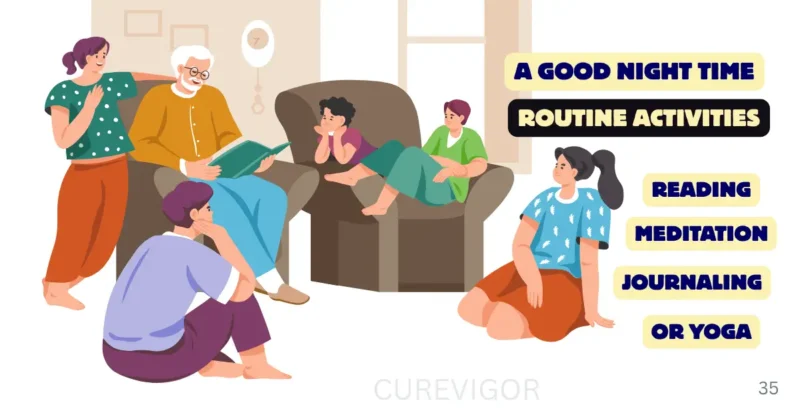
Reading, Meditation, or Yoga for a Good Night Time Routine
1. Reading for Relaxation
Reading occupies your mind, preventing work-stress rumination while promoting relaxation. Choose physical books over screens when possible.
Select calming content—save thrillers for daytime. At night, choose gentle fiction, poetry, or light non-fiction. Read for 15-30 minutes before sleep.
2. Meditation for Mind Clearing
Meditation doesn’t require special skills. It’s simply focused attention that calms your nervous system.
Start with just 5 minutes. Sit comfortably, close your eyes, and focus on your breath. When work thoughts intrude, gently return focus to breathing. Apps like Calm or Headspace offer helpful guided meditations.
3. Gentle Yoga for Physical Release
Simple, gentle stretches release physical tension accumulated during your workday. Focus on restorative poses rather than energizing ones.
Even 10 minutes of gentle stretching significantly improves sleep quality. Pay attention to areas where you hold tension—shoulders, neck, lower back.
Journaling or Writing for a Good Night Time Routine
4. Brain Dump Journaling
Your mind races at night because it’s trying to process the day. Journaling gives these thoughts a place to go outside your head.
Write everything on your mind without editing—work frustrations, tomorrow’s tasks, random thoughts. This externalization signals your brain that these thoughts are “stored.”
5. Gratitude Journaling
Write three to five things you’re grateful for from your day. They don’t need to be significant events. Small moments count.
This practice literally rewires your brain over time, strengthening neural pathways associated with positive emotions.
6. Tomorrow’s Planning
Spend 5-10 minutes writing your top three priorities for tomorrow. It creates clarity and eliminates anxiety about forgetting essential tasks.
Close your planner to signal “planning is complete.”
My Friend Teena’s Transformation
Teena, a 34-year-old marketing manager, used to lie awake replaying difficult client conversations. She’d check her phone repeatedly, reading emails and crafting responses.
Her sleep suffered. She woke exhausted and irritable.
Teena started a simple routine:
- 9:00 PM: Phone in another room
- 9:15 PM: Gentle yoga (10 minutes)
- 9:30 PM: Warm shower
- 9:45 PM: Brain dump journaling
- 10:00 PM: Read fiction (20 minutes)
- 10:30 PM: Lights out
The first week felt awkward. By week two, her body anticipated the routine. By week four, she fell asleep within 15 minutes.
Three months later: “I still experience work-related stress, but it no longer follows me to bed.
Personal Insight
I resisted bedtime routines for years. I thought I was too busy. What if someone emailed with an emergency?
Then I realized: there’s always another email. If I waited for work to be “done” before resting, I’d never rest.
Creating a good night time routine wasn’t about time management; it was about self-respect. “This is where work ends, and my life begins” is how I describe my routine.
The world didn’t end when I stopped checking emails after 9 PM. I actually became more effective because I was rested.
Making a Good Night Time Routine a Habit
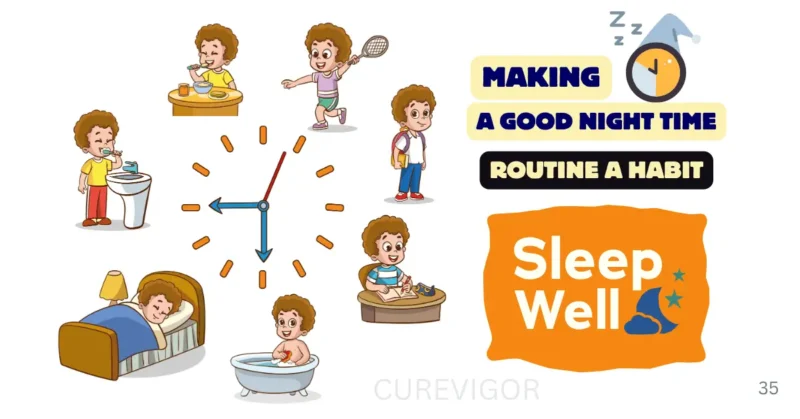
Tips for Sticking to Your Good Night Time Routine
1. Start Small
Don’t implement a perfect routine immediately. Begin with one or two activities and add more as these become habitual.
2. Create Environmental Cues
Place your phone charger in another room. Put your journal on your nightstand. Lay out your yoga mat. These visual cues trigger your routine automatically.
3. Use a Routine Trigger
Set a gentle alarm 60 minutes before bedtime. When it sounds, immediately begin your first routine activity.
4. Track Your Progress
Use a simple habit tracker. For each completed routine, mark it. Seeing successful days motivates you to continue.
Overcoming Common Obstacles in a Good Night Time Routine
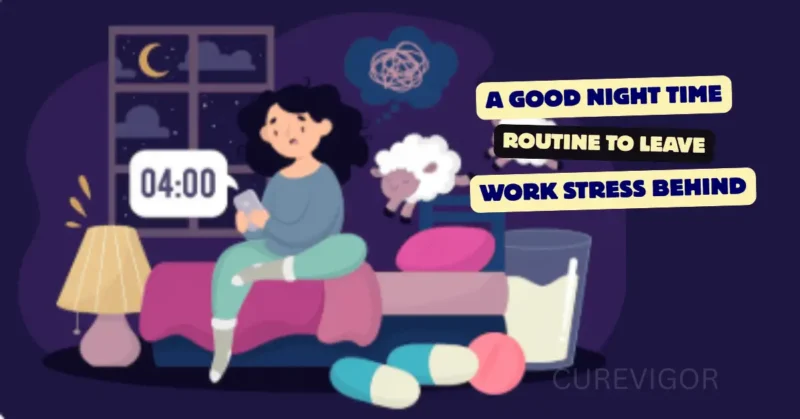
“I Don’t Have Time”
Poor sleep costs more time than a routine takes. Start with just 20 minutes. Better sleep makes you more efficient during waking hours.
“My Schedule Is Unpredictable.”
Maintain consistent routine activities even if timing varies. Start your routine at the same interval before bed, regardless of the actual time.
“I Get Distracted.”
Remove distractions before they tempt you. Set the phone to Do Not Disturb automatically. Use app blockers if needed.
“My Partner Has a Different Schedule”
Communicate your needs. Use sleep masks or earplugs if necessary. Create individual routines that can coexist.
Practical Checklist on a Good Night Time Routine
60 Minutes Before Bed:
- The phone is in another room or on airplane mode
- Dim lights throughout the home
- Stop all work-related activities
- Change into comfortable clothes
Routine Activities (Choose 3-4):
- Gentle stretching or yoga (10 minutes)
- Warm shower or bath
- Brain dump journaling (10 minutes)
- Gratitude journaling (5 minutes)
- Tomorrow’s planning (5 minutes)
- Reading (15-20 minutes)
- Meditation (5-10 minutes)
Final Steps:
- Set an alarm for tomorrow
- Ensure complete darkness
- Get into bed at the target time
Habits to Avoid
1. Making Your Routine Too Complicated
A 15-step routine will fail. Start with 3-4 simple activities.
2. Using Screens During Your Routine
Blue light and stimulating content disrupt melatonin and relaxation. Make your routine screen-free.
3. Starting Too Late
Begin 60 minutes before bedtime, not 15. Your body needs proper decompression time.
4. Including Stressful Activities
No work emails, news, or problem discussions. Only genuinely calming activities.
5. Giving Up Too Soon
Make a minimum commitment of 21 days. By weeks two or three, most people start to notice changes.
5-Step Action Plan: Get Started Right Now
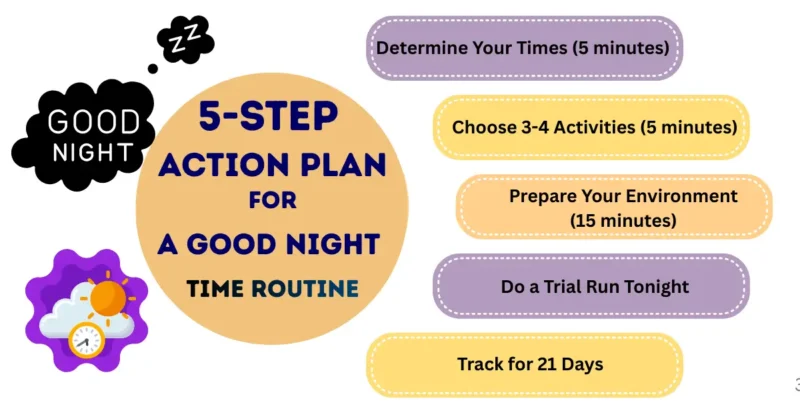
Step 1: Determine Your Times (5 minutes)
Calculate your target bedtime (7-9 hours before wake-up). Your routine starts 60 minutes before that.
Step 2: Choose 3-4 Activities (5 minutes)
Select activities from this article that appeal to you. Arrange from moderately calming to most soothing.
Step 3: Prepare Your Environment (15 minutes)
Move the phone charger outside the bedroom. Gather reading materials, a journal, and any needed supplies.
Step 4: Do a Trial Run Tonight
At your designated time, begin your routine exactly as planned. Notice what works and what needs adjusting.
Step 5: Track for 21 Days
Record routine completion and sleep quality daily. Review weekly and make minor adjustments as needed.
Advanced Tips for a Deeper, More Effective a Good Night Time Routine
- Create a sleep-conducive environment: cool room temperature (around 60–67°F / 15–19°C), blackout curtains, and comfortable bedding.
- Optimize your bed for comfort: mattress and pillow quality influence sleep quality more than you might realize.
- Consider a light exposure strategy: natural light in the morning helps regulate melatonin; dim evening lighting supports melatonin production.
- Use a short, soothing wind-down script: a 1-minute verbal cue that you are releasing the day and welcoming rest.
- Pair routine with stress-management tools: if your day was particularly stressful, add a brief journaling entry focused on your top 3 stressors and a plan to address them.
Sample Templates for a Good Night Time Routine
Template A (30–40 minutes)
- 5 minutes: dim lights, turn off or silence devices
- 10 minutes: warm shower or bath
- 10 minutes: gentle yoga or stretching
- 5 minutes: journaling
- 5 minutes: breathing exercises or meditation
- 0–5 minutes: prepare for tomorrow and lights out
Template B (15–20 minutes, for busy days)
- 3 minutes: quick breathing exercise
- 5 minutes: 1–2 gentle stretches
- 5 minutes: journaling or a simple gratitude note
- 2 minutes: set a single focus for tomorrow
- 0–5 minutes: lights out
Template C (Weekend-friendly, deeper unwind)
- 10 minutes: long, warm bath
- 15 minutes: calm reading or guided meditation
- 10 minutes: journaling and reflection
- 5 minutes: plan a gentle morning routine
Modify these templates to fit your schedule and requirements. Consistency and a sense of impending rest are the objectives.
FAQ: Your Questions Answered for a Good Night Time Routine
Q: How long should a good night time routine take?
A wind-down routine usually fits comfortably into the last half-hour to an hour of your evening, though you can adjust the timing to suit your needs.
Start with just 20 minutes if you’re new to routines. Consistency is more important than duration.
A simple routine you do every night beats an elaborate one you abandon. Listen to your body and adjust timing based on how you feel after experimenting for two weeks.
Q: What if I can’t fall asleep after my routine?
If you find yourself lying awake, step out of bed and engage in something quiet and low-effort until sleepiness returns.
Keep lights dim, avoid screens, and return to bed when you feel genuinely sleepy. Also, evaluate your routine: are any activities secretly stimulating? Is your bedroom dark and cool enough?
Q: Can I include TV in my routine?
Televisions and smartphones can interfere with your ability to unwind, both because of their brightness and because the content often keeps your mind active.
If you can’t eliminate screens, use maximum blue-light filters, choose calming content only, set a firm time limit, and stop at least 30 minutes before bed.
Even better, gradually substitute really calming activities for screen time.
Q: Should my routine be the same on weekends?
Ideally, yes. If you want to prevent “social jet lag,” limit your sleep duration to one hour throughout the week.
On weekends, you can be more flexible with your activities; you could even spend more time reading, but you still need to stick to the basic timetable and sequence. One disrupted night won’t undo your progress.
Q: How do I maintain my routine with young children?
Create parallel routines—your children’s bedtime flows into yours. Read to them, then yourself.
Trade nights with your partner if possible. Even 15 minutes of intentional wind-down helps. During the years of intense parenting, your schedule may be shorter, and that’s acceptable.
Q: What if I break my routine streak?
Release the guilt. It is not possible to destroy weeks of progress in one night. Simply resume your routine the next night without dwelling on the break.
View your routine as practice, not a test. Every night is a fresh opportunity.
Q: How soon will I see results?
After one to two weeks of regular practice, the majority of people see improvements. Sleep quality typically improves first, followed by easier sleep onset and reduced morning grogginess.
Most people need a few weeks of consistent practice before the routine starts to feel automatic. Be patient and trust the process.
Final Thoughts
Creating a good night time routine is one of the most loving things you can do for yourself. It’s a daily declaration that your rest matters.
Perfection is not necessary. Complex installations are not required. All you have to do is start.

Start small tonight. Choose two calming activities. Notice how they feel. Add more gradually. Be patient as new habits form.
Over time, your routine becomes your refuge from daily demands. Work stress will feel more manageable. Your sleep will deepen. Your mornings will brighten.
A good night time routine is waiting. Tonight is the perfect night to start.
Sweet dreams!
Ready to Transform Your Nights?
Take action right now:
- Set your routine start time alarm for tonight
- Choose three calming activities to begin with
- Remove your phone from your bedroom
- Commit to 21 days of consistency
You deserve rest. You deserve peace. Start tonight—your future self will thank you.
Read more articles on Health and Balance.
You might like: