

The best proven sleep schedule for night-shift workers. Get fillable sleep blueprints, anchor sleep strategies, and shift-specific plans for nurses, logistics, and rotating workers.
What is the Best Proven Sleep Schedule for Night Shift Workers?
Most articles on the best sleep schedule for night-shift workers repeat the same advice: “Sleep right after your shift.” While that’s important, it’s only the starting point—not the complete solution.
The truth is, no single sleep schedule works for everyone who works nights. A nurse working three 12-hour shifts, followed by four days off, has very different sleep needs from a warehouse employee on permanent night shifts.
Likewise, someone on a rotating schedule faces challenges that fixed-shift workers never experience. The wrong sleep plan can leave you tired, unfocused, and constantly trying to catch up on rest.

In this guide, you’ll learn the best proven sleep schedule for people who work nights, based on your specific shift type.
You’ll find three fillable sleep blueprints, practical strategies for healthcare professionals, logistics workers, remote employees, and rotating shifts, plus science-backed advice on anchor sleep, managing days off, and aligning your routine with family life.
By the end, you’ll have a realistic sleep plan you can actually follow—not just generic tips that ignore the realities of shift work.

This guide provides specific schedules, not general principles, for every common night-shift pattern. Built around the biology of the circadian rhythm, the CDC’s occupational health guidelines, and the anchor sleep research published in the Journal of Physiology.
Hook stat: Research confirms that night shift workers who sleep at irregular times experience more severe circadian disruption than those who keep a fixed schedule, even if the fixed schedule delivers fewer total hours some nights.
Understanding Work Shift Types
When creating a healthy sleep schedule, the first step is understanding your shift type. Not all work shifts are created equal, and some can disrupt your sleep far more than others.
Here’s a breakdown of the most common shift types, how they affect your internal clock, and why they matter for your rest and recovery.

Fixed Shifts (Day, Evening, or Night)
Fixed shifts mean you work the same hours every day, whether it’s a standard 9-to-5 or an overnight shift from 11 PM to 7 AM.
- Pros: Your body can gradually adapt to a consistent routine.
- Cons: Night shifts can still disrupt your natural circadian rhythm, especially if you’re exposed to daylight after work.
- Best Sleep Strategy: Stick to the same sleep-wake time, even on weekends.
Rotating Shifts (Forward or Backward)
Rotating shifts change frequently; you might work mornings this week and nights next week.
- Forward rotation (day → evening → night) is easier on your body than backward (night → evening → day).
- Cons: Your circadian rhythm is repeatedly disrupted, increasing sleep debt and fatigue.
- Best Sleep Strategy: Gradually shift your sleep time by 1–2 hours each time you rotate.
Split Shifts
Split shifts divide your workday into two parts, such as 6 AM to 10 AM and 4 PM to 8 PM.
- Cons: Fragmented schedules leave little room for deep, restorative sleep.
- Best Sleep Strategy: Try one long nap (at least 90 minutes) and another shorter one to mimic a full night’s rest.
On-Call Shifts
You may be called in unexpectedly, common in healthcare and emergency services.
- Cons: High unpredictability, which can lead to sleep fragmentation and increased stress.
- Best Sleep Strategy: Use controlled naps and wind-down rituals when off-duty.
Why Knowing Your Shift Type Matters
Your shift type determines how much control you have over your sleep-wake cycle. Fixed shifts (especially day shifts) offer the most flexibility, while rotating or irregular shifts require stricter sleep hygiene and environmental control.
In the next section, we’ll explore alternative shift types that fall outside the norm and why they can be just as challenging for your sleep.
The Sleep Schedules by Shift Type
Not all night shifts affect your body in the same way, so a one-size-fits-all sleep plan rarely works. The schedules below are tailored to different shift patterns to help you protect your sleep, maintain energy, and recover more effectively.
8-hour fixed night shift (e.g., 11 pm–7 am)
| Shift ends. | 7:00 AM |
| Arrive home. | 7:30 AM |
| Wind-down routine | 7:30–8:00 AM |
| Sleep window | 8:00 AM–3:30–4:00 PM |
| Wake up. | 3:30–4:00 PM |
| Pre-shift meal | 8:30–9:00 pm |
| Shift starts. | 11:00 PM |
Days off recommendation: Keep your sleep start at the same time for the first 2–3 days off. If you need to shift toward a daytime schedule, move bedtime later by 1–2 hours per day, not all at once.
10-hour fixed night shift (e.g., 9 pm–7 am)
| Shift ends. | 7:00 AM |
| Arrive home. | 7:30 AM |
| Sleep window | 8:00 AM – 4:00 PM |
| Wake up. | 4:00 PM |
| Pre-shift meal | 7:30–8:00 PM |
| Shift starts. | 9:00 PM |
Don’t eat immediately upon waking; wait 30–60 minutes to let cortisol normalize.
12-hour fixed night shift (e.g., 7 pm–7 am)
This is the most common rotation for nurses and hospital staff. Between 3 am and 6 am, cognitive performance drops measurably, reaction time slows, attention lapses more frequently, and decision-making degrades. The 12-hour schedule must account for this nadir.
| Shift ends. | 7:00 AM |
| Arrive home. | 7:45 AM |
| Sleep window | 8:30 AM – 4:30 PM |
| Wake up. | 4:30 PM |
| Pre-shift meal | 5:00–5:30 PM |
| Shift starts. | 7:00 PM |
Days off for 3-on/4-off nurses: Cover the CDC compromise schedule, stay up until 3–4 am on days off, and sleep until noon to avoid a complete readjustment every block.
Rotating shift workers
People who work the night shift on a rotating or irregular schedule should go to bed as soon as they get home from work and sleep as long as their bodies allow.
Additional guidance: forward rotation (morning → afternoon → night) is significantly easier on the body than backward rotation. Explain why the circadian rhythm naturally trends toward a slightly longer than 24-hour cycle, making it easier to delay sleep than to advance it.
Why Night Shift Sleep Is Not Just “Sleeping During the Day”
Many people assume that sleeping after a night shift is simply the reverse of sleeping at night. Unfortunately, your brain does not work that way. Even if you are exhausted, powerful biological systems are still following their normal daytime schedule, making quality sleep much harder to achieve.
Your Circadian Clock Wants You Awake
Your body’s master clock, called the suprachiasmatic nucleus (SCN), is controlled mainly by light. As soon as morning sunlight reaches your eyes, the SCN suppresses melatonin—the hormone that promotes sleep—and increases cortisol, which helps you become alert.
This response happens whether you just woke up or finished a demanding 12-hour night shift. In other words, your internal clock is encouraging you to stay awake at the exact time you need to sleep.
Sleep Pressure Is Your Biggest Advantage
Fortunately, another biological system works in your favor. During long periods of wakefulness, adenosine gradually builds up in the brain, creating what scientists call sleep pressure. After a full night shift, this pressure is at its highest, making it easier to fall asleep.
However, this advantage does not last forever. If you stop for shopping, exercise, or other errands after work, your body can experience a “second wind,” reducing your urge to sleep.
The best strategy is simple: go straight home and get into bed as soon as possible while your sleep pressure is strongest.
Consistency Helps Your Body Adapt
Research published in The Journal of Physiology found that maintaining a consistent 4-hour sleep anchor can help stabilize your circadian rhythm to a 24-hour cycle, even if the rest of your sleep occurs at different times.
This finding underpins the anchor sleep strategy, a practical approach that can help many night shift workers improve sleep consistency despite changing schedules.
Your Weekly Sleep Blueprint
You bought the blackout curtains. You installed the white noise machine. Your mattress costs more than your first car.
Yet you still feel destroyed.
Here’s the brutal truth. A great sleep environment means nothing without a structured weekly calendar blueprint.
Most night shift workers focus entirely on where they sleep. Almost nobody focuses on when they sleep over a full seven-day cycle.
Think about it this way. A five-star hotel room won’t fix jet lag. The problem isn’t the room. The problem is your body clock doesn’t match your schedule.
Night shift sleep optimization starts with a calendar. Not a pillow.
Not All Night Shifts Are the Same
Not all night shifts are equal. A nurse working three 12-hour shifts per week faces a completely different biological challenge than a warehouse associate clocking fixed 11 PM to 7 AM five days straight.
Lumping every night worker into one category is lazy advice. Let’s break it down.
Healthcare (Nurses, Doctors, Techs)
Healthcare workers typically rotate between day and night shifts. Many work three 12-hour shifts per week. That leaves four recovery days, but those days often flip between daytime and nighttime living.
This constant flipping is the single most destructive pattern for circadian health. Your body never fully commits to one rhythm.
Biggest challenge: The 48-hour turnaround from night shift back to daytime life for appointments, family, and errands.
Logistics and Warehousing
Fixed third-shift warehouse workers have one advantage most night workers don’t. Consistency.
They work the same hours, usually five nights per week. The sleep window stays predictable. The real danger? Abandoning the schedule on weekends to “live normally.”
Biggest challenge: Social pressure to flip back to a daytime schedule every Friday night.
Emergency Services (EMS, Fire, Police)
EMS and fire crews often work 24-hour shifts or 48/96 rotations. These shifts include intermittent sleep opportunities rather than guaranteed sleep blocks.
You cannot apply a standard night shift sleep template here. A 24-hour shift requires pre-shift banking, mid-shift napping strategies, and post-shift recovery windows. It’s a three-phase approach, not a single sleep block.
Biggest challenge: Unpredictable call volume is destroying mid-shift nap opportunities.
Hybrid Remote Night Workers
A growing category. These workers handle overnight remote tasks, customer support for global companies, IT monitoring, and freelance work across time zones.
They have maximum schedule flexibility but minimum external structure. Without a locked calendar, they drift into chaotic sleep patterns within weeks.
Biggest challenge: No external accountability. Nobody forces a start or end time.
Industry Comparison Checklist
| Factor | Healthcare | Logistics | EMS | Hybrid Remote |
|---|---|---|---|---|
| Schedule consistency | Low | High | Very Low | Self-directed |
| Sleep block reliability | Medium | High | Low | High |
| Social disruption risk | High | High | Medium | Medium |
| Blueprint recommendation | Dynamic Rotation | Permanent Anchor | Split-Sleep and Banking | Permanent Anchor |
What to Do on Your Days Off
The Decision That Makes or Breaks Your Schedule
Your days off can either help you recover or undo all the progress you’ve made during your workweek. Many night shift workers focus on sleeping well after each shift but overlook what happens on weekends or rest days. How you manage these breaks strongly affects your energy, alertness, and long-term sleep quality.
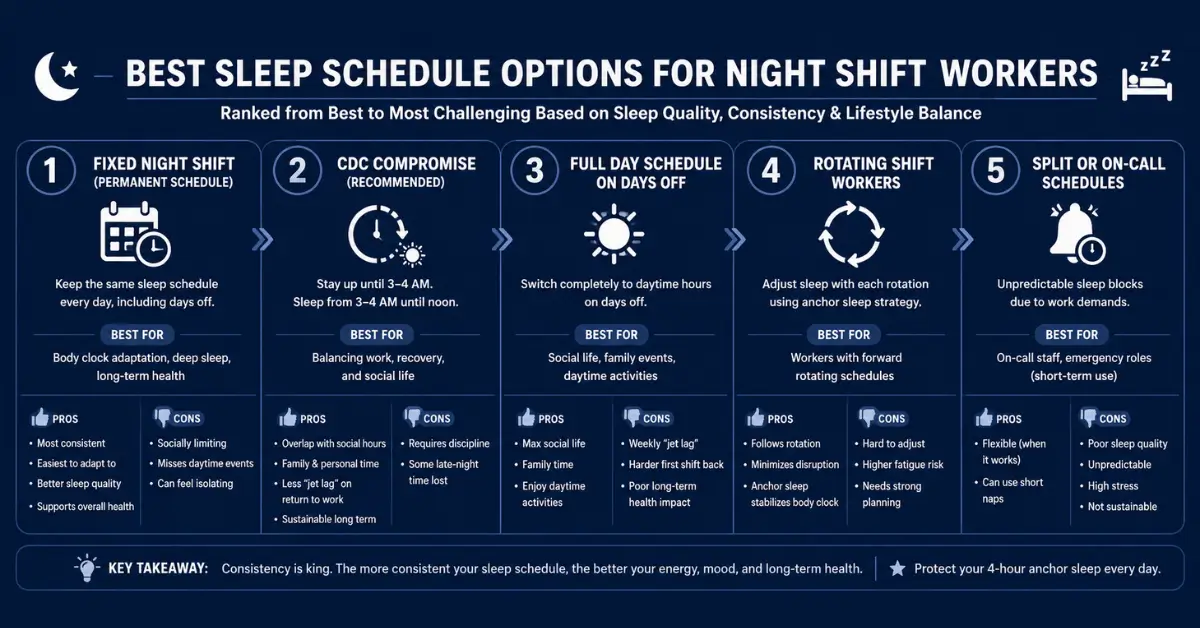
Option A: Stay on Your Night Schedule
The simplest way to support your internal body clock is to stick to the same sleep routine each day. It is easier to fall asleep and wake up when work resumes because your circadian cycle is more predictable.
The drawback is that you’ll probably miss many social activities, family get-togethers, and daytime events, which can eventually feel lonely.
Option B: Switch Back to a Day Schedule
On their days off, some employees switch entirely to daylight hours in order to spend time with their loved ones.
Although this strengthens social ties, it comes at a cost. Constantly switching between day and night schedules creates a type of weekly jet lag, which can make the first shift back feel draining. Frequent sleep disturbances may also hinder recovery and make it harder to maintain healthy sleep habits.
Option C: Use the CDC-Inspired Compromise
A balanced approach works well for many people. Instead of switching completely, stay awake until around 3–4 a.m. on your days off and sleep until about noon. This schedule gives you more overlap with normal daytime life while keeping your body reasonably adapted to night work.
You’ll have time for family, errands, and evening activities without forcing your internal clock to start over every week.
Remember the Anchor Sleep Rule: Even if your schedule changes on days off, protect the same 4-hour core sleep block whenever possible. Keeping this consistent helps your body maintain a more stable circadian rhythm and reduces the stress of moving between workdays and days off.

Respect Your Sleep Schedule
Here’s where most night-shift sleep plans die. Not in the bedroom. In the living room.
Your kids don’t understand why Dad sleeps at 8 AM. Your partner thinks, “Just stay up later on weekends.” Your roommate blasts music at noon on your sleep day.
You need a system. Not a conversation. A system.
Family Scripts That Actually Work
For your partner:
“I need you to treat my sleep window like a medical appointment. From 8:30 to 4:00, the house is quiet. Kids use headphones. You handle everything. I handle nothing. This isn’t a favor; it’s how I stay safe at work.”
For your kids (age 6+):
“Daddy’s body works backwards. When the sun is up, I sleep. When the moon is up, I work. During my sleep time, you’re the boss of the house. You keep it quiet. I’ll be 100% yours when I wake up.”
For roommates:
“Here’s my schedule. I sleep from 8:30 AM to 4 PM daily. After 4 PM, the house is normal. Before 8:30, keep noise under a 4. “I’ll return the favor, I’ll handle trash, dishes, and quiet hours when you need them.”
Environmental Setup Checklist
- Blackout curtains in the bedroom (100% light block, test with a phone flashlight)
- Door sign: “SLEEPING—Do Not Enter”
- White noise machine or fan (consistent sound, not music)
- Blue-light glasses for the 30 minutes before your sleep window
- Phone on Do Not Disturb, set to auto-activate 15 min before sleep
- Meal prep done before the sleep window—no cooking during the day
- One “wake-up ritual”: same coffee, same light, same 5-min stretch every day
The Boundary Rule
Protect your sleep window like you protect your paycheck. Because it literally is.
Every hour of sleep you lose on a night shift costs you roughly $2,200 per year in lost productivity and health expenses (per the National Sleep Foundation). Your schedule isn’t a preference. It’s a job requirement.
Treat it like one.
The Strategy That Changes Everything
If you can only follow one sleep strategy as a night shift worker, make it anchor sleep. Instead of trying to keep your entire sleep schedule identical every day, which is often unrealistic, you protect one consistent 4-hour sleep block no matter what your work or personal plans look like.
Research published in The Journal of Physiology found that maintaining a regular 4-hour sleep anchor can help keep your circadian rhythm aligned to a 24-hour cycle, even when the rest of your sleep varies. In other words, your body benefits from having a predictable sleep period it can rely on every day.
The key is to choose a 4-hour window that fits your lifestyle and rarely changes. For many permanent night-shift workers, an early-morning block such as 3:00 a.m. to 7:00 a.m. works well. On workdays, you can extend your sleep before or after this anchor period.
On days off, you can adjust the remaining hours to spend time with family, run errands, or attend social events, while keeping the same core block protected.
Think of your anchor sleep as the foundation of a house. The rest of your schedule may shift, but the foundation stays in place.
This simple habit helps reduce constant readjustment, supports more stable sleep patterns, and makes it easier to transition between workdays and days off without feeling like you’re starting over every week.
The Wind-Down Routine That Makes the Schedule Work
A sleep routine alone can’t guarantee better rest. When it’s time to go from being awake to sleeping, your brain requires clear signals. Using the same wind-down technique at the end of each shift makes it easier to fall asleep and stay asleep.
Five Habits You Should Never Skip
- Wear sunglasses on your commute home. Morning sunlight tells your brain to stop creating melatonin and become alert. Limiting bright light exposure helps your body prepare for sleep.
- Create complete darkness. Use blackout curtains together with a comfortable sleep mask. Even small amounts of light can interrupt sleep quality and affect your body’s overnight recovery.
- Keep your bedroom cool. Aim for 65–68°F (18–20°C). A cooler room supports your natural drop in body temperature and helps you fall asleep faster.
- Before going to bed, spend thirty minutes away from screens. Blue light from televisions, phones, and tablets delays melatonin production, making it more difficult to unwind.
- If at all feasible, go to bed at the same time. Maintaining a regular bedtime improves your internal body clock and makes your sleep more predictable.
Quick Tip: If you only make one change today, make your bedroom completely dark before your next sleep. This simple improvement often provides the biggest boost to daytime sleep quality, while the other habits become even more effective when combined with it.
What Happens If the Schedule Is Not Working
Even the best sleep schedule cannot solve every sleep problem. If you consistently struggle despite following healthy sleep habits, there may be an underlying condition that requires medical attention.
When to Consider Shift-Work-Related Sleep Disorder
Shift Work Sleep Disorder (SWSD) is a recognized condition that affects some people who regularly work overnight or rotating shifts.
You may have SWSD if you usually sleep fewer than 5–6 hours, have persistent difficulty sleeping after shifts, or experience overwhelming sleepiness that does not improve even after getting enough rest.
Research, including a 2023 Delphi consensus, supports healthy sleep practices for shift workers, but these strategies are not always enough when a clinical sleep disorder is present.
Signs You Should Discuss With a Healthcare Professional
- Persistent insomnia lasting longer than three months
- Excessive sleepiness that affects work performance or driving safety
- Mood changes, irritability, or difficulty concentrating linked to disrupted sleep
- Constant fatigue despite following a consistent sleep routine
The good news is that SWSD can often be managed. Depending on your situation, treatment may include carefully timed light exposure, strategic melatonin use, behavioral sleep therapy, or prescription medication under medical supervision.
Quick Challenge: 7-Day Sleep Blueprint Reset
Ready to start? Do this right now.
| Day | Challenge |
|---|---|
| Day 1 | Pick your blueprint. Write it on paper. Tape it to your fridge. |
| Day 2 | First full day on the new blueprint. Track your energy on a scale of 1–10 every 2 hours. |
| Day 3 | Tell one person your schedule. Use the scripts above. |
| Day 4 | Blackout test: stand in your room at noon. Can you see anything? Fix it. |
| Day 5 | Meal prep your first 3 days of food. No decisions during the sleep window. |
| Day 6 | First full day on the new blueprint. Track your energy 1–10 every 2 hours. |
| Day 7 | Review. What worked? What drifted? Adjust by 15 minutes max. |
Small shifts win. Don’t overhaul everything at once.
Recap
A healthy sleep routine starts with understanding your shift type because every schedule places different demands on your body. While your circadian clock naturally promotes wakefulness during the day, using strategies like anchor sleep, consistent bedtimes, and a proper wind-down routine can make daytime sleep more restorative.
Remember these key takeaways:
- Know your shift type and follow the sleep schedule that best matches your work hours.
- Sleep as soon as possible after your shift to take advantage of natural sleep pressure.
- Protect a consistent 4-hour anchor sleep block every day, including days off.
- Use the CDC-inspired compromise instead of completely switching to a daytime schedule on your days off.
- Make your bedroom dark, cool, and quiet, and follow the same bedtime routine after every shift.
- Ask family members for support and set clear boundaries to protect your sleep.
- If you continue struggling despite good sleep habits, speak with a healthcare professional about Shift-Work-Related Sleep Disorder (SWSD).
Small, consistent improvements can have a big impact. Start with one change today, follow your 7-Day Sleep Blueprint Reset, and build a sleep routine that supports both your health and your performance on every shift.
FAQs on the Best Proven Sleep Schedule
Q. What is the best sleep schedule for a night shift worker?
The best sleep schedule for a night-shift worker stays as consistent as possible, even on days off. Aim to sleep soon after your shift ends while your sleep pressure is strongest, and protect a regular 4-hour anchor sleep block every day.
Keep your bedroom cool, dark, and quiet to improve sleep quality. A schedule you can maintain consistently is far more effective than one that changes every week.
Q. Should night shift workers sleep before or after their shift?
Most night shift workers should sleep immediately after their shift ends. Your body has built up high sleep pressure overnight, making it easier to fall asleep quickly.
Delaying sleep for errands, shopping, or exercise can reduce this natural sleep drive and make it harder to get enough rest. Going straight home and getting into bed helps maximize recovery.
Q. How many hours should a night shift worker sleep?
Night shift workers generally need 7 to 9 hours of sleep, just like people who work during the day.
Because daytime sleep is often lighter and interrupted by noise or sunlight, many workers benefit from an additional 1 to 2 hours of rest or a planned nap to make up for lower sleep quality.
The goal is to wake up feeling refreshed, not just to count hours.
Q. What is the best sleep schedule for night shift nurses?
Night shift nurses usually benefit from sleeping as soon as they return home after work and keeping a consistent sleep routine throughout the week.
Many nurses use an anchor sleep schedule, in which a fixed 4-hour sleep block remains the same on both workdays and days off. This approach helps reduce fatigue during long shifts and makes switching between work and personal life less exhausting.
Q. How do I fix my sleep schedule after the night shift?
Instead of abruptly transitioning between day and night sleep, make small adjustments to your sleep routine. Keep your bedtime consistent, avoid bright morning light following night shifts, and expose yourself to bright light when you want to stay up.
Your body will adjust more easily if you stick to an established sleep pattern, cut back on caffeine before bed, and have a calming nighttime routine.
Q. Should I sleep the same time on my days off?
Keeping a similar sleep schedule on your days off is usually better than completely switching back to daytime hours. A moderate adjustment, such as sleeping from 3 to 4 a.m.
until noon, allows you to enjoy family and social activities while reducing the “social jet lag” that comes from changing your body clock every week. Protecting the same 4-hour anchor sleep block also helps keep your circadian rhythm more stable.
Final Thoughts: The Best Proven Sleep Schedule for Night Shift Workers
Building a healthier sleep routine as a night shift worker is not about finding a perfect schedule. It is about creating a realistic plan that your body can follow week after week.
Remember These Three Principles
- Consistency beats perfection. A schedule you follow every week will always produce better results than an ideal schedule you cannot maintain.
- Handle your days off wisely. Avoid completely switching back to daytime hours whenever possible. A balanced approach helps reduce weekly jet lag and makes returning to work much easier.
- Protect your anchor sleep. Keeping the same 4-hour core sleep block gives your body a stable foundation, even when the rest of your schedule changes.
Night shift sleep isn’t just possible; it’s manageable with the right tools, mindset, and structure. Download and personalize the free sleep schedule template, test what works best for your lifestyle, and give your body the rest it deserves, even when the world is still asleep.
Read more about night-shift sleep workers’ health.
You might like: