
What are the foundations of self-love? Learn 7 practical pillars, from self-compassion to boundaries, that boost confidence and quiet your inner critic.
Self-love is not bubble baths and vague affirmations. It is a set of daily habits that quietly build self-worth. When you practice these habits, confidence follows. You stop needing outside approval because you finally approve of yourself.
This guide breaks down seven practical foundations of self-love to boost confidence. Each one is simple, actionable, and backed by psychology. You will learn how to practice self-love in ways that stick, even on hard days.
How Can Self-Love Boost Your Confidence

The 7 foundations of self-love are self-awareness, self-acceptance, self-compassion, self-care, boundaries, self-forgiveness, and purposeful living.
These habits build self-worth from the inside out. They calm your inner critic, strengthen emotional wellness, and create lasting confidence.
The 7 foundations of self-love are self-awareness, self-acceptance, self-compassion, self-care, boundaries, self-forgiveness, and purpose.
Practicing them daily builds self-worth, resilience, and confidence without relying on outside validation. Each foundation is a skill you can learn and strengthen over time.
Confidence Comes from Self-Love
Many people chase confidence through achievement. They get the promotion, the praise, and the likes. It works for a moment. Then the doubt returns. That is because confidence built on external validation is fragile. It depends on things you cannot control.
Self-love is different. It is an internal foundation. When you love yourself, you do not need constant proof that you are enough. You already believe it. That belief shapes how you show up in the world. It makes you resilient, grounded, and calm.
Confidence vs Self-Esteem vs Self-Worth
These three terms get mixed up. Here is the simple difference.
- Confidence is trust in your abilities. It is situational. You can be confident at work and nervous in social settings.
- Self-esteem is how you evaluate yourself overall. It reflects your beliefs about your value.
- Self-worth is the deep knowing that you matter simply because you exist. It is not earned. It is inherent.
Self-love connects all three. It builds confidence through action, lifts self-esteem through self-compassion, and anchors self-worth through self-acceptance.
How Low Self-Love Fuels the Inner Critic
When you do not love yourself, your inner critic gets loud. It whispers that you are not good enough. It compares you to others. It magnifies every mistake.
That voice is not the truth. It is a learned pattern. Often it comes from childhood, past criticism, or cultural pressure. Without self-love, you believe it. With self-love, you can hear it and choose a kinder response.
The Psychology of Self-Compassion and Resilience
Research shows that self-compassion strongly predicts emotional wellness. A leading expert in the subject, Dr. Kristin Neff, discovered that self-compassion practitioners experience less anxiety and despair. They also have greater resilience.
Self-compassion has three parts:
- Self-kindness: treating yourself with warmth instead of harsh judgment.
- Common humanity: remembering that suffering is part of being human.
- Mindfulness: observing your emotions without suppressing or exaggerating them.
When you practice these, you build a buffer against stress. You recover faster from setbacks. You stop fearing failure because you know you will treat yourself well regardless.
The 7 Foundations of Self-Love to Boost Confidence
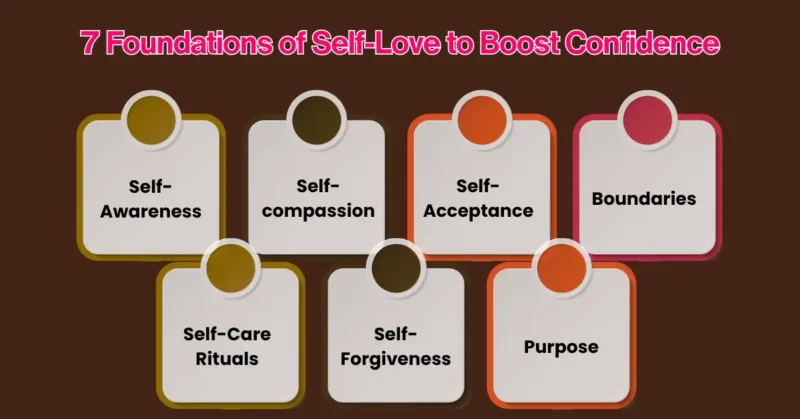
Here are the seven foundations. Each one includes a definition, a practical action, and a real-life example. Use them as a checklist for your own growth.
1. Self-Awareness
Know Your Inner Critic and True Self
Definition: Self-awareness is the ability to observe your thoughts, emotions, and behaviors without judgment. It means knowing your values, triggers, strengths, and limitations.
Why it matters: You cannot change what you do not notice. Self-awareness is the first step to taming the inner critic and aligning with your authentic self.
How to practice:
- Journal for five minutes each morning. Write down what you feel and why.
- Track your triggers. Notice when you feel small, angry, or anxious. Ask what set it off.
- Do a mindset check. Are your thoughts facts or stories?
Example: Maya noticed she felt anxious every time her boss sent a vague email. She journaled about it and realized she feared criticism. That awareness helped her respond calmly instead of spiraling.

2. Self-Compassion
Talk to Yourself Like Someone You Love
Definition: Self-compassion is treating yourself with kindness during difficult moments. It replaces harsh self-criticism with understanding.
Why it matters: Self-compassion lowers stress and builds emotional wellness. It helps you bounce back from failure instead of beating yourself up.
Practical tip: When you catch negative self-talk, reframe it. Ask, “What would I say to a friend in this situation?” Then say that to yourself.
Example: After a presentation went poorly, James wanted to call himself a failure. Instead, he paused. He said, “That was hard. You are learning. One bad talk does not define you.” He felt calmer and more motivated to improve.
3. Self-Acceptance
Embrace Imperfection to Build Self-Worth
Definition: Self-acceptance is embracing who you are right now, including your flaws. It means your worth is not conditional on change.
Why it matters: Perfectionism destroys confidence. Self-acceptance frees you from the need to be flawless. It builds authentic self-worth.
Exercise: Make a flaws vs. strengths list. Write down five flaws and five strengths. Then ask, “Do my flaws cancel my strengths?” They do not. Both make you human.
Example: Lena hated being shy. Then she realized her shyness made her a great listener. She stopped fighting her nature and started using it as a strength.
4. Boundaries
Say No to Protect Your Self-Care and Mental Health
Definition: Boundaries are healthy limits that protect your time, energy, and peace. They are not walls. They are gates you control.
Why it matters: Without boundaries, you burn out. You please people until you resent them. Boundaries boost confidence because they show you value yourself.
How boundaries boost confidence:
- They stop people-pleasing.
- They reduce resentment and stress.
- They teach others how to treat you.
Example: Priya used to answer work messages at midnight. She set a boundary: no work after 8 PM. At first, she felt guilty. Then she slept better and felt more in control.
5. Self-Care Rituals
Daily Habits That Prove Self-Love
Definition: Self-care is meeting your basic physical, emotional, and mental needs. It includes sleep, movement, nutrition, and rest.
Why it matters: You cannot pour from an empty cup. Self-care is not indulgent. It maintains your mind and body.
Daily habits:
- Sleep seven to nine hours.
- Move your body in a way you enjoy.
- Eat foods that fuel you.
- Schedule rest without guilt.
Example: Tom started a ten-minute evening stretch. It became a signal to his brain that the day was done. His sleep improved. His patience grew. His confidence followed.

6. Self-Forgiveness
Release Guilt and Learn from Mistakes
Definition: Self-forgiveness is letting go of guilt and shame from past mistakes. It means viewing errors as learning opportunities, not life sentences.
Why it matters: Holding onto guilt drains energy. It keeps you stuck in the past. Self-forgiveness frees you to grow.
How to practice:
- Name the mistake without judgment.
- Ask what you learned.
- Make amends if needed.
- Then release it.
Example: After snapping at her partner, Ana apologized. Then she forgave herself. She did not spend days replaying the moment. She moved forward.
7. Purpose
Live Intentionally and Honor Your Authentic Self
Definition: Purpose is living intentionally and pursuing passions that honor who you truly are. It is your why.
Why it matters: Purpose gives direction. It connects daily actions to deeper values. That connection builds lasting confidence.
How to practice:
- Identify your core values.
- Align small daily choices with them.
- Pursue hobbies and work that feel meaningful.
Example: Ben loved writing but worked in finance. He started writing for thirty minutes each morning. That small act of authenticity made him feel more alive and confident.
How to Practice These Foundations Daily: 10-Minute Self-Love Routine
You do not need hours. A ten-minute routine can anchor these foundations.
Morning Mindset Ritual
- Two minutes: Breathe deeply. Set an intention for the day.
- Three minutes: Journal one thing you are grateful for and one thing you will do well.
- Five minutes: Read an affirmation or self-compassion phrase.
Evening Reflection
- Three minutes: Write one win from the day.
- Three minutes: Notice one moment you were hard on yourself. Reframe it with kindness.
- Four minutes: Stretch or breathe. Let the day go.
Weekly Check-In
- Review your boundaries. Did you honor them?
- Notice your self-talk. Was it kind?
- Celebrate one act of self-care.
- Set one small goal for the next week.
Mistakes That Block Self-Love and Kill Confidence
Even with good intentions, these mistakes can stall your progress.
Confusing Self-Love with Selfishness or Arrogance
Self-love is not about ignoring others. It is about filling your own cup so you can share from overflow. Arrogance says, “I am better than you.” Self-love says, “I am enough, and so are you.”
Seeking Validation vs. Building Inner Self-Worth
Validation feels good, but it is temporary. If your worth depends on likes, praise, or approval, it will always be shaky. Build inner self-worth through self-acceptance and self-trust.
Perfectionism and Comparison Trap
Perfectionism says you are only worthy when you are flawless. Comparison says you are only worthy when you are ahead. Both destroy self-acceptance. Both keep confidence out of reach.
Research and Therapy on Self-Love and Confidence
Self-Compassion Research by Kristin Neff
Dr. Kristin Neff’s research shows that self-compassion improves mental health. It reduces anxiety, depression, and stress. It also increases life satisfaction and resilience. Her work confirms that self-kindness is not weakness. It is strength.
Therapist Insights on Boundaries and the Inner Critic
Therapists often teach clients to name their inner critic. They call it “the voice” or “the judge.” Naming it creates distance.
That distance allows you to respond with compassion instead of reacting with fear. Therapists also emphasize boundaries as a core skill for healthy relationships and self-respect.
Author Credibility and Disclaimer
Both personal experience and proven psychology are used in this piece. It is not a replacement for expert mental health assistance. Please seek assistance from a competent therapist or counselor if you experience extreme anxiety, depression, or trauma.
FAQ on Foundations of Self-Love to Boost Confidence
Q. What are the foundations of self-love?
The foundations of self-love are self-awareness, self-acceptance, self-compassion, self-care, boundaries, self-forgiveness, and purpose. These seven pillars build self-worth and confidence from the inside out.
Q. How does self-love boost confidence and self-esteem?
Self-love boosts confidence by reducing dependence on external validation. When you accept yourself, you stop fearing judgment. When you practice self-compassion, you recover faster from setbacks. This creates steady, resilient confidence.
Q. How can I practice self-love daily for confidence?
Practice a ten-minute morning ritual. Journal, breathe, and set an intention. Reflect at night on one win and one kind reframe. Set boundaries. Keep small promises to yourself. These daily habits build self-trust and confidence.
Q. Can self-love help with anxiety and low self-worth?
Yes. Self-compassion research shows it reduces anxiety and depression. Self-acceptance quiets the inner critic. Boundaries reduce overwhelm. Together, these foundations create emotional wellness and resilience.
Q. How long does it take to build confidence with self-love?
It varies. Some people feel shifts in weeks. Bigger change takes months of consistent practice. The key is consistency, not perfection. Small daily actions compound over time.
Final Takeaway: Confidence Grows Where Self-Love Lives
Confidence is not something you chase. It is something you cultivate. It grows in the soil of self-love. When you practice self-awareness, self-compassion, self-acceptance, boundaries, self-care, self-forgiveness, and purpose, you build a foundation that cannot be shaken.
Start small. Pick one foundation. Practice it for a week. Then add another. Over time, you will notice a quieter inner critic, stronger boundaries, and a deeper sense of worth. That is confidence from the inside out.
References
Neff, K. D. (2003). Self-compassion: An alternative conceptualization of a healthy attitude toward oneself. Self and Identity, 2(2), 85–101.
Neff, K. D., & Germer, C. K. (2013). A pilot study and randomized controlled trial of the mindful self-compassion program. Journal of Clinical Psychology, 69(1), 28–44.
Read more articles on Health and Fitness.