
Is your balanced life out of alignment? Explore physical, emotional, mental, and spiritual signs plus easy steps to restore peace, purpose, and productivity.
Thank you for reading this post, don't forget to subscribe!Have you ever felt like you’re doing everything right, yet something still feels “off”?
Like your days are full, but your life feels empty?
That’s usually the first whisper that your balanced life is slipping out of balance.
Short Summary
This guide helps you identify the early signs of an imbalanced life and shows you practical, simple, human-friendly steps to fix each one.
You’ll learn about physical, emotional, mental, and spiritual warning signs, along with real examples, personal insights, mistakes to avoid, and a 5-step action plan.
What Is a Balanced Life?
A balanced life means your physical, emotional, mental, and spiritual needs work together in harmony.
It doesn’t mean perfect schedules or zero stress.
It means:
- You feel grounded, not overwhelmed.
- You have time for work and personal joy.
- You care for your body, mind, heart, and purpose.
- You function with clarity rather than chaos.
A balanced life gives you energy, focus, peace, and a sense that you’re living with intention, not just reacting to everything around you.
Recognizing the Signs of an Imbalanced Life
For overall well-being, a balanced life is essential, but it’s easy to get off track. During stressful seasons, responsibilities pile up, or when you stop caring for yourself, life slowly shifts out of alignment.

Let’s explore the most common signs so you can catch them early.
Physical Signs Your Balanced Life Is Out of Balance
1. Chronic Fatigue and Your Balanced Life
When your body is tired, everything else feels heavy.
- You may sleep, but still wake up exhausted.
- You may rest, but don’t feel restored.
Why does it happen:
- Overworking
- Poor sleep habits
- No recovery time
- Constant mental load
- Ignoring body signals
How to Fix It:
- Prioritize sleep like an appointment.
- Add a micro-rest: 10 minutes of nothing.
- Eat meals on time.
- Reduce multitasking.
Action steps:
- Go to bed 30 minutes earlier tonight.
- Take 2 2-minute break every hour.
- Add one energy-boosting habit (hydration/walk/sun exposure).
Relatable Example:
A working mom shared with me how she felt tired even after a long sleep. It wasn’t the sleep; it was the nonstop emotional and mental load that drained her.
Personal Insight:
I’ve been there. I once kept pushing through fatigue, thinking, “I’ll rest on the weekend.” But weekends came and went. Only when I scheduled rest the same way I scheduled work did my energy return.
2. Weight Changes and Your Balanced Life
Sudden weight gain or unexpected weight loss can signal an imbalance.
Why does it happen:
- Emotional eating
- Skipping meals
- High stress hormones
- Sedentary lifestyle
- Lack of routine
How to Fix It:
- Eat slow, mindful meals.
- Incorporate light daily movement.
- Reduce stress instead of restricting food.
Action steps:
- Add a 10-minute evening walk.
- Plan simple meals.
- Drink water before every meal.
Julia, one of my friends, gained weight during a stressful job season. Once she added small daily walks and regular meals, her weight naturally balanced.
Emotional Signs Your Balanced Life Is Out of Balance
3. Mood Swings and Your Balanced Life
Do you snap easily?
Get irritated quickly?
Feel sad without reason?
These are emotional imbalances triggered by stress or emotional overload.
Why does it happen:
- Suppressed feelings
- Overcommitment
- No emotional outlets
- Lack of boundaries
How to Fix It:
- Practice grounding techniques.
- Share feelings with someone you trust.
- Permit yourself to pause.
Action steps:
- Use the “name it to tame it” method.
- Keep a simple emotion journal.
- Take 5 deep breaths before reacting.
Relatable Example:
A woman I coached shared how she cried over a broken glass. Not because of the glass, but because she was overwhelmed.
Personal Insight:
Our emotions don’t explode randomly. They leak when we ignore them.
4. Loss of Motivation and Your Balanced Life
If everything feels “too much,” or tasks feel pointless, you’re emotionally exhausted.
Why does it happen:
- Burnout
- Lack of joy
- No personal time
- Overworking
- Feeling undervalued
How to Fix It:
- Break tasks into tiny steps.
- Set mini-goals that feel achievable.
- Add one joy activity daily.
Action steps:
- Spend 10 minutes on something you love.
- Rewrite your weekly goals into smaller steps.
- Celebrate small wins.
One client told me, “I don’t even feel excited about weekends anymore.” That was a clear sign that her emotional energy was drained.
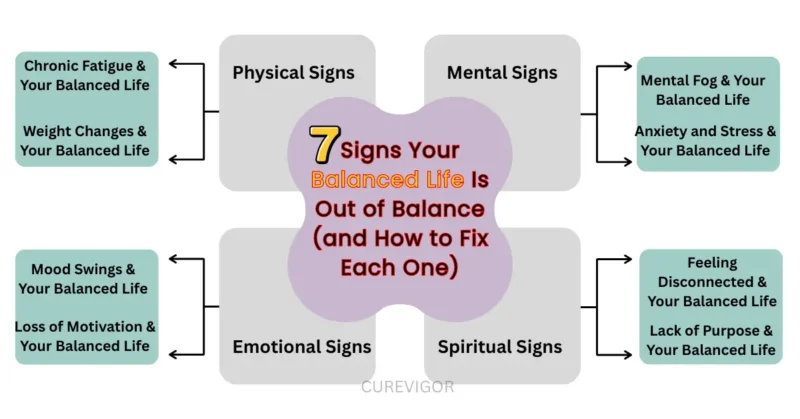
Mental Signs Your Balanced Life Is Out of Balance
5. Mental Fog and Your Balanced Life
You know the feeling:
- Reading the same line twice.
- Forgetting small things.
- Struggling to concentrate.
Mental fog is a major sign of imbalance.
Why does it happen:
- Information overload
- Poor sleep
- No downtime
- High digital noise
- Constant multitasking
How to Fix It:
- Reduce screen time.
- Take brain breaks.
- Organize your space.
Action steps:
- Silence notifications for 1 hour daily.
- Try a 5-minute meditation.
- Clear one cluttered area.
I once opened my phone to check one message and ended up scrolling for 45 minutes. That mental fog? Digital overload.
6. Anxiety and Stress & Your Balanced Life
Anxiety is often your mind saying, “I’m carrying too much.”
Why does it happen:
- Overthinking
- Financial or work pressure
- No stress-relief habits
- Lack of boundaries
- Constant rushing
How to Fix It:
- Practice slow breathing.
- Reduce unnecessary commitments.
- Do grounding activities.
Action steps:
- Try the 4-7-8 breath.
- Say “no” once this week.
- Walk barefoot on grass.
Once, a friend told me she couldn’t relax even during vacations. That was a sign her stress had become her default state.
Spiritual Signs Your Balanced Life Is Out of Balance
7. Feeling Disconnected and Your Balanced Life
You may feel disconnected from your relationships, your goals, or even yourself.
Why does it happen?
- No self-reflection
- Always in “busy mode.”
- Losing sense of meaning
- Emotional fatigue
How to Fix It:
- Spend time in quiet reflection.
- Reconnect with someone close.
- Revisit meaningful goals.
Action steps:
- Write 3 things you’re grateful for.
- Spend 10 minutes alone in silence.
- Call a loved one.
8. Lack of Purpose and Your Balanced Life
When life feels directionless, everything feels heavy.
Why does it happen:
- Too much routine, not enough purpose
- Emotional burnout
- Unrealistic expectations
- No long-term goals
How to Fix It:
- Reconnect with your values.
- Set short, meaningful goals.
- Explore hobbies or passions.
Action steps:
- Write your top 3 values.
- Start a passion project.
- Review your life goals monthly.
Personal Observation:
Whenever I lose purpose, it’s never because life is empty; it’s because I stopped connecting with what truly matters to me.
Practical Checklist: Are You Living a Balanced Life?
Use this simple checklist to see which areas of your life need attention.
Check all that apply:
Physical Balance Checklist
- ☐ I wake up tired even after sleeping.
- ☐ My eating habits are irregular.
- ☐ I experience body tension or body aches.
- ☐ My weight fluctuates frequently.
- ☐ I avoid movement or feel too tired to exercise.
Emotional Balance Checklist
- ☐ Small issues trigger big emotional reactions.
- ☐ I feel overwhelmed more often than usual.
- ☐ I no longer enjoy things that once made me happy.
- ☐ I feel disconnected from my emotions.
- ☐ I have no desire to socialize or connect.
Mental Balance Checklist
- ☐ I forget simple things or lose focus easily.
- ☐ My mind feels cloudy or scattered.
- ☐ I struggle to complete tasks that used to feel easy.
- ☐ I feel mentally exhausted even after rest.
- ☐ I overthink situations for too long.
Spiritual Balance Checklist
- ☐ I feel lost or directionless.
- ☐ My life feels like routines, not purpose.
- ☐ I feel disconnected from myself or others.
- ☐ I miss meaningful moments because I’m always rushing
- ☐ I feel a sense of emptiness or soul fatigue.
If you checked:
- 1–4 boxes → You may be entering an imbalance.
- 5–10 boxes → You’re likely out of balance in one main area.
- 10+ boxes → You need gentle rebalancing and self-care now.
Common Mistakes to Avoid When Rebalancing Your Life
Most people try to balance their lives but unknowingly fall into these traps.
Avoid them to make real, lasting progress.
1: Trying to Fix Everything at Once
Life becomes overwhelming when you try to tackle 10 habits in one day.
Balance grows from one gentle step, not pressure.
2: Ignoring Physical Needs
You cannot achieve emotional or mental balance without sleep, food, and rest.
Your body is the foundation of your balanced life.
3: Overthinking Instead of Acting
Thinking about change is not the same as taking action.
If you wait for the perfect moment, you’ll stay stuck.
4: Comparing Your Balance to Others
Balance looks different for every person.
Don’t copy someone else’s lifestyle; build one that feels good to you.
5: Assuming Balance Means Doing More
True balance often means doing less, not more.
Fewer obligations. Fewer distractions. Fewer energy leaks.
6: Avoiding Boundaries Because of Guilt
If you say yes to everything, you say no to yourself.
Boundaries protect your peace; they are not selfish.
7: Expecting Instant Results
Rebalancing is a slow, loving process.
Little improvements add up beautifully over time.
5-Step Action Plan to Rebalance Your Life
(Humanlike, unique, written in first-person for empathy and connection)
Step 1: I Pause and Become Aware
I’ve learned that I cannot fix what I refuse to see.
Whenever life feels messy, heavy, or confusing, the very first thing I do is pause.
Not to judge myself.
Not to force a solution.
Just to notice what’s going on inside me and around me.
Ask yourself:
- What is draining me?
- What feels out of alignment?
- What have I been ignoring?
Awareness is the doorway to a balanced life.
Step 2: I Identify My Biggest Imbalance Area
Not everything needs fixing at once.
When my life feels off, I ask myself:
“Where am I struggling the most, physically, emotionally, mentally, or spiritually?”
Most people try to fix everything at once.
But balance comes from focusing on the one area that needs you the most today.
Check in with yourself:
- Am I exhausted? (Physical)
- Am I overwhelmed? (Emotional)
- Am I mentally foggy? (Mental)
- Am I feeling disconnected or empty? (Spiritual)
Finding the main imbalance makes the solution much easier.
Step 3: I Choose One Small Change
In the past, I used to push myself to rebuild my whole life at once, and it always failed.
Now I choose one tiny habit that feels doable, gentle, and supportive.
Just one.
Because balance grows through small, consistent shifts, not dramatic overnight changes.
Examples of one small change:
- Sleep 20 minutes earlier
- Drink one extra glass of water.
- Unfollow one toxic account
- Step outside for 5 minutes of fresh air.
- Do a 2-minute stretch between tasks.
Tiny steps create big transformation.
Step 4: I Add Daily Micro-Rest and Set Boundaries
I used to underestimate rest.
But now I know:
micro-rests protect your energy. Boundaries protect your peace.
You don’t need a vacation to feel balanced.
A few intentional moments throughout your day can shift everything.
Simple micro-rest ideas:
- 60 seconds of breathing
- 2 minutes of no phone
- 5 minutes of sunlight
- A quiet cup of tea
- Stretching your shoulders
And boundaries?
They are love letters to your future self.
Step 5: I Reevaluate Weekly and Adjust
Life keeps changing, so balance must shift with it.
Every week, I take a moment to reflect:
What improved? What still feels heavy? What needs adjusting?
This small check-in keeps me grounded, intentional, and connected to myself.
It’s not about perfection; it’s about staying aligned with what matters most.
Balance is not a fixed destination.
It’s a living rhythm we rebuild, refine, and return to again and again.
Real-Life Relatable Examples
Example 1: The Overworked Parent
A mother of two noticed constant fatigue, irritability, and no time for herself.
Her imbalance came from taking care of everyone except herself.
She chose one small change:
➡ 10 minutes of quiet tea time before the kids wake up.
Within weeks, she felt calmer and more present.
Example 2: The Burned-Out Employee
A remote tech worker struggled with mental fog and anxiety.
His biggest imbalance was mental exhaustion.
One tiny change helped:
➡ A 5-minute walk after finishing each task.
His focus improved, and the anxiety slowly softened.
Example 3: The Lost Young Adult
A young woman felt disconnected and directionless.
She didn’t know her purpose or why everything felt “empty.”
She added one habit:
➡ Writing 3 truths about herself every night.
This helped her reconnect with her identity and goals.
Example 4: My Own Journey
I’ve personally felt imbalanced many times.
For me, imbalance shows up as mental overload and emotional heaviness.
One tiny shift changed everything:
➡ Allowing myself pauses, even if only for 60 seconds.
Those micro-moments of rest rebuilt my clarity and inner peace faster than any huge lifestyle change.
FAQs About Balanced Life
Q. What does a truly balanced life look like?
A truly balanced life is not about equal hours for everything. It means your energy, emotions, and priorities align with what matters most. You feel grounded rather than overwhelmed, focused rather than scattered, and purposeful rather than lost.
You make time for rest, relationships, work, joy, and growth. You can handle challenges without feeling emotionally flooded. Most importantly, a balanced life feels calm, intentional, and meaningful.
Q. Why is my life always out of balance, even when I try to manage everything?
Most people try to balance life by controlling schedules, not energy. The truth is, life shifts constantly. Stress, responsibilities, and emotions change, and your habits must adjust too.
If you rely only on willpower or overplanning, imbalance returns quickly. Instead, focus on flexible routines, small habits, and emotional awareness. When your energy flows smoothly, balance becomes natural rather than forced.
Q. How do I fix an imbalanced life when I have no time?
Start small. The biggest mistake is waiting for “free time.” You create balance through micro-actions: 5 minutes of breathing, a short walk, silent moments, preparing one healthy meal, or setting a simple boundary.
These take less than 10 minutes but create massive shifts. When you protect small pockets of time, your energy improves, and suddenly, bigger changes become possible too.
Q. Can stress alone ruin my balanced life?
Yes. Chronic stress impacts sleep, motivation, weight, emotional stability, and mental clarity. It drains your energy and disrupts every area of your life. But stress isn’t the enemy; unmanaged stress is.
With grounding, deep breathing, relaxation habits, and boundaries, you can keep stress from taking over. The goal is not to eliminate stress but to build resilience so stress doesn’t shake your inner balance.
Q. What is the fastest way to restore balance in life?
The fastest way is to identify your top imbalance area and fix that first. If you’re exhausted, prioritize sleep. If you’re overwhelmed, reduce commitments. If you’re anxious, practice grounding.
If you’re disconnected, reconnect with someone meaningful. Balance returns quickly when you focus on the root cause instead of trying to change everything at once.
Q. How do I know if I’m emotionally imbalanced?
Signs include mood swings, irritability, overreacting, emotional numbness, crying easily, or feeling disconnected. Emotional imbalance usually stems from suppressed feelings, overwork, or a lack of boundaries.
Rest, journaling, honest conversations, emotional awareness, and small pockets of joy help restore emotional balance. When your emotions feel calmer and more predictable, you’ll know your emotional balance is returning.
Q. What habits help maintain a balanced life long-term?
Daily habits like restful sleep, mindful eating, movement, gratitude journaling, digital boundaries, deep breathing, and weekly self-reflection help maintain balance.
You don’t need a perfect routine, just consistent small actions. When you regularly nurture your physical, emotional, mental, and spiritual needs, balance becomes a lifestyle rather than a temporary goal.
Q. Can I rebalance my life without making big lifestyle changes?
Yes, in fact, small changes are usually more effective. You don’t need to quit your job, meditate for an hour, or change your entire routine.
Most people improve their balanced life through tiny habits: better sleep, mindful breaks, breathing exercises, drinking more water, or setting one simple boundary.
Micro-shifts create macro-results. It’s the small promises you keep to yourself that rebuild your confidence, peace, and energy.
Q. What should I do when I feel overwhelmed but don’t know where to start?
Start by pausing. Take a slow, deep breath. Overwhelm often comes from trying to solve every problem at once. Instead, ask yourself, “What small action can I take right now to feel better?”
It may be drinking water, stretching, journaling for 2 minutes, or simply stepping outside for fresh air. When you reduce the size of the challenge, you reduce the intensity of overwhelm. Small clarity leads to bigger clarity.
Final Thoughts
A balanced life isn’t built overnight. It’s built slowly, gently, and consistently, through tiny decisions that honor your well-being.
If your life feels out of balance right now, you’re not failing. You’re simply being called to realign.
You deserve clarity.
You deserve peace.
You deserve a life that feels balanced, joyful, and meaningful.
Start with one small step.
Your future self will thank you.
Read more Health and Balance articles.

You might like: