
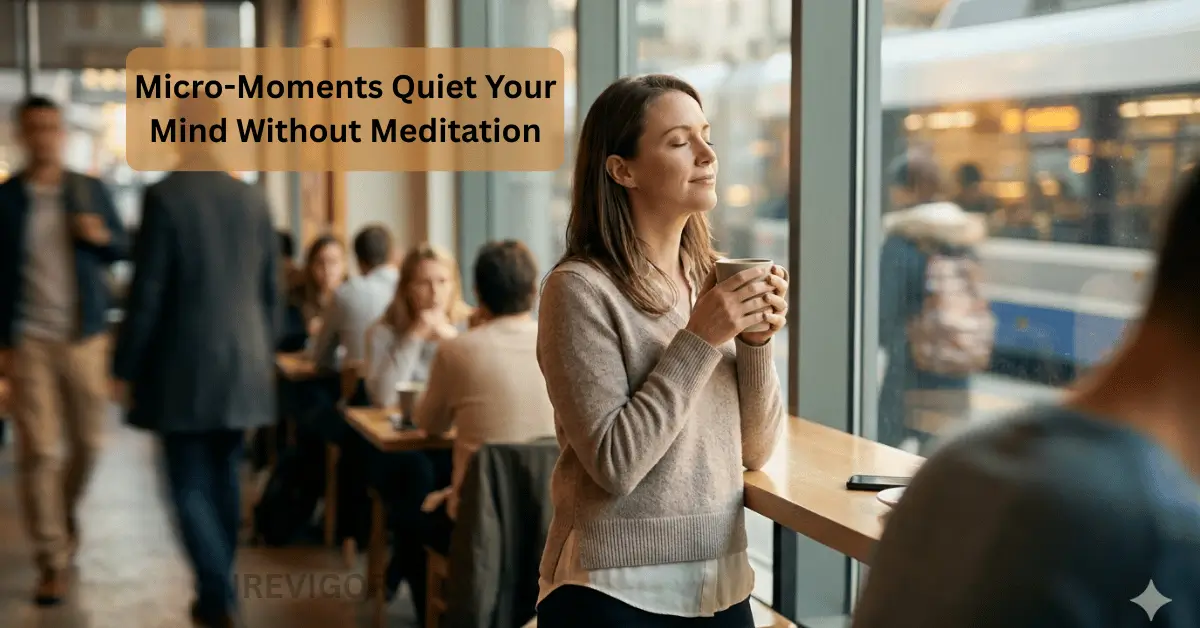
There is a special kind of exhaustion that comes from being told to slow down when your life is already too full.
Thank you for reading this post, don't forget to subscribe!You know the advice. Meditate for twenty minutes. Sit still. Clear your mind. Breathe deeply. Be present.
It sounds beautiful in theory, but in real life, it can feel like one more task staring at you from the same crowded mental shelf as unanswered messages, unfinished work, dishes in the sink, and the low hum of worry you cannot quite turn off.
That is why so many people quietly give up on meditation before they ever really begin.
Not because they do not want peace, but because the version of peace they were handed feels hard to reach. Too structured. Too ideal. Too far away from ordinary life.
If that sounds familiar, there is good news: a calm mind does not always arrive through long rituals or perfectly silent mornings. Sometimes it begins much smaller. Sometimes it begins in a matter of seconds.
Micro-moments are tiny pockets of awareness woven into normal life. They do not ask you to disappear from your day.
They invite you to come back to it. One breath. One sip. One glance at the sky. One relaxed jaw. One quiet pause before you open the next tab, answer the next message, or step into the next task.
That is what makes them so liberating. They are not a replacement for meditation in a strict sense, but they are a deeply human way to access some of the same relief without guilt, pressure, or performance.
They are the effortless, nourishing version of mindfulness for people who do not have extra space in their day but still need moments of peace inside it.
Quick Summary Box
Estimated read time: 10–12 minutes
What are micro-moments?
Micro-moments are brief pauses, often just three to ten seconds long, that help you notice something grounding, soothing, or beautiful in the present moment.
How do micro-moments quiet your mind without meditation?
They interrupt mental overload, shift attention away from stress loops, and give your nervous system a small signal of safety and steadiness.
Do they have to be formal?
No. They can happen while drinking tea, washing your hands, walking to your car, waiting for a page to load, or looking at the clouds.
Why do they work?
Tiny pauses are easier to repeat than big routines. Because they feel realistic, they often become sustainable.
Main takeaway
Peace does not always require a ceremony. Sometimes it begins with one small, luminous moment of noticing.
Why Quieting Your Mind Feels So Hard When Meditation Becomes Another Task
For many people, the idea of meditation becomes tangled up with self-improvement pressure.
It stops feeling like rest and starts feeling like homework. You are not just trying to be calm. You are trying to do calm correctly.
That pressure changes everything.
Instead of offering relief, meditation can begin to carry the same emotional weight as the rest of your to-do list. You miss a day, and now you feel inconsistent. You sit down to try it, and your mind races even more.
You wonder whether you are doing it wrong. Then the guilt arrives. Then the avoidance. Then the quiet conclusion that maybe this just is not for you.
But often the real problem is not you. It is the size and shape of the practice you were trying to force into a life that did not have room for it.
Many people do not need more discipline before they feel better. They need a gentler entry point. They need something that works in the middle of real life, not only outside of it.
This is where micro-moments matter. They remove the idea that inner calm must happen under perfect conditions.
They allow you to stop treating peace as a destination you visit later and start experiencing it as something you can touch in small doses right now.
That shift is powerful. When you stop thinking of calm as a long event and begin seeing it as a repeatable pattern, the entire conversation changes.
You are no longer asking, “When will I have time to be peaceful?” You are asking, “Where is one small opening in my day where I can return to myself?”
That question is easier. Kinder. More honest. And, for many people, much more effective.
What Is a Micro-Moment, Really?
A micro-moment is a very short pause in which you fully notice one thing.
That is all.
It might last three seconds. It might last ten. It usually happens in the middle of another activity rather than apart from it.
The point is not to empty your mind, achieve transcendence, or become a new person in an afternoon.
The point is to interrupt the speed of mental autopilot long enough to reconnect with what is real, sensory, and present.
A simple working definition looks like this:
A micro-moment is a brief act of awareness that creates a small shift from mental noise to embodied presence.
That shift may sound subtle, but subtle does not mean insignificant. When your mind is cluttered, even a tiny break in the pattern can feel like hitting the refresh button on a frozen browser.
Everything does not become perfect, but the mental screen stops locking up. You can breathe again. You can think again. You can feel the next moment instead of being dragged through it.
The Three-Second Rule
If the idea still feels abstract, here is a useful way to understand it: a micro-moment is often just long enough to notice one beautiful thing.
Three seconds is enough to feel the warmth of a mug in your hands. It is enough to notice sunlight on a wall. Enough to soften your shoulders.
Enough to hear birds outside your window. Enough to look up and realize the sky is still there above your crowded thoughts.
That is why micro-moments work so well for busy people. They are small enough to be possible.
Small enough to avoid resistance. Small enough to feel effortless. But they are also meaningful enough to spark change.
And often, that spark is all you need.
How Micro-Moments Help Shift the Mind Out of Survival Mode
When your day is packed, your brain can start operating as if it’s constantly bracing for impact. You move from one demand to the next with very little recovery in between.
Notifications, deadlines, background worries, multitasking, emotional tension, and overstimulation can leave your mind stuck in a state of ongoing alertness.
In that state, your attention narrows. Your body tightens. Your thoughts get louder. Small problems feel bigger than they are. Even rest can feel difficult because your system has forgotten how to downshift.
Micro-moments help because they create tiny signals of interruption and safety.
When you pause and truly notice something neutral or pleasant, your brain is briefly invited to stop scanning for the next threat.
Your attention emerges from abstraction and returns to sensory reality. You feel the chair under you. The air on your skin. The taste of tea. The softness in your jaw. The sound of leaves moving outside.
These are simple experiences, but they are powerful because they anchor you in the present instead of in anticipation.
That present-moment anchoring matters. Mental overload often feeds on what just happened, what might happen, what you forgot, what you should have done, and what you still need to fix.
A micro-moment interrupts that loop by giving your mind something immediate and real to hold.
This is not magic, and it does not erase stress. But it can support the nervous system in a very practical way.
It can help create a pattern of returning rather than spiraling. It can reduce the feeling of inner fragmentation. It can make the day feel more breathable.
You might think of it as a form of neuro-nourishment: small, repeated doses of steadiness that feed a tired mind something gentler than urgency.
No dark room required. No silence required. No perfect technique required.
Just a small pause that reminds your system, again and again, that not every moment is an emergency.
Why Tiny Pauses Often Work Better Than Big Promises
One reason people struggle with long wellness routines is not that those routines are useless. It is because they are often too far away from real conditions.
A perfect morning ritual sounds wonderful until the baby wakes up early, the meeting starts sooner than expected, the traffic is worse than usual, or your energy is already gone before lunch.
Then the routine collapses, and with it comes the familiar story that you are falling behind in your own healing.
Micro-moments work differently because they respect the shape of real life.
They do not ask for a separate identity. They do not require special clothes, a special app, a special room, or a special mood.
They fit into what is already happening. That makes them far easier to repeat, and repetition matters more than intensity in quieting the mind over time.
A single long meditation once a week may feel meaningful, but five to ten small moments of presence across a normal day can be profoundly regulating.
They teach your mind that calm is not rare. It is available in passing. Available between tasks. Available in motion. Available even when life is still imperfect.
This is why micro-moments can feel so luminous. They take peace out of the category of “someday” and place it gently inside ordinary reality.
Everyday Micro-Moments That Can Quiet Your Mind in Real Time
The beauty of micro-moments is that they are hiding everywhere. You do not need to invent them from scratch. You only need to start noticing where they already belong.
The First Sip

There is a reason the first sip of coffee or tea can feel almost sacred on a hard day. It is not only the drink. It is the pause.
When you take that first sip and actually notice it, the warmth, the aroma, the texture, the familiar comfort, you give your mind a sensory anchor.
For a few seconds, your attention is no longer sprinting ahead. It is here. In your hands. In your mouth. In a tiny, nourishing experience that asks nothing from you except presence.
This is one of the easiest micro-moments to practice because it is already attached to something many people do every day.
The Sky Glance
Looking up sounds too simple to matter until you do it on a busy afternoon and feel your whole inner world widen.
When your thoughts become cramped and repetitive, your field of attention does too. Staring at screens, walls, lists, and tasks can make the mind feel boxed in. A ten-second glance at the sky interrupts that.
It creates perspective. It reminds your body that life is bigger than the thought loop you are stuck inside.

Clouds moving slowly overhead can be strangely regulating. So can sunlight, changing colors, birds crossing the horizon, or even a gray sky that makes you stop and breathe.
The point is not to force wonder. The point is to let the world be bigger than your stress for a moment.
The Soft Smile
The face holds more tension than most people realize. A clenched jaw, pressed lips, tight eyes, and a fixed expression can quietly reinforce mental stress throughout the day.
A soft smile does not mean pretending to be happy. It means releasing hardness. It means letting the face become less defensive. Sometimes that alone changes the emotional tone of a moment.
You can try it privately while standing in line, sitting at your desk, or walking down the street. You can also pair it with a softening of the jaw and a slower exhale.
The result is often immediate: not dramatic joy, but a gentler mood, a little more ease, a subtle return to yourself.
The Hand-on-Heart Pause
Some days, the mind is not just busy. It is aching. Restless. Overfull. On those days, a more direct gesture can help.
Place a hand lightly on your chest and take one slow breath. You do not have to say anything. You do not have to fix anything.
The gesture itself can feel grounding because it introduces contact, warmth, and a sense of reassurance.

This is especially helpful during emotional transitions: after a difficult message, before a stressful call, or in the brief aftermath of bad news. It creates a portable sanctuary amid whatever is happening.
The Window Breath
Windows are underrated for nervous system relief. They offer light, distance, movement, and perspective. Standing by one for a few seconds and taking a slower breath can feel surprisingly restorative.
Notice what is outside. The wind. The trees. A passing car. A patch of light on the pavement. Let your eyes rest on something that is not asking anything from you. Let your breath follow.
This is the kind of micro-moment that does not look impressive from the outside, but, inwardly, can create a luminous reset.
The In-Between Moments You Usually Rush Past
Some of the best micro-moments happen in spaces you normally try to skip over:
- waiting for the kettle to boil
- washing your hands
- locking the front door
- sitting in the car before getting out
- walking from one room to another
- waiting for a meeting to start
- watching a page load
- pausing before replying when you feel emotionally charged
These moments are already there. They are natural transition points. The only thing missing is your awareness. Once you begin using them, they stop being dead time and start becoming gentle recovery points built into your day.
Why This Works Without Requiring Silence or a Perfect Mood
A lot of people assume calm can only be accessed under ideal conditions. Quiet room. Soft lighting. Plenty of time. Clear mind. Zero interruptions.
But life does not usually arrange itself so neatly.
Micro-moments work because they do not wait for ideal conditions. They work with what is available.
They help you notice that relief is often less about the external environment and more about the quality of your attention for a few seconds.
That matters because the mind does not always need a grand intervention. Sometimes it needs a channel change.
When you are stressed, your attention can become glued to tension, prediction, and problem-solving. A micro-moment gently changes the channel by offering sensory specificity.
This cup is warm. The air is cool. My feet are on the floor. The sky is bright. My shoulders are tight. I can soften them. That tree is moving in the wind.
These are small observations, but they bring you back into contact with direct experience. And direct experience is often quieter than mental narrative.
The effect is not always dramatic. Sometimes it is just a little more room in your chest. A little less mental friction. A little less sharpness in your mood. A little more access to your own clarity.
Over time, those small shifts can accumulate. Not because every micro-moment is life-changing, but because each one teaches your system how to return. That return is the real practice.
How to Build a Micro-Moment Habit Without Turning It Into Another Obligation
The irony of self-care is that it often stops helping the moment it becomes rigid. If you want micro-moments to support you, they need to feel welcoming, not demanding.
The easiest way to build the habit is to attach it to what you already do. Instead of scheduling a separate practice, anchor micro-moments to ordinary cues in your day.
Try linking them to:
- your first drink of the morning
- opening a door
- hearing a notification
- sitting down at your desk
- finishing a task
- washing your hands
- waiting at a red light
- turning off a light before bed
This approach works because your brain loves patterns. As the cue becomes familiar, the pause begins to feel automatic rather than forced.
Another helpful idea is to lower the bar dramatically. Do not aim to feel transformed. Do not expect instant serenity.
Do not measure success by whether your mind became silent. The goal is simply to notice one thing, one time, more fully than you would have otherwise.
That is enough.
In fact, the most sustainable micro-moment practice is often the least dramatic one. It is not about collecting perfect experiences. It is about making space for small returns.
And once you stop demanding a huge result, the practice often becomes far more effective.
What Micro-Moments Are Not
It helps to be clear about what micro-moments are not, because clarity protects them from becoming another wellness trend that feels impossible to live up to.
Micro-moments are not about pretending stress does not exist. They are not toxic positivity.
They are not a command to feel grateful when you are actually overwhelmed. They are not a substitute for therapy, rest, boundaries, or deeper support when needed.
They are also not about “hacking” your mind into constant happiness.
They are simply a way of interrupting mental intensity with small doses of presence.
That distinction matters. If you are going through a difficult season, micro-moments may not remove the heaviness, but they can make the heaviness more livable.
They can offer moments of relief inside it. They can remind you that even on hard days, not every second has to be spent in internal bracing.
That is a quiet kind of hope. A grounded kind. One that does not deny pain, but still makes room for ease.
The Hidden Benefit: Micro-Moments Change Your Relationship With Yourself
There is another benefit to micro-moments that people do not talk about enough: they gently change the tone of your inner life.
When you repeatedly pause to notice something calming, beautiful, or sensory, you send yourself a message. The message is not just “slow down.” It is also “you are worth returning to.”
That matters more than it may seem.
Many people move through the day in a constant state of self-abandonment. Not because they do not care about themselves, but because urgency keeps taking the wheel.
There is always something to solve, produce, clean, answer, manage, or anticipate. Eventually, the self becomes background noise.
Micro-moments reverse that pattern in small but meaningful ways. Every pause becomes a tiny act of self-contact.
A quiet statement that your mind does not have to be dragged through the day without care. That you can meet yourself here, in this ordinary second, with a little softness.
And over time, that softness can become radiant. Not because life gets easier overnight, but because you stop relating to yourself only through pressure.
Recap: How Micro-Moments Quiet Your Mind Without Meditation
Micro-moments quiet your mind without meditation by creating brief, repeatable pauses that interrupt stress and bring your attention back to the present.
They work because they are:
- short enough to fit real life
- sensory enough to ground attention
- gentle enough to avoid resistance
- repeatable enough to become a pattern
- nourishing enough to support a tired nervous system
You do not need a perfect routine. You do not need a silent room. You do not need to prove that you are good at mindfulness.
You only need a few seconds of honest noticing.
That may be the first sip of tea. The sight of clouds. A hand on your heart. A relaxed jaw. One slower breath by a window. One soft pause before you rush into the next thing.
Small does not mean shallow. Tiny moments can still carry real peace.
Conclusion: Your Portable Sanctuary
Peace is often described as a place you have to arrive at someday, after the work is done, after the inbox is empty, after the stress finally eases, after you become more disciplined, more spiritual, more consistent, more in control.
But maybe peace is not a destination at all.
Maybe it is a frequency you can tune into in the middle of real life. In the kitchen. In the car. At your desk. At the sink.
On the sidewalk. Between one task and the next. Maybe it has been available in brief, luminous flashes all along, waiting not for more effort, but for a little attention.
That is the promise of micro-moments. They make calm feel portable. Human. Possible.
They remind you that a quiet mind does not always begin with a perfect practice. Sometimes it begins with one beautiful thing noticed fully for three seconds.
So when you finish reading this, do not close the tab and rush straight into the next demand.
Pause.
Take one breath. Feel your feet. Look at the light in the room. Soften your jaw. Notice one thing that feels steady, warm, or alive.
That is your first micro-moment.
And it is enough to begin.
Read more Health and Wellness articles.
You might like: