
Affirmations not working? There is a quieter, more honest way to boost self-confidence. Explore how mindfulness shifts your mindset, one small, real moment at a time.
Forcing self-confidence often stirs up more doubt. You tense up and perform, but it feels hollow inside. This pushback comes from inner resistance.
Presence shifts the ground. It builds self-assurance from steady awareness. No masks needed. This guide maps the path. First, grasp why mindfulness anchors trust. Next, explore core ideas.
Download Free A 7-Day Mindfulness Confidence Challenge.
Then, dive into five hands-on exercises and challenges. Tackle real-life hurdles. Try a quick guided practice. Form lasting routines. Wrap with extra boosts for momentum.
What Is Mindfulness for Self-Confidence?
Mindfulness is about paying attention to what is happening right now, your thoughts, feelings, and body, without judging any of it. It is not about clearing your mind or pretending everything is fine.
It is about noticing what real, moment to moment, with a calm and open attitude.
When people feel low on confidence, their inner world is usually loud and unkind. Mindfulness gives you a way to hear that noise without letting it run the show.
Self-confidence, at its core, is not about feeling good all the time. It is about trusting yourself even when things feel uncertain. When you practice mindfulness, you start to see your thoughts more clearly.
You stop treating every worried thought as a fact. That shift, small as it sounds, is where real confidence begins to grow.
Forced positivity is one of the biggest traps people fall into when trying to feel more confident. You tell yourself, “I am amazing”, while deep down you do not believe it.
That gap between what you say and what you feel creates tension, not confidence. Research in cognitive science shows that suppressing negative thoughts actually makes them stronger, a phenomenon known as the “rebound effect.” Mindfulness works differently.
Download Free A 7-Day Mindfulness Confidence Challenge.
Instead of pushing hard feelings away, it teaches you to sit beside them, which slowly removes their power over you.
4 Ways Low Self-Confidence Shows Up Daily
Negative Self-Talk and Inner Critic
Most people are far harder on themselves than they would ever be on a friend. The inner critic is that sharp, fast voice that says, “You are not good enough,” “you sounded stupid,” or “Everyone noticed that mistake.”
This voice does not take breaks. It shows up when you wake up, when you look in the mirror, and when you replay conversations at night.
Over time, this kind of self-judgment quietly shrinks the space you feel you are allowed to take up in the world.
The tricky part is that negative self-talk can feel like honesty. It disguises itself as being realistic or staying humble.
But there is a difference between honest self-reflection and a mental loop that only focuses on what went wrong.
When every small mistake becomes proof that you are not capable, you are no longer thinking clearly, and you are stuck in a criticism loop.
Signs of this include rarely finishing a task without judging it, constantly comparing yourself to others, or feeling a wave of shame after speaking up in a group.
Mindfulness helps you spot these patterns early. When you notice the inner critic mid-sentence, you are no longer inside the thought; you are watching it. That small distance is powerful.
You can then ask yourself: “Is this a helpful thought, or just a familiar one?” That question alone begins to loosen the grip of self-judgment.
Overthinking and Self-Doubt
Overthinking is not just about thinking too much. It is about getting caught in loops that feel productive but go nowhere. You replay a conversation a dozen times.
You plan what you will say before a meeting, then plan it again, and then doubt the first plan.
Psychologists call this rumination, repetitive thinking focused on problems without moving toward solutions. It is mentally exhausting, and it is deeply connected to low confidence.
When you doubt yourself often, your mind starts to treat every decision like a high-stakes test. Small choices, what to say in an email, whether to share an idea, get loaded with anxiety.
Download Free A 7-Day Mindfulness Confidence Challenge.
This happens at work when you hesitate before speaking up in meetings. It happens in relationships when you constantly wonder if you said the wrong thing.
The trigger is usually uncertainty, and the response is to think more, plan more, and avoid acting until the thinking feels “safe enough.”

Mindfulness disrupts this cycle by pulling your attention back to what is actually in front of you. Instead of living three steps ahead in your mind, you return to the present moment.
This is not a magic fix, but it is a real, practiced skill. Over time, you learn that you can tolerate uncertainty without needing to think your way out of it before moving forward.
Fear of Judgment or Rejection
Social confidence is one of the areas people struggle with most. The fear of being judged, saying something awkward, being rejected, or looking incompetent can stop someone from speaking in meetings, making new friends, or asking for what they need.
This fear is not irrational. Humans are wired to care about belonging. But when the fear takes over, it becomes a barrier rather than a guide.
What makes mindfulness especially useful here is that it teaches you to notice fear without immediately reacting to it. Fear of judgment usually lives in the body before it reaches your thoughts.
Your stomach tightens, your chest constricts, your voice gets quieter. These are physical signs of social anxiety.
When you learn to recognize them without panicking, you create a pause between the feeling and your behavior. That pause is where choice lives.
Mindfulness does not make the fear disappear. What it does is change your relationship with fear. You stop treating every fearful moment as a signal that something has gone terribly wrong.
You start to see it as information, your nervous system being alert, rather than proof that you should retreat. That reframe, practiced consistently, is what builds real social confidence from the inside out.
Perfectionism and Fear of Failure
Perfectionism looks like high standards on the surface, but underneath it is often the belief that mistakes make you less worthy.
When “good enough” never feels good enough, you end up putting things off, overworking yourself, or not trying at all.
The pressure to always get it right is exhausting. And paradoxically, the harder you try to be confident, the more pressure you create, which makes confidence harder to access.
Many people think the solution to low confidence is to try harder, to push past fear with sheer willpower, or to act confident even when you do not feel it.
But this approach treats confidence like a performance. And performances are tiring to keep up.
The moment you slip out of the performance, the old doubts rush back in. Trying to force confidence is like holding your breath; it works for a short while, then becomes unsustainable.
Mindfulness reframes mistakes in a practical way. When you notice a mistake with curiosity instead of shame, you extract real information from it. What actually went wrong? What can be adjusted?
This is how growth happens, not through self-punishment, but through honest and kind awareness.
Over time, you build evidence that you can face mistakes and keep going, and that evidence becomes the foundation of genuine confidence.
5 Practical Mindfulness Exercises to Build Self-Confidence
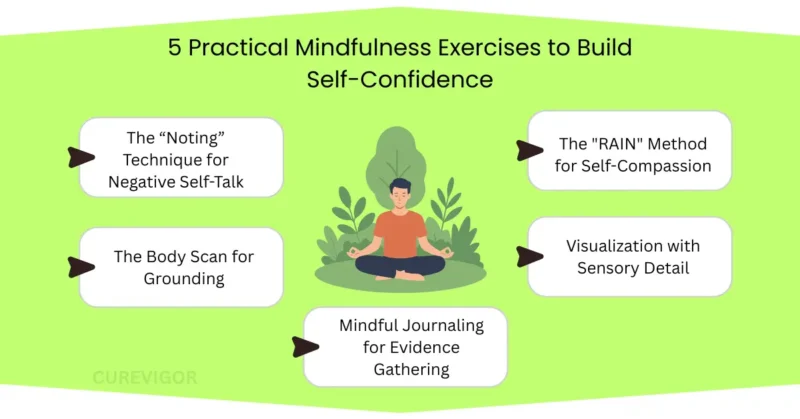
1. The “Noting” Technique for Negative Self-Talk
Hear the doubt whisper. Label it plain: judging, worrying. Step back, watch it float. Truth stays untouched. Do this with your eyes shut, breathe even.
2. The Body Scan for Grounding
Before big steps, sweep attention down. Toes to crown, note holds. Soften each knot slowly. Stability floods in. Ready now.
3. Mindful Journaling for Evidence Gathering
Nightly, pen three strengths proved. See the moments vividly. Wins stack against dark bias. Proof builds bedrock.
4. The “RAIN” Method for Self-Compassion
Spot the low feeling. Recognize it as true. Allow full breath. Probe kind: where, why. Nurture soft as kin.
5. Visualization with Sensory Detail
Eye shut, scene success complete. Colors pop, sounds ring, touch is real. Rehearse breath-tied. Brain wires win.
6 Mindfulness Practices to Build Real Self-Confidence
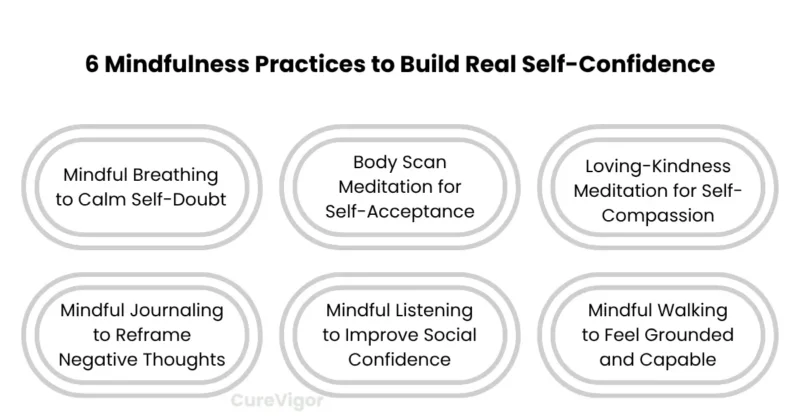
Mindful Breathing to Calm Self-Doubt
The breath is one of the most overlooked tools for managing a spiraling mind. When self-doubt surges, your nervous system shifts into a stress response, your heart rate rises, your thinking narrows, and your body gets ready to fight or flee.
A simple breathing technique can interrupt this pattern before it takes hold. Box breathing is one of the most effective methods: breathe in for four counts, hold for four, breathe out for four, and hold again for four. Repeat this three to five times.
This is not about “relaxing” in a passive way. It is about giving your nervous system a clear signal that you are safe.
When your breathing slows, your parasympathetic nervous system activates, and your thinking becomes clearer and less reactive.
Use this technique right before a difficult conversation, during a moment of social anxiety, or when your inner critic starts getting loud.
You do not need a quiet room or a special time. You can do it at your desk, in a hallway, or on the bus.
Body Scan Meditation for Self-Acceptance
Many people with low confidence live almost entirely in their heads. They are so focused on analyzing thoughts and managing fears that they lose touch with their physical experience.
The body scan meditation is a practice that reconnects you with your body in a gentle and non-judgmental way.
This connection is important because self-trust is not only a mental experience, but it also lives in how safe you feel in your own skin.
To begin, find a comfortable position lying down or seated. Close your eyes. Start by noticing your feet, not trying to change anything, just noticing.
Move your attention slowly upward: legs, stomach, chest, hands, arms, shoulders, neck, face. At each area, simply notice what is there: tension, warmth, numbness, tingling.
Do not judge the sensations. If your mind wanders, gently bring it back to the body. Doing this for 10 to 15 minutes teaches your nervous system that paying attention need not be threatening.
It builds a quiet, steady relationship with yourself that gradually becomes self-acceptance.
Loving-Kindness Meditation for Self-Compassion
Self-compassion is not the same as self-pity.
It is the practice of treating yourself with the same warmth you would offer a good friend who is going through a hard time.
Research by psychologist Dr. Kristin Neff has shown consistently that self-compassion is one of the strongest predictors of emotional resilience and genuine confidence.
When you are kind to yourself in moments of failure, you are more likely to try again, not less.
Loving-kindness meditation, known in Buddhist tradition as Metta, trains this capacity.
Sit quietly and silently repeat phrases directed toward yourself: “May I be well. May I be at peace. May I feel worthy of love and belonging.”
These are not affirmations you need to believe right away. They are intentions, invitations for a new relationship with yourself.
You can also extend these wishes to others, people you care about, acquaintances, even people who have hurt you.
The outward movement of compassion often strengthens the inward one. Even five minutes daily of this practice can begin to soften the harshness of your inner world.
Mindful Journaling to Reframe Negative Thoughts
Writing is one of the most powerful ways to observe your own thinking without being swallowed by it. When you put a thought on paper, it shifts from being something you are inside of to something you are looking at.
This is called cognitive defusion in Acceptance and Commitment Therapy (ACT), and it is a core principle in mindfulness-based approaches to self-confidence. You are not your thoughts.
Your thoughts are patterns your mind produces, and many of them are old, repetitive, and not very accurate.
Mindful journaling is not about writing everything that is wrong. It is about using specific prompts to uncover what your mind is doing and what your strengths actually are.
Try prompts like: “What did I handle well today that I did not give myself credit for?” or “What thought kept showing up today, and is there evidence that it is true?”
Another useful prompt is: “If a friend told me they felt this way, what would I say to them?” These questions move you from emotional reaction into honest reflection.
Done regularly, journaling builds a record of your real experiences that you can return to when doubt feels overwhelming.
Mindful Listening to Improve Social Confidence
A large part of social anxiety comes from being too focused on yourself during conversations.
You are mentally preparing your next sentence, worrying about how you sound, or analyzing the other person’s expression for signs of disapproval.
This internal busyness pulls you away from the actual moment, and ironically, makes you less connected and less confident.
Mindful listening is, in fact, the practice of giving your full, undivided attention to the person in front of you.
In practice, this means letting go of the need to prepare your response while the other person is still talking.
It means noticing when your attention drifts and gently bringing it back to their words. In meetings, it means focusing on what is being said rather than rehearsing your contribution.
When you are truly present with someone, you respond more naturally, and that ease reads as confidence to others.
The fear of saying the wrong thing shrinks when you are no longer performing a version of yourself. You are simply there, listening and responding honestly.
Mindful Walking to Feel Grounded and Capable
Movement is one of the fastest routes to a different mental state. When anxiety and self-doubt feel heavy and stuck, walking with awareness can shift that.
Mindful walking is not about getting somewhere; it is about noticing the experience of moving through space.
Feel your feet on the ground with each step. Notice how your arms swing, how the air feels on your skin, and what sounds are around you. This kind of grounded attention interrupts the mental chatter that feeds low confidence.
There is also a physical dimension to self-confidence that deserves serious attention. Research in embodied cognition shows that posture and movement affect how we feel about ourselves.
Slouching, hunching, and moving hesitantly send signals to your brain that reinforce anxious states. Walking upright, with a steady and unhurried pace, does the opposite.
Mindful walking trains you to inhabit your body with intention. Even a five-minute walk during a stressful moment at work, done with full presence rather than mental distraction, can shift you from anxious to grounded.
How to Practice Mindfulness for Self-Confidence Daily
Building a mindfulness habit does not require long, perfect sessions. In fact, expecting perfection in your practice is itself a confidence trap. The goal is consistency, not intensity.
Start with two to five minutes a day, at a time that already exists in your routine, right after you wake up, before you open your phone, or during your lunch break.
Attach the practice to something you already do so it becomes automatic rather than another item on a to-do list.
Tracking progress in mindfulness is a subtle art. You are not measuring how peaceful or confident you feel every day.
You are noticing, over weeks and months, how your relationship with your own thoughts shifts.
A simple way to track this is a brief daily note, one sentence describing how you felt before and after your practice, or one observation about your inner dialogue that day.
It is not a performance review. It is a record of your experience and shows patterns you would otherwise miss.
Some days, self-confidence will feel completely out of reach. Those days are not failures; they are part of the process. On the hardest days, the goal is not to feel confident.
It is to be gentle with yourself while showing up anyway. Even sitting quietly for two minutes and noticing how you feel is a form of mindfulness. You do not need to fix anything on those days. You just need to not abandon yourself.

Mindfulness vs Affirmations: Why Gentle Awareness Works Better
Positive affirmations became popular because they are simple and appealing. The idea that you can talk yourself into a new identity is comforting.
But for many people, especially those with genuinely low self-esteem, repeating “I am confident and worthy” feels hollow at best and, at worst, mockingly dishonest.
When your mind recognizes that a statement is not true, it pushes back. Psychologists call this psychological reactance, and it explains why forced positivity often leaves people feeling worse, not better.
Mindfulness does not ask you to believe something better about yourself before you have evidence for it. Instead, it creates the conditions for that evidence to accumulate naturally.
By observing your thoughts without judgment, you stop feeding the stories that undermine you.
By practicing self-compassion, you build an inner environment where growth feels safe. By staying present, you gain real experience handling uncertainty, speaking up, and recovering from mistakes.
Confidence built on this foundation is durable. It does not depend on everything going well; it depends on knowing you can handle things even when they do not.
The shift from affirmations to awareness is the shift from performance to presence. You stop trying to convince yourself of something and start discovering it, slowly and honestly, through direct experience.
That is a much quieter process than positive thinking, and much more lasting.
FAQs on How to Use Mindfulness to Boost Self-Confidence
Q. How can I help raise my self-confidence?
Start by changing how you talk to yourself every day. Most people wait for big wins to feel confident, but confidence actually builds through small, repeated actions.
Notice when your inner critic speaks, and gently challenge it instead of accepting it as truth.
Practices like mindful breathing, journaling, and self-compassion meditation slowly rewire how you see yourself or how you raise self-confidence.
Over weeks, these small shifts create a much steadier and more honest sense of self-worth.
Q. How do I get 100% self-confidence?
Complete, unshakeable confidence is not a realistic goal, and chasing it can actually work against you. Even the most successful people experience doubt, fear, and uncertainty.
The real goal is not 100% confidence but a strong enough foundation that self-doubt no longer controls your decisions.
Mindfulness helps you build that foundation by teaching you to act even when fear is present. That ability to move forward despite uncertainty is what true self-confidence actually looks like in real life.
Q. Is there a difference between self-confidence and self-esteem?
Yes, and the difference matters. Self-confidence is, in fact, your belief in your ability to do specific things, speak in public, handle a difficult task, or start a new project.
Self-esteem is deeper. It is your overall sense of worth as a person, regardless of what you achieve or how well you perform. You can be confident in certain skills but still struggle with low self-esteem beneath the surface.
Mindfulness addresses both layers by helping you act with more confidence while also building a kinder, more stable relationship with who you are at your core.
Q. What is the best mindfulness exercise for a quick confidence boost?
Mindful breathing is the fastest and most accessible option in a high-pressure moment.
When self-doubt spikes before a meeting, a conversation, or a presentation, three to five rounds of box breathing, four counts in, four counts hold, four counts out, can calm your nervous system within minutes.
Another quick option is a short body scan, where you spend 60 seconds noticing physical tension and releasing it with slow exhales.
These techniques do not artificially manufacture confidence. They remove the anxiety that was blocking your natural confidence from coming through.
Q. Can mindfulness make you too quiet or less assertive?
This is a common concern, and it is worth addressing honestly. Mindfulness does encourage stillness and observation, but it does not make you passive. In fact, the opposite tends to happen over time.
When you are less reactive and more self-aware, you speak with more intention and clarity. You’re holding back out of fear and need to start expressing yourself from a grounded place.
Assertiveness that comes from calm awareness is far more effective than assertiveness driven by anxiety or the need to prove something. Mindfulness does not silence your voice; it helps you use it more confidently.
Q. Can mindfulness help with social media-induced insecurity?
Social media is designed to trigger comparisons, and comparisons are among the fastest ways to erode self-confidence. Mindfulness helps by making you aware of the moment comparison begins, that small, familiar sting when you see someone else’s highlight reel.
Instead of scrolling deeper into that feeling, you learn to pause, name it, and step back.
Mindful journaling and loving-kindness meditation are especially useful here because they redirect your focus inward, back to your own values and progress.
Over time, your sense of worth becomes less dependent on external feedback and more rooted in your own lived experience.
Start Small: Your First Step to Mindful Self-Confidence
Real confidence does not arrive all at once. It grows slowly, in small and quiet moments. One moment, you notice your inner critic. You hear it, and you choose not to follow it.
Another moment, a wave of social anxiety hits. You breathe through it instead of walking away. Then comes a mistake. You sit with it. You respond with curiosity instead of shame.
These moments may seem small. But each one matters more than it looks. These moments build on each other. Over time, they form a new pattern, and that pattern becomes a new relationship with yourself.
The six practices covered in this article, mindful breathing, body scan meditation, loving-kindness meditation, mindful journaling, mindful listening, and mindful walking, each offer a different entry point into that process.
You do not need to begin all of them at once. Pick the one that feels most accessible to you right now. Maybe it is two minutes of breathing before you check your phone in the morning.
Maybe it is writing one journal prompt tonight before bed. Maybe it is going for a slow, attentive walk during your lunch break tomorrow.
Start with one practice, do it consistently for a week, and notice what shifts, even slightly.
The goal is not to become a different person. The goal is to build a kinder, clearer relationship with the person you already are. That relationship, cultivated with patience and honesty, is where confidence lives.
Confidence does not come from thinking your way into it. It comes from showing up for yourself, one small practice at a time.
Pick one technique from this guide, just one, and try it today. Notice what shifts. Your relationship with yourself is worth those two minutes.
Download Free A 7-Day Mindfulness Confidence Challenge.
Read more articles on Health and Wellness.
You might like: