
Learn how to start a charity that donors love with proven best practices for trust, transparency, donation websites, zakat giving, monthly support, and long-term growth.
Thank you for reading this post, don't forget to subscribe!Starting a charity is not just about collecting money. It is about building trust, solving a real problem, and showing people that their gift creates visible change.
The charities that donors remember are the ones that make giving feel clear, safe, and meaningful from the first visit to the final impact update.

Today, people do not support a cause only because the mission sounds good. They also look at the donation website, the payment flow, the proof of impact, and the organization’s honesty.
Google also tends to reward content and pages that help people first, not pages made only to rank or persuade without substance.
How to Start a Charity That Donors Love
A charity that donors love usually does three things well. It explains the problem in plain language, it shows exactly how help is delivered, and it makes the giving process simple on any device.
That mix of mission, proof, and ease is what turns a first-time donor into a monthly supporter.
Starting a charity is about more than collecting donations. It is about building trust, solving a real problem, and making it easy for people to help.
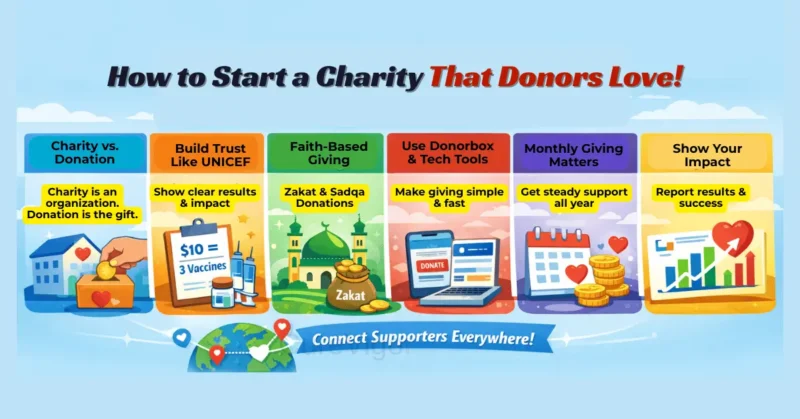
The charities that grow over time are the ones that show clear impact, use simple systems, and treat every donor with honesty and care.
In today’s world, donors expect more than a good mission. They want a fast donation website, secure payment options, real stories, and proof that their support makes a difference.
If you want to build a charity that donors love, you need strong values, smart systems, and a clear way to show where every gift goes.
What Is the Difference Between Charity and Donation?
A charity is the organization that manages the work. A donation is the gift that powers that work. This simple difference helps people understand how the system works.
A charity is the vehicle. A donation is the fuel. This is the easiest way to understand the system.
The charity organization is the legal and operational structure that plans, manages, and delivers help, while the donation is the act of giving money, goods, or time to support that work.
When you start a charity, your goal is to bridge the gap between charities and people seeking the best charities to donate to. Donors are not only choosing a cause; they are also choosing a cause.
They are choosing a system they can trust. That means your charity must be organized, transparent, and easy to understand from the start.
In the past, charity often meant local giving through community leaders, places of worship, or neighborhood groups.
Today, the practice has expanded into a digital-first experience that lets someone read your mission, compare your work, and give in less than two minutes from a phone.
This shift means your charity must act like both a mission-driven organization and a modern service platform.
That change matters because donor behavior has changed, too. People now expect quick answers, secure payments, tax receipts, and updates that show results.
In simple terms, a charity may be built on compassion, but it grows through systems, clarity, and follow-through.
Why Donors Choose One Charity Over Another
Donors usually support organizations that feel clear, honest, and active. They look for signs that the charity is real and well-managed.
It includes a clear mission, up-to-date information, secure payment methods, and simple answers to common donor questions.
Trust also grows when a charity stays consistent. If the message on the homepage, donation page, and social media all match, the organization feels more reliable.
Donors want to feel safe before they give, and clear communication helps create that feeling.
Most donors do not read every page on a nonprofit website. They scan. They look for signs that the organization is real, active, and responsible.
A clear mission statement, recent impact stories, visible contact details, and financial honesty often matter more than polished slogans.
This is one reason the best charities to donate to often look simple rather than flashy. Their message is focused. Their language is human.
Their pages answer basic donor questions quickly, such as who you help, where the money goes, how impact is measured, and why your method works better than doing nothing.
Trust is also built through consistency. If your homepage says one thing, your donation page says another, and your social media feels outdated, donors notice.
People are very good at sensing friction. When details do not align, confidence drops, and donations decline.
A donor-friendly charity treats every public touchpoint as part of one trust system. Your website, receipts, reports, campaigns, and follow-up emails should all support the same message.
That message is simple: we know the problem, we know how to help, and we will show you what your gift achieved.
How to Start a Charity with a Strong Purpose
Every strong charity begins with one clear problem. The mission should be easy to understand and easy to explain. A focused mission helps donors know what they are supporting and why it matters.
A new charity should also know who it serves, how help is delivered, and what success looks like.
This makes the organization easier to manage and easier to trust. Donors are more likely to support a charity that knows exactly what it is trying to change.
Building for Trust with the UNICEF Model
If you want a model for donor trust, UNICEF donation campaigns offer a strong example.
Large organizations like UNICEF have built support over time by making impact easy to understand, giving easy-to-complete forms, and making trust signals easy to find.
A new charity may not have its scale, but it can learn from its structure.
One of the smartest lessons is impact reporting. Donors want to know what their money does in real terms.
General promises are weak. Specific outcomes are strong. Saying that a gift supports children is less powerful than saying a set amount helps fund vaccines, clean water, nutrition support, or school materials.
Even if you are not a massive charity organization like UNICEF, you can adopt their transparency by clearly showing the impact of your donations on your donation website.
You can explain what a small gift does, what a medium gift does, and what a recurring gift makes possible over time. This helps donors feel useful, not just generous.
Trust also grows when reporting is regular rather than occasional. A strong charity shares updates before donors ask for them.
That includes, where appropriate, photos, field notes, verified totals, progress milestones, and lessons learned.
Honest reporting is not only about success. It is also about showing what did not work and how you improved.
Why Impact Reporting Matters for Donor Confidence
Impact reporting turns emotion into confidence. Many people are willing to give once because a story touched them.
They continue giving when they believe the organization is competent. Competence is shown through numbers, context, and results that make sense.
For example, a food charity can explain how many meals were funded, how deliveries were managed, and which areas were served.
A health charity can report treatments, screenings, medicine support, or outreach visits.
A school charity can demonstrate gains in attendance, book distribution, or improved classroom access. These details make your mission concrete.
There is also a deeper reason why impact reporting works so well. Donors do not only want proof for themselves.
They want confidence when they tell friends, family, or colleagues about their cause.
Clear reporting makes your supporters more likely to recommend you, and that is one of the most powerful growth channels for any charity.
From an experience point of view, strong reporting also reduces fear. New donors often worry about waste, overhead, or fake appeals.
When your reports are specific, readable, and updated often, you answer those fears without needing a long defense page.
Why Monthly Support Helps a Charity Grow
A charity that relies solely on one-time donations lives in constant uncertainty. A charity with recurring giving has a stronger future.
Monthly support helps with planning, staff stability, fieldwork, emergency reserves, and long-term programs that cannot rely solely on seasonal fundraising.
This is why many successful charities gently and respectfully guide donors toward monthly giving. They do not pressure people.
They explain the value. A monthly donor can help keep a clinic stocked, support a child’s meals year-round, or fund regular outreach rather than a single event. That message is simple and powerful.
Recurring giving also changes the donor relationship. A one-time donor may feel like a visitor. A monthly donor feels like a partner.
That emotional shift matters because people stay longer when they believe they are part of an ongoing solution rather than a short-term response.
From a systems angle, recurring support also helps smaller charities stay honest and realistic.
Instead of chasing viral campaigns all year, they can budget with more accuracy. This makes the whole organization stronger, calmer, and more trustworthy.
Faith-Based Giving: Understanding Sadqa and Zakat Donation

For many people, charity is not only a social act. It is spiritual. Whether it is a daily sadqa or an annual zakat donation, your organization must provide a seamless way to facilitate these donations.
This is especially important for charities that serve Muslim donors or work in regions where faith-based giving shapes donor behavior.
Sadqa, often written as sadaqah, is voluntary giving offered from compassion, gratitude, or a desire to help others.
Zakat donation is different. It is a required form of almsgiving in Islam for eligible Muslims, usually calculated at 2.5 percent of qualifying wealth.
Because of this, donors who give zakat often want clarity about compliance, eligibility, and fund handling.
A modern charity that wants to attract these donors must do more than just add a button labeled “zakat.”
It should explain whether the charity is zakat-compliant, how zakat funds are separated if needed, what types of programs qualify, and how the organization ensures proper distribution.
Without this clarity, many faith-based donors will hesitate.
Islamic donation trends have also moved online. More donors now want to calculate, give, and receive confirmation digitally.
That means your donation process should support faith-based intent with clear fund labels, trustworthy payment pages, and explanations that respect both religious duty and donor care.
Why Zakat-Compliant Giving Matters
Many Muslim donors want to know whether a charity is zakat-compliant before they give.
This means the charity should clearly explain whether zakat funds are accepted, how they are handled, and how they are used.
Without this information, donors may hesitate even if they care about the cause.
A charity that accepts zakat should make this process simple and transparent. Clear fund labels, easy explanations, and a smooth payment experience can make a big difference.
Faith-based donors want both spiritual confidence and practical clarity.
How to Make Your Charity Zakat-Compliant and Donor-Friendly
Zakat-compliant giving is built on clarity. If your organization accepts zakat, you should clearly state so and explain the basis for that claim.
Donors should not need to search through hidden pages to learn whether their religious giving is being handled correctly.
It also helps to separate funds or at least explain your accounting method. Many donors want confidence that zakat donation funds are not mixed in a way that undermines trust.
Even if your backend process is complex, the public explanation should be simple and direct. People should know where their money goes and under what rules it is used.
Language matters here as well. A respectful charity does not reduce faith-based giving to a marketing trend.
It recognizes that these gifts come with intention, duty, and emotion. When you explain sadqa and zakat with care, donors feel understood rather than targeted.
This is one area where personal experience and local understanding matter a lot. In many Muslim communities, donors do not just ask whether a cause is urgent. They ask whether the method of giving is correct.
Charities that understand this question early are often better positioned to serve both local and global donors.
The Role of Donorbox and Modern Donation Tools
A charity donors love is easy to use. This is where tools like Donorbox can help. Donorbox is often used by new and growing charities because it supports recurring giving, donation forms, tax receipts, and multiple currencies in one system.
To compete with the best charities to donate to, a new charity should use a professional donation website powered by tools like Donorbox.
A better giving experience reduces friction, improves trust, and makes it easier for donors to complete their gift without confusion.
Technology is not just a convenience layer. It is part of trust. A broken form, a missing confirmation email, or a poor mobile layout can damage donor confidence, even if the mission is excellent.
The donor may not complain. They may simply leave.
This is why your website should be treated as a frontline part of your charity’s operations.
If your fieldwork is serious, your digital giving system should be serious too. A donation page is not a side page. It is one of the main places where trust is won or lost.
Why Your Donation Website Must Be Mobile Friendly
Many people now donate through their phones. This means your donation website must load quickly, look clean on smaller screens, and make checkout simple.
If your site is slow or hard to use, donors may leave before completing their gift.
Mobile donors behave differently from desktop donors. They are often faster, more distracted, and less patient.
They need clear text, large buttons, minimal steps, and payment options that feel familiar. A donation page that works beautifully on desktop but poorly on mobile will quietly lose support every week.
This matters even more for urgent campaigns. When someone sees a charity appeal on social media, in a message group, or through a search result, they often open it on a phone first.
That first mobile session may be your only chance to convert their interest into action.
A mobile-friendly page should use short text, clear donation amounts, simple forms, and fast payment options.
It should also send confirmation right away. When the giving process feels smooth on mobile, your charity becomes easier to trust and easier to support.
What Your Donation Website Must Include
A good donation website does not try to impress with too many moving parts. It removes friction.
The home page should explain the cause; the donation page should make giving easy, and the trust pages should answer deeper questions for donors who want proof before they give.
At a minimum, your site should show your mission, your legal status (where relevant), clear contact details, recent activity, secure payment processing, and an explanation of how funds are used.
If you support special giving types such as zakat donations or memorial giving, those paths should be easy to find.
Your content should also reflect real-world experience. Google’s guidance repeatedly emphasizes the need for helpful, reliable content and encourages creators to consider who created it, how it was made, and why.
For a charity site, that means real field knowledge, clear explanations of the process, and content that helps donors make informed decisions.
In practice, the strongest charity websites sound informed without sounding corporate.
They use plain language, answer real donor concerns, and avoid inflated claims. A donor should leave your site feeling informed, not overwhelmed.
How to Explain Your Charity’s Flow So Donors Understand It
Many new charities assume donors understand how charitable work happens. In reality, most people only see the beginning and the end.
They see the appeal and the result, but not the system in between. That gap can create doubt.
A smart charity explains the full flow in a simple way. A donor gives through the website.
The charity records the donation, assigns the fund to the appropriate fund, sends a receipt, distributes resources through partners or direct programs, verifies delivery, and reports back on outcomes. That process makes the ecosystem visible.
This is where a simple process diagram on your page can help. It does not need to be fancy.
It just needs to show that giving moves through a clear chain of care and accountability. When donors understand the path, they are more likely to trust the result.
The deeper value of this approach lies in education. You are not only asking for money.
You are teaching people how responsible charity works. That helps your reputation, your repeat-giving rate, and your long-term ranking, because genuinely useful content tends to align better with Google’s people-first guidance.
What Makes the Best Charities to Donate To?
The best charities to donate to are not always the biggest or the loudest. They are usually the clearest.
They know what problem they solve, they explain their model in plain language, and they show proof that the work is happening in the real world.
They also respect the donor’s time. Their websites load well. Their forms are easy. Their follow-up is thoughtful.
Their reports are readable. These small things may sound technical, but together they create the feeling that the organization is competent and donor-centered.
Another key trait is restraint. Strong charities do not overclaim. They do not present every program as a miracle.
They tell the truth about scale, limits, costs, and progress. That honesty builds stronger loyalty than emotional exaggeration ever can.
In real terms, donors love a charity that feels human and well-run at the same time. Mission brings them in, but trust keeps them there.
That is why the best charity brands are built on both heart and structure.
How to Make Donors Love Your Charity
Donors love charities that make them feel informed, respected, and part of something real.
They want to know that the organization understands the problem, has a workable solution, and uses money responsibly. Strong trust often grows from small details done well.
A clear mission, honest updates, a professional website, and regular communication can make a strong impression.
Over time, this leads to repeat giving, word-of-mouth support, and stronger long-term growth for the organization.
How to Start a Charity with Long-Term Strength
If you are starting from zero, begin with one problem, one audience, and one model of help. Do not try to solve everything at once.
A focused charity is easier to explain, easier to manage, and easier for donors to trust.
Next, build your trust assets before you push hard on fundraising. Create a clear mission page, a professional donation website, an explanation of where funds go, and a reporting system you can maintain every month.
It is better to launch smaller with a real structure than to launch big with weak operations.
Then, design your giving paths based on real donor behavior. Include one-time gifts, monthly support, and, where relevant, faith-based options such as sadqa and zakat donations.
Make the process mobile-friendly and remove extra steps that slow people down.
Finally, remember that donor love is earned through repetition. One good campaign can bring attention, but only consistent clarity creates loyalty.
Over time, the charities that last are the ones that make people feel safe, informed, and truly connected to the impact of their giving.
Final Thoughts on Starting a Charity That Lasts
Starting a charity that donors love is not about copying big nonprofit brands word-for-word. It is about learning the principles behind their trust. Use clear reporting, as in the UNICEF donation model.
Support recurring gifts for stability. Respect cultural and religious giving, such as sadqa and zakat.
Build a donation website that works cleanly on mobile and feels safe from the first click.
If you do these things well, your charity organization can stand out even in a crowded space. People do not only want to donate.
They want to believe. When your systems, message, and proof all work together, giving stops feeling like a transaction and starts feeling like a partnership.
That is the real goal when you start a charity. You are not just collecting support. You are building a trusted bridge between people who want to help and those who need it most.
And when that bridge is strong, donors return, recommend, and stay with you for the long run.
FAQ
Q. What is the difference between a charity and a donation?
A charity is an organization that manages programs and support. A donation is the money, goods, or help given to support that charity’s work.
The charity is the structure, and the donation is the act that powers it.
Q. How do I start a charity that people trust?
Start with a clear mission and explain it simply. Show who you help, how you help, and where donations go.
Build a clean website, add real contact details, and share regular updates with proof of impact. People trust a charity when it feels honest, active, and easy to understand.
Q. What makes donors love a charity?
Donors love a charity that feels clear, caring, and reliable. They want to see real results, not vague promises.
A simple donation process, honest reporting, and timely thank-you messages make a big difference. When donors feel respected and informed, they are more likely to give again.
Q. What is the 50-30-20 rule for donations?
The 50-30-20 rule is primarily a personal budgeting method, not a charity law. It means 50% of income goes to needs, 30% to wants, and 20% to savings or debt payments.
Some people choose to donate from the 30% or from their extra savings. In charity planning, it is best used as a guide for donors who want to give in a balanced way.
Q. How to start a successful charity?
A successful charity starts with a real problem and a practical plan to solve it. You need the right legal setup, a trusted team, clear funding methods, and strong record-keeping.
Success also depends on donor trust, good communication, and regular impact reporting. The best charities grow step by step instead of trying to do everything at once.
Q. What is a zakat donation?
Zakat donation is a required form of giving in Islam for eligible Muslims. It is usually 2.5% of qualifying wealth and is meant to support people in need. Many donors look for charities that handle zakat properly and transparently.
A charity that accepts zakat should clearly explain how those funds are collected and used.
Q. What are the 4 types of charities?
A simple way to group charities is into relief, education, health, and faith-based charities.
Relief charities help with food, shelter, and emergency support. Education charities focus on schools, training, and access to learning, while health charities support treatment and care.
Faith-based charities combine service work with religious values and often include giving practices such as zakat or sadqa.
Q. What are common charity mistakes?
A common mistake is starting with a broad mission that is hard to manage. Another is asking for donations before building trust, systems, and proof of work.
Many charities also fail because their website is weak, their reporting is unclear, or their donor follow-up is poor. Small gaps in trust can hurt growth more than most people expect.
Q. Is it hard to open a charity?
Opening a charity can be challenging, but it is possible with the right planning. The hard part is not only the legal setup but also building trust, securing funding, and sustaining operations that last.
Many people can launch a charity, but fewer can run it well over time. It becomes easier when the mission is focused and the systems are simple.
Q. What is sadqa?
Sadqa, also called sadaqah, is a voluntary charity in Islam. It is given out of kindness, compassion, and the wish to help others.
Unlike zakat, it is not fixed or required at a set rate. People can give sadqa at any time, in any amount, whether through money, food, clothing, or other support.
Q. Why should a charity use Donorbox?
Donorbox helps a charity create a smoother online donation experience. It supports recurring donations, simple checkout, receipts, and multiple payment options in one place.
This makes it easier for donors to complete their gift without confusion. For a new charity, that kind of ease can improve trust and increase conversions.
Q. Why is monthly giving important for charities?
Monthly giving provides a charity with steady support rather than an unpredictable one-time income. It helps with planning, staff costs, regular programs, and long-term community work.
Additionally, it improves the donor-organization relationship. Rather than being a one-time supporter, a monthly donation frequently feels like a partner.
Read more articles about Healthy Lifestyles.
You might like to read: