
Does age influence mindset? Learn how age affects fixed vs. growth mindset, neuroplasticity, lifelong learning, and personal growth at any age.
Have you ever caught yourself thinking, “I’m too old to learn this,” “I’ve always been this way,” or “I’m just not good at it”?
These thoughts can sound like simple observations, but they may reflect something deeper: your beliefs about whether people can change.
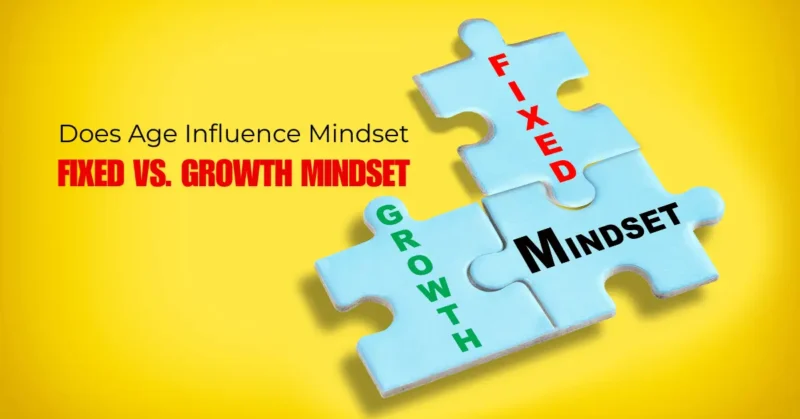
That is where the difference between a growth mindset and a fixed mindset becomes important.
Psychologist Carol Dweck and her colleagues helped popularize the idea that people can hold different beliefs about whether abilities are relatively fixed or can develop over time. A growth mindset involves viewing intellectual abilities as developable, while a fixed mindset treats them as more static.
But does age influence mindset?
Yes, age can be associated with differences in mindset, but getting older does not automatically give you a fixed mindset. Your experiences, education, environment, health, opportunities to learn, social expectations, and beliefs about yourself can all play a role.
Research published in 2026 found that older age was associated with lower growth-mindset indicators in some areas of later life, particularly education- and belief-related measures. However, the researchers also found important differences across types of mindset and links with education, employment, wealth, health, and memory.
That makes the real question more useful:
Can you develop a growth mindset at any age?
The evidence suggests that people can strengthen growth-oriented beliefs later in life, although changing a mindset is not always permanent or effortless.
Direct Answer—Does Age Influence Mindset?
Yes, but age doesn’t lock you into a fixed or growth mindset.
Age can influence the experiences, responsibilities, opportunities, and physical or cognitive changes that shape how you think about learning and personal change.
However, age is not a psychological switch that changes someone from a growth mindset to a fixed mindset.
Two people of the same age can have completely different beliefs about their abilities.
A 65-year-old may think:
“I have never used this software, but I can learn.”
Another person of the same age may think:
“Technology isn’t for people my age.”
Likewise, a teenager may enthusiastically embrace new challenges in one area but avoid anything that threatens their self-image in another.
Mindset is also domain-specific. You might believe you can improve your writing but feel that your athletic ability is fixed. You might be open to learning technology but believe your personality can never change.
So instead of asking whether someone has a permanently fixed or growth mindset, it is often more useful to ask:
“What do I believe can change, and what do I believe cannot?”
What research says: mindset is influenced by age, experience, and neuroplasticity.
Research does suggest that age is associated with differences in growth-mindset measures, particularly in later adulthood. A 2026 study using data from the English Longitudinal Study of Ageing found that older age was associated with lower growth-mindset indicators in some domains.
But the study also found that mindset was socially patterned and differed according to education, employment, wealth, health, and cognitive functioning.
This matters because age and opportunity are not the same thing.
Someone who has fewer opportunities for formal learning may appear less growth-oriented on an education-based measure, even though they remain curious, adaptable, creative, or willing to learn in other areas.
At the same time, neuroscience provides an important reason not to assume that learning stops with age. The aging brain does change, and some learning-related abilities decline. Yet research shows that the adult brain retains capacity for experience-dependent plasticity, and older adults can improve skills through training.
What is a fixed mindset?
- Core belief: Your intelligence, talents, and basic qualities are unchangeable traits.
- Reaction to failure: You see setbacks as proof that you lack skill.
- Behavior: You avoid challenges and quit when things get hard.
What is a growth mindset?
Behavior: You embrace tough tasks and persist through obstacles.
Core belief: Your abilities can improve through hard work, practice, and dedication.
Reaction to failure: You view mistakes as chances to learn and grow.
How Age Influences Mindset
- Not destiny: Chronological age is a factor in how we think, but it is not a final rule.
- Life experience: Some older adults lean toward fixed ideas because of stable routines, long-held roles, or environments that value old habits over new learning.
- Malleability: Research shows that people can shift their mindset at any stage of life when they encounter new contexts, supportive teachers, or fresh challenges.
How Age Influences Mindset at Different Life Stages
Age does not affect everyone in the same way. Each life stage brings different experiences that can influence self-belief, learning, resilience, and adaptability.
Childhood (0-12): How early feedback shapes fixed vs growth mindset
Children are constantly developing ideas about what they can and cannot do.
When a child struggles with mathematics, reading, drawing, sports, or another skill, the response from adults can influence how that child interprets the experience.
A child who hears:
“You’re so naturally smart.”
may begin to worry about situations where they might not appear smart.
A child who hears:
“You worked hard on that strategy. What could you try next?”
receives a different message about learning.
This does not mean parents should praise every attempt regardless of quality. Useful feedback can focus on:
- Strategies
- Persistence
- Improvement
- Problem-solving
- Learning from mistakes
- Asking for help
Research associated with Dweck’s work shows that children’s concepts of ability develop earlier and can be more sophisticated than previously assumed.
The goal is not to tell children they can do everything.
It is to help them understand that struggling with something today does not necessarily define their ability tomorrow.
Teenage Years (13-19): Identity, peer pressure, and resilience
Teenagers are developing stronger identities while navigating school expectations, friendships, social comparison, and future decisions.
This can make mindset complicated.
A teenager may have a strong growth mindset about academics but a fixed belief about appearance or social confidence.
For example:
“I can improve my grades, but I’ll never be good at speaking in front of people.”
Peer feedback can make these beliefs stronger.
This is one reason the environment matters so much. Research on growth-mindset interventions has found that the surrounding context can influence whether a growth-oriented belief translates into meaningful behavior.
Resilience also matters.
A growth-oriented teenager can learn to interpret a poor grade as information:
“I need a different study method.”
rather than as an identity statement:
“I’m stupid.”
Young Adulthood (20-35): Career, comparison, and self-belief
Young adulthood often brings major decisions about education, careers, relationships, finances, and identity.
Early successes can build confidence.
Early failures can also create limiting beliefs.
Someone who fails an interview might think:
“I need to improve my interview skills.”
Or:
“I’m simply not good enough for professional jobs.”
The first interpretation leaves room for development.
The second can turn one experience into a permanent identity.
Social media and comparison can add another layer. Seeing someone else’s career success can make personal development feel like a competition rather than a process.
A growth mindset does not require ignoring other people’s achievements. It encourages you to ask:
“What can I learn from their experience?”
Middle Age (36-60): Does mindset become fixed with age?
Middle age does not automatically produce a fixed mindset.
However, routines and responsibilities can make change feel harder.
People may be balancing:
- Careers
- Parenting
- Finances
- Relationships
- Caregiving
- Health
- Household responsibilities
After years in one profession, starting again can feel risky.
Someone might say:
“I’ve been doing this for 20 years. It’s too late to change.”
But age may not be the only issue.
Time, money, responsibilities, confidence, and opportunity all matter.
A growth mindset can help someone examine the situation more carefully:
“What kind of change is realistic for me now?”
That could mean a completely new career—or simply learning a new skill within the existing career.
Research involving adults aged 40–80 found that growth mindset was associated with successful aging in both middle-aged and older groups. This was an observational study, so it does not prove that mindset itself caused better aging outcomes, but it supports the idea that growth-oriented beliefs remain relevant beyond young adulthood.
Older Adults (60+): Can you develop a growth mindset after 60?
Yes, and research specifically involving older adults makes this an important area to explore.
In a multi-skill learning intervention, older adults who participated in growth-mindset discussions increased their growth-mindset beliefs. Participants with stronger pre-existing growth mindsets also showed larger cognitive gains after the intervention.
Other research found that growth-mindset interventions could increase growth-oriented beliefs in older adults, although some of those changes declined over longer follow-up periods. This suggests that mindset development may need continued practice rather than a single motivational session.
So yes, developing a growth mindset after 60 is possible.
But that does not mean aging does not affect learning.
Healthy aging involves real changes in memory, processing speed, brain structure, and other cognitive functions. A 2025 systematic review of 265 studies found overall age-related declines in several learning-related cognitive and brain outcomes, while some abilities, including crystallized abilities and certain forms of implicit learning and memory, showed greater stability.
The realistic message is:
You may learn differently as you age, but learning does not simply stop.
5 Key Factors That Influence Mindset More Than Age
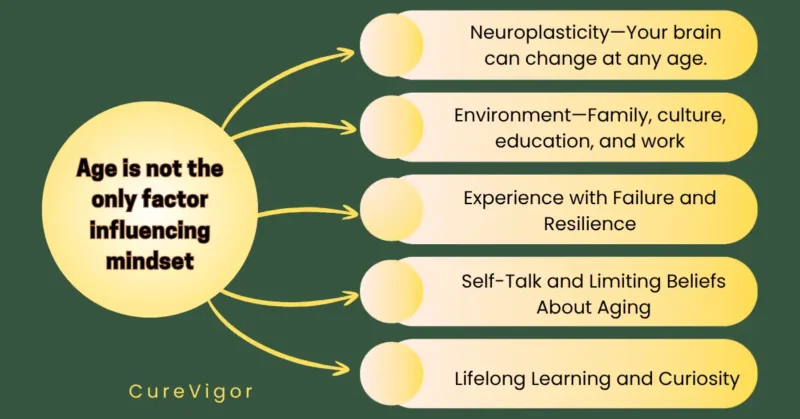
Age is only one part of the picture.
1. Neuroplasticity—Your brain can change at any age.
Neuroplasticity refers broadly to the brain’s ability to change in response to experience, learning, and other influences.
It does not mean the brain remains unchanged throughout life.
Aging brings genuine neurological changes, and some forms of plasticity become less pronounced. Still, research shows that older adults retain the capacity to improve skills through training and learning.
This is why the phrase “my brain can’t learn anymore” is too absolute.
A better thought is:
“Learning may require different strategies, more repetition, or more time than it once did.”
That is a much more realistic form of growth thinking.
2. Environment—Family, culture, education, and work
Your environment repeatedly tells you what is possible.
A workplace that rewards learning may encourage adaptability.
A family that treats mistakes as embarrassing may encourage avoidance.
A school that supports questions can make curiosity feel normal.
A culture can also influence beliefs about aging, intelligence, success, and social roles.
The 2026 later-life study found growth-mindset indicators were associated with factors including education, employment, wealth, health, and memory, demonstrating why age alone is an incomplete explanation.
3. Experience with Failure and Resilience
Failure can strengthen a fixed mindset or a growth mindset depending on how it is interpreted.
Consider two people who fail an exam.
Person A thinks:
“I’m not intelligent enough.”
Person B thinks:
“My preparation wasn’t effective. I need another approach.”
The event is similar.
The interpretation is different.
Over time, repeated experiences of coping with setbacks can build resilience and change how people respond to challenges.
Research in older adults has also linked malleable beliefs about intelligence with resilience and cognitive functioning, although such findings should not be interpreted as proof that mindset alone produces these outcomes.
4. Self-Talk and Limiting Beliefs About Aging
Age-related self-talk can quietly become a barrier.
Examples include:
- “I’m too old for this.”
- “Young people are better with technology.”
- “People my age don’t start new careers.”
- “My memory isn’t good enough.”
- “I’ve missed my chance.”
Some age-related changes are real.
But turning a real change into a universal conclusion can create unnecessary limits.
Instead of:
“I’m too old to learn this.”
try:
“This is unfamiliar, so I may need more practice.”
That is not pretending age does not matter.
It is refusing to let age become the entire explanation.
5. Lifelong Learning and Curiosity
Curiosity gives your brain reasons to keep engaging with new information.
Lifelong learning can include formal education, but it does not have to.
You can learn through:
- Reading
- Languages
- Music
- Cooking
- Technology
- Travel
- Hobbies
- Exercise
- Volunteering
- Community activities
- Teaching others
A systematic review of learning across healthy adulthood found that aging affects different forms of learning differently and that factors such as education and socioeconomic status can influence learning trajectories.
The point is not to compete with your younger self.
It is to remain engaged with learning in a way that fits your current life.
Myths About Age and Fixed Mindset
Myth 1: You can’t teach an old dog new tricks
This saying is catchy, but it is not a scientific description of human learning.
Older adults can learn new skills, and research shows that the aging brain retains plasticity and that older adults can improve with training.
Learning may sometimes be slower or require different strategies.
That is different from being unable to learn.
Myth 2: Young people naturally have a growth mindset
Young age does not guarantee a growth mindset.
A teenager may be highly adaptable in one area and deeply fixed in another.
Mindset develops through experiences, beliefs, feedback, social context, and opportunities.
Even among young people, growth-mindset interventions work differently depending on context.
Myth 3: Fixed mindset gets worse with age automatically.
The evidence does not justify this simple conclusion.
Some research finds lower growth-mindset indicators with older age, including the 2026 English Longitudinal Study of Ageing. But that same research found substantial variation across different mindset dimensions and links with socioeconomic, health, and cognitive factors.
So the better conclusion is:
Age may influence mindset, but it does not determine it.
What Science Says About Age and Growth Mindset
Dweck’s studies on age-related beliefs and personal growth
Dweck’s broader research has established mindset as a way of understanding beliefs about the malleability of abilities.
Importantly, modern mindset research has become more nuanced.
Researchers increasingly ask:
- When does mindset matter?
- For whom does it matter?
- In what environment?
- Which abilities are being discussed?
- How strong is the effect?
- Does a change in mindset last?
Stanford’s current profile of Dweck’s work emphasizes exactly this broader development of mindset research, including the importance of context and differences between individuals.
This prevents us from turning “growth mindset” into a simple motivational slogan.
Neuroscience of brain plasticity after 50, 60, 70
The brain changes throughout adulthood.
Aging can affect processing speed, memory, brain structure, and other cognitive functions. However, research also shows that older brains can respond to learning and training.
A 2024 review of aging, brain plasticity, and motor learning concluded that older adults maintain the capacity for skill improvement through training despite age-related changes in motor performance.
This is important because brain plasticity is not an all-or-nothing concept.
The fact that plasticity remains does not mean every ability can be restored to a younger level.
It means the nervous system retains capacity to adapt.
Studies on older adults learning new skills and adaptability
Research provides several useful examples.
Older adults participating in a multi-skill learning program increased growth-mindset beliefs, and stronger pre-existing growth mindsets were associated with greater cognitive gains in that study.
Another study found that growth mindset was associated with better adjustment and well-being during the COVID-19 pandemic across younger, middle-aged, and older adults. Among older adults, growth mindset was also associated with a greater likelihood of adapting daily routines.
These findings are encouraging, but they do not mean a growth mindset is a cure-all.
Mindset is one psychological factor among many.
How to Develop a Growth Mindset at Any Age—Actionable Framework
Step 1: Identify Your Fixed Mindset Triggers About Age
Pay attention to moments when you automatically think:
- “I’m too old.”
- “I’m too young.”
- “I’m not naturally good at this.”
- “I should already know this.”
- “People like me don’t do that.”
Write the thought down.
Then ask:
“Is this a fact, or is it a belief?”
That small distinction can create room for a different response.
Step 2: Reframe Failure as Feedback—Building Resilience
Instead of asking:
“What is wrong with me?”
ask:
“What does this experience tell me?”
Maybe you need:
- More practice
- Better instruction
- A different strategy
- More time
- Feedback
- Support
Failure becomes useful when it gives you information.
Step 3: Practice Lifelong Learning Habits Daily
You do not need to enroll in a degree program.
Set aside a small amount of time for something unfamiliar.
Read a few pages.
Learn a new digital tool.
Practice a language.
Try a new recipe.
Study a subject that interests you.
The goal is to maintain a relationship with learning.
Step 4: Use a Language Shift—From “I Can’t” to “I Can’t Yet”
“I can’t” can sound final.
“I can’t yet” leaves room for development.
But use this phrase honestly.
If something truly isn’t possible or appropriate, accept the limitation.
Growth mindset is not about denying reality.
It is about identifying what can be developed.
Step 5: Surround Yourself With Growth-Minded People
Your environment can reinforce your beliefs.
Spend time with people who:
- Keep learning
- Ask questions
- Admit mistakes
- Try new things
- Give constructive feedback
- Encourage development
You do not need everyone around you to think exactly like you.
But regular exposure to curiosity and adaptability can make those behaviors feel more normal.
Real Examples of Growth Mindset Across Ages
Case studies: People who changed careers at 40, 50, 60+
Career-change stories can be inspiring, but individual stories are examples, not scientific proof.
Rather than inventing names or presenting celebrity success stories as evidence, consider three realistic scenarios.
Career Change at 40
A 40-year-old office worker realizes that digital skills could open new opportunities.
A fixed interpretation might be:
“Everyone younger than me already knows this.”
A growth interpretation is:
“I have experience in this industry. Now I need to add digital skills.”
The age of the individual has not vanished.
Their existing experience becomes part of the new learning process.
Career Change at 50
A 50-year-old professional decides to move into consulting.
Instead of starting from zero, they identify transferable skills:
- Communication
- Industry knowledge
- Leadership
- Problem-solving
- Client relationships
The growth mindset here is not pretending to be 25.
It is recognizing that previous experience can become an asset while new skills are developed.
Learning After 60
An older adult decides to learn a new language or digital tool.
The first attempts may feel slower than expected.
Rather than interpreting this as evidence that learning is impossible, the person adjusts the pace, practices regularly, and uses feedback.
This example is consistent with research showing that older adults can participate in multi-skill learning and improve their growth-mindset beliefs.
Why Mindset Matters as We Age
- Better health: Older adults with a growth mindset handle stress and negative aging stereotypes much better than those with fixed views.
- Longer life: Studies show that positive self-perceptions about aging can significantly improve physical health and longevity.
- Active living: Believing you can change helps you adopt healthy habits, stay resilient, and enjoy lifelong personal growth
Expert Insight: Age and Mindset
The broader psychological evidence suggests that mindset should not be treated as a permanent personality label.
Carol Dweck’s research focuses on beliefs about ability and how those beliefs interact with motivation, behavior, and context. More recent work also emphasizes that mindset effects can vary across people and environments.
Research involving older adults adds another important point: growth-oriented beliefs can be associated with learning, resilience, well-being, and adaptation, but interventions may require continued reinforcement to maintain changes.
Author Experience in Personal Growth
A responsible personal-growth article should distinguish practical guidance from scientific evidence.
The strategies in this article—such as reframing fixed thoughts, learning new skills, seeking feedback, and practicing adaptive self-talk—are practical applications of the concepts discussed in mindset research.
They should not be presented as psychological treatment or as guaranteed methods for changing someone’s personality.
For persistent distress, severe self-doubt, depression, anxiety, or difficulties that interfere with daily life, speaking with a qualified mental-health professional is more appropriate than relying on mindset exercises alone.
Fixed vs. Growth Mindset Comparison Table
| Situation | Fixed Mindset | Growth Mindset |
|---|---|---|
| Learning something difficult | “I’m not good at this.” | “I need more practice or a better strategy.” |
| Making a mistake | “I failed.” | “I can learn from what happened.” |
| Receiving criticism | “They think I’m incapable.” | “Is there something useful in this feedback?” |
| Facing a challenge | “I might look bad.” | “This could help me develop.” |
| Getting older | “My best years are behind me.” | “Some things change, but I can keep developing.” |
| Learning technology | “I’m too old for this.” | “I may need time and practice.” |
| Career change | “It’s too late to start again.” | “What skills can I transfer and what can I learn?” |
| Slow progress | “I’m not capable.” | “Progress may take longer than I expected.” |
| Failure | Avoids another attempt | Adjusts strategy and tries again |
| Feedback | Takes it as a judgment | Uses it as information |
How Mindsets Respond to Challenges, Criticism, and Aging
The difference is not that one person experiences failure while the other does not.
Both may experience disappointment, fear, frustration, or self-doubt.
The difference is often in how the experience is interpreted.
A fixed interpretation can turn a temporary difficulty into a statement about identity.
A growth-oriented interpretation asks what can be learned or changed.
This does not mean the growth-oriented person always succeeds.
It means they are less likely to treat one outcome as the final definition of their ability.
FAQ – Does Age Influence Mindset?
Q. Does age influence mindset?
Yes, age can influence mindset through life experience, opportunities, social expectations, and age-related changes, but it does not determine whether someone has a fixed or growth mindset. Research shows substantial variation within age groups.
Q. Can you develop a growth mindset after 50?
Yes. Research with older adults shows that growth-mindset beliefs can increase through learning interventions, although maintaining those changes may require continued practice and reinforcement.
Q. At what age is mindset most flexible?
There is no scientifically established age at which mindset is universally “most flexible.” Mindset varies between individuals and across different abilities, while learning capacity and brain plasticity also change across the lifespan.
Q. Is fixed mindset more common in older adults?
Some research finds lower growth-mindset indicators with increasing age, but this does not mean all older adults have fixed mindsets. Education, health, wealth, employment, memory, and other factors are also associated with mindset patterns.
Q. How do I stop feeling too old to learn?
Start with one manageable skill, practice regularly, and replace “I’m too old” with a more specific question: “What support, practice, or strategy would help me learn this?” Older adults can continue learning and improving skills.
Final Takeaway—Your Age Is Not Your Mindset Ceiling
So, does age influence fixed vs. growth mindset?
Yes—but age is only part of the story.
Your experiences, environment, education, health, opportunities, relationships, self-talk, and beliefs about your own abilities also matter.
According to research, several growth-mindset metrics tend to decline with age, especially in specific later-life sectors. Research on older persons also demonstrates that they can continue to acquire new abilities and that growth-oriented views can be reinforced.
Even while aging causes significant changes in cognitive and learning processes, the brain’s capacity for adaptation persists into adulthood.
That means a realistic growth mindset is not:
“Age doesn’t matter.”
It is:
“Age may change the way I learn, but it does not automatically decide what I can learn.”
You may need more repetition than you once did.
You may need a different strategy.
You may need support.
You may even discover that some goals need to change because your circumstances have changed.
None of those things mean personal growth has ended.
At 20, you can learn.
At 40, you can learn.
At 60, you can learn.
And beyond 60, there can still be room for curiosity, adaptation, skill development, and meaningful personal growth.
Your age is part of your story. It does not have to be the ceiling on your mindset.
Medical and psychology disclaimer: This article is for general educational purposes and is not a psychological diagnosis or substitute for professional mental health care. Mindset strategies cannot replace appropriate treatment for mental-health conditions or cognitive concerns. If persistent emotional, cognitive, or behavioral difficulties interfere with daily life, consider speaking with a qualified healthcare or mental-health professional.
Read more about mindfulness.