

Learn how to create a 12 hour rotating shift schedule with the right pattern, staffing numbers, and fatigue rules, without burning out your team.
Rotational shiftwork refers to work schedules that systematically cycle employees through changing hours, such as days, evenings, nights, or weekends, rather than keeping them on a fixed-time schedule.
Common in healthcare, manufacturing, emergency services, and transportation, these schedules can rotate rapidly (every few days) or slowly (weekly or monthly).
What a 12 Hour Rotating Shift Schedule Is

A 12-hour rotating shift schedule divides the 24-hour day into two shifts, typically from 7 am to 7 pm and from 7 pm to 7 am. By alternating workers between day and night shifts on a recurring cycle, it offers continuous, round-the-clock coverage.
A rotating schedule ensures each team member shares the harder night shifts and the better day shifts equally over time, unlike set schedules where one group works nights and another constantly works days.
The direct answer to how to create one:
- Define your 24/7 coverage requirements and headcount.
- Choose a rotation pattern (Pitman, DuPont, Panama, or 4-on-4-off)
- Build equally skilled teams to cover each shift slot.
- Design forward rotation (days → evenings → nights, never the reverse)
- Schedule adequate rest between shift blocks.
- Build your template and test it for a full rotation cycle.
- Gather feedback and adjust before full rollout.
The sections below walk through each step in full, including a comparison of the most common 12-hour patterns, legal compliance checkpoints, and common mistakes to avoid.

Pros and Cons of 12-Hour Rotating Shifts
The Benefits
Fewer daily handovers. A 24-hour operation running 12-hour shifts needs only two shift changes per day instead of three (as with 8-hour shifts).
Fewer handovers mean fewer communication gaps and a lower risk of errors, which matters significantly in healthcare, manufacturing, and emergency services.
Shorter working weeks. On a 12-hour schedule, most employees work 3 to 4 days per week rather than 5. Staff get longer blocks of consecutive time off, which many workers prefer for family time, personal appointments, and recovery.
Simpler coverage. With only two shift patterns per day, scheduling is structurally simpler than 8-hour triple-shift systems.
Competitive attraction and retention. Many workers actively seek 12-hour shift roles because of the extended days off, particularly in healthcare, logistics, and utilities.
The Risks You Must Plan For
Fatigue accumulates quickly. A twelve-hour shift is lengthy. Toward the end of 12-hour shifts, especially night shifts, occupational health research, including guidelines cited by the National Institute for Occupational Safety and Health (NIOSH), consistently shows increased fatigue, reduced awareness, and higher error rates.
Circadian rhythm disruption. Night shifts force the body to work against its natural sleep-wake cycle. Poorly designed rotations, especially backward rotations (nights to evenings to days), compound this disruption significantly.

Burnout risk if rest days are insufficient. Four consecutive 12-hour night shifts with inadequate recovery time is a design flaw, not just a discomfort. It increases health risks and long-term turnover.
Compliance complexity. Overtime rules, mandatory rest periods, and maximum consecutive hours vary by country, state, and industry. A 12-hour schedule can look clean on paper but create unexpected overtime liability if you don’t model it carefully.
Designing Healthy 12-Hour Rotations Before You Build
Getting the design right before you open a spreadsheet saves significant problems later.
Use Forward Rotation
Forward rotation means the schedule moves with the body clock: days → nights, or more specifically, the start time of each successive shift block gets progressively later, not earlier.
Research in chronobiology, the study of biological timing, consistently shows that the body adapts more easily to forward rotation than to backward rotation.
A schedule that moves a worker from night shifts directly to early morning day shifts (backward) forces a sharp sleep disruption. Forward rotation lets the body clock adjust gradually.
Practical rule: When your cycle moves from one shift type to the next, ensure workers move toward later start times, not earlier ones.
Build in Adequate Recovery Time
Many jurisdictions require at least 11 hours between shifts, including under the EU Working Time Regulations. Many occupational health guidelines recommend 12–16 hours between shift blocks for workers transitioning from nights to days.
Before finalizing your schedule, identify every transition point in the rotation and check the gap.
Design for Equal Distribution
A well-designed rotating schedule gives all team members roughly the same number of night shifts, weekends, and public holidays over the full rotation cycle. This equity supports morale and reduces resentment between teams.
Legal Compliance Checkpoint
Before building your schedule, confirm the following in your jurisdiction:
| Maximum shift length | 12 hours (varies by sector) | ✓ |
| Minimum rest between shifts | 11 hours (EU); varies in the US | ✓ |
| Maximum weekly hours | 48 hours averaged (EU); 40 + OT (US FLSA) | ✓ |
| Consecutive night shifts | Often limited to 3–7 maximum | ✓ |
| Mandatory breaks during shift | Typically 20–30 min per 6 hours | ✓ |
This article provides general guidance only. Employment law varies significantly by country, state, sector, and collective agreement. Consult an employment lawyer or HR professional for advice specific to your organization.
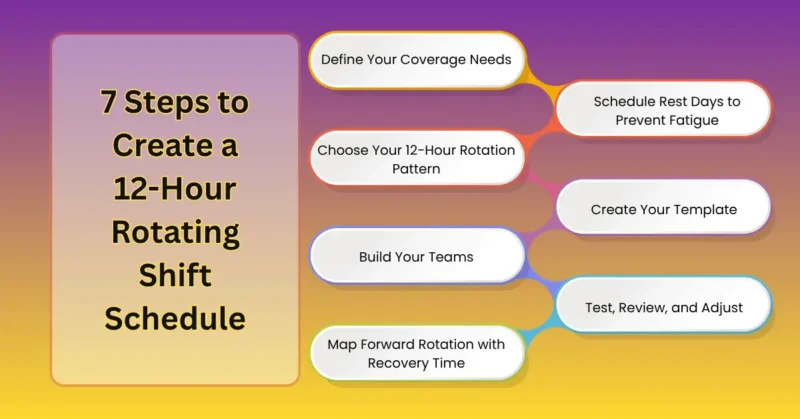
7 Steps to Create a 12-Hour Rotating Shift Schedule
Step 1: Define Your Coverage Needs
Start by answering three questions precisely:
How many hours per day does your operation run? If you run 24 hours a day, 7 days a week, you need continuous coverage. If it’s 16 hours, 5 days, a rotating 12-hour schedule may be unnecessary.
How many staff do you need per shift? Don’t just count warm bodies. Identify the minimum competent staffing level for each shift, the number of people with the right skill mix needed to operate safely and effectively. This is your minimum shift staffing number.
What is your annual leave, sick leave, and training allowance? Most organizations need 15–25% additional headcount above minimum shift staffing to absorb absence without going below safe cover. This is sometimes called the relief factor.
Example: If you need 4 staff per shift and run 2 shifts per day, your base daily requirement is 8 staff. If your relief factor is 20%, you need approximately 10 staff in total, more once you build in teams.
Step 2: Choose Your 12-Hour Rotation Pattern
The four most widely used 12-hour rotating patterns are compared in detail in the next section. At this stage, shortlist based on:
- Number of staff available
- How important long blocks of time off are to your workforce
- Your overtime budget
- Whether your operation can tolerate slightly uneven weekly hours across the cycle
The Pitman (2-2-3) schedule is the most common starting point for organizations new to 12-hour rotating shifts.
The DuPont schedule offers longer guaranteed time-off blocks. The Panama and 4-on-4-off patterns suit operations where consistent rest blocks are the priority.
Step 3: Build Your Teams
Most 12-hour rotating schedules that provide 24/7 coverage require 3 to 4 teams.
- 3-team schedules work mathematically but often lead to higher average weekly hours and less flexibility to cover absences. They are more common in lower-risk environments.
- 4-team schedules (used in Pitman and DuPont) distribute hours more evenly, typically averaging 42 hours per week across the cycle, and are more sustainable for long-term operations.
Each team should have:
- An equal (or as close as possible) number of people
- A balanced skill mix, including senior, mid-level, and junior staff where relevant
- Cross-trained staff where single points of failure exist
Step 4: Map Forward Rotation with Recovery Time
Once you have your teams, map the rotation sequence.
Using a 4-team Pitman schedule as the example:
| 1 | Day, Day, Off, Off, Night, Night, Night | Night, Night, Night, Off, Off, Day, Day | Off, Off, Day, Day, Day, Off, Off | Day, Off, Off, Night, Night, Night, Off |
The key design check at this stage: identify every transition from night shifts to the next shift type. Ensure that when a team finishes their night block.
They receive at least 48 hours off before returning to day shifts. Most established 12-hour patterns build this in; custom schedules often miss it.
Step 5: Schedule Rest Days to Prevent Fatigue
The most common design error is minimizing rest days to reduce headcount. This creates a schedule that looks efficient on paper but leads to chronic fatigue, rising sick rates, and eventual turnover, all of which cost far more than the headcount saving.
Evidence-based rest guidelines for 12-hour rotating shifts:
- Limit consecutive night shifts to 3–4 maximum. NIOSH guidance highlights that error rates and health effects increase significantly after the third or fourth consecutive 12-hour night shift.
- Provide at least 48 hours off after a block of night shifts before the next shift type begins.
- Do not schedule more than 4 consecutive 12-hour shifts of any type without at least a 24-hour break.
- Build at least 1–2 full weekends off per month into each team’s rotation where possible.
Step 6: Create Your Template
At this point, you have enough information to build the schedule.
A standard 4-team Pitman rotation template uses a 28-day grid with rows for each team member and columns for each calendar date.
Each cell carries one of three values: D (day shift), N (night shift), or O (off). Add a row at the bottom that auto-counts total staff on shift each day so you can instantly see if any date falls below your minimum staffing level.
Build a separate tab that calculates each person’s total hours per week across the full 28-day cycle. This is where overtime liability usually surfaces before it becomes a real problem.
If you prefer a ready-made starting point, a pre-built Pitman or DuPont rotation spreadsheet is faster than building from scratch; most scheduling software providers offer free downloadable templates.
Step 7: Test, Review, and Adjust
Before going live, run the completed schedule through these checks:
- Does every shift slot meet minimum staffing requirements every day of the cycle?
- Are rest gaps between all shift transitions at least 11 hours (and 48 hours after night blocks)?
- Does the average weekly hours calculation across the full cycle comply with your legal maximum?
- Is overtime distributed fairly, or does it fall disproportionately on specific teams?
- Does every team get equivalent night shift exposure over the full cycle?
- Have you modeled what happens if one person is absent? Can the remaining cover safely?
Once it passes the paper check, share the draft with team representatives before final sign-off.
Workers on this schedule often identify practical problems, school pickup conflicts, religious observance days, and commute issues that a manager working from a spreadsheet cannot see.
Best 12-Hour Rotating Shift Patterns Compared
The four most widely used 12-hour shift patterns each prioritize a different operational and workforce need:
- Pitman (2-2-3) Schedule
- Operational Priority: Minimizing consecutive workdays and stabilizing staff morale.
- How it works: Uses a 14-day (or slow 28-day) cycle where employees work 2 days on, 2 days off, 3 days on, then 2 days off, 2 days on, and 3 days off.
- Key benefit: No employee works more than 3 consecutive days, and it features built-in 3-day weekends every other week.
- DuPont Schedule
- Operational Priority: Maximizing continuous off-time and long recovery blocks.
- How it works: Runs on a 28-day cycle that combines day and night shift blocks with a major 7-day stretch off once per cycle.
- Key benefit: Deep mental and physical disconnect periods for workers, though it includes longer stretches (up to 7 consecutive night shifts).
- 4-On-4-Off Schedule
- Operational Priority: Simplicity, predictable rhythm, and minimal administrative planning.
- How it works: Employees work 4 consecutive 12-hour shifts, then take 4 consecutive days off, repeating every 8 days.
- Key benefit: Extremely easy for staff and managers to forecast months in advance, though days 3 and 4 carry higher cumulative fatigue.
Panama Schedule (or Modified 12-Hour Rotations)
- Operational Priority: Even-handed weekend distribution and fixed crew predictability.
- How it works: Often structured around a 2-2-3 or 2-3-2 variant where weekend work rotates evenly so nobody loses every weekend.
- Key benefit: Balances round-the-clock 24/7 coverage with steady, repeatable team assignments.
Creating 12-Hour Rotating Schedules: Common Mistakes
1. Using Backward Rotation
Moving workers from nights directly to early-morning day shifts forces the body clock to shift backward and is proven to produce more fatigue and errors than forward rotation.
Fix: Design rotation so each successive shift block starts later, not earlier.
2. Too Many Consecutive Night Shifts
Four, five, or six consecutive night shifts look efficient on paper. NIOSH data shows error rates and health effects rise measurably after the third consecutive 12-hour night shift.
Fix: Cap consecutive night shifts at three or four, followed by a substantial rest break.
3. Ignoring Individual Fatigue Signals
A mathematically correct schedule can still cause fatigue; long commutes, caregiving responsibilities, and sleep conditions don’t show up on a spreadsheet.
Fix: Monitor attendance and near-miss incidents in the first 3–6 months, and adjust based on what the data shows.
4. Under-Staffing the Relief Factor
Without a built-in relief factor, one absence triggers overtime, which drives fatigue, which increases absence. The spiral is common and costly.
Fix: Add at least a 15–20% relief factor to your headcount before recruiting.
5. Launching Without Worker Input
Schedules announced without consultation face resistance, grievances, and higher early turnover.
Fix: Share a draft with team representatives, listen to practical concerns, and modify where feasible before sign-off.
Tools and Templates to Create Your Schedule Faster
- Smaller operations (under 30 staff): Excel or Google Sheets works well. Build a rotation grid with shift codes (D, N, O), a weekly hours calculator, and conditional formatting to flag any week that exceeds your legal maximum.
- Larger operations (30+ staff): Dedicated scheduling software reduces admin significantly; look for built-in overtime alerts, absence management, and compliance reporting. Most platforms offer a free trial.
How to implement the schedule without burning out your team
Implementation matters as much as design. Here is how to get it right.
Communicate Early and Clearly
Give staff 4–6 weeks’ notice, explain why the rotation is changing, how you chose the pattern, and who to contact with concerns.
Workers who understand the reasoning accept the schedule far more readily than those who receive it as a directive.

Support Sleep Hygiene
Share basic guidance with night-shift workers: dark sleep spaces, avoiding caffeine 4–5 hours before sleep, and not driving home when severely fatigued. It signals the organization takes their health seriously, which matters for retention.
Monitor and Adjust
Review at 3 and 6 months. Track absence rates, overtime cost, incident reports, turnover, and fatigue survey responses. Adjusting after launch doesn’t mean the design failed; it shows a well-managed operation.
HR and Occupational Health Research Guidance
NIOSH research consistently identifies increased fatigue and error rates after the third or fourth consecutive 12-hour night shift. WHO guidance supports forward rotation as safer for workers’ circadian health than backward rotation.
For operations running 12-hour rotating shifts, the UK Health and Safety Executive and equivalent agencies in other countries recommend offering night workers access to periodic health assessments, a legal obligation in some jurisdictions.
Build these findings into your design from the start rather than treating fatigue management as an afterthought.
This article provides general information about shift schedule design for educational purposes only. It does not constitute legal or employment advice. Always consult a qualified HR professional or employment lawyer for guidance specific to your workforce and jurisdiction.
FAQs on 12 Hour Rotating Shift Schedule
Q. What is the best 12-hour rotating shift pattern?
The best pattern depends on your priorities. Pitman (2-2-3) is the most widely used because it is predictable and never exceeds 3 consecutive shifts. DuPont is preferred in high-retention environments because it provides 7 consecutive days off every 4 weeks.
Panama suits healthcare and emergency services that require a hard limit of 3 consecutive shifts. No single pattern is universally superior; the right choice depends on your staffing numbers, industry, legal context, and workforce preferences.
Q. How many teams do you need for a 12-hour rotating schedule?
For continuous 24/7 coverage, you need at least 3 teams, though 4 teams are standard for most sustainable 12-hour rotating schedules.
With 3 teams, average weekly hours are higher (around 56 hours), which creates overtime and fatigue issues.
Four teams bring average hours down to approximately 42 per week, which is more manageable and more compliant with maximum working-hours legislation in most countries.
Q. How do you prevent fatigue in 12-hour rotating shifts?
The most effective design measures are forward rotation (days before nights, not the reverse), limiting consecutive night shifts to 3–4, ensuring at least 48 hours off after a night-shift block, and building a relief factor into headcount so absence doesn’t automatically generate overtime.
Beyond schedule design, supporting workers with sleep hygiene guidance, adequate break facilities, and a culture where workers can flag fatigue without penalty makes a significant practical difference.
Q. Is the DuPont or Panama schedule better for work-life balance?
The DuPont schedule generally scores higher for work-life balance because it provides a guaranteed 7 consecutive days off every 4-week cycle, long enough for holidays, family events, and genuine recovery.
The Panama schedule offers more consistent rest (never more than 3 consecutive shifts) and better week-to-week predictability but doesn’t provide the same extended break.
Workers who value periodic long breaks typically prefer DuPont. For those who prefer consistency and predictability, Panama is often the better fit.
Q. How do you handle overtime in a 12-hour rotating schedule?
Start by building a relief factor of 15–20% into your headcount so that routine absence does not immediately trigger overtime.
Model the full rotation cycle before launch to identify any week where a team naturally exceeds your legal overtime threshold, and adjust the design if it does.
Once live, track overtime by individual and by team. If one team consistently generates more overtime than others, investigate the cause: it usually points to an absence pattern, a skill-mix gap, or an uneven distribution of difficult shifts in the rotation design.
Final Takeaway on 12 Hour Rotating Shift Schedule
A 12-hour rotating shift schedule is a powerful tool for organizations that need continuous coverage.
Done well, it reduces handovers, creates meaningful work-life balance through extended time off, and can be genuinely popular with workers. Done poorly, it generates chronic fatigue, legal liability, rising absence, and turnover.
The difference usually comes down to three things: using forward rotation, building in adequate rest, and involving the people who will work the schedule in its design.
Start with your coverage requirements. Choose the pattern that fits your staffing reality and legal obligations.
Build teams with an even distribution of skills. Map the rotation with rest gaps as a non-negotiable constraint. Test it on paper before you launch it. And commit to reviewing it against real data at three and six months.
A schedule that covers your operation and respects the people running it will work long-term, not just on a spreadsheet.
Build your 12-hour rotating shift schedule the right way: Use the 7-step framework above to map your coverage, choose the right pattern, and launch a rotation your team can actually sustain. Start with Step 1 today and have your draft schedule ready within the week.
Read more about night shift workers.