

Learn 7 brave steps to communicate your needs, prioritize your well-being, and get things done when grief leaves you emotionally drained. Empower your healing journey today.
When grief takes away your energy, even simple conversations can feel like exhausting work. You may know what needs to be said, but finding the words, explaining how you feel, or asking for help can suddenly seem overwhelming.

You do not have to communicate perfectly while you are grieving. You need simple ways to express what you need, protect your limited energy, and let trusted people know how they can support you.
Grief can bring exhaustion, sadness, numbness, anger, guilt, and unexpected waves of emotion. There is no single “right” way to grieve, and these feelings can affect how you think, work, connect with others, and manage everyday responsibilities.
Quick Summary
- Grief can leave you emotionally and physically drained.
- You do not need to explain everything to everyone.
- Short, honest communication can be easier than long conversations.
- Decide which tasks truly need your attention and let less important things wait.
- Ask trusted people for specific help rather than simply saying, “I need help.”
- Small routines can make daily life feel more manageable.
- If grief continues to severely interfere with everyday life, professional support can help.
Why Grief Can Make Communication So Difficult
Grief affects more than your emotions. It can affect your energy, concentration, sleep, appetite, motivation, and ability to handle ordinary responsibilities.
The NHS lists tiredness and exhaustion among common experiences of grief, along with sadness, shock, numbness, anger, and guilt.
That can make communication surprisingly difficult.
You may find yourself thinking:
“I don’t have the energy to explain this again.”
“Everyone keeps asking if I’m okay, but I don’t know what to say.”
“I need help, but I don’t even know what kind of help I need.”
“I should be getting things done, but I can’t concentrate.”
If this sounds familiar, remember that struggling to communicate does not mean you are failing.
You are grieving.
Your emotional capacity may simply be much smaller than usual right now.
Instead of expecting yourself to communicate exactly as you did before your loss, try simplifying how you communicate.
7 Brave Steps to Communicate When You’re Grieving
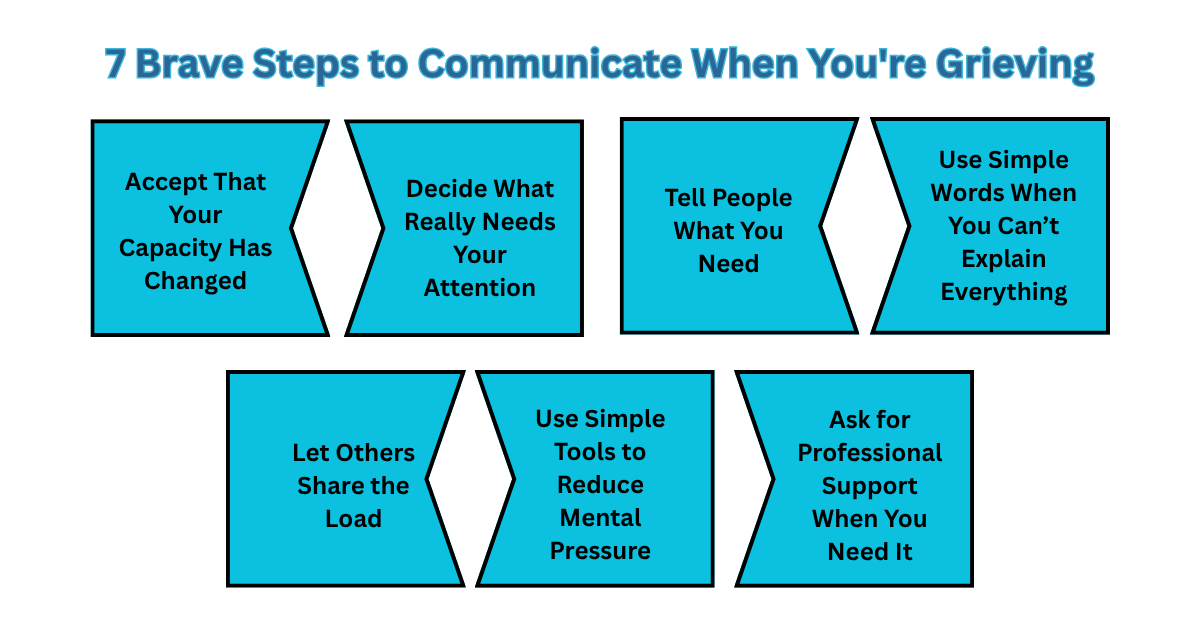
Step 1: Accept That Your Capacity Has Changed
One of the kindest things you can do during grief is stop expecting your old level of energy from yourself.
You may have previously answered messages quickly, managed household responsibilities, worked long hours, attended social events, and handled problems without much thought.
Now, even replying to one message may feel like a task.
That does not mean you have become lazy or unreliable.
It means your circumstances have changed.
Give Yourself Permission to Do Less
Ask:
What genuinely needs to happen today?
Maybe it is:
- Going to work.
- Preparing a simple meal.
- Taking medication if prescribed.
- Paying one urgent bill.
- Caring for your children.
- Returning one important phone call.
Everything else can wait if it needs to.
The NHS recommends setting small, achievable targets rather than trying to do everything at once while grieving.
Use a Simple Sentence
If someone expects more from you than you can currently give, you can say:
“I’m having a difficult time with my grief right now, so I may not be able to do everything I normally would.”
You don’t need a long explanation.
Sometimes one honest sentence is enough.
Step 2: Decide What Really Needs Your Attention
Grief can make your to-do list feel enormous.
When everything feels urgent, your mind has no clear place to start.
Instead, divide your responsibilities into three groups:
Must Do
These are things that genuinely cannot wait.
Examples include:
- Essential work responsibilities.
- Childcare.
- Important appointments.
- Paying urgent bills.
- Basic health needs.
Can Wait
These might include:
- Deep cleaning.
- Non-urgent shopping.
- Organizing cupboards.
- Responding to every social message.
- Optional appointments.
Someone Else Can Do It
This is the category many grieving people overlook.
Maybe someone else can:
- Prepare dinner.
- Pick up groceries.
- Make a phone call.
- Drive you somewhere.
- Help with household chores.
- Collect children from school.
- Handle a practical task related to the loss.
You do not have to prove your strength by doing everything yourself.
Step 3: Tell People What You Need
One of the hardest parts of grief can be answering the question:
“What can I do for you?”
You may appreciate the offer but not know how to respond.
Instead of trying to identify every need, start with something small and specific.
For example:
“Could you bring dinner tomorrow?”
“Would you mind calling me this weekend?”
“Can you help me with the grocery shopping?”
“I don’t need advice right now. I just need someone to listen.”
“I need some quiet time today, but I’ll contact you when I’m ready.”
Specific requests are often easier for both sides.
According to NHS guidance, talking with trusted friends, family members, healthcare professionals, or counselors can help during grief.
You Can Also Say What You Don’t Need
Communication is not only about asking for help.
You can also set boundaries.
Try:
“Thank you for checking on me. I don’t feel like talking about it today.”
Or:
“I appreciate your concern. I need some space right now.”
Or simply:
“I’m okay with listening, but I don’t have the energy to talk.”
Your grief belongs to you. You get to decide when and how much you share.
Step 4: Use Simple Words When You Can’t Explain Everything
Sometimes grief makes you feel too tired to have a meaningful conversation.
You don’t need the perfect words.
Try using a few simple phrases you can repeat when needed.
When You Are Exhausted
“I’m emotionally drained today.”
When You Need Space
“I need some quiet time right now.”
When You Need Company
“I don’t want to talk, but I’d like someone to sit with me.”
When You Cannot Make a Decision
“Can we come back to this tomorrow?”
When You Need Practical Help
“Could you help me handle this?”
When Someone Keeps Asking If You’re Okay
“I’m having a hard time, but I appreciate you checking on me.”
These small sentences can prevent you from spending energy explaining something you cannot fully put into words.
And remember: you are allowed to change your mind.
You might want company in the morning and solitude in the afternoon.
You might want to talk about your loved one one day and avoid the subject the next.
Grief does not always follow a predictable emotional pattern. The NHS notes that people do not necessarily experience grief in fixed stages or in a particular order.
Step 5: Let Others Share the Load
When you are grieving, accepting help can feel uncomfortable.
You may think:
“Other people have their own problems.”
“I should be able to handle this.”
“I don’t want to bother anyone.”
But letting someone help doesn’t make you weak.
It gives people who care about you a practical way to support you.
Instead of saying “I’m fine,”
Try being a little more honest.
You might say:
“I’m managing, but today is difficult.”
Or:
“I’m getting through the day, but I could use some help.”
Or:
“I don’t need you to fix anything. I just need you to be here.”
These statements create room for genuine connection.
Accept Different Types of Support
Support does not always mean talking about your feelings.
Someone may support you by:
- Bringing food.
- Doing laundry.
- Sitting quietly beside you.
- Taking you for a walk.
- Looking after your children.
- Helping organize paperwork.
- Listening to memories of the person you lost.
Sometimes practical help is emotional support in another form.
Step 6: Use Simple Tools to Reduce Mental Pressure
When your mind is overwhelmed, you do not need another complicated system.
Use simple tools that reduce the number of things you have to remember.
Keep a Short Daily List
Write down only three important tasks.
For example:
Today
- Reply to work email.
- Buy groceries.
- Call Mom.
If you finish those three, the day was productive enough.
Use Phone Reminders
Set reminders for:
- Appointments.
- Important calls.
- Bills.
- Medication, if applicable.
- Work commitments.
- Family responsibilities.
You are not trying to become more productive.
You are trying to reduce mental load.
Create a “Not Today” List
This can be surprisingly helpful.
Write down things you need to deal with eventually but cannot handle today.
For example:
- Clean the garage.
- Organize photographs.
- Sort old clothes.
- Reply to non-urgent messages.
- Plan next month’s event.
Writing them down tells your brain:
“I haven’t forgotten. I just don’t need to handle this today.”
Step 7: Ask for Professional Support When You Need It
Grief is a natural response to loss, and needing support does not automatically mean something is wrong.
But sometimes grief becomes so intense or persistent that it significantly interferes with daily life.
The NHS recommends seeking professional help if you are struggling to cope with stress, anxiety, or low mood, or if things you are trying yourself are not helping.
What If Grief Doesn’t Seem to Ease?
For some people, severe grief symptoms can persist and significantly affect functioning.
The American Psychiatric Association recognizes prolonged grief disorder as a clinical condition. For adults, the DSM-5-TR criteria distinguish it from normal grief when severe grief reactions persist for at least 12 months after the death, cause significant distress or impairment, and exceed expected social, cultural, or religious norms.
Possible signs include persistent intense yearning or preoccupation with the person who died, difficulty reintegrating into everyday life, emotional numbness, intense loneliness, and feeling that life has lost meaning.
This does not mean you should put a deadline on your grief.
No universal timetable exists for mourning.
It means that if your grief remains overwhelming and is preventing you from functioning, you deserve professional support rather than having to struggle alone.
What to Say When You Don’t Know What to Say
Sometimes the hardest conversation is the one you know you need to have.
Here are simple phrases you can keep available.
To a Friend
“I don’t really know what I need right now, but I’d like you to check in with me.”
To Family
“I’m still trying to process everything. Please be patient with me.”
To a Coworker
“I’m dealing with a personal loss, so my concentration and energy may be lower than usual.”
To Your Manager
“I’m grieving and may need some flexibility while I adjust.”
When You Don’t Want Advice
“Thank you for caring. Right now, I need someone to listen rather than give me advice.”
When You Need Space
“I’m not ready to talk today. I’ll reach out when I have more energy.”
When You Need Help
“Could you take care of this for me? I don’t have the capacity today.”
You can save these phrases on your phone.
You don’t have to invent the right words every time.
How to Communicate With Family and Friends While Grieving
People around you may also be grieving, but that doesn’t mean everyone processes loss the same way.
One person may want to talk constantly.
Another may prefer silence.
Someone may want to look through photographs.
Someone else may need to return to ordinary routines.
Try not to assume that your way of grieving has to be everyone else’s way.
Make Conversations Easier
Instead of asking:
“How are you?”
Try more specific questions:
- “How are you feeling today?”
- “Do you want to talk about what happened?”
- “Would you like company?”
- “Would practical help be useful?”
- “Do you want to remember them together?”
And if you’re the person grieving, you can tell others exactly what kind of conversation you can handle.
Sometimes:
“I want to talk about them.”
And sometimes:
“Can we talk about something completely different for a while?”
Both are okay.
How to Communicate at Work While Grieving
Returning to work after a loss can be complicated.
You may want normality, but your concentration and emotional energy may not return to their previous level right away.
You do not necessarily need to share personal details with everyone.
A simple statement can be enough:
“I’m dealing with a bereavement and may need a little flexibility while I adjust.”
Depending on your workplace and circumstances, you may also ask about:
- Bereavement leave.
- Flexible working.
- Temporary changes to workload.
- Employee assistance programs.
- A quieter workspace.
- Adjusted deadlines.
If talking feels overwhelming, consider writing an email instead.
Written communication gives you time to choose your words without managing an emotional conversation immediately.
Small Self-Care Habits When You’re Emotionally Drained
Communication becomes harder when your body and mind are running on empty.
You don’t need an elaborate wellness routine.
Focus on basic care.
Eat Something Regularly
Even simple meals are better than ignoring hunger all day.
The NHS recommends regular healthy meals to help maintain energy while coping with grief.
Move Gently
A short walk, stretching, or another comfortable form of movement may help your mood and sleep.
Rest Without Guilt
Rest is not wasted time.
Your mind is processing a major emotional experience.
Avoid Using Substances to Numb the Pain
It can be tempting to use alcohol, cigarettes, drugs, gambling, or other behaviors to escape difficult emotions. NHS guidance specifically recommends avoiding these coping strategies because they can contribute to poorer mental health.
Give Yourself One Quiet Moment
Sit outside.
Make tea.
Listen to music.
Pray or reflect if that is meaningful to you.
Look through a photograph.
Or simply breathe.
You do not have to turn every moment into a productive activity.
When Grief Makes Everyday Life Too Difficult
There is a difference between having difficult days and feeling unable to function for a prolonged period.
Consider reaching out for professional support if:
- Your low mood is becoming increasingly difficult to manage.
- Anxiety is interfering with daily life.
- You can’t return to ordinary activities.
- You feel persistently isolated or disconnected.
- You cannot manage basic responsibilities.
- Your grief feels increasingly overwhelming rather than gradually becoming more manageable.
- You are experiencing thoughts of suicide or self-harm.
The NHS advises seeking medical help when low mood persists, when you are struggling to cope, or when self-help efforts are not working.
And if you are experiencing a mental health crisis or feel you may harm yourself, seek urgent help in your country rather than trying to manage the situation alone.
Common Communication Mistakes During Grief
Trying to Explain Everything
You don’t owe everyone the complete story.
Choose the people you trust and share only what you are comfortable sharing.
Saying “I’m Fine” When You’re Not
You don’t have to tell everyone the truth about every feeling, but consider being honest with the people who can genuinely support you.
“I’m having a difficult day” is enough.
Taking on Too Much
Grief can make ordinary responsibilities feel heavier.
Before agreeing to something, ask:
“Do I actually have the energy for this?”
Isolating Yourself Completely
Wanting solitude is normal.
But complete isolation can make grief harder to carry.
Even one supportive conversation can matter.
Expecting Yourself to Be “Back to Normal”
Grief is not a productivity challenge.
You do not have to return to your previous version of yourself on someone else’s schedule.
FAQs About Communicating Through Grief
Q. Why is it so hard to communicate when grieving?
Grief can involve exhaustion, sadness, shock, anger, guilt, numbness, and difficulty managing everyday activities. These experiences can reduce the energy and concentration needed for ordinary conversations.
Q. What should I say when someone asks how I’m doing after a loss?
You can keep it simple. Try, “I’m having a difficult time today, but I appreciate you asking.” You don’t need to provide a detailed explanation unless you want to.
Q. How can I ask for help when I’m grieving?
Ask for something specific. Instead of saying “I need help,” try “Could you bring dinner tomorrow?” or “Could you help me with the shopping?” Specific requests make it easier for people to respond.
Q. Is it normal to want to be alone while grieving?
Yes. People experience grief differently, and there is no single correct way to respond to loss. Wanting some quiet time can be normal. However, prolonged isolation can become a concern if you are increasingly unable to engage with everyday life or supportive people.
Q. When should I seek professional help for grief?
Consider professional support if grief is becoming increasingly difficult to manage, is interfering significantly with everyday life, or is accompanied by persistent anxiety, depression, or other concerning symptoms. The NHS recommends seeking help when you are struggling to cope or when self-help approaches are not helping.
Q. How long does grief last?
There is no universal timeline. Grief can change over time and may come in waves rather than following a straight path.
Prolonged grief disorder is a specific clinical condition involving severe, persistent grief and significant impairment; for adults, DSM-5-TR criteria require the symptoms to persist for at least 12 months following the death.
You Don’t Have to Carry Everything Alone
When grief leaves you drained, communication may feel like another responsibility you simply cannot handle.
So make it smaller.
You don’t need the perfect explanation.
You don’t need to answer every message.
You don’t need to accept every invitation.
You don’t need to solve every problem.
You can say:
“I need some time.”
“I don’t know what I need yet.”
“Could you help me with this?”
“I don’t want advice right now. I just want you to listen.”
Those simple words can create space for the support you need.
Most importantly, remember that asking for help is not a sign that you are failing to cope. It is one way to care for yourself as you move through an experience that may be emotionally and physically exhausting.
Take today one conversation, one task, and one small step at a time.
You don’t have to carry everything alone.
Read more articles on Health Tips.
You might like to read: