

“Always win” sounds like a bold promise. But most people interpret it incorrectly. They think winning means working more. Pushing harder. Sleeping less. Saying yes to everything.
That path can create results. But it often destroys the person getting it. Real winning is different.
It is being successful in life and staying healthy enough to enjoy it. It is progress that does not cost your peace. This guide is built for that kind of win.
You will learn how to define success in a modern way, choose the right priorities, build habits that keep you stable, and stay consistent for years—without burnout.
Quick Summary: The “Always Win” Formula
If you remember only one thing, remember this:
- Always winning = Clear priorities + Daily systems + Strong boundaries + Recovery + Learning
- Not motivation (motivation changes every day)
- Not hustle (hustle without rest causes burnout)
- Not luck (luck helps, but it is not reliable)
- It’s systems (repeatable habits that keep working even on bad days)
Redefining What It Means to Being Successful in Life Today
A few years ago, success was often measured in visible things:
- Money
- Status
- Job title
- Followers
- Awards
These things are not “bad.”
But they are incomplete.
Today, success in life is more like a comprehensive score, not a single number.
A modern definition of success
A successful life usually includes:
- Meaningful work
- Strong relationships
- Physical health
- Mental peace
- Personal freedom
- Financial stability
- Time for rest and joy
If you win in one area but lose the others, you are not truly winning.
You are trading your life for a scoreboard.
The “Balanced Scorecard” mindset
Try seeing your life in five core areas:
- Health (body + mind)
- Work/Business (impact + income)
- Relationships (family + friends)
- Growth (learning + skills + spiritual meaning)
- Lifestyle (time, fun, flexibility)
Now ask:
- Which area is strong?
- Which area is fragile?
- What is one small upgrade that improves the weak area?
This single shift changes everything.
Because it stops you from calling burnout “ambition.”
Why “Winning” Includes Mental Health and Personal Time
Mental health is not separate from performance. It is the foundation of performance. When your mind is overloaded:
- focus drops
- patience disappears
- decision-making becomes emotional
- creativity becomes slow
- Small problems feel huge.
Personal time is not wasted time.
It is recovery time.
And recovery is what allows consistent winning.
Think of it like training.
No athlete improves by training hard every day with no rest.
They improve through training and recovery.
To remain successful in life, you need to follow the same rule.
Winning is not intensity. Winning is sustainability.
The Cost of Unbalanced Success (And How to Avoid It)
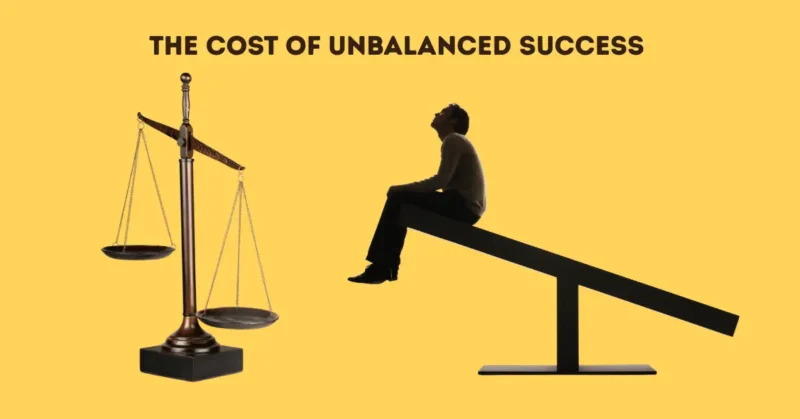
Unbalanced success has a hidden bill.
It is paid later, with interest.
Common costs include:
- burnout
- anxiety
- chronic stress
- damaged relationships
- health issues
- loss of identity outside work
- “I achieved it… now what?” emptiness
Early warning signs
If you notice these patterns, your balance is already slipping:
- You feel guilty when resting.
- You can’t enjoy wins.
- You are always behind.
- Your sleep is poor
- You get irritated easily.
- You stop doing basic self-care
- Your relationships feel “managed” instead of lived.
How to avoid the trap
Use this simple rule:
If your success requires compromising your health, it is not success. It is an extraction.
Your goal is not just to achieve. Your goal is to achieve while staying whole.

Core Strategies for Being Successful in Life and Business
Success becomes easier when your life is designed well. Most people do not need more motivation.
They need a smarter structure. Here are core strategies for success in life and staying balanced.
Setting Non-Negotiable Boundaries for Work-Life Balance
Boundaries are not restrictions. They are protection. If you do not set them, life will set them for you, through stress and collapse.
The 3 boundary types that winners use
1) Time boundaries
Examples:
- “Work ends at 7:00 pm.”
- “No meetings before 10:00 am.”
- “Sunday is family day.”
2) Energy boundaries
Examples:
- “I do deep work in the morning only.”
- “I do not accept calls when I’m mentally drained.”
- “I schedule recovery after heavy tasks.”
3) Access boundaries
Examples:
- “Notifications are off.”
- “I check email twice daily.”
- “I respond to messages within 24 hours, not instantly.”
A simple boundary script (that works)
Use calm clarity:
- “I can do X, but I cannot do Y.”
- “I’m available at these times.”
- “If you need it sooner, we can adjust the scope.”
You do not need to be harsh. You need to be consistent. Consistency is what makes people respect your boundaries.
Priority Mapping: Focus on Wins That Actually Matter
Many people are busy. But they are not effective. They collect tasks, not outcomes.
Priority mapping means you identify:
- What creates real progress
- What creates fake progress
- What should be delayed?
- What should be removed?
The “3 Wins” method
Every day, define:
- One big win (moves your life forward)
- One relationship win (connection, support, presence)
- One health win (sleep, movement, nutrition, calm)
This keeps success balanced by design. You are training yourself to win in multiple dimensions. That is how being successful in life becomes stable, not fragile.
The 80/20 question
Ask daily:
“What 20% of actions will create 80% of results?”
Then protect that 20%.
The Daily Habits of Consistent Winners
Winners are not people who never fail. They are people who recover fast and continue. And they usually have simple habits that do not depend on mood.
Sustainable Productivity: Moving Beyond the 24/7 Hustle
“Hustle culture” sells a fantasy:
Work harder now, relax later.
But later often never comes.
Sustainable productivity is different:
- fewer hours
- better focus
- smarter planning
- more rest
- higher quality output
The 4-part sustainable day for Being Successful in Life
1) Start with clarity (5 minutes)
Write:
- Today’s 3 wins
- One thing to ignore
- One thing to delegate/automate
2) Deep work (60–120 minutes)
One task. No switching. No multitasking.
3) Recovery breaks (short, real breaks)
Walk. Stretch. Breathe. Water. Light snack. No doom scrolling.
4) A clean shutdown (10 minutes)
Close loops:
- Note unfinished tasks
- Set tomorrow’s first action
- Mentally “end” work
When you end your day properly, your mind rests better. Sleep is a secret weapon for success in life.
The Power of Reflection and Course Correction
People lose balance when they don’t pause.
They keep running even when they are going the wrong way.
Reflection is the steering wheel.
Weekly reflection questions (simple and powerful)
Once a week, answer:
- What gave me energy?
- What drained me?
- What wins am I proud of?
- What did I avoid?
- What is one change for next week?
This makes success intelligent.
You stop repeating the same mistakes.
You build self-awareness, a major advantage in life and business.
Staying Successful: How to Maintain Momentum Long-Term
Short-term success is easier than long-term success.
Long-term success requires resilience, learning, and smart pacing.
Building Resilience to Handle Life’s Inevitable Setbacks
Setbacks are not a sign that you are failing. They are a sign that you are doing real work.
Resilience is not “being tough.” Resilience is “recovering well.”
The resilience loop
When something goes wrong:
- Name it: What exactly happened?
- Normalize it: “This is hard. It makes sense that I feel this.”
- Learn from it: What is this teaching me?
- Act small: What is the smallest next step?
- Get support: A mentor, friend, coach, or therapist, if needed.
Resilience keeps you moving without breaking you.
That is the real “always win” skill.
Why Continuous Learning Is the Key to “Always Winning”
Life changes. Markets change. People change. If you stop learning, you fall behind even if you work hard.
Continuous learning helps you:
- adapt faster
- See opportunities earlier,
- solve problems with less stress
- Increase income and impact
- Stay relevant and confident.
A realistic learning system
You do not need hours daily. You need consistency.
Try:
- 20 minutes a day reading or listening
- One skill per quarter (3 months focus)
- Weekly practice (use the skill, don’t just consume it)
Learning keeps your success renewable.
That is how being successful in life becomes a long game you can actually win.
Checklist on Being Successful in Life
Use this as a weekly self-check. Tick to be pick.
Success and balance checklist
- I know my top 3 priorities right now.
- I have clear working hours (even if flexible)
- I protect at least one deep-work block on most days.
- I exercise at least 3–5 times a week.
- I sleep enough to function calmly.
- I spend intentional time with people I love
- I have at least one hobby or a joyful activity.
- I reflect weekly and adjust.
- I learn something consistently.
- I say “no” without guilt when needed
If you check most of these, you are on the right path.
Mistakes to Avoid When Trying to “Always Win” for Being Successful in Life
These mistakes look productive. But they quietly destroy balance.
- Confusing busy with successful: Busy is movement. Success is direction.
- Saying yes to protect your image: Your calendar becomes a prison.
- Ignoring recovery: Your body will collect the debt.
- Trying to do everything alone is not a weakness; delegation is. It is a strategy.
- Chasing goals you didn’t choose: You wake up in someone else’s life.
- All-or-nothing thinking: One bad day is not a failure. It is data.
Action Plan: 7 Days to Start Winning Without Losing Balance
This is a short plan you can start today.
Day 1: Define your “balanced success” statement
Write one paragraph: What does being successful in life mean to you?
Day 2: Choose your top 3 priorities for this month
One for work. One for relationships. One for health.
Day 3: Set one non-negotiable boundary
The time boundary is easiest. Keep it realistic.
Day 4: Build your “3 wins” daily habit
Write your 3 wins every morning for one week.
Day 5: Create a simple shutdown routine
10 minutes. Close loops. Plan tomorrow’s first action.
Day 6: Do a weekly reflection (even if it’s not the weekend)
Use the five reflection questions above.
Day 7: Pick one skill to learn this quarter
Make it practical. Make it useful. Make it measurable.
This plan is small on purpose.
Small systems are easier to keep.
And consistency is the real secret.
FAQs on Being Successful in Life
Q. How to maintain balance in life?
Balance starts with knowing what matters most right now. Set clear boundaries for time, energy, and access.
Protect sleep, movement, and quiet time as you would appointments. Keep daily priorities small: one work win, one health win, one relationship win.
Do a weekly reflection to remove what drains you and repeat what restores you. Balance is not equal time for everything; it is the right focus at the right time.
Q. What are the 7 secrets to success?
- Clear goals that you can measure.
- Consistent daily habits, not occasional motivation.
- Focus on high-impact work, not busy work.
- Strong boundaries that protect your health and time.
- Resilience to recover from setbacks without quitting.
- Continuous learning to stay adaptable and valuable.
- Good relationships, because support and trust multiply success.
Q. What is the secret to being successful in life?
The secret is building a life system you can sustain. Success grows from clarity, discipline, and smart priorities.
You win more by protecting your health and peace of mind. Strong relationships keep you stable during pressure.
Learning keeps you improving even when life changes. In short, being successful in life comes from steady progress without self-destruction.
Q. What are the 4 pillars of success?
A simple model has four pillars that support long-term results.
Clarity: You know your goals and values.
Action: You execute consistently with good habits.
Resilience: you handle setbacks and keep going.
Growth: you learn, adapt, and improve your skills.
When these four are strong, success becomes repeatable and balanced.
Q. What is the #1 key to success?
The #1 key is consistency. Talent helps, but consistency compounds results over time.
Small actions done daily beat big actions done rarely. Consistency also builds confidence by reinforcing your self-trust.
It reduces stress by eliminating the need for last-minute effort. If you want a single rule: show up, do the work, and repeat.
Q. What are the 21 secrets of self-made millionaires about?
It is about common habits and patterns often seen in self-made wealthy people. The main idea is that wealth is usually built through discipline and systems.
It focuses on skills such as goal-setting, persistence, and smart risk-taking. It also highlights learning, networking, and using time well.
Many versions emphasize multiple income streams and long-term thinking. Overall, it frames money as a result of behaviors repeated over the years.
Q. What makes 90% of millionaires?
Most millionaires are made by steady, long-term habits rather than sudden luck. Common drivers are consistent saving, investing, and living below your means.
They often build wealth through businesses, careers, or real estate over time. They focus on skills that increase income and on protecting cash flow.
They avoid high debt and make disciplined financial decisions. The real “maker” is compounding: small, smart moves repeated for many years.
Conclusion: Your Journey to Being Successful in Life
Winning is not a single moment. Winning is a lifestyle you can maintain. If you want to be successful in life without losing balance, stop chasing endless intensity.
Start building the structure.
- define success in a whole-life way.
- protect boundaries
- Focus on meaningful priorities.
- build daily habits that don’t burn you out.
- reflect and adjust.
- learn continuously.
- recover as it matters—because it does
You do not need to be perfect to win. You need to be consistent, clear, and kind to yourself while you grow.
Read more Life-Balance articles.
You might like: