
Do night shift workers have high cortisol levels? Discover the truth about stress hormones, key warning signs, and simple ways to reset your rhythm.
Night shift workers don’t always have high cortisol, but they often have a disrupted cortisol rhythm. Cortisol normally peaks in the morning and drops at night. Working nights can flatten or shift that pattern, leaving people tired, wired, and sleeping poorly.
Yes, but it’s dysregulated cortisol, not just high cortisol.
“High cortisol” means too much of the hormone overall. Dysregulated cortisol” means the timing is off. Night work is linked more often to the second problem.
Picture a wave. On a day schedule, the wave rises in the morning and falls by night. On nights, that wave can flatten, shift, or peak at an unhelpful time, such as when you’re trying to sleep.
Normal cortisol pattern vs. night shift cortisol disruption
| Waking | Sharp rise (the “wake-up boost”) | Weaker or delayed rise |
| Midday | Gradual decline | Flatter, less predictable |
| Evening | Low and settling | May stay higher than ideal |
| Sleep | Lowest point, supports rest | May stay elevated, making sleep lighter |
This is a general pattern, not a rule. Individual results vary a lot.

What Is Cortisol, and Why Does Shift Work Disrupt It?

Body clock and HPA axis control cortisol: the stress hormone
Cortisol is a hormone your adrenal glands release to help you wake up, handle stress, and manage energy and blood sugar. Two systems control it:
- Your circadian rhythm, your body’s internal 24-hour clock, which sets the daily timing.
- The HPA axis (hypothalamic-pituitary-adrenal axis), the chain of signals between your brain and adrenal glands that responds to stress.
Put simply, your body clock sets the schedule, and your stress system adds extra cortisol when needed.
The normal cortisol curve
Cortisol is highest in the morning, which helps you feel alert. It then falls through the day and is lowest at night, which lets sleep hormones like melatonin do their job. That daily rise and fall is called the cortisol curve.
How the night shift flips the pattern
Night shifts ask your body to be alert when the clock says “sleep” and to sleep when it says “wake.” Daylight, noise, meals, and social life keep pulling your body back toward a day rhythm. That tug-of-war can leave cortisol out of step with your actual schedule.
Research: What Do Studies Show?
Honest summary: results are mixed. Some studies find a flattened or shifted cortisol pattern in night workers. Others find little difference, especially in people who sleep well and keep a steady routine.
Cortisol in 12-hour night shift workers
Long night shifts are common in healthcare, security, and manufacturing. Studies of these workers generally find that cortisol timing can change, and the effect depends on:
- Whether the schedule is fixed or rotating
- How well the person sleeps during the day
- How much light exposure they get at the wrong times
- How many years they’ve worked nights
No single “night shift cortisol number” applies to everyone.
The flattened cortisol curve
Some research reports a blunted morning rise and higher-than-ideal evening levels, which flattens the curve. One catch: a night worker’s “morning” is whenever they wake up, so you have to measure timing against their own sleep schedule, not the clock on the wall.
Chronic stress, HPA axis strain, and burnout
Long-term poor sleep and constant pressure can keep the stress system switched on. In everyday terms, your body doesn’t get enough time to recover. Burnout isn’t measured by cortisol alone, but poor sleep, stress, and irregular hours often feed each other.
5 Ways Night Shift Work Can Disrupt Cortisol
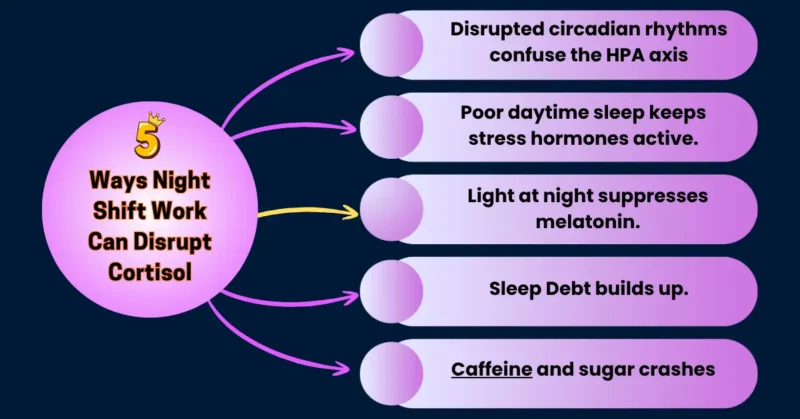
1. Disrupted circadian rhythms confuse the HPA axis
When your body clock and schedule disagree, the timing signals that control cortisol get mixed up. The result is a less predictable curve.
2. Poor daytime sleep keeps stress hormones active.
Daytime sleep is often shorter and lighter because of light, noise, and heat. Sleep loss is linked with changes in stress hormone activity.
3. Light at night suppresses melatonin.
Bright light signals to your brain that it’s daytime. Light after your shift, like sunlight on the drive home, can delay your sleep signals and throw off your rhythm.
4. Sleep debt builds up.
Missing sleep day after day builds a “recovery debt.” A body running on debt tends to stay more stressed and alert.
5. Caffeine and sugar crashes
Caffeine can raise cortisol in the short term and hurt sleep if you take it late. Blood sugar rises, and the body sees crashes from sugary snacks as additional minor stress.
What Raises Cortisol Quickly?
Cortisol rises fast when the body senses a short-term demand:
| Sudden stress or emergencies | The body prepares for action. |
| One night of poor sleep | Sleep loss is a stressor. |
| Large doses of caffeine | Stimulates the stress response |
| Very intense exercise | Physical stress |
| Skipped meals or sugar crashes | Low blood sugar signals stress. |
| Pain, illness, or injury | The body responds to threat. |
| Corticosteroid medicines | Act like cortisol (only adjust under medical advice). |
A short spike is normal and useful. It becomes a concern only when spikes are constant, and there’s never a real low point.
Symptoms of High Cortisol Levels in Night Shift Workers
Persistently high cortisol may cause the signs below. Many of them also happen with normal night-shift tiredness, so they can’t confirm anything on their own.
Physical signs
- Weight gain, especially around the belly
- Ongoing inflammation or frequent illness
- Blood sugar or blood pressure changes (often found at check-ups)
- Easy bruising, slow healing, or muscle weakness
Mental signs
- Anxiety or feeling “on edge”
- Energy crashes during the shift
- Brain fog and trouble concentrating
- Poor sleep even when exhausted
The 5 signs of high cortisol, in short
- Belly weight gain
- Constant tiredness with poor sleep
- Mood changes, such as anxiety or irritability
- Blood pressure or blood sugar changes
- Easy bruising or muscle weakness
Long-term risks
Over years, ongoing stress and poor sleep can affect metabolism, immune strength, and burnout risk. Very high cortisol from a medical condition like Cushing’s syndrome is uncommon and needs medical testing.

How to Tell If You Have High Cortisol on Night Shift
At-home clues vs. lab tests
Symptoms are clues, not proof. Only a doctor can decide whether testing makes sense. Tests can include saliva, blood, or urine samples, usually timed at specific points because cortisol changes through the day.
For night workers, take time samples based on your sleep schedule, and tell your doctor when you sleep.
Track sleep, heart rate, and energy.
For two weeks, keep a simple log:
- Sleep and wake times
- Sleep quality (1-5)
- Resting heart rate, if you have a watch or tracker
- Energy levels during and after your shift
- Caffeine and meal timing
This helps you spot patterns and gives your doctor useful information.
Adrenal fatigue vs. HPA axis dysfunction
“Adrenal fatigue” is a popular term, but it is not a recognized medical diagnosis. Major endocrine organizations don’t accept it as a condition.
Real hormone problems do exist, such as Cushing’s syndrome (too much cortisol) or Addison’s disease (too little), so persistent or severe symptoms deserve proper medical testing rather than self-diagnosis or supplements.
How to Lower and Fix Cortisol Levels While Working Nights
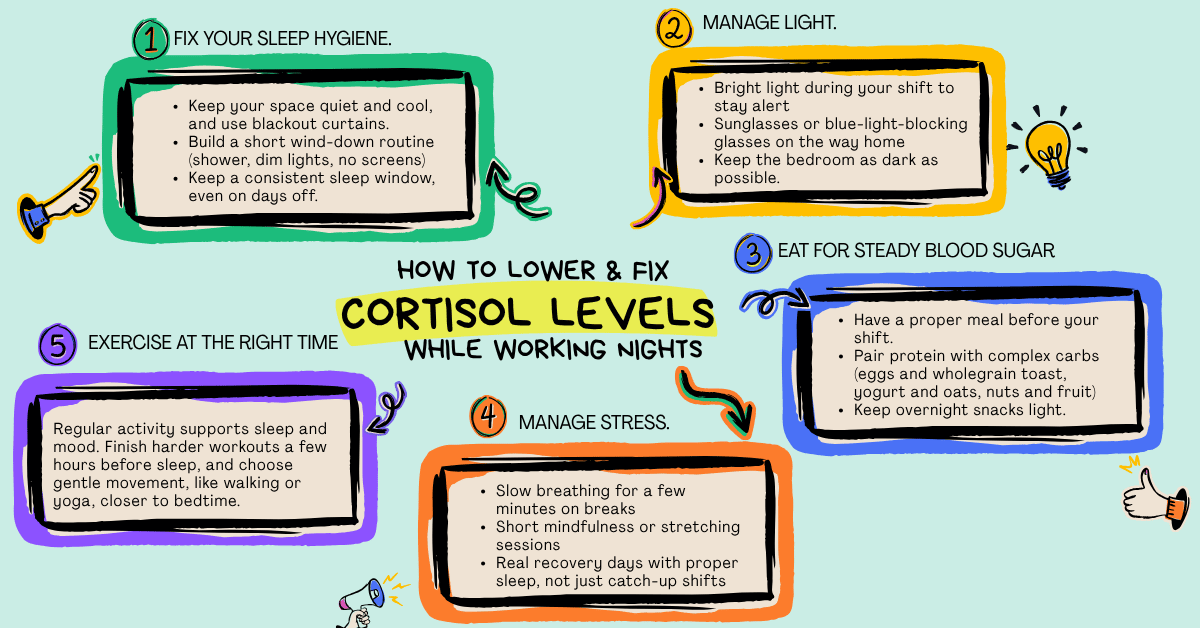
You can’t control every factor, but these habits support a healthier rhythm.
Fix your sleep hygiene.
- Keep your space quiet and cool, and use blackout curtains.
- Build a short wind-down routine (shower, dim lights, no screens)
- Keep a consistent sleep window, even on days off.
Manage light.
- Bright light during your shift to stay alert
- Sunglasses or blue-light-blocking glasses on the way home
- Keep the bedroom as dark as possible.
Eat for steady blood sugar.
- Have a proper meal before your shift.
- Pair protein with complex carbs (eggs and wholegrain toast, yogurt and oats, nuts and fruit)
- Keep overnight snacks light.
Manage stress.
- Slow breathing for a few minutes on breaks
- Short mindfulness or stretching sessions
- Real recovery days with proper sleep, not just catch-up shifts
Exercise at the right time
Regular activity supports sleep and mood. Finish harder workouts a few hours before sleep, and choose gentle movement, like walking or yoga, closer to bedtime.

What Gives You Energy on Night Shifts?
- Bright light during the first half of the shift
- Caffeine early, then stop several hours before sleep.
- A short 20-30 minute nap, if your workplace allows it
- Water to offset dehydration-related tiredness.
- A short walk or stretch to beat the mid-shift slump
- Steady meals instead of sugar hits
What Is Night Shift Worker Syndrome?
“Night shift worker syndrome” isn’t an official medical term. It usually refers to shift work disorder, a sleep condition linked to working outside daytime hours.
Common signs include trouble sleeping, heavy sleepiness at work, poor concentration, and low mood. Not every night worker has it. If symptoms last for weeks or affect your safety, see a doctor. Effective treatments exist.
What NOT to Do: Habits That Keep Cortisol High on Nights
High-intensity workouts right before daytime sleep
Hard exercise raises heart rate, body temperature, and stress hormones. Doing it right before bed can make it harder to fall asleep. Finish intense sessions a few hours earlier.
Energy drinks and caffeine during the second half of the shift
Caffeine stays in your system for hours. Late-shift coffee or energy drinks can delay sleep and push you into a cycle of poor rest, more caffeine, and more stress.
Sugar and processed carbs at 3 a.m.
A short boost from sugary snacks is followed by a crash that makes you feel hungrier and more exhausted. Instead, go for yogurt, fruit, almonds, or protein.
Also avoid:
- Scrolling on your phone in bed
- Constantly changing your sleep schedule.
- Skipping meals, then overeating
What Do Experts Say About Shift Work and Cortisol?
Research on circadian rhythm and cortisol disruption
Research from sleep and endocrine science consistently shows that cortisol follows a circadian pattern and that shift work can affect that timing.
Findings on how strong the effect is vary between studies. According to the National Institute for Occupational Safety and Health (NIOSH / CDC), shift work—defined as any schedule outside the standard hours of 7 a.m. to 6 p.m.—disturbs natural sleep and circadian rhythms, which can escalate health risks such as cardiovascular disease, gastrointestinal issues, and metabolic disorders.
A central driver of these complications is disrupted hormone pathways. As noted by NIH MedlinePlus, cortisol is an essential hormone produced by the adrenal glands that governs the body’s stress response, controls blood glucose, regulates blood pressure, and coordinates the daily sleep-wake cycle.
When the normal sleep-wake schedule is inverted, cortisol regulation breaks down. A peer-reviewed study published in MDPI’s International Journal of Environmental Research and Public Health showed that shift workers, particularly those on rotating night shifts, experience direct hyperactivation of the hypothalamic-pituitary-adrenal (HPA) axis, leading to significantly elevated morning cortisol levels immediately after a night shift due to prolonged wakefulness.
This chronic misalignment compromises sleep’s restorative function, fostering systemic stress and physiological exhaustion over time.
Is it high cortisol or dysregulated cortisol?
The distinction matters. High cortisol means too much overall, often from a medical condition or medication. Dysregulated cortisol means the daily rhythm is off, which is more typical of shift work. Each requires a different fix, which is why testing and medical guidance matter.
Sleep deprivation can wreak havoc on our hormonal health, especially hormones influenced and secreted by our circadian rhythm, or 24-hour body clock. — Dr. Izzy Smith, Endocrinologist
Medical disclaimer and when to seek testing
See a doctor if you have symptoms that last for weeks despite better sleep, unexplained weight gain, easy bruising, muscle weakness, high blood pressure or blood sugar, ongoing anxiety or low mood, or sleepiness that affects driving or safety. Pregnant workers, older adults, and anyone taking regular medication should check with a doctor before making major changes.
Summary
Night shift workers do not simply have “high” cortisol all day; instead, their normal daily cortisol rhythm is significantly disrupted and misaligned.
How Night Work Affects Cortisol
- Inverted or Flattened Rhythms: Normally, cortisol peaks shortly after waking and drops to its lowest point around midnight to allow for rest. Night shift work inverts or flattens this curve, keeping cortisol high at night when it should be low and blunting the natural surge needed upon waking.
- Blunted Awakening Response: Studies show that waking up after daytime sleep often results in a lower-than-normal Cortisol Awakening Response (CAR). This mismatch can lead to chronic fatigue, brain fog, and reduced stress resilience.
- Elevated Night/Evening Levels: Working through the night and eating during unconventional hours keeps the body on high alert, elevating nocturnal cortisol concentrations.
Managing Cortisol on the Night Shift
- Avoid Overeating at Night: Heavy meals or continuous calories overnight can spike blood sugar and keep cortisol from reaching its necessary low point.
- Optimize Sleep Hygiene: Sleep in a completely dark, quiet room using blackout curtains and white noise machines to improve the quality of daytime rest.
- Limit Blue Light Before Bed: Reduce smartphone or computer screen exposure right before your daytime sleep period to help stabilize hormone regulation.
FAQ: Do Night Shift Workers Have High Cortisol Levels?
Q. Do night shift workers have high cortisol levels?
Not necessarily. Many have a shifted or flattened cortisol rhythm rather than consistently high levels. Results vary by person and schedule, and better sleep and routine can help.
Q. What does cortisol do to night shift workers’ metabolism?
Cortisol helps manage blood sugar and energy. When its timing is off, it can affect appetite, blood sugar, and fat storage, especially with poor sleep and late-night eating; regular meals and better sleep help.
Q. How long does it take for cortisol to normalize after night shifts?
It varies. Some people settle within days of returning to a regular sleep schedule, while others need weeks. Consistent sleep, morning light, and regular meals speed the process.
Q. Can you lower cortisol while still working nights?
Often, yes. Consistent sleep, smart light exposure, timed caffeine, balanced meals, and stress management all help. If symptoms persist, see a doctor.
Is low cortisol or high cortisol worse for night shift workers?
Neither is “worse” in general. Both can cause problems, and you should see a doctor if symptoms persist. Low cortisol tiredness can also be mistaken for ordinary shift fatigue.
Q. What are the 5 signs of high cortisol?
Belly weight gain, tiredness with poor sleep, mood changes, blood pressure or blood sugar changes, and easy bruising or muscle weakness. These overlap with normal shift fatigue, so only a doctor can confirm it.
Final Takeaway: A broken rhythm isn’t just high cortisol
For most night workers, the issue isn’t too much cortisol. It’s cortisol at the wrong time. Protect your sleep, manage light, time your caffeine, eat for steady blood sugar, and see a doctor if symptoms won’t go away.
Your next step: pick one change this week, such as stopping caffeine a few hours before sleep or setting up blackout curtains, and build from there. For more, read our guide to night shift sleep.
Disclaimer: This article is for general information only and is not medical advice. It cannot diagnose any condition. If you’re concerned about your health, please speak to a qualified healthcare provider.
Find out more about night shift workers’ health.