Learn how to prevent burnout and chronic fatigue on the night shift with 6 evidence-based strategies, a 7-day reset challenge, and tips for your next roster talk.
In this guide
Years of nights can wear you down slowly, then all at once. This guide shows you how to stop that. You will learn how to:
- Set up daytime sleep that lasts 7-9 hours.
- Control light so your body clock stops fighting you.
- Schedule meals, drinks, and caffeine around your bedtime.
- Take time off to recuperate without changing your timetable.
- Get checked for medical conditions that can be treated for weariness.
- Identify and avoid burnout, and ask your employer for helpful adjustments.
- 7-day reset challenge.
How to Prevent Burnout and Chronic Fatigue
To prevent burnout and chronic fatigue after years on the night shift, protect your daytime sleep (7 to 9 hours in a dark, cool, quiet room), control your light exposure (bright light at work, sunglasses on the commute home), time caffeine and meals around your sleep, keep your schedule consistent on days off, limit consecutive night shifts, and get screened for medical causes such as low iron, thyroid problems, and sleep apnea.
If you do only one thing, protect your sleep window. Everything else on this page supports it.
Key takeaways
- Burnout and chronic fatigue are related but not identical. Both are common in long-term night workers, and both are easier to prevent than to reverse.
- Your body clock is built for daytime activity. You can’t fully “adapt” to nights, but you can reduce the damage with consistent light, sleep, and meal timing.
- Persistent exhaustion that doesn’t improve with better sleep is a reason to see a doctor, not a sign of weakness.
What are night shift burnout and chronic fatigue?
Night shift burnout is long-term exhaustion from unmanaged work stress. It can show up as feeling drained, detached, or cynical about the job and being less effective at it.
Chronic fatigue is tiredness that lasts for weeks or months and doesn’t go away with normal rest. In night workers, it often comes from circadian disruption and sleep debt, but it can also come from medical causes such as anemia, thyroid problems, or sleep apnea.
The two overlap, but they are not the same. Burnout is tied to your work. Chronic fatigue is a symptom with many possible causes, so persistent exhaustion deserves a medical check.
Why years on nights wear you down
Humans run on a roughly 24-hour internal clock (the circadian rhythm), set mainly by light. When you work all night and sleep in daylight, your clock is constantly pushed against the sun. Over months and years, that mismatch can show up as short, fragmented daytime sleep, a build-up of sleep debt, digestive trouble, mood changes, and a flat, drained feeling that a day off doesn’t fix.
Two terms are worth knowing:
- The World Health Organization defines burnout as an occupational condition caused by unmanaged, persistent work stress. Exhaustion, increasing cynicism or disengagement from the work, and a diminished sense of effectiveness are its defining characteristics.
Shift work disorder is a recognized circadian rhythm sleep disorder in which your work hours cause insomnia, excessive sleepiness, or both.
Night-shift workers can have any of these, or an unrelated medical problem. That is why this guide combines sleep and lifestyle fixes with a medical check-up.
6 Burnout Prevention Strategies
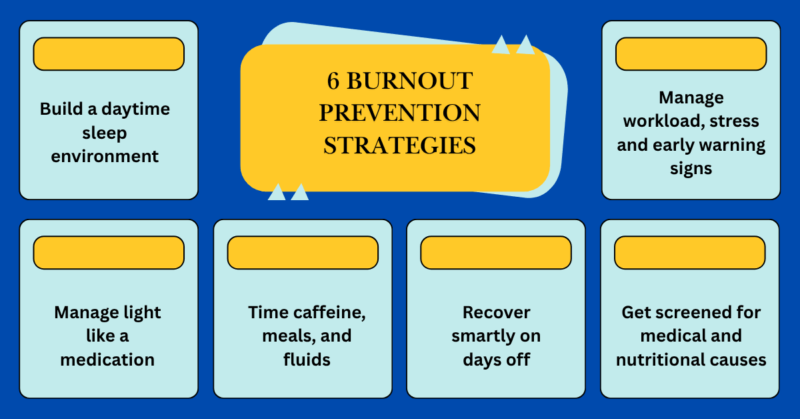
Strategy 1: Build a daytime sleep environment that actually works
Daytime sleep is lighter and shorter than nighttime sleep unless you design the room for it. Treat it as a medical requirement, not a nap you fit in when life allows.
- Block light completely. Use blackout curtains, window film, or a well-fitted eye mask. Daylight signals your brain to stay alert and can cut sleep short.
- Keep the room cool. Most sleep guidance suggests roughly 60 to 65°F (15 to 18°C).
- Mask noise—earplugs or a white-noise machine help with traffic, deliveries, and household activity. Put a “sleeping” sign on the door, silence your phone, or use Do Not Disturb with emergency exceptions.
- Protect the window. Plan for seven to nine hours of continuous sleep. If you can’t get that in one block, a main sleep plus a planned nap is better than random dozing.
- Tell your household. A shared schedule on the fridge saves more sleep than any gadget.
Strategy 2: Manage light like a medication
Light is the strongest signal for your body clock, so timing matters.
- Wear dark sunglasses on the drive or walk home. Morning light tells your brain it’s time to wake up, and you can push your clock later. Sunglasses help you wind down once you leave work.
- Use bright light early in your shift. Exposure during the first half of the night, especially around midnight to 4:00 AM when alertness dips, helps you stay sharper.
- Dim down before sleep. In the hour before bed, lower overhead lights and limit bright screens.
- Don’t chase the sun on days off. See Strategy 4.
Strategy 3: Time caffeine, meals, and fluids
What you consume decides how well you sleep later.
- Cut off caffeine 6 to 8 hours before bed. For most night workers, that means finishing coffee or energy drinks by around the middle of the shift, not at the end.
- Eat light, balanced meals at work. Include protein and fiber to keep energy steady.
- Avoid heavy, sugary, or high-carb meals right before sleep. They can cause blood sugar swings and stomach discomfort that disturb rest. A small snack is fine if you’re hungry.
- Drink water through the night. Mild dehydration adds to fatigue and headaches.
- Limit alcohol. A drink may make you drowsy, but it fragments sleep and leaves you less rested.
Strategy 4: Recover smartly on days off
Many long-term night workers flip to a daytime schedule on days off to see family and friends. That repeated flip creates “social jet lag” and can leave you tired on both schedules.
- Keep your sleep-wake schedule as consistent as you can. If you must shift, move it by no more than 1-2 hours.
- After your last night shift, take a short recovery nap (about 2 to 4 hours). Then stay up until a reasonable evening bedtime. This is better than staying awake 24 hours or more.
- Cap consecutive nights at 3 or 4 where you can. Longer runs build sleep debt faster. If your employer controls the roster, raise it as a safety and retention issue.
- Schedule real recovery. Block out a full day off each cycle for sleep, movement, and something you enjoy, not just errands.

Strategy 5: Get screened for medical and nutritional causes
If you feel exhausted despite decent sleep habits, don’t assume it’s “just nights.” Years of circadian disruption can affect metabolic and hormonal health, and several treatable conditions look like burnout.
Ask your primary care provider about:
- Blood tests: iron and ferritin, vitamin D, vitamin B12, folate, and thyroid-stimulating hormone (TSH).
- Sleep disorder screening: shift work disorder, insomnia, and obstructive sleep apnea (OSA). Red flags include loud snoring, gasping, morning headaches, and unrefreshing sleep.
- Mood screening: depression and anxiety are common companions of chronic exhaustion and respond well to treatment.
Structured approaches such as Cognitive Behavioral Therapy for Insomnia (CBT-I) can help when insomnia has become a habit.
Strategy 6: Manage workload, stress and early warning signs
Burnout is a workload and recovery problem, so fixing sleep alone won’t cure it. Better sleep gives you the energy to cope, but burnout also comes from understaffing, emotional strain, and little control over your schedule. Strategy 6 covers what you can change yourself and what to ask your employer to change.
Know the three signs of burnout.
Burnout shows up in three ways, and night workers often notice them in this order:
- Exhaustion: you feel drained before the shift starts, and days off don’t restore you.
- Cynicism or detachment: you stop caring about patients, customers, or colleagues, or feel irritable and numb at work.
- Reduced effectiveness: you make more mistakes, feel that nothing you do matters, or doubt your skills.
Run a two-minute check once a month.
Ask yourself these four questions. If you answer “yes” to two or more for several weeks in a row, treat it as a warning sign and talk to someone.
- Do I dread most of my upcoming shifts?
- Do I still feel exhausted after a full sleep window?
- Am I more irritable, detached, or tearful than usual?
- Am I making errors I wouldn’t normally make?
This is not a diagnostic; it is a self-check. It can be appropriately assessed by a physician or mental health specialist.
Six habits that protect you from burnout
- Take your breaks. Step away from the work area for the full break, eat something, and move for a few minutes.
- Plan your recovery before you need it. Block out one full day off per cycle for sleep, light exercise, and something you enjoy.
- Keep one social anchor per week. Pick a recurring call, meal, or walk with someone who understands your schedule so work doesn’t become your only contact.
- Set a shutdown routine. Ten minutes of slow breathing, a shower, or stretching on the way out signals your brain that work is over.
- Say no to extra shifts when you’re already tired. Overtime on top of sleep debt often triggers burnout.
- Talk early. A peer, supervisor, employee assistance program, or therapist is easier to approach when you’re struggling than when you’ve hit a wall.
Ask your employer for changes that help.
Individual habits only go so far. If your roster is the problem, raise it as a safety and retention issue, not a complaint. Reasonable requests include:
- Advance notice of schedules
- A cap of 3 or 4 consecutive night shifts where possible
- Protected breaks and a quiet place to rest
- Time off after your final night shift
A simple opener: “I want to keep doing this job safely. Can we look at the schedule to reduce long runs of nights?”
If you ever feel hopeless or think about harming yourself, contact local emergency services or a crisis line right away.
7-day night shift reset challenge
Copy this table into your notes app, print it, or share it with a coworker. Tick one box per day, and repeat the week if it helps.
| Day | Challenge | Why it Helps | Done |
| 1 | Hang blackout curtains or wear an eye mask for your sleep | Blocks daylight that cuts sleep short | ☐ |
| 2 | Wear dark sunglasses on your commute home | Stops morning light from pushing your body clock later | ☐ |
| 3 | Set a caffeine cut-off 6 to 8 hours before bed | Protects sleep quality | ☐ |
| 4 | Drink water through the shift and skip alcohol before sleep | Reduces fatigue and fragmented sleep | ☐ |
| 5 | Take every break and walk for 5 minutes | Breaks up fatigue and stress | ☐ |
| 6 | Keep your days-off sleep schedule within 1 to 2 hours of normal | Limits social jet lag | ☐ |
| 7 | Do the monthly burnout check and book any doctor visit you need | Catches problems early | ☐ |
A sample night-worker day
| Time | Action |
| Start of shift | Bright light, main meal, last big caffeine in the first half of the shift |
| Middle of shift | Water, light protein and fiber snack, short walk |
| Last 2 hours | No more caffeine, lighter food |
| Commute home | Dark sunglasses |
| Before bed | Dim lights, cool dark room, earplugs or white noise |
| Sleep | 7 to 9 hours, phone silenced |
| Wake | Light meal, movement, daylight if it won’t delay your next sleep |
Adjust the times to fit your own sleep window.
FAQs on How to Prevent Burnout and Chronic Fatigue
Q. Are overnight shifts bad for your health?
Long-term night work is associated with higher risks of sleep disorders, fatigue, mood problems, and metabolic and cardiovascular issues. The International Agency for Research on Cancer has classified night shift work as probably carcinogenic to humans. These are population-level risks, not a prediction for any one person, and the habits above can reduce them.
Q. Can night shift work cause chronic fatigue?
Yes, it can cause ongoing fatigue through sleep loss and circadian disruption. But persistent exhaustion can also come from anemia, thyroid problems, sleep apnea, depression, and other conditions, so it deserves a medical check.
Q. How do I lower cortisol while working night shift?
There is no quick fix. Cortisol follows your sleep and light patterns, so the most reliable approach is consistent sleep timing, controlled light exposure, regular meals, exercise, and stress-management practices such as slow breathing. Don’t use supplements to “balance cortisol” without your doctor’s advice.
Q. How do I beat chronic fatigue syndrome?
Chronic fatigue syndrome (also called ME/CFS) is a specific medical diagnosis that involves severe fatigue, post-exertional worsening, and other symptoms. It is not the same as night shift tiredness. If you suspect it, see a doctor for a proper diagnosis and a pacing-based management plan. If your fatigue is shift-related, start with the steps in this article.
Q. How many years off your life does night shift take?
No reliable single number exists. Studies link long-term night work with higher risks of certain health problems, but the effect on lifespan varies with how long and how often you work nights, your genetics, and your health habits. Focus on what you can control: sleep, light, food, and screening.
Q. How long does it take to recover from night shift fatigue?
Mild sleep debt can improve in several days of better sleep. Deeper exhaustion may take weeks of consistent habits, and longer if a medical condition is involved.
When to see a doctor
Book an appointment if exhaustion lasts more than a few weeks despite good sleep habits, you fall asleep while driving or working, you snore loudly or gasp at night, you have low mood, or you have unexplained weight or appetite changes.
Final takeaway
Night shift burnout and chronic fatigue are preventable when you protect your sleep, control your light, and treat burnout as more than a personal failing. This guide covered six strategies:
- A dark, cool, quiet daytime sleep space and a protected 7- to 9-hour window
- Light control: bright light early in the shift, sunglasses on the way home
- Caffeine cut-off, light meals and steady hydration
- A consistent schedule on days off, short recovery naps and capped consecutive nights
- Medical screening for low iron, thyroid problems, sleep apnea and insomnia
- Burnout prevention: early warning signs, recovery habits and workplace changes
Research on shift work and circadian health supports the sleep and light strategies, and the American Psychiatric Association’s guidance on preventing burnout backs the focus on well-being and workload.
Start tonight: pick one challenge from the 7-day reset table, tick it off, and send this guide to a night-shift coworker. If exhaustion lasts more than a few weeks despite better habits, book a check-up.
Read more about night shift workers’ health.
This article is for general education and is not medical advice. Talk with a qualified healthcare provider about your own situation.
Sources and further reading
- PubMed Central (PMC10651732): research on shift work, sleep and circadian health, https://pmc.ncbi.nlm.nih.gov/articles/PMC10651732/
- Medical News Today, sleep and shift work: https://www.medicalnewstoday.com/articles/319918
- Resolve Sleep, shift worker sleep and CBT-I: https://www.resolvesleep.com/educational-material/shift-worker-sleep-how-to-manage-fatigue-on-rotating-schedules/
- American Psychiatric Association, preventing burnout: https://www.psychiatry.org/news-room/apa-blogs/preventing-burnout-protecting-your-well-being/
- Ubie Health, night shifter guide: https://ubiehealth.com/doctors-note/night-shifter-guide-transition-day-sleep-96-revive32e4
- Fatigue Science, night shift fatigue management: https://fatiguescience.com/blog/night-shift-fatigue-management
- NHS Health Education England, surviving the night shift: https://heeoe.hee.nhs.uk/sites/default/files/everything_wellbeing_blog_-_surviving_the_night_shift_0.pdf