
The healthiest work shift for good sleep patterns is a fixed day shift. See all five shifts ranked, plus how to protect your sleep on any schedule.
If you’re choosing between shifts or stuck in one that leaves you exhausted, you probably want a straight answer. Which schedule gives your body the best chance at good sleep?
Here it is, and then the reasons behind it. After that, you’ll get a ranking of every common shift type, a seven-point checklist for judging any schedule, and practical fixes if day shift isn’t an option.
What Is the Healthiest Work Shift for Good Sleep Patterns?

The healthiest work shift for good sleep patterns is a fixed day shift during standard daylight hours, such as 7 a.m. to 3 p.m. or 9 a.m. to 5 p.m.
You sleep at night, in the dark, at the same time every day because it synchronizes with your body’s natural schedule. For night owls, fixed evening shifts come in second. Rotating shifts affect sleep the most.
This schedule aligns naturally with human circadian biology, allowing core body temperature, melatonin secretion, and sleep architecture to operate without systemic disruption.
Healthiest Shift for Sleep
The fixed day shift is the healthiest work shift for sleep. It supports regular melatonin release at night and uninterrupted 7–9-hour sleep blocks by balancing your circadian cycle. A fixed schedule prevents chronic sleep debt, circadian misalignment, and long-term shift work sleep disorder.

Why circadian alignment is the key
Your body runs on a roughly 24-hour internal clock called the circadian rhythm. It tells you when to feel alert and when to feel sleepy.
Light is its main signal. When darkness arrives, your brain releases melatonin, the hormone that helps you drift off. In the morning, light shuts melatonin down and cortisol rises, which helps you wake up.
A day shift works with that system. You’re awake in daylight, you wind down as it gets dark, and you sleep when your body is already primed for it.
Every other schedule asks your body to work against its own wiring. That’s why shift choice matters so much for sleep.
How Work Shifts Affect Sleep Patterns: The Science
To understand why shift schedules impact your health, you have to look beneath the surface at human biology.
Circadian Rhythm, Sleep-Wake Cycle, and Hormonal Balance
When you work at night and try to sleep in the day, your internal clock and your schedule point in opposite directions. Sleep researchers call this circadian misalignment.
Your body releases alertness signals while you lie in bed at 9 a.m. Then, at 3 a.m. on shift, it’s pushing out sleepiness signals while you’re trying to concentrate.
Daylight makes it worse. Sunlight on the drive home tells your brain it’s morning, which can delay melatonin and make it harder to fall asleep when you finally get to bed.
The result is a sleep-wake cycle that never settles. Most people notice it as trouble falling asleep, waking up early, or feeling unrefreshed no matter how long they stayed in bed.
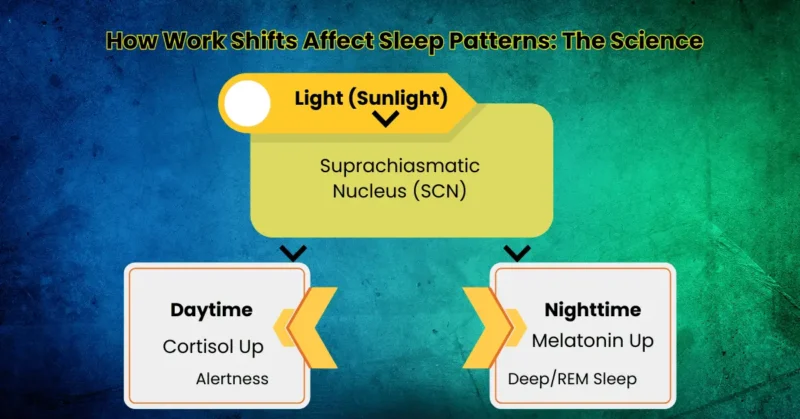
At the center of your brain sits the suprachiasmatic nucleus (SCN), a master clock driven by external light cues (zeitgebers). Under natural daylight:
- Cortisol peaks in the morning to enable wakefulness, peak cognitive function, and energy.
- Melatonin synthesis increases in total darkness, lowering core body temperature and inducing sleep readiness.
When you work non-standard shifts, you expose your retina to bright artificial light when melatonin should be rising. This suppresses melatonin output, causing irregular sleep-wake cycles and fragmented rest.
How Night and Rotating Shifts Damage Sleep Architecture
Sleep isn’t one block of rest. You move through lighter stages, deep sleep (which supports physical recovery), and REM sleep (which supports memory and mood), in repeating cycles.
Daytime sleep tends to be shorter and more fragmented. Noise, light, and a warming bedroom all interrupt it. Many night workers sleep noticeably fewer hours than day workers, and their sleep is often lighter.
Rotating shifts add another problem: your body never gets time to adapt. Just as your clock starts adjusting to one schedule, the schedule changes.
Over time, this pattern is linked with fatigue, mood changes, and a higher risk of drowsy mistakes on the job and on the road. That’s not meant to scare you. It’s a reason to take sleep protection seriously and to know which schedules make it easier.
Normal, restorative sleep consists of 90-minute cycles alternating between Slow-Wave Sleep (SWS/Deep Sleep) and Rapid Eye Movement (REM) sleep.
- Deep Sleep restores physical tissues, flushes metabolic waste from the brain via the glymphatic system, and supports immune health.
- REM Sleep consolidates memories, processes emotions, and supports executive decision-making.
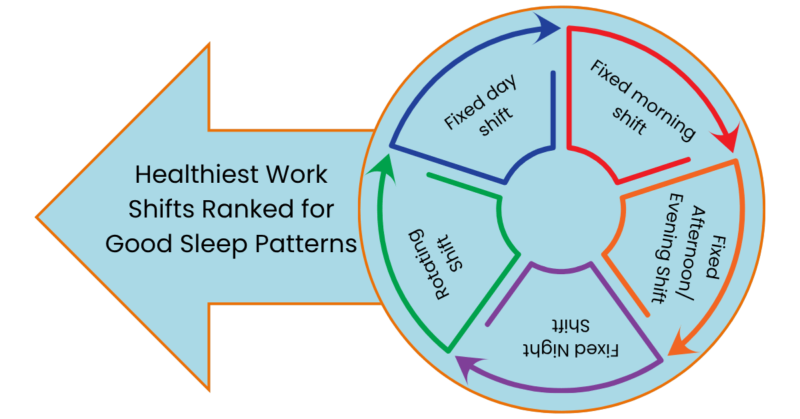
Healthiest Work Shifts Ranked for Good Sleep Patterns
Here’s how the five common shift types compare. This is a general ranking, since individual bodies differ, but it reflects what sleep research and occupational health guidance consistently point toward.
| Shift Type | Sleep impact | Circadian alignment | Who it suits |
| Fixed day (7 a.m.–3 p.m. / 9 a.m.–5 p.m) | Lowest disruption | Strong | Most people, especially morning types |
| Fixed morning (early start) | Low, if bedtime is protected. | Strong | Early risers |
| Fixed afternoon/evening | Moderate | Moderate | Night owls, evening types |
| Fixed night | High | Weak, rarely fully adapts | People who can keep the same sleep schedule every day, including days off |
| Rotating | Highest | Very weak | Rarely a good fit; best as a short-term arrangement |
1. Fixed day shift: Healthiest for Sleep Hygiene
A standard day shift gives you the most natural sleep window: roughly 10 or 11 p.m. to 6 or 7 a.m., in a quiet, dark home, while others sleep.
You also get daylight exposure at the right times, which strengthens your body clock. Social life, meals, and family routines line up with your schedule instead of fighting it.
Watch out for: a long commute, early alarms that cut sleep short, and scrolling in bed. A late bedtime can still waste a good shift.
2. Fixed morning shift: Consistent but Demanding
A fixed morning shift, say 5 a.m. to 1 p.m., can be excellent for sleep if you actually go to bed early enough. It keeps you on a daytime pattern and leaves your evenings free.
The catch is simple math. If you start at 5 a.m., you may need to wake at 3:30 or 4 a.m. To get seven hours, you’d be in bed by 8:30 or 9 p.m. Many people don’t manage that, and they run a chronic sleep debt.
Very early starts work best for natural early risers who are happy to go to bed with the sun.
3. Fixed Afternoon / Evening Shift: The “Night Owl” Preferred Choice
A schedule like 2 p.m. to 10 p.m. or 3 p.m. to 11 p.m. lets you sleep at night and wake naturally, without an alarm. If you’re a night owl, this can be the best shift for you personally, even better than a day shift.
You’ll sleep in the dark, which protects melatonin. The tradeoff is social: evenings with family or friends get hard to protect.
The main thing to guard is your wind-down. Finishing at 11 p.m. and going to bed at 11:30 p.m. rarely works. Give yourself an hour to settle before sleep.
4. Fixed Night Shift: Suboptimal, Yet Predictable
Fixed night work can be workable, but only when it’s truly fixed. That means sleeping on the same night-worker schedule on your days off too.
Here’s the honest part. Many night workers switch back to daytime living on weekends to see family, which keeps resetting the body clock. Studies suggest most permanent night workers never fully adapt for exactly this reason.
If you must work nights, consistency is your best friend. Sleep the same hours every day, use bright light on shift, and keep your bedroom truly dark.
5. Rotating Shift: The Worst Pattern for Sleep Patterns
Rotating shifts, where you move between days, evenings, and nights, are the hardest on sleep. Your body never settles into a stable pattern.
Some rotations are better than others. A forward rotation (day, then evening, then night) is generally easier because your body clock finds it easier to drift later than to jump earlier. Backward rotation (night, then evening, then day) is tougher and often leaves too little recovery time.
If you’re on a rotating schedule, you can’t change; the fixes later in this guide matter even more.
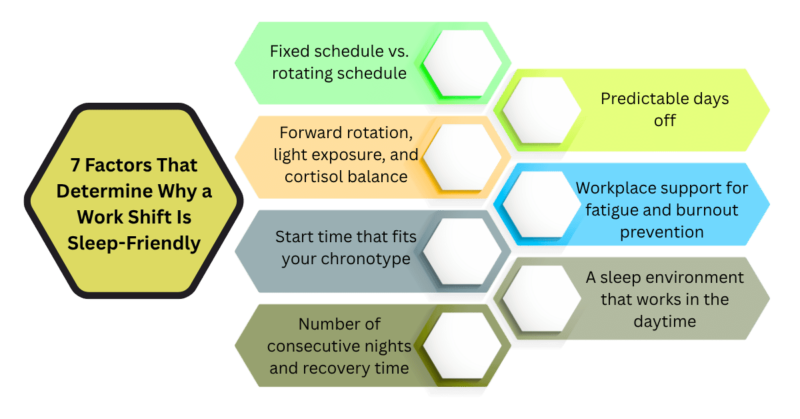
7 Factors That Determine If a Work Shift Is Healthy for Sleep
Whether you’re comparing job offers or negotiating your current roster, these seven factors predict how well you’ll sleep.
1. Fixed schedule vs. rotating schedule
Predictability beats almost everything else. A schedule that’s the same every week lets your body clock settle. One that changes constantly never does.
2. Forward rotation, light exposure, and cortisol balance
If rotation is unavoidable, ask for forward rotation. Also look at light: daytime light and evening dimness keep cortisol and melatonin on a healthy rhythm. Night work needs deliberate light management to compensate.
3. Start time that fits your chronotype
Your chronotype is your natural preference for earlier or later sleep. A shift that fits it needs less willpower and costs less sleep. (More on this in the next section.)
4. Number of consecutive nights and recovery time
Fewer consecutive night shifts are easier on your body. Occupational health guidance, including NIOSH recommendations, generally favors short runs of nights followed by enough rest, rather than long stretches that pile up sleep debt.
After a run of nights, you need real recovery sleep, not just one long nap.
5. Predictable days off
Knowing your days off weeks ahead lets you plan sleep, family time, and appointments. Last-minute roster changes are a hidden source of stress and sleep loss.
6. Workplace support for fatigue and burnout prevention
A healthy shift also depends on the workplace. Look for employers who offer breaks, a safe place to rest, overtime limits, and a culture that treats fatigue as a safety issue, not a weakness.
7. A sleep environment that works in the daytime
If you sleep during the day, your bedroom has to act like night: dark, cool, and quiet. Without that, even a good schedule can’t protect your sleep.
Quick checklist: fixed or forward-rotating schedule, start time that fits you, short runs of nights, predictable days off, adequate recovery time, supportive workplace, and a bedroom built for sleep.
Best Work Shift by Chronotype
Your chronotype is your body’s natural preference for sleep and wake times, determined by genetic variations in your circadian genes (such as PER3).
Chronotype vs. Ideal Work Shift Comparison
| Feature / Trait | Morning Lark (Early Chronotype) | Night Owl (Late Chronotype) |
| Peak Alertness Window | 6:00 AM – 12:00 PM | 2:00 PM – 10:00 PM |
| Daily Alertness Curve | ┌───┐ ┌──┘ └──┐ 6 AM, 12 PM, 6 PM | ┌───┐ ┌──┘ └──┐ 12 PM, 6 PM, 12 AM |
| Natural Sleep Window | 10:00 PM – 6:00 AM | 2:00 AM – 10:00 AM |
| Melatonin Onset Time | ~ 8:00 PM | ~ 12:00 AM – 2:00 AM |
| Best Work Shift | Fixed Day / Morning Shift (7 AM – 3 PM / 9 AM – 5 PM) | Fixed Evening / Afternoon Shift (2 PM – 10 PM / 3 PM – 11 PM) |
| Worst Work Shift | Night Shift (11 PM – 7 AM) | Early Morning Shift (5 AM – 1 PM) |
| Key Sleep Advantage | Easily aligns with standard societal hours and early-morning daylight. | Naturally avoids morning sleep inertia and gets more daylight exposure before work. |
Two people can work the same shift and sleep very differently. Chronotype is the reason.
Morning larks: why an early day shift gives the best sleep quality
If you wake easily before sunrise and feel sleepy by 9 p.m., an early day or morning shift fits you. You’ll fall asleep fast and wake up rested, because your body is already running on that timetable.
Forcing a lark onto an evening or night schedule often means shortened, poor-quality sleep.
Night owls: why an afternoon shift may be healthiest for you
If you feel sharpest in the evening and struggle with 6 a.m. alarms, an afternoon or evening shift may give you more sleep and better sleep than a standard day shift.
Owls that start early often accumulate sleep debt during the week and attempt to make up for it on the weekends. The body finds that pattern taxing.
How to find your chronotype
You don’t need a lab test. Think about a free-choice day, like a holiday with no alarm.
- What time do you naturally fall asleep?
- What time do you wake without an alarm?
- When do you feel most alert and focused?
If you drift toward early sleep and early waking, you lean lark. If you naturally stay up late and wake late, you are an owl. Most people fall somewhere in the middle, and a standard day shift suits them fine.
How to Protect Sleep on Non-Standard Shifts
If you are currently working a night or non-standard shift, implementing targeted sleep hygiene strategies can protect your rest and physical health.
Most people can’t pick. Here’s how to protect sleep when the roster is already set.
Anchor sleep for a consistent sleep-wake cycle.
Anchor sleep means keeping one block of sleep, about four hours, at the same time every day, even when your schedule shifts. It gives your body clock a fixed point to hold onto.
For example, if you work nights one week and days the next, you might always be asleep between 3 a.m. and 7 a.m. Then you add extra sleep before or after that anchor as your shift allows.
Light management, blackout curtains, and melatonin timing
Light is your strongest tool.
- On the night shift: keep your workspace brightly lit, especially in the first half of the shift.
- On the way home: wear sunglasses to reduce morning light, so your brain doesn’t think the day has started.
- In the bedroom: use blackout curtains or a sleep mask, and keep the room cool.
- Before sleep: dim lights and put screens away for 30 to 60 minutes.
Some shift workers use melatonin supplements to help shift their sleep time. Dose and timing matter, and it isn’t right for everyone, so talk to your doctor or pharmacist before trying it.
Sleep hygiene checklist for shift workers
- Keep the same sleep and wake times on workdays and days off as much as you can.
- Use earplugs, a white-noise machine, or a fan to mask daytime noise.
- Tell family or housemates your sleep hours. Put your phone on Do Not Disturb.
- Eat a light meal before bed. Heavy meals and hunger can both wake you.
- If you feel drowsy, take a short nap (about 20 to 30 minutes) before a night shift.
- Aim for at least seven hours of sleep in every 24 hours, which is the general adult recommendation from sleep medicine groups.

Common Mistakes That Ruin Shift Worker Sleep Patterns
- Flipping Schedules Completely on Off-Days: Reverting to a typical daytime routine on weekends causes major circadian strain, leaving you exhausted when you return to night shifts.
- Counter-Clockwise (Backward) Rotations: Transitioning backward from night shifts directly to morning shifts deprives the brain of essential recovery sleep.
- Over-Reliance on Caffeine Late in the Shift: Consuming coffee or energy drinks within 6 hours of your intended sleep window inhibits adenosine receptors, ruining sleep quality.
- Alcohol as a Sleep Aid: While alcohol induces sedation, it severely suppresses REM sleep and causes frequent awakenings during the second half of your rest block.
What Sleep Experts Say About the Healthiest Shift for Sleep
Leading public health and sleep medical organizations agree on the risks of non-standard shifts and offer clear guidelines:
- American Academy of Sleep Medicine (AASM): Recommends fixed shift schedules over rotating schedules wherever possible. When rotation is unavoidable, AASM guidelines urge forward-rotating patterns with adequate recovery periods.
- National Institute for Occupational Safety and Health (NIOSH): Warns that shift work lasting longer than 8 to 10 hours continuously increases fatigue-related error rates and recommends structured fatigue risk management systems (FRMS) across industrial workplaces.
- National Sleep Foundation (NSF): Emphasizes that shift workers need the same 7 to 9 hours of quality sleep as daytime workers and strongly cautions against driving home while fatigued after night duty.
Medical note: This article is general information, not medical advice. If you have ongoing sleep problems, talk to your doctor or a sleep specialist.
FAQ: Healthiest Work Shift for Good Sleep Patterns
Q. What is the healthiest shift pattern to work?
The healthiest pattern is a fixed, predictable schedule that keeps you awake during the day and asleep at night, such as a fixed day shift. If you must rotate, choose forward rotation (days, then evenings, then nights) with short runs of nights and enough rest between changes. Consistency matters more than the exact hours.
Q. What is the 10-3-2-1-0 rule for sleep?
It’s a popular bedtime routine that counts down to sleep:
- 10 hours before bed: no more caffeine.
- 3 hours before: no heavy food or alcohol.
- 2 hours before: stop work.
- 1 hour before: switch off screens.
- 0: zero snooze button presses in the morning.
It’s a handy habit framework, not a clinical guideline. Shift workers should count back from their own bedtime, not the clock.
Q. What is a 5-2/5-3 work schedule?
It’s a repeating pattern of five days on, two days off, five days on, and three days off. Public safety employers such as police departments and dispatch centers use it, with an eight-and-a-half-hour workday. That averages about 40 hours a week. Its sleep impact depends on which hours you work, since the pattern only decides which days you work.
Q. Is 6 p.m. to 2 a.m. a good shift?
It can be if it’s fixed and you’re a night owl. You finish in the dark, so you avoid morning sunlight on the way home, and you can sleep roughly 3 a.m. to 10 or 11 a.m. The downsides are less family time and late-night eating. It’s a poor fit for natural early risers.
Q. Is 2 p.m. to 10 p.m. a good shift?
Yes, it’s one of the better options. You can sleep at night in the dark, wake without an alarm, and keep a fairly normal body clock. The main challenge is winding down after work. Give yourself an hour before bed so you don’t go to sleep still wired.
Q. What’s the worst shift to work?
For sleep, the worst is a rotating shift, especially backward rotation or quick turnarounds, like finishing a night shift and starting an early morning shift a few hours later. Your body clock never settles. Among fixed shifts, permanent nights are the hardest, because most people never fully adapt to them.
Summary
The healthiest work shift for good sleep patterns is a standard day shift (such as 9:00 AM to 5:00 PM) because it aligns naturally with your body’s internal 24-hour circadian rhythm.
Why Day Shifts Are Healthiest
- Circadian Alignment: Your body releases melatonin in darkness to trigger sleep and cortisol/alertness hormones in daylight. Day shifts match when your brain and metabolism naturally want to be active and resting.
- Maximum Sleep Duration: Research on sleep regulation shows that shifts starting between 9:00 AM and 2:00 PM allow for maximum sleep duration (up to 8 hours) and the lowest fatigue levels.
- Minimizing Health Risks: Shifts starting before 6:00 AM, late-night shifts, or rotating shifts fight your biology, increasing chronic sleep deprivation and long-term health risks.
Rules for Shift Rotation (If Necessary)
If your job requires rotating or non-standard hours, certain patterns are safer for your sleep:
- Forward Rotation: If you must rotate, use a clockwise or forward rotation (day to evening to night), which reduces sleep disruption significantly compared to backward rotations.
- Start Times: Studies indicate that shifts starting after midnight cause less fatigue than pre-midnight starts (such as 8:00 PM to midnight) because post-midnight timing permits pre-shift sleep rather than fighting peak circadian sleep pressure.
Final Takeaway: The Healthiest Shift Is the One Your Body Can Predict
If you can choose, pick a fixed day shift or a fixed evening shift if you’re a night owl. If you can’t, build a routine around what you can control: steady anchor sleep, smart lighting, a dark bedroom, and the same wake-up habits on your days off.
Your body doesn’t need a perfect schedule. It needs one it can see coming.
Start with one change this week, like blackout curtains or a consistent bedtime, and build from there.
Read more about night shift workers’ health.