
Tired but can’t sleep at daylight? Struggling to sleep during the day even when exhausted? Discover why your body resists daytime sleep and proven strategies to finally rest deeply. It is good if you read a simple version of this post as part 1, which is not only for shift workers but for all
You can’t sleep during the day even though you’re tired because your body’s circadian rhythm is biologically programmed to keep you awake during the day. Bright light suppresses melatonin (your sleep hormone), while cortisol peaks in the morning to boost alertness.
Additionally, daytime noise, warmer temperatures, hyperarousal from your shift, and irregular schedules all fight against sleep onset.

The good news is that with strategic light control, a cool dark bedroom, consistent routines, and specific pre-sleep techniques, you can override these biological signals and achieve deep restorative daytime sleep.
Why Can’t I Sleep at Daylight, Even Though I’m Tired?
You just finished a long night shift. Your body aches with exhaustion, your eyes burn, and your brain feels foggy. All you want is to collapse into bed and sleep for hours.
But somehow, when you finally lie down in your quiet bedroom, sleep refuses to come. You toss, you turn, you check your phone, and hours pass with only broken, restless sleep to show for it.
If this sounds familiar, you are not alone. Millions of shift workers, new parents, medical professionals, and travelers struggle with the same frustrating experience. The problem is not laziness or weak willpower; it is biology working against you.
This guide will reveal the exact reasons your body resists daytime sleep even when you are utterly exhausted. More importantly, you will learn science-backed strategies to override these signals so you can finally achieve deep, restorative sleep during daylight hours.
Understanding Your Body’s Sleep-Wake System
The circadian rhythm is your body’s intrinsic 24-hour clock. This clock is greatly influenced by external signals, particularly light. When sunlight enters your eyes, your brain interprets it as “daytime” and releases hormones that promote wakefulness.
At the same time, your body produces melatonin, your primary sleep hormone, only when it senses darkness. During daylight, melatonin production drops dramatically, making sleep onset difficult even when you feel physically exhausted.
You may notice that you feel completely drained yet lie awake for hours. That is because tiredness and sleep readiness are two different biological states, and your body’s clock ultimately determines which one wins.
Why You Can’t Sleep During the Day Even When Tired:
You can’t sleep during the day, even when tired, because your circadian rhythm signals wakefulness in response to light exposure, cortisol peaks in the morning, and melatonin production is suppressed. Additionally, daytime noise, elevated body temperature, and stress- or shift-work-related hyperarousal make sleep onset significantly harder than at night.
- Light suppresses melatonin production.
- Cortisol naturally rises in the morning.
- Body temperature increases during the day.
- Environmental noise disturbs sleep.
- Hyperarousal keeps your nervous system alert.
The Science Behind Daytime Sleep Resistance
Definition: Circadian misalignment happens when your desired sleep schedule conflicts with your body’s internal clock. This is one of the primary reasons daytime sleep feels almost impossible for shift workers and others with unusual schedules.
Research from Harvard Medical School shows that people who try to sleep during the day get, on average, 1–4 hours less sleep than those who sleep at night.
Even when they do fall asleep, their sleep is often lighter, more fragmented, and less restorative.
Your goal should be to understand these biological forces so you can work with them, not against them, to achieve the sleep your body desperately needs.
Reason 1: Bright Light Suppresses Melatonin
Light is the most powerful signal your brain uses to regulate sleep. Melatonin production can be suppressed by up to 90% when even tiny amounts of light reach your eyes.
When you come home after a night shift and encounter morning sunlight, your body interprets this as a signal to stay awake. Even if you make it home before the sun rises, exposure to bright indoor lights, screens, or streetlights can disrupt your ability to fall asleep.
Simple solutions for light control:
- Wear blue-light-blocking glasses on your commute home.
- Install blackout curtains or use a high-quality sleep mask.
- Cover all LED lights from electronics in your bedroom.
- Use dim, warm-colored lights (red or amber) in the hour before bed.
- Avoid screens for at least 30 minutes before trying to sleep.
You should consider treating your commute home as the beginning of your sleep routine, not the end of your shift.
Reason 2: Cortisol Peaks in the Morning
Cortisol is your body’s primary alertness hormone. It naturally peaks in the early morning (between 6 AM and 9 AM) to help you wake up and face the day. Unfortunately, this same cortisol peak fights against your attempts to sleep after a night shift.
Additionally, chronic shift work often elevates baseline cortisol levels, leading to persistent hyperarousal. Even when you attempt to rest, your body remains in “fight or flight” mode.
How to lower cortisol before daytime sleep:
- Practice 5 minutes of deep breathing (4-7-8 or box breathing).
- Take a warm shower to signal relaxation to your body.
- Steer clear of caffeine at least six hours before you want to go to bed.
- Do gentle stretching or restorative yoga.
- Journal or write down worries to clear your mind.
You can improve your sleep onset dramatically by giving your nervous system 30–60 minutes to shift out of high-alert mode.
Reason 3: Your Body Temperature Rises During the Day
Sleep is closely tied to your core body temperature. Your body normally warms up during the day and cools down at night to get ready for sleep. When you try to sleep in the afternoon or midday, your body is at its warmest point, making it harder to enter deep sleep.
Comparison Table: Body Temperature and Sleep Quality
| 2 AM – 4 AM | Lowest | Easiest |
| 6 AM – 8 AM | Rising | Difficult |
| 10 AM – 2 PM | Peak | Very difficult |
| 4 PM – 8 PM | Slight dip | Moderate |
| 10 PM – Midnight | Falling | Easy |
Simple ways to cool your body for daytime sleep:
- Keep your bedroom between 60 and 67°F (15.5 and 19.4°C).
- Take a warm shower 60–90 minutes before bed (post-shower cooling helps).
- Use breathable cotton bedding and lightweight pajamas.
- Use an air conditioner or fan while you sleep.
- Avoid heavy exercise in the 2 hours before sleep.
You may notice that a cooler bedroom is one of the single most effective changes you can make for daytime sleep.
Reason 4: Daytime Noise Disrupts Sleep
The world is much noisier during the day than at night. Traffic, construction, delivery drivers, lawnmowers, and household activity all create constant background noise that fragments your sleep—even if you don’t fully wake up.
Even low-level daytime noise has been shown to decrease REM and deep sleep, leaving you feeling restless even after spending hours in bed.
Best Ways to Block Daytime Noise for Sleep:
The best ways to block daytime noise for sleep include using white or pink noise machines, wearing high-quality earplugs, soundproofing your bedroom door, and communicating your sleep schedule to household members.
Consistent sound masking allows your brain to filter out disruptive noises and stay in deep sleep.
- Use a white- or pink-noise machine consistently.
- Wear earplugs designed for sleep (foam or silicone).
- Install weather stripping and door sweeps.
- Silence phone notifications and put your phone in another room.
- Post a “sleeping—do not disturb” sign for visitors.
- Reduces sleep fragmentation
- Promotes deeper sleep stages
- Improves overall sleep quality
- Blocks unpredictable sudden noises
- Signals to your brain that sleep is safe
Reason 5: Hyperarousal from Stress and Shift Work
After a long shift, your mind is often racing with thoughts about work, patients, tasks, or family responsibilities. This mental hyperarousal keeps your brain active even when your body is exhausted.
Chronic shift work also creates a state of long-term hyperarousal, in which your nervous system remains elevated most of the time, making relaxation and sleep feel nearly impossible.
Techniques to reduce hyperarousal:
- Practice progressive muscle relaxation before bed.
- Try guided meditation apps designed for sleep.
- Journal about your shift to release lingering thoughts.
- Listen to calming music or nature sounds.
- Do gentle yoga or stretching for 10–15 minutes.
Your goal should be to create a clear mental transition between “work mode” and “sleep mode.”

Reason 6: Inconsistent Sleep Schedule
Your body loves predictability. When you sleep at different times every day, your circadian rhythm never fully adapts, making sleep onset harder each time.
Even on days off, shifting your sleep schedule dramatically can worsen your sleep problems. Many shift workers try to “switch back” to nighttime sleep on their days off, only to struggle again when they return to night shifts.
How to build a consistent daytime sleep schedule:
- Keep the same sleep and wake times every day (as much as possible).
- Follow the same wind-down routine before every sleep period.
- Avoid dramatic schedule shifts on days off.
- Use light exposure strategically to anchor your rhythm.
- Give your body 2–3 weeks to adapt to any new schedule.
You can improve your sleep quality significantly by treating your sleep schedule as sacred, even when family or social plans tempt you to break it.

Reason 7: Diet and Hydration Choices
What you eat and drink during the day has a big impact on your ability to sleep. If you consume caffeine at eight in the morning, it will still be active in your body at two in the afternoon since it has a half-life of five to six hours. Large meals and sweets also disrupt sleep due to elevated digestive activity and blood sugar spikes.
Foods and drinks that help daytime sleep:
- Tart cherry juice (natural melatonin source)
- Chamomile or valerian root tea
- Small handful of walnuts or almonds
- Warm milk with honey and cinnamon
- Turkey or foods high in tryptophan
Foods and drinks to avoid before sleep:
- Coffee, energy drinks, and caffeinated tea
- Alcohol (disrupts REM sleep despite initial drowsiness)
- Heavy, greasy, or spicy meals
- Sugary snacks and desserts
- Excessive fluids that cause bathroom trips
You should consider tracking what you eat and drink to identify patterns that disrupt your sleep.

Reason 8: Environmental Factors in Your Bedroom
Even if you address all the above factors, an unsuitable sleep environment can still sabotage your rest. Your bedroom needs to function like a cave: dark, cool, quiet, and free from distractions.
Ideal bedroom setup for daytime sleep:
- Complete darkness with blackout curtains or shades
- Cool temperature (60–67°F)
- White or pink noise for sound masking
- Comfortable, supportive mattress and pillows
- No electronics or blue-light-emitting devices
- Clutter-free, calming space
You may notice that upgrading your sleep environment produces almost immediate improvements in how quickly you fall asleep and how deeply you sleep.
Common Mistakes That Worsen Daytime Sleep Problems
- Scrolling on your phone right before bed
- Drinking caffeine to “make it home” from a shift
- Trying to sleep in a bright, warm bedroom
- Eating heavy meals after your shift
- Working out intensely right before sleep
- Napping too long in the afternoon
- Ignoring your body’s stress signals
You can improve your sleep dramatically by addressing even two or three of these mistakes.
Step-by-Step Protocol to Sleep Better During the Day
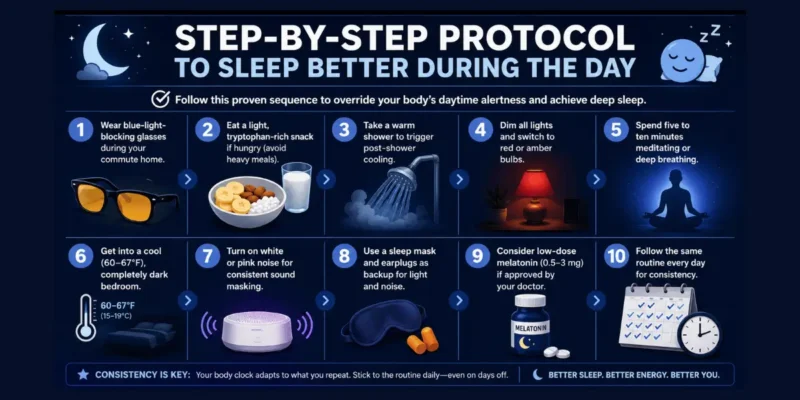
Follow this proven sequence to override your body’s daytime alertness and achieve deep sleep.
- Wear blue-light-blocking glasses during your commute home.
- Eat a light, tryptophan-rich snack if hungry (avoid heavy meals).
- Take a warm shower to trigger post-shower cooling.
- Dim all lights and switch to red or amber bulbs.
- Spend five to ten minutes meditating or deep breathing.
- Get into a cool (60–67°F), completely dark bedroom.
- Turn on white or pink noise for consistent sound masking.
- Use a sleep mask and earplugs as backup for light and noise.
- Consider low-dose melatonin (0.5–3 mg) if approved by your doctor.
- Follow the same routine every day for consistency.
Your goal should be to build this into a non-negotiable ritual; your future sleep quality depends on it.
Key Takeaways
- Your body is biologically programmed to be awake during daylight, making daytime sleep genuinely difficult.
- Bright light suppresses melatonin, cortisol peaks in the morning, and body temperature rises during the day.
- Environmental factors like noise, warm temperatures, and light can sabotage even the most exhausted sleeper.
- Hyperarousal from shift work and stress keeps your nervous system elevated, blocking sleep onset.
- Consistent routines, blackout environments, cool temperatures, and pre-sleep rituals dramatically improve daytime sleep.
- Small changes in light exposure, diet, and stress management often produce significant results within 1–2 weeks.
- Your body can adapt to daytime sleep with strategic, science-backed habits.
Daytime Sleep Solutions Checklist
Use this practical checklist to overcome daytime sleep struggles and finally rest deeply. Check off each item as you implement it into your routine.
Light Control Strategies
- Wear blue-light-blocking glasses on your commute home.
- Put shades or blackout curtains in your bedroom.
- Use a high-quality sleep mask as backup light protection.
- Cover or unplug all LED lights from electronics.
- Switch to red or amber bulbs in your evening routine.
Bedroom Environment Setup
- Keep your bedroom temperature between 60 and 67°F.
- Use a fan or air conditioner for consistent cooling.
- Choose breathable cotton bedding and lightweight pajamas.
- Set up a white- or pink-noise machine.
- Remove all electronics and screens from your bedroom.
Pre-Sleep Wind-Down Routine
- Take a warm shower 60–90 minutes before bed.
- Spend five to ten minutes meditating or deep breathing.
- Do gentle stretching or restorative yoga.
- Journal about your shift to clear your mind.
- Listen to calming music or nature sounds.
Diet and Hydration Habits
- Steer clear of caffeine at least six hours before going to bed.
- Eat light, tryptophan-rich snacks if hungry.
- Try tart cherry juice or chamomile tea before bed.
- Avoid heavy, greasy, or spicy meals after your shift.
- Limit alcohol, which disrupts REM sleep.
Consistency and Scheduling
- Keep the same sleep and wake times daily.
- Follow the same wind-down routine every day.
- Avoid dramatic schedule shifts on days off.
- Give your body 2–3 weeks to adapt to changes.
- Communicate your schedule with household members.
Noise Blocking Techniques
- Use foam or silicone earplugs designed for sleep.
- Install door sweeps and weather stripping.
- Silence phone notifications completely.
- Post a “do not disturb” sign for visitors and delivery drivers.
- Set your phone in another room during sleep.
Stress and Nervous System Management
- Practice progressive muscle relaxation before bed.
- Use guided meditation apps designed for sleep.
- Journal thoughts to release mental hyperarousal.
- Try 4-7-8 breathing or box breathing techniques.
- Consider low-dose melatonin (0.5–3 mg) with medical guidance.
Long-Term Sleep Health Habits
- Track sleep quality and duration weekly.
- Note what works and what doesn’t in a journal.
- Reassess your routine every 2–4 weeks.
- See a doctor if problems persist beyond 6 weeks.
- Celebrate small wins as your sleep improves.
Quick Tip: Consistency is your most powerful tool. When you follow the same routine daily and thoroughly optimize your environment, your body will gradually learn to sleep deeply during the day. Give yourself time and patience—the transformation is worth it.
Recap
Fixing an inverted sleep schedule where you are tired all day but wide awake at daylight requires resetting your internal clock. You can achieve this by using three core actions: anchor your wake time, block daytime light, and shift your habits gradually.
Reset Your Body Clock When You Can’t Sleep at Daylight
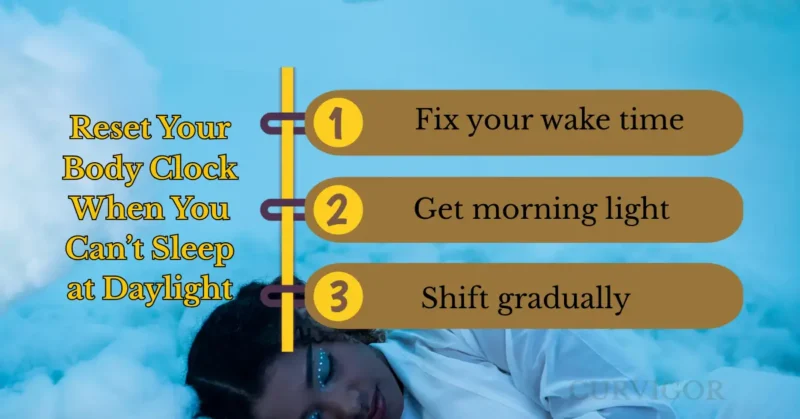
- Fix your wake time: Set your alarm for the same early hour every single day, even after a sleepless night. This anchors your circadian rhythm.
- Get morning light: Step outside or open your blinds within 60 minutes of waking up to signal to your brain that the day has begun.
- Shift gradually: Move your target bedtime earlier by only 15 to 30 minutes every few days rather than trying to force an instant change.
Optimize Your Environment and Habits
- Block out daylight: Use thick blackout curtains or wear a comfortable eye mask so sunlight does not trick your brain into staying alert.
- Cut off caffeine: Stop drinking coffee, tea, or soda by noon or at least 8 hours before your intended bedtime.
- Turn off screens: Put away phones, tablets, and TVs an hour before bed. The blue light stops your body from making sleep hormones.
If you want to tailor this plan, tell me:
- What is your current sleep and wake schedule?
- Do you work night shifts or have an irregular routine?
I can give you a specific timeline to adjust your hours safely.
This is merely for informational purposes. See a professional for a diagnosis or medical advice. Errors may occur in AI responses.
FAQ on How to Fix ‘Can’t Sleep at Daylight’
Q. Why do I feel so tired but can’t fall asleep during the day?
You feel tired but can’t fall asleep during the day because tiredness and sleep readiness are two different biological states. Your body may have accumulated significant sleep debt (making you tired), but your circadian rhythm signals wakefulness during daylight through cortisol release and melatonin suppression.
Additionally, hyperarousal from stress or your shift can keep your nervous system on high alert. Even in a dark room, if your body temperature is high or your mind is racing, sleep will remain elusive.
The solution is to create a comprehensive pre-sleep routine that addresses light, temperature, sound, and mental relaxation together.
Q. Is it harmful to sleep during the day long-term?
Sleeping during the day long-term can have health consequences if your sleep quality is poor, but consistent, high-quality daytime sleep can be sustainable.
Research shows that shift workers who develop optimal sleep environments and routines can maintain reasonably good health. However, chronic poor daytime sleep is linked to cardiovascular disease, metabolic issues, cognitive decline, and mood disorders.
The key is not simply sleeping during the day; it is sleeping deeply enough. Blackout curtains, cool temperatures, noise masking, and consistent schedules dramatically improve daytime sleep quality and reduce long-term health risks.
Q. How many hours should you sleep during the day after a night shift?
You should aim for 7–9 hours of daytime sleep after a night shift to match your normal sleep needs. Some shift workers use a split-sleep strategy—sleeping 4–5 hours immediately after their shift and taking a 2–3 hour nap before their next shift.
This approach can work well when your schedule is variable. Your goal should be 7–9 hours of sleep per day, regardless of when you get it. Getting less than 6 hours consistently leads to sleep debt, mood problems, and long-term health risks. Prioritize quality over quantity by optimizing your sleep environment.
Q. Does melatonin help you sleep during the day?
Yes, melatonin can help you sleep during the day when used correctly. Supplemental melatonin (0.5–3 mg taken 30–60 minutes before bed) can assist in telling your brain that it’s time to sleep because your body decreases natural melatonin production during the day.
But melatonin is not a stand-alone remedy; rather, it works best in conjunction with rigorous light management, a dark bedroom, and regular routines.
Higher doses (5–10 mg) may make you drowsy and are typically no more effective. Before beginning melatonin, always get medical advice, particularly if you have any health issues or take other prescriptions.
Q. Why do I wake up after just a few hours of daytime sleep?
You wake up after just a few hours of daytime sleep because your body’s circadian rhythm signals wakefulness as the day progresses.
Rising cortisol levels, increased body temperature, environmental noise, and light exposure all contribute to early waking. Additionally, daytime sleep is often lighter than nighttime sleep, making you more susceptible to disturbances.
Solutions include ensuring complete darkness, using consistent white noise, keeping your bedroom very cool, avoiding caffeine, and following the same wind-down routine every day. Some shift workers benefit from a small carbohydrate snack or warm milk before returning to sleep after early waking.
Q. How long does it take to adjust to daytime sleep?
Adjusting to daytime sleep with regular routines and a suitable sleeping environment usually takes two to four weeks. Some people adapt faster (within 1–2 weeks), while others struggle for months if their environment is poor or their schedule changes frequently.
Rotating shift workers may never fully adapt because their schedules keep changing. Permanent night shift workers with consistent routines usually adapt better.
The key factors influencing the speed of adaptation are strict light control, environmental quality, consistent sleep timing, stress management, and dietary habits. Patience and consistency are essential; improvements often come gradually.
Q. When should you see a doctor about daytime sleep problems?
You should see a doctor about daytime sleep problems if you consistently struggle to fall asleep despite optimizing your environment for 4–6 weeks, experience severe fatigue affecting your work or safety, or notice mood changes, cognitive issues, or physical symptoms.
A healthcare provider can rule out sleep disorders like shift work sleep disorder, sleep apnea, or insomnia. They may recommend a sleep study, prescription treatments, or referral to a sleep specialist.
Don’t dismiss chronic daytime sleep issues as “just part of shift work”—effective treatments exist, and early intervention prevents more serious long-term health consequences.
Conclusion on How to Fix ‘Can’t Sleep at Daylight’
If you have been asking yourself, “Why can’t I sleep at daylight, even though I’m tired?” You now have your answer. Your body is not broken, and you are not doing anything wrong. You are simply fighting against millions of years of biological programming that keeps humans awake during daylight.
The good news is that you can override these signals with the right strategies. By controlling light exposure, cooling your bedroom, masking noise, calming your nervous system, and building consistent routines, you can achieve the deep, restorative sleep your body desperately needs.
Start with the changes that feel most doable. Perhaps you begin with blackout curtains and a white noise machine this week. Next week, add a wind-down routine and cooler bedroom temperature. Small, consistent improvements compound over time into powerful sleep transformation.
You deserve quality rest, no matter what time your body clock says. Take the first step today; your future, well-rested self will thank you.
Ready to finally sleep during the day? Choose one strategy from this guide and start tonight; your body will thank you with the deep, restorative rest you deserve.
Read more about the night shift workers’ health.
You might like: