

Learn how spirituality and social support connect through belonging, shared values, compassion, purpose, community, and meaningful relationships.
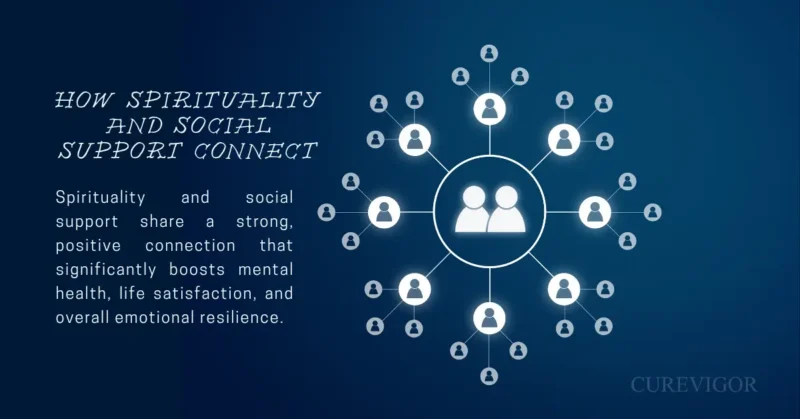
Spirituality and social support share a strong, positive connection that significantly boosts mental health, life satisfaction, and overall emotional resilience.
How Spirituality and Social Support Connect
- Shared Communities: Spiritual and faith-based groups create built-in networks of like-minded people who offer mutual aid, friendship, and a dependable sense of belonging.
- Reduced Isolation: Regular participation in spiritual gatherings actively combats loneliness by providing emotional backing during difficult life events.
- Enhanced Coping: Belief systems and community connections act as a psychological buffer, helping people manage stress and lower rates of anxiety and depression.
- Deeper Meaning: Spirituality fosters a broader perspective and sense of purpose, which encourages individuals to engage more openly with supportive social networks.
The Strong Connection Between Spirituality and Social Support
What makes people feel truly connected to others?
It is not always frequent conversations, a large friend group, or being surrounded by people. Sometimes, connection grows from something deeper: shared values, compassion, purpose, faith, service, and the feeling that you are part of something larger than yourself.
This is where spirituality and social support intersect.
Spirituality can shape how people understand their lives, relationships, challenges, and responsibilities toward others. When those beliefs are practiced within a supportive community, they can create opportunities for friendship, emotional support, shared rituals, service, and belonging.
Research also provides an important clue. In a large longitudinal analysis of three U.S. prospective cohorts, regular religious-service attendance was associated with greater social integration and purpose in life, as well as lower levels of loneliness, anxiety, hopelessness, and several measures of psychological distress.

The researchers described religious participation as a potential form of social integration, not proof that attendance itself caused these outcomes.
So, spirituality does not automatically create strong relationships. But spiritual beliefs and practices can provide a framework for meaningful relationships to grow.
Spirituality and social support are connected because spiritual beliefs and practices can create shared values, belonging, compassion, purpose, and opportunities for people to support one another.
What Is the Connection Between Spirituality and Social Support?
Spirituality creates belonging, shared values, and emotional support.
Spirituality often encourages people to think about meaning, purpose, compassion, gratitude, forgiveness, and their connection with other people.
When these ideas are practiced with others, they can become social experiences.
A prayer group may meet every week. A meditation group may practice together. A faith community may organize meals for a grieving family. People may volunteer together, visit someone who is sick, or gather during important life events.
These activities create repeated opportunities for interpersonal connection.
The social-support side is just as important. Social support can include:
- Someone who listens when life feels difficult
- Practical help during a crisis
- Encouragement when you feel discouraged
- Advice when you face an unfamiliar situation
- Companionship during lonely periods
- A community that shares important values
- People who celebrate meaningful moments with you
Spirituality can therefore become one pathway into a wider support system.
However, the quality of the community matters. A spiritual group can be supportive, neutral, or even harmful depending on how people treat one another. Spirituality should never be used as a reason to tolerate abuse, manipulation, discrimination, or isolation.
Why spiritual people may have stronger social support
Spiritual people may experience stronger social support when their spiritual beliefs connect them with communities that provide belonging, shared values, compassion, practical help, and meaningful relationships.
This distinction matters because spirituality and social support are not the same thing.
A person can be deeply spiritual and still feel lonely. Another person may have strong social support without identifying as spiritual or religious.
The connection is possible, but it is not automatic.
What Do We Mean by Spirituality and Social Support?
Before exploring the relationship, it helps to define the two concepts.
Spirituality: connectedness beyond self, purpose, and inner peace
Spirituality can mean different things to different people.
For one person, it may involve belief in God and prayer. For another, it may involve meditation, connection with nature, service, reflection, or a strong sense of purpose.
Some people practice spirituality through organized religion. Others describe themselves as spiritual without belonging to a religious institution.
A useful way to think about spirituality is as a person’s search for meaning, purpose, connectedness, values, and inner peace.
That does not mean every spiritual person feels peaceful all the time. Spirituality can also involve questioning, grief, uncertainty, and searching for meaning during difficult periods.
Social support: emotional, informational, and community support
Social support is the help and connection people receive from others.
It can take several forms.
Emotional support means having someone who listens, understands, comforts, or encourages you.
Informational support means receiving advice, guidance, knowledge, or useful information.
Practical support means receiving tangible help, such as meals, transportation, childcare, financial assistance, or help during illness.
Community support is broader. It can include belonging to a group where people recognize you, share experiences, and offer opportunities to participate.
Research involving more than 113,000 people across 177 studies found that higher social support was associated with lower loneliness. This does not make spirituality a treatment for loneliness, but it helps explain why supportive relationships are important for well-being.
Spiritual community vs. religious community—overlapping but different
A religious community generally forms around an organized religious tradition, its beliefs, practices, teachings, or institutions.
A spiritual community can be broader.
It might include:
- Meditation groups
- Mindfulness communities
- Interfaith groups
- Spiritual discussion circles
- Nature-based communities
- Prayer groups
- Yoga or contemplative groups
- Service organizations centered around shared values
There can be considerable overlap between the two.
The key point is that social connection can develop around shared meaning and values, whether or not the group is formally religious.
Why Spirituality and Social Support Are Deeply Connected — 7 Core Links
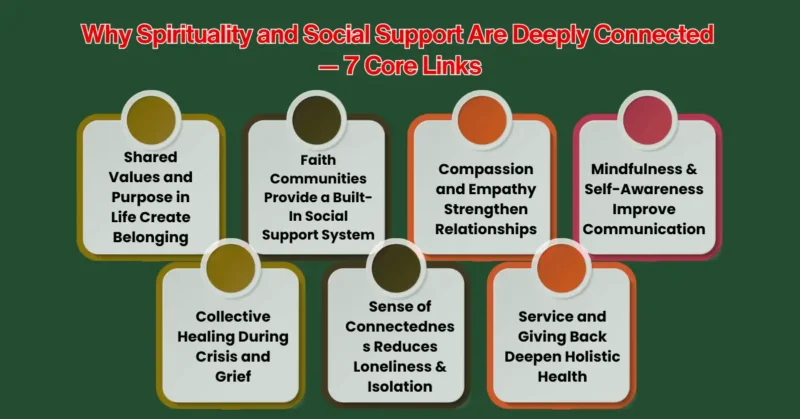
1. Shared Values and Purpose in Life Create Belonging
One reason spirituality can support social connection is that shared values give people something meaningful to build relationships around.
Imagine joining a community where people value compassion, service, honesty, gratitude, or caring for others.
You already have something in common.
Shared values can make it easier to start conversations, build trust, and participate in group activities.
A spiritual community may also provide a shared sense of purpose. Members may work together to help families in need, care for older adults, support people experiencing grief, or organize charitable activities.
These experiences can turn an abstract belief into a shared social practice.
Purpose can also influence how people view difficult periods. Instead of seeing hardship only as something to endure, people may interpret it through their values and beliefs.
That interpretation does not remove the problem. But it can give people a framework for responding.
2. Faith Communities Provide a Built-In Social Support System
Faith communities can create regular opportunities for connection.
Weekly services, prayer meetings, study groups, celebrations, community meals, charity projects, and life events can bring people together repeatedly.
Repeated contact matters.
Friendships often become stronger when people see one another regularly and have opportunities to help each other.
The research is particularly interesting here. A large prospective study involving three U.S. cohorts found that people who attended religious services at least weekly had higher levels of social integration and purpose in life compared with those who never attended.
The study also found associations with lower loneliness, anxiety, hopelessness, and depression-related outcomes.
This does not mean that attending a religious service guarantees better mental health.
People who participate may differ from nonparticipants in many other ways, including their existing social networks, health, lifestyle, and socioeconomic circumstances.
Still, the findings support the idea that community participation can be an important part of the relationship between spirituality and social support.
3. Compassion and Empathy Strengthen Relationships
Many spiritual traditions emphasize compassion, forgiveness, generosity, gratitude, and caring for others.
These qualities can influence everyday relationships.
For example, compassion can encourage you to ask:
“What might this person be going through?”
Instead of judging someone right away, you may pause and listen.
Empathy can also improve the quality of conversations.
Suppose a friend tells you that they are struggling at work. You could immediately give advice. Or you could first listen and acknowledge what they are experiencing.
That small difference can make someone feel heard.
Spiritual practices do not automatically make someone compassionate. They need to be practiced consistently.
But reflection, gratitude, service, prayer, and mindfulness can give people regular opportunities to think about how their behavior affects others.
That can support healthier interpersonal connection.
4. Mindfulness and Self-Awareness Improve Communication
Spiritual practices often encourage some form of reflection.
Prayer may create a quiet space for reflection. Meditation may encourage attention to thoughts and feelings. Journaling may help someone understand their reactions. Contemplative practices may encourage people to slow down before responding.
Greater self-awareness can be useful in relationships.
You may notice:
- “I am becoming defensive.”
- “I am reacting before listening.”
- “I am assuming what the other person means.”
- “I need a moment before answering.”
- “This conversation is bringing up an old hurt.”
That awareness creates an opportunity to respond rather than simply react.
Research on spirituality and mental health is still developing, and researchers have emphasized the need for stronger studies and better measurement of spirituality.
So it is better to say that mindfulness and reflective spiritual practices may support skills that are useful in relationships, rather than claiming that spirituality automatically improves communication.
5. Collective Healing During Crisis and Grief
Difficult life events can change a person’s social world.
After a death, divorce, serious illness, job loss, or other major transition, people may feel disconnected from their normal routines.
Spiritual communities can sometimes provide a structure during these periods.
Someone may bring food to a grieving family.
A group may pray together.
Community members may visit a sick person.
A spiritual leader may provide guidance.
Friends may simply sit together without trying to solve the situation.
These actions can create a sense of collective healing.
The value is not necessarily in having the perfect answer. Often, it is in knowing that you do not have to carry everything alone.
Faith communities have also been examined as potential partners in mental health support. A recent scoping review found that faith communities can play an important role in mental health support and identified reciprocal relationships and support from faith leaders as potential facilitators, while also noting the need for more rigorous research on effectiveness.
6. Sense of Connectedness Reduces Loneliness and Isolation
Loneliness is not simply about being physically alone.
A person can live in a busy household and still feel emotionally disconnected.
Social support is strongly related to loneliness. A large meta-analysis found a moderate negative relationship between social support and loneliness, meaning people who reported greater social support generally reported less loneliness.
Spirituality may contribute to connectedness in several ways.
A person may feel connected to:
- Family
- Friends
- A faith community
- A spiritual teacher
- A service group
- Nature
- A larger sense of purpose
- God or a higher power
For people with religious beliefs, spiritual connection can also provide comfort when physical companionship is limited.
A 2025 multinational study using data from more than 180,000 people across 22 countries reported associations between religious belief, loneliness, social isolation, and health.
The authors also suggested that beliefs about a loving higher power may provide a perceived source of support. Because the study is observational, it cannot establish that belief itself caused better health outcomes.
7. Service and Giving Back Deepen Holistic Health
One of the most practical ways spirituality can build social connection is through service.
Helping others gives people a reason to come together.
Examples include:
- Preparing meals for families
- Visiting older adults
- Supporting charitable projects
- Helping at a community center
- Organizing food drives
- Mentoring younger people
- Supporting people during illness
- Participating in environmental projects
Service creates interpersonal connection because people are working toward something together.
It can also change the experience of belonging.
Instead of asking only, “What can this community give me?” you begin asking, “What can I contribute?”
That shift can strengthen purpose and shared identity.
Benefits of Spiritual Social Support for Holistic Health
The connection between spirituality and social support can influence several areas of well-being, although the strength of evidence varies by outcome.
Mental wellness: Less anxiety and more emotional support
Supportive relationships can provide a place to talk, share concerns, receive encouragement, and feel understood.
Research on religious participation has found associations with lower levels of several psychological distress measures, including loneliness, anxiety, hopelessness, and depressive symptoms.
A systematic review of religion and mental health also found substantial research examining how religious beliefs and practices may relate to mental health, although the literature includes mixed findings and methodological limitations.
Spiritual support should therefore be viewed as one possible source of emotional support, not a replacement for professional mental health care.
If someone is experiencing severe anxiety, depression, trauma, suicidal thoughts, or another serious mental-health concern, professional help remains important.
Physical health: What research says about faith communities
Some long-term studies have found associations between regular religious-service attendance and health outcomes.
For example, the large prospective cohort analysis discussed earlier found that weekly attendance was associated with lower all-cause mortality and some healthier behaviors, including lower risks of heavy drinking and current smoking. However, the researchers did not find broad associations with every physical disease outcome they examined.
This is an important distinction.
It would be misleading to say:
“Spirituality makes you live longer.”
A more accurate statement is:
“Some studies have found associations between religious participation and longevity, health behaviors, and psychosocial well-being.”
Social integration, lifestyle, socioeconomic conditions, health status, and other factors may contribute to these relationships.
Spiritual wellness: Deeper purpose and alignment through belonging
Spiritual wellness is not necessarily about feeling happy all the time.
It can involve feeling that your life has meaning and that your daily actions are connected to your values.
A supportive community can reinforce that sense of alignment.
For example, someone who values compassion may feel more fulfilled when they regularly serve.
Someone who values reflection may benefit from a meditation group.
Someone whose faith is central to their identity may find meaning through prayer and community worship.
In each case, social connection can help turn personal values into lived experiences.
How Spirituality Builds Social Support in Real Life
Meditation groups, prayer circles, and mindfulness communities
A meditation group may meet once or twice a week.
The activity itself may be quiet, but the social connection can still be meaningful.
Members recognize each other. They share a common practice. They may talk before or after sessions. Over time, those repeated interactions can develop into friendships.
Prayer circles can work similarly.
People may gather around shared concerns, celebrate good news, or support someone going through hardship.
Faith-based support during life transitions, illness, and grief
Spiritual communities often become especially visible during major life transitions.
A family experiencing bereavement may receive meals, visits, prayers, or practical assistance.
Someone moving to a new city may find friends through a local faith community.
A new parent may receive advice and support from people with similar values.
Someone facing illness may appreciate both emotional encouragement and practical help.
The support may be spiritual, social, or practical—or all three.
Online spiritual communities and modern connectedness
Not every person has access to a supportive spiritual community nearby.
Online communities can create another avenue for connection.
People may join:
- Online prayer groups
- Virtual meditation sessions
- Spiritual discussion groups
- Faith-based support communities
- Mindfulness communities
- Online study circles
Digital communities can be meaningful, particularly for people who are geographically isolated or have mobility limitations.
But online connection has limitations too.
It may not provide the same practical support as face-to-face relationships, and online communities can sometimes expose people to misinformation, conflict, or unhealthy group dynamics.
The goal is not to replace every offline relationship with an online one. Instead, digital communities can complement other forms of social connection.
What Happens When Spirituality Lacks Social Support?
Spiritual isolation and loss of belonging
A person can have a rich private spiritual life and still feel lonely.
This is an important point.
Spirituality does not automatically create social support.
Someone may pray, meditate, reflect, or study alone without having people they can call during a difficult time.
Private spirituality can be meaningful, but humans also need relationships.
A person who feels disconnected from family, friends, or community may need to intentionally build social connections alongside their spiritual practices.
How lack of community affects inner peace and resilience
When people repeatedly feel isolated, they may have fewer opportunities to share emotions, receive practical help, or gain perspective from others.
That can make stressful periods feel heavier.
Social support does not remove grief or hardship.
Instead, it can give people resources for navigating those experiences.
This is why spiritual wellness and relationships can work together. Inner reflection may help you understand what matters to you, while supportive relationships give you opportunities to live those values with other people.
How to Build Social Support Through Spirituality — 6 Actionable Steps
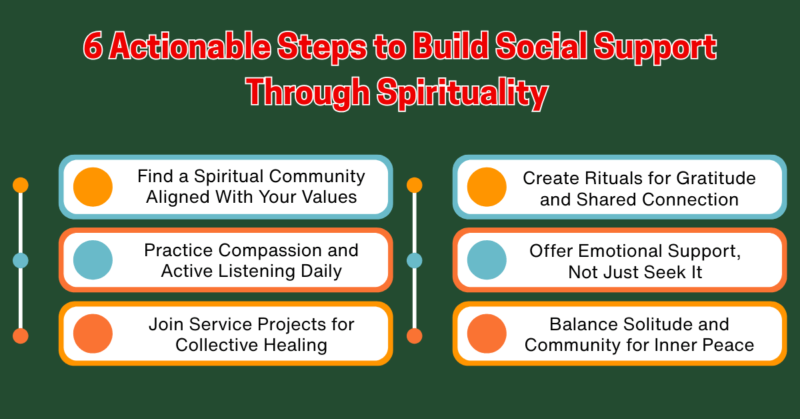
Step 1: Find a Spiritual Community Aligned With Your Values
Do not choose a community simply because it calls itself spiritual.
Look for a group where people treat one another with respect.
Ask:
- Do members listen to different perspectives?
- Are newcomers welcomed?
- Can you ask questions without being shamed?
- Do people help one another?
- Are boundaries respected?
- Does the group encourage healthy relationships with family and friends?
A healthy spiritual community should make room for dignity, compassion, and personal choice.
Step 2: Practice Compassion and Active Listening Daily
You do not need to wait for a spiritual gathering to practice connection.
Start with everyday conversations.
Put your phone away.
Listen without immediately interrupting.
Ask a follow-up question.
Notice when someone needs encouragement.
Avoid turning every conversation into advice.
Sometimes people need to feel heard more than they need a solution.
These simple behaviors can make spirituality visible in your relationships.
Step 3: Join Service Projects for Collective Healing
Look for opportunities to serve.
You could help at a community meal, charity project, educational program, food drive, or local support initiative.
Service has a double benefit.
You contribute to other people’s well-being while also creating opportunities to meet people who share your values.
You do not need to join a religious organization to volunteer.
Any community built around compassion and service can provide meaningful social connection.
Step 4: Create Rituals for Gratitude and Shared Connection
Rituals do not have to be complicated.
Try a weekly family gratitude practice.
Begin a shared meal with a moment of reflection.
Meet a friend for a weekly walk and meaningful conversation.
Create a regular meditation session with someone you trust.
The purpose is consistency.
Small repeated practices can become anchors in relationships.
Step 5: Offer Emotional Support, Not Just Seek It
A strong support system works in both directions.
If you always ask for help but rarely offer it, relationships can become unbalanced.
Ask people:
“How are you really doing?”
Remember important dates.
Check on someone who is grieving.
Celebrate another person’s progress.
Offer practical help when possible.
Sometimes a short message can remind someone that they matter.
Step 6: Balance Solitude and Community for Inner Peace
Spirituality often includes solitude.
Quiet reflection, prayer, meditation, journaling, or time in nature can help you reconnect with yourself.
But too much isolation can become a problem.
Aim for balance.
Spend some time alone to reflect and recharge.
Spend some time with people who make you feel respected and supported.
Healthy solitude can strengthen self-awareness.
A healthy community can strengthen belonging.
You need room for both.
What Experts and Research Say About Spirituality and Social Support
Psychology research on belonging, resilience, and faith community
Psychological research increasingly examines spirituality, religion, meaning, social relationships, and mental health together.
The evidence does not support a simple statement that spirituality always improves mental health.
Instead, researchers have found mixed associations depending on the type of spirituality or religious involvement, the population studied, relationship quality, and the outcome measured. A systematic review of religion and mental health noted both growing research interest and ongoing debate about the relationship.
Another systematic review examining neuroscience, spirituality, religion, and mental health concluded that the evidence is promising in some areas but that additional research and better measurement are needed.
This is why the strongest wellness message is not:
“Spirituality fixes mental health.”
It is:
“Meaningful spiritual practices and supportive communities may contribute to well-being for some people, particularly when they strengthen belonging, purpose, healthy coping, and social connection.”
Sociological insight: Shared values can strengthen interpersonal connection.
From a social perspective, communities become stronger when people have repeated opportunities to interact, cooperate, and support one another.
Spiritual communities can provide these opportunities through shared rituals, gatherings, celebrations, service, and mutual assistance.
The large longitudinal cohort study mentioned earlier found a particularly strong association between weekly religious-service attendance and social integration, alongside associations with purpose in life and several well-being measures.
The finding fits a simple social pattern:
Shared values → repeated interaction → relationships → support → stronger sense of belonging.
But this pathway is not unique to religion.
Sports teams, volunteer organizations, cultural groups, neighborhood associations, and other communities can create similar forms of social support.
Wellness Perspective: Why Connection Matters
From a wellness perspective, spirituality can be valuable because it gives people a chance to ask deeper questions:
What matters to me?
Who do I want to become?
How do I want to treat other people?
What gives my life meaning?
Those questions can influence relationships.
When personal values such as compassion, gratitude, service, forgiveness, and empathy become daily behaviors, they can create opportunities for stronger interpersonal connection.
The goal is not to collect spiritual practices.
The goal is to build a life in which your values, relationships, and actions support one another.
Spirituality and Social Support: A Simple Comparison
| Spirituality | Social Support |
|---|---|
| Focuses on meaning, purpose, values, and connectedness | Focuses on help, relationships, and belonging |
| Can be private or communal | Usually involves relationships with others |
| May involve prayer, reflection, meditation, or service | May involve emotional, practical, or informational help |
| Can exist without organized religion | Can exist without spirituality |
| Can encourage compassion and service | Provides opportunities to practice compassion and receive support |
| May strengthen a sense of purpose | Can strengthen belonging and resilience |
The two overlap when spiritual beliefs become part of a supportive community.
Final Takeaway on Spirituality and Social Support
The connection between spirituality and social support is not about spirituality automatically making someone healthier, happier, or more connected.
It is more nuanced.
Spirituality can give people meaning, purpose, compassion, gratitude, and connectedness. Communities can turn those values into shared experiences through friendship, service, rituals, emotional support, and practical help.
Research supports important links between religious participation, social integration, purpose, loneliness, and well-being, while also showing why we should avoid treating correlation as proof of causation.
The most useful lesson is simple:
Your spiritual life does not have to stay inside your own thoughts.
When your values lead you toward compassion, service, listening, gratitude, and meaningful relationships, spirituality can bridge inner wellness and community.
You can pray alone.
You can meditate alone.
You can reflect alone.
But you can also share your values, help someone through a difficult season, listen without judgment, serve your community, and allow others to support you.
That is where spirituality and social connection can meet.
And sometimes, that sense of belonging is one of the most meaningful forms of support we can give—and receive.
FAQs ON Spirituality and Social Support
Q. What are 7 signs that you are spiritually connected to someone?
- Unspoken understanding – You often know what the other person is thinking or feeling without them saying it.
- Instant comfort—Being around them feels naturally safe, calm, and familiar, even early in the relationship.
- Shared growth—You challenge each other to become better, more authentic versions of yourselves.
- Synchronicities—Meaningful coincidences, repeated numbers, or timing that feels “meant to be” surround your connection.
- Energy shifts – You feel energized or peaceful after time with them, rather than drained.
- Unconditional acceptance—You can be fully yourself without fear of judgment, and you offer the same to them.
- Sense of purpose—The relationship feels like it serves a larger purpose beyond romance or friendship, such as mutual healing or service.
Q. Why is spirituality important in social work?
Spirituality is important in social work because it is often a core part of a client’s identity, culture, and coping system. It can:
- Provide meaning, hope, and resilience during crisis.
- Shape values, family roles, and community ties.
- Offer practical support through faith communities.
- Help social workers practice culturally competent, holistic care.
- Guide ethical reflection and prevent burnout by connecting workers to their own sense of purpose.
Professional social work emphasizes client self-determination, so workers respect spiritual beliefs whether or not they share them.
Q. Does spirituality improve mental health?
Research suggests spirituality can improve mental health for many people, though it is not a substitute for professional treatment. Benefits may include:
- Lower rates of depression, anxiety, and substance misuse.
- Greater sense of purpose, gratitude, and optimism.
- Better coping with grief, illness, and trauma.
- Stronger social support through spiritual communities.
However, effects depend on the type of spirituality. Positive, supportive beliefs tend to help; rigid, fear-based, or shaming religious experiences can harm mental health. It works best alongside therapy, medication, and healthy lifestyle habits when needed.
Q. What are the 7 levels of spirituality?
Different traditions describe different levels, but a common modern framework includes:
- Survival/Ego-driven – Focus on safety, possessions, and personal control.
- Rule-based / Conformist – Identity comes from group, religion, or tradition.
- Questioning / Seeking – Doubt, exploration, and leaving inherited beliefs.
- Self-reflective / Inner work – Healing, mindfulness, and emotional awareness.
- Compassionate / Others-centered – Service, empathy, and universal love.
- Non-dual / Mystical – Sense of oneness with all life; less attachment to ego.
- Unity/Enlightenment—Sustained peace, wisdom, and presence; often described as full awakening.
These are not strict stages—people can move between them or experience several at once.
Q. What is the spiritual root of depression?
From a spiritual perspective, depression is sometimes linked to:
- Loss of meaning or purpose—feeling disconnected from what matters most.
- Unresolved grief or guilt—carrying shame, forgiveness blocks, or buried pain.
- Disconnection from self—ignoring one’s true needs, values, or calling.
- Disconnection from community—Isolation from supportive relationships or faith groups.
- Spiritual dryness—A sense of abandonment by God, the universe, or a higher power.
- Existential crisis—Questions like “Why am I here?” or “Does anything matter?”
Important: Depression is also a medical condition with biological, psychological, and social causes. A spiritual root may coexist with these, but it does not replace the need for professional assessment and care.
Q. How does spirituality affect the brain?
Spiritual practices and experiences can affect the brain in measurable ways:
- Meditation and prayer—Increase activity in prefrontal regions linked to attention, compassion, and emotional regulation; may reduce amygdala reactivity (fear and stress).
- Mindfulness—Strengthens grey matter in areas tied to memory, empathy, and self-awareness.
- Ritual and community—Trigger oxytocin and dopamine, supporting bonding, trust, and reward.
- Belief and meaning-making—Activate reward and meaning networks, which can buffer stress.
- Long-term practice—Associated with slower age-related cognitive decline and greater emotional resilience.
The brain is neuroplastic, so repeated spiritual practice can reshape neural pathways over time. Effects vary by person, tradition, and practice intensity.
Read more articles about health & wellness.
You might like to read: