Struggling with night shift sleep? Learn practical, science-backed strategies to rest better, feel energized, and stay productive, no matter your schedule.
This guide covers:
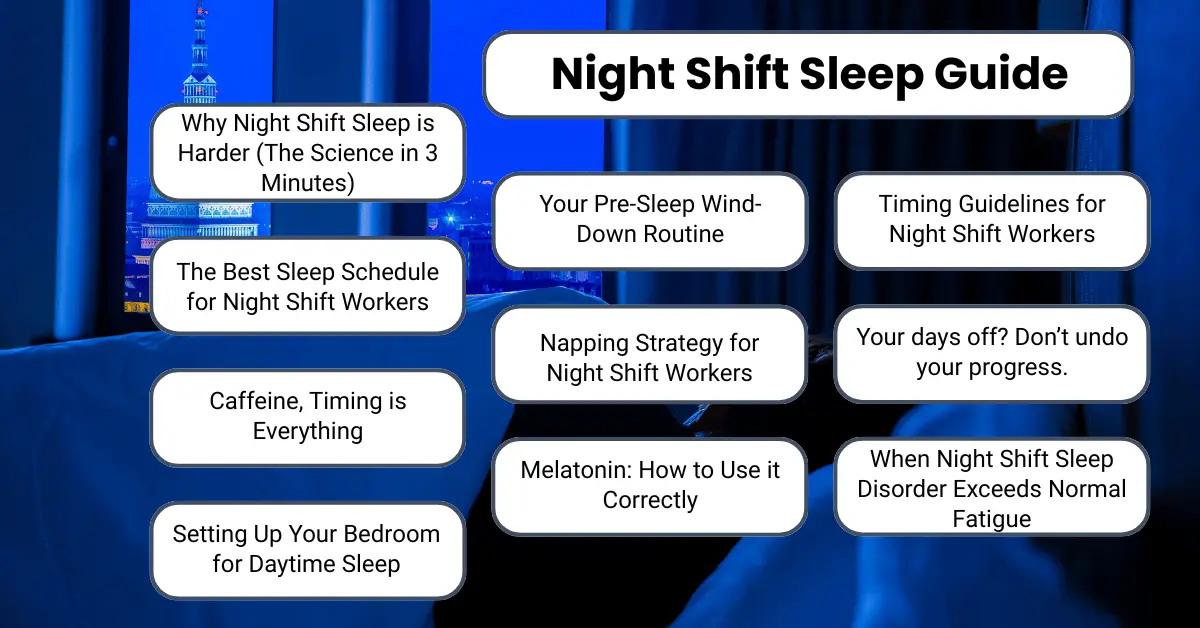
• Sleep schedules • Bedroom setup • Pre-sleep routines • Napping strategy • Melatonin • Days off • Shift work sleep disorder • Night shift meal plan • Quick-reference checklist

You just worked an exhausting 8- or 12-hour shift while the rest of the world slept. Your feet ache, your mind is racing with uncompleted tasks, and all you want to do is collapse into bed.
But as you pull into your driveway at 7:30 AM, the emotional reality hits you.
The morning sun is blindingly bright. School buses are rumbling down the street. Your neighbors are starting their lawnmowers, and your kids are loudly getting ready for school.
Your brain, fueled by leftover work adrenaline and a massive cup of coffee from 3:00 AM, is suddenly buzzing. You are utterly exhausted, yet completely wide awake.
If you’ve ever searched for night shift sleep, you’ve probably been hit with frustratingly generic advice. “Drink chamomile tea.” “Go to bed at the same time every day.” “Keep your room dark.”
When you work irregular hours, generic sleep hygiene doesn’t cut it. You don’t need platitudes; you need a tactical, minute-by-minute game plan.
This post offers a step-by-step night shift wind-down routine that starts before you leave work and ends when you fall asleep. It also accounts for what most competitors ignore:
- A minute-by-minute routine from drive home → front door → bedroom → sleep
- Different advice for 7 am vs 8 am vs 9 am shift finishers (daylight exposure changes the game)
- What to do when you can’t sleep after a night shift because you’re too “amped.”
- Real solutions for family/household noise (not just “tell them you’re sleeping”)
- A clear explanation of split sleep with example schedules you can actually follow
Not medical advice: If you have loud snoring, pauses in breathing, severe insomnia, depression/anxiety, or you’re relying on alcohol/sedatives to sleep, talk to your clinician. Shift work can also worsen underlying sleep disorders.
To fix your night shift sleep schedule, you first need to understand the biological warfare happening in your body when you clock out. Why is it so hard to fall asleep when you are so obviously tired?
It comes down to a clash between three powerful biological forces:
Why your brain won’t shut off after night shift (and why a routine matters)
After nights, your body is trying to sleep at the exact time when your biology is pushing you to wake up.
To fix your night shift sleep schedule, you first need to understand the biological warfare happening in your body when you clock out. Why is it so hard to fall asleep when you are so obviously tired?

It comes down to a clash between three powerful biological forces:
- Light suppresses melatonin. Morning daylight (even on a cloudy day) signals “wake time,” reducing melatonin and shifting your circadian rhythm later. Exposure to bright light soon after your shift can make it harder to sleep during the day.
- Cortisol and adrenaline can still be elevated. A busy shift can keep your stress hormones up. That “finally off” feeling often comes with a wired-but-tired crash that delays sleep onset.
- Adenosine timing is weird. Adenosine is the “sleep pressure” chemical that builds while you’re awake. If you’ve had caffeine late, bright light early, or a stressful final hour, the timing gets messy, and you may feel exhausted but unable to drift off.
Now let’s get practical.
Read it once, bookmark it, and refer back to the sections you need most.
Night Shift Sleep Guide:
Section 1: Why Night Shift Sleep is Harder (The Science in 3 Minutes)
Your body runs on a 24-hour internal clock called the circadian rhythm. This clock is primarily controlled by light, specifically the suprachiasmatic nucleus (SCN) in your brain, which detects light through your eyes and uses it to regulate hormones, body temperature, and alertness.
When it is light outside, your SCN suppresses melatonin (your sleep hormone) and raises cortisol (your alertness hormone).
When it is dark, the process reverses. This system evolved over millions of years to keep humans awake during daylight and asleep at night.
When you work nights, you are asking your body to override this system every single day.
The result: Research shows that, on average, night shift workers sleep 1.5 to 2 hours less per day than day workers.
A 2023 study published in Frontiers in Psychiatry analyzing over 37,000 workers found that night workers reported short sleep (6 hours or less) at 26%, compared to just 12% for day workers.
That statistic comes from a study published in Frontiers in Psychiatry on December 7, 2023, by researchers in the Netherlands and Belgium
Over time, this cumulative sleep debt impairs judgment, reaction time, and long-term health.
The good news is that your circadian rhythm is trainable. Not perfectly; full adaptation to a night shift is rare, but with the right strategies, you can significantly improve the quality and quantity of your daytime sleep.
Everything in this guide targets the same root problem: circadian misalignment. When you understand what you are fighting, the strategies make more sense and are easier to stick to.
Key insight:
Light is your main lever. Managing your light exposure before, during, and after your shift. It is the single most impactful thing you can do for your sleep as a night shift worker.

Section 2: The Best Sleep Schedule for Night Shift Workers
There is no single perfect schedule; the right one depends on whether you work permanent nights, rotating shifts, or an irregular pattern.
Here is what the research and occupational health guidelines recommend for each situation.
Permanent night shift
If you always work nights, the CDC’s NIOSH guidelines recommend sleeping as soon as you get home after each shift and keeping your sleep window as consistent as possible, including on days off.
This is the hardest part for most people. Flipping to a “normal” schedule on days off might feel more social, but it creates a constant state of jet lag that makes every work week harder.
The compromise approach (recommended by sleep scientists): On days off, stay up until 3–4 am and sleep until noon. This preserves a core overlap (8 am–noon) with your workday sleep window, so your body never has to fully readjust.
Rotating shifts
Rotating shifts are harder on the body than fixed nights because you never fully adapt. Forward rotation (days → evenings → nights) is significantly better for sleep quality than backward rotation.
Research shows backward rotation nearly doubles the odds of poor sleep quality.
When transitioning from nights to days, prioritize sleep immediately after your last night shift.
A short anchor nap in the morning, followed by an earlier bedtime that evening, helps realign your clock without creating a 24-hour stretch of wakefulness.
The split sleep option
Some night shift workers do better splitting their sleep into two blocks rather than one long stretch.
A common pattern is to sleep 3–4 hours immediately after the shift ends, then take another 3–4-hour block in the early evening before the next shift. This works particularly well for workers with family responsibilities during the day.
| Shift type | Main sleep window | Days off strategy |
| Permanent nights | Sleep immediately after shift (e.g., 7 am–3 pm) | Stay up until 3–4 am and sleep until noon |
| Rotating (forward) | Sleep after each shift and shift bedtime gradually | Gradual anchor nap → earlier bedtime |
| Split sleep | 3–4 hr after shift + 3–4 hr pre-shift nap | Maintain at least one consistent block |
| 12-hour shifts (3 on/off) | Sleep 7–8 hours after each shift | Keep the same sleep window on off days |
Critical warning: Never stay awake for 24+ hours before or after a block of night shifts. Research shows this dramatically increases accident risk and compounds sleep debt. Plan your transition; do not just push through.

Section 3: Setting Up Your Bedroom for Daytime Sleep
If you want to sleep after a 12-hour night shift, your bedroom must do more work than a normal bedroom. The goal is to remove the three biggest sleep killers for day sleepers:
- Heat (and comfort disruptions)
- Light
- Noise
1. Block light for day sleeping (non-negotiable)
This is your highest priority. A 2022 Northwestern University study found that even 100 lux of ambient light during sleep, the equivalent of a dim living room, raised heart rate, activated the sympathetic nervous system, and increased next-morning insulin resistance.
That result came from a single night of light exposure.
Your brain needs complete darkness to produce melatonin and maintain sleep quality. Any light source, even a small LED standby light or a gap in the curtains, can disrupt your sleep architecture without you even realizing it.
Daylight is the enemy of melatonin. You want your room to be “cave dark.”
Best → good → backup:
- Blackout curtains (top pick; easiest high-impact upgrade)
- Blackout liner + curtain rod wrap
- Sleep mask (great backup even if you have curtains)
If you’ve ever thought, “My curtains are dark enough,” test it: stand in your bedroom at 8:30 am and look toward the window. If you can see the window outline, your brain can “see” morning too.
- Invest in 100% blackout curtains (look for ones with a thermal liner, which also reduces heat in summer)
- Add blackout window film behind the curtains for any remaining gaps.
- Cover all LED indicator lights with black electrical tape.
- Use a contoured sleep mask as a backup, especially when traveling or in unfamiliar environments.
2. Temperature: Set it Colder Than You Think
Most people sleep best around 65–68°F (18–20°C). Day sleepers often fail here because the house warms up fast.
Tactics:
- Pre-cool the room before bed.
- Use a fan (also helps with white noise)
- Consider breathable bedding
Phone: set boundaries before you’re tired
- Turn on Do Not Disturb (allow emergency contacts only)
- Put your phone face down and out of arm’s reach.
- If you use your phone as an alarm, use a simple alarm screen (no notifications)
3. Noise: Go beyond “tell them you’re sleeping.”
Noise is the #1 struggle for people who sleep during the day with families, roommates, or in apartments.
Real-world solutions that work:
- White noise machine (or speaker plus white noise app). You want a consistent sound to mask sudden spikes (doors, voices, dogs).
- Door draft stopper to reduce hallway noise
- Soft-close pads for doors/cabinets
- Earplugs as a backup (especially for sudden impact sounds)

The family plan (scripts + rules that actually stick)
Don’t make it emotional. Make it a system.
House rule checklist:
- Quiet hours: “8:00 am–2:00 pm = Dad/Mom is asleep”
- No shouting through the door
- No loud appliances (vacuum, blender) until your wake-up time
- Designate a “loud zone” in the house (e.g., the living room) away from your bedroom.
Use a physical cue: a “Do Not Disturb—Night Shift Sleep Workers” door hanger sign. Print one and tape it up.
Quick script for older kids/roommates:
“When this sign is up, pretend it’s nighttime. If it’s urgent, text me. If it can wait, it waits.”

4. Eliminating interruptions
- Set your phone to Do Not Disturb mode, with only specific emergency contacts able to get through
- Turn off or silence all non-essential notifications.
- If you have children, arrange care or supervision so you are not on call during your sleep window.
- Do not check your phone if you wake briefly during sleep; light exposure and cognitive engagement make it significantly harder to fall back asleep.
Section 4: Your Pre-Sleep Wind-Down Routine
What you do in the 60 minutes before bed has a bigger impact on how quickly you fall asleep than most people realize.
The goal is to lower your cortisol levels, reduce light exposure, and signal to your brain that sleep is approaching.
The Drive Home (Start Your Wind-Down Before You Leave Work)
The biggest mistake night shift workers make is starting their wind-down routine after they walk through their front door.
1. Put on sunglasses before you step outside (yes, really)
It is the most commonly missed daytime sleep tip. Light is the strongest cue to your brain’s clock.
- If your shift ends at 7 am, daylight can already be intense in many seasons.
- At 8–9 am, light is usually stronger and more “alerting,” making it even harder to fall asleep later.
What to do: Keep a pair of dark sunglasses in your bag/locker and put them on before you walk to your car. Some people do well with blue-light-blocking sunglasses.
2. Don’t “scroll at red lights.”
Social media + news + texts = cognitive arousal. You’re telling your brain, “Stay engaged.” Save it for after you wake up.
If you need stimulation to stay safe while driving, use audio-only: a calm podcast or a familiar playlist (nothing that spikes emotion).
3. Avoid the drive-through heavy meal (most days)
A big, greasy meal can worsen reflux, raise body temperature, and disrupt sleep.
If you’re truly hungry, aim for a small, sleep-friendly bite you can digest easily (more on this in the routine).
For a full strategy, see Night Shift Meal Plan.

4. Keep coworker debriefs short
If your shift ends with a 20-minute adrenaline recap in the parking lot, your nervous system stays switched on.
Try this boundary line:
“I’m heading home to sleep—text me the details later if it’s important.”
5. The 15-minute decompression (before you enter your house)
This is simple and surprisingly effective.
When you arrive home, sit in your car for 10–15 minutes with sunglasses still on. Do nothing “productive.” Just let your heart rate come down.
If your mind is racing, try one of these:
- 10 slow breaths
- A quick voice note “brain dump.”
- A short “I’m safe, I’m home, shift is over” self-check
Then go inside.
Avoid heavy or greasy food during the commute. A large meal raises core body temperature and triggers digestion, both of which interfere with sleep onset.
Step 5: Your 30-minute pre-sleep night shift wind-down routine (minute-by-minute)
It is the routine you follow every single shift until it becomes automatic. The point is to create a predictable sequence that tells your brain: “We’re powering down now.”
The routine (example: you get home at 7:30 am)
Adjust the clock times to match your commute and shift end time.
0:00–0:03 — Enter quietly + keep lights low
- Don’t flip on bright overhead lights.
- If possible, use lamps or a dim hallway light.
0:03–0:06 — Change clothes immediately
Putting on “sleep clothes” is a psychological cue: the shift is over.
0:06–0:10 — Quick “brain dump” (optional but powerful)
Write 5–10 bullet points:
- What’s still stuck in your head
- What you must remember later
- One thing that went well (yes, one)
It reduces rumination, the biggest reason many people say they can’t sleep after a night shift.
0:10–0:15 — Light snack only if you’re truly hungry
Choose something small and boring:
- Yogurt + banana
- Oatmeal
- Toast + peanut butter
- Small protein snack
Avoid large meals, spicy food, and excessive sugar.
0:15–0:25 — Warm shower (or warm wash + pajamas if you’re exhausted)
A warm shower helps with thermoregulation: warming the skin triggers your body to dump heat afterward, and that drop in core temperature can support sleepiness.
(This mechanism is widely discussed in sleep medicine; see Sleep Foundation’s resources on temperature and sleep.)
Keep the bathroom lighting as low as you can safely manage.
0:25–0:30 — 5 minutes: “dim and boring” activity
Pick one:
- Read a physical book (easy, not gripping)
- Simple stretching
- A calm audio track with eyes closed
Avoid: phone scrolling, news, and intense videos. If you must use a screen, dim it all the way and use a warm color filter.
At 0:30 — In bed: lights out.
Your job now is not to “try hard” to sleep. Your job is to let sleep happen.

If you cannot fall asleep
The worst thing you can do is lie in bed frustrated for more than 20 minutes. This teaches your brain to associate the bed with wakefulness. Instead:
- Get up and go to a dim, quiet room.
- Do something boring and non-stimulating, like a word puzzle, light reading, or no digital devices.
- Return to bed only when you feel genuinely sleepy.
- Try progressive muscle relaxation: tense and release each muscle group, starting with your feet and working up. This activates the parasympathetic nervous system and has been clinically proven to reduce sleep-onset time.
- 4-7-8 breathing: inhale for 4 counts, hold for 7, exhale for 8. Repeat 4 times
Section 6: Napping Strategy for Night Shift Workers
Naps are a legitimate, evidence-based tool for night shift workers, but timing and duration matter enormously. The wrong nap at the wrong time will leave you more groggy and disrupt your main sleep block.
Nap durations: what the research says
- 20-minute nap: Boosts alertness and improves mood without entering deep sleep. Minimal sleep inertia (grogginess on waking). Best for a quick pre-shift energy lift.
- 90-minute nap: Completes one full sleep cycle, including REM sleep. You wake up between cycles, so grogginess is low. Research from Emergency Medicine Cases confirms this is the optimal pre-shift nap length.
- 30–60 minute nap: Avoid this range. These durations interrupt deep sleep (stage 3) and consistently produce significant sleep inertia on waking; you feel worse than before the nap.
When to nap
- Pre-shift: A 90-minute nap ending 30–60 minutes before your shift significantly improves alertness during work hours.
- Mid-shift (during break): A 20-minute nap if your workplace allows it. Even a brief rest reduces errors significantly in the second half of a shift.
- The coffee nap: Drink a coffee immediately before a 20-minute nap. Caffeine takes 20–30 minutes to absorb, so it kicks in exactly as you wake up. Many night-shift workers swear by this.
- After shift: A short 2–3-hour nap upon arrival home works well for the split-sleep approach. Avoid long naps (4+ hours) after a shift to maintain a consistent main sleep window.
Section 7: Melatonin, How to Use it Correctly
Many people take 5–10 mg and feel groggy or get vivid dreams without better sleep.
Evidence and clinical practice often support low-dose melatonin (0.5–1 mg) as a circadian “nudge” rather than a knockout pill. Take it 30–60 minutes before your planned sleep.
If you’re pregnant, on blood thinners, on immunosuppressants, or have epilepsy, check with your clinician.
Melatonin is one of the most misunderstood supplements on the market. Most people take far too much of it. Here is what the research actually says.
Timing is considerably more important if you’re attempting to change your routine earlier.
What melatonin does (and does not do)
Melatonin is not a sedative. It does not knock you out. It is a timing hormone that signals your brain that darkness has arrived and that it’s time to sleep. It shifts your circadian clock, rather than forcing sleep.
This means melatonin is most effective when taken at the right time, not in the largest dose. Research consistently shows that 0.5-1 mg is as effective as, and often more effective than, 5-10 mg doses.
High doses can cause grogginess the following day and may disrupt your natural melatonin production over time.
Timing for night shift workers
- Take 0.5–1 mg of melatonin 30–60 minutes before your intended sleep time.
- If your shift ends at 7 am and you plan to sleep at 8 am, take it at 7:15–7:30 am, before the morning light exposure has fully suppressed your melatonin.
- Do not take it if you wake mid-sleep to use the bathroom; at that stage, it will shift your clock in the wrong direction.
- Use it consistently for 1–2 weeks to help shift your rhythm, then taper off if possible. Long-term daily use is not well-studied.
A note on alcohol and “sleep aids.”
Alcohol can knock you out, but fragments sleep and reduce recovery. Many OTC sleep aids cause next-day grogginess (which is dangerous if you drive to your next shift). Use caution and get medical guidance if you’re stuck.
Note: Always consult your doctor before starting melatonin, particularly if you take other medications or have existing health conditions.
Section 8: Timing Guidelines for Night Shift Workers
You don’t need to quit caffeine. You need to time it.
Caffeine’s half-life varies, but a conservative cutoff prevents it from sabotaging your sleep.
Example: If you plan to sleep at 8:00 am, make your last caffeine intake 2:00–3:00 am.
If you’re ending at 9 am and aiming to sleep at 10 am, your last caffeine should still be around 4:00–5:00 am at the latest.
Tip: If you rely on caffeine late in the shift, reduce the dose rather than delay it. A smaller amount earlier beats a big hit late.
Caffeine is a legitimate tool for night shift workers when used strategically. The problem is that most people use it reactively, drinking coffee when they feel tired, rather than proactively at the right times.
- Caffeine has a half-life of 5–7 hours in most adults. This means half of a 200 mg cup of coffee (one standard mug) is still active in your system 5–7 hours later.
- Cut off all caffeine at least 5–6 hours before your intended sleep time. If you plan to sleep at 8 am, your last caffeine intake should be no later than 2–3 am.
- Use small, spaced doses rather than large single servings. 50–100mg every 2 hours is more effective at sustaining alertness than 300mg at the start of a shift.
- The 3 am wall is real; your circadian nadir (lowest alertness point) typically falls between 2 am and 5 am for most people. This is when a planned caffeine dose or a 20-minute nap has the most impact.
- Avoid caffeine on an empty stomach. It increases cortisol levels and can cause jitteriness, making subsequent sleep harder.
Section 9: What about on your days off? Don’t undo your progress.
The fastest way to make sleeping after a night shift harder is to switch to a daytime schedule on your days off, then flip back.
You have two workable strategies. Pick the one that matches your life.
Strategy 1: Stay mostly on a night schedule (best for permanent nights)
It protects your circadian rhythm.
Example:
- Workdays: sleep 8 am–3 pm
- Days off: sleep 2 am–10 am (a “compromise” schedule)
You still get daylight and social time, but you’re not asking your body to time-travel twice a week.
Strategy 2: Gradual shift (best for rotating shifts or occasional nights)
If you must be functional in the daytime on off-days:
- After last night’s shift, sleep a shorter block (e.g., 8 am–12 pm)
- Go to bed earlier that night (e.g., 11 pm–7 am)
- Before returning to nights, shift later in 1–2 steps.
It’s not perfect, but it’s less brutal than a total flip.
Social life without wrecking sleep:
Pick one daytime event, not three. Protect at least one core sleep block. If you “borrow” from sleep, pay it back with a planned nap, not random dozing.
Section 10: When Night Shift Sleep Disorder Exceeds Normal Fatigue
Being tired on the night shift is normal. But for some people, the sleep problems go beyond typical fatigue and become a clinical condition called shift work sleep disorder (SWSD).
Signs of SWSD
- Insomnia, consistent inability to fall or stay asleep during your designated sleep time
- Excessive sleepiness during your shift that does not improve with sleep
- These symptoms persist for more than 3 months.
- Significant impact on work performance, safety, or personal relationships
A 2025 review in the Scandinavian Journal of Work, Environment, and Health found that approximately 27% of shift workers meet criteria for SWSD.
If you recognize these symptoms, it is worth speaking with a doctor who has experience in sleep medicine or occupational health.
What can help with night shift sleep?
- Consistent application of all strategies in this guide is the first-line treatment.
- Light therapy, using a bright light box at the right time to reset the circadian clock
- Cognitive Behavioral Therapy for Insomnia (CBT-I), which has been adapted for shift workers and is available digitally
- In some cases, a doctor may prescribe a prescription wakefulness agent or sleep medication.
Do not self-medicate with alcohol. Alcohol may help you fall asleep initially, but it significantly disrupts sleep architecture, reducing the quality of the sleep you do get.
Should you sleep straight through or split your sleep?
A night shift sleep schedule is not one-size-fits-all. Most people do best with one of two options:
Option A: Straight sleep (best if your household is quiet)
You aim for one main sleep block right after work.
Example:
- In bed: 8:00 am
- Wake: 3:00 pm (7 hours)
It can work well if:
- You’re not a parent of young kids at home.
- Your environment is controllable (light + noise)
- You can protect that window consistently.
Option B: Split sleep (best if life keeps interrupting your day’s sleep)
Split sleep can be a game-changer if you’re constantly woken up.
Example split schedule (two-block):
- Block 1 (recovery nap): 7:30 am–10:00 am
- Block 2 (pre-shift core sleep): 6:00 pm–9:00 pm
It often works better if:
- You have school drop-offs, appointments, or unavoidable daytime noise.
- You feel groggy and miserable after one long daytime block.
- You’re on a rotating schedule and need flexibility.
The goal is still to get enough total sleep across 24 hours; split sleep just makes it easier to achieve.
Shift end time matters: 7 am vs 8 am vs 9 am (daylight changes your strategy)
Here’s a simple guide you can screenshot.
| The shift ends | Daylight risk | Drive-home rule | Target bedtime | Notes |
| 7:00 AM | Medium | Sunglasses and avoiding bright stops | 7:45–8:15 am | You can often get ahead of peak brightness |
| 8:00 AM | High | Sunglasses are mandatory | 8:45–9:15 am | Stronger light equals harder melatonin onset |
| 9:00 AM | Very high | Sunglasses minimize outdoor time | 9:45–10:15 am | Consider split sleep if afternoons are too short |
If you end at 9 am and try to sleep “straight through,” you may only get 4–5 hours before the day becomes loud/hot/bright. That’s where split sleep shines. For job-specific examples, see Best Sleep Schedule for Night Shift Workers.
The “too wired to sleep” problem: what to do when your brain won’t stop
It is the part most articles skip. The reality is sometimes you do everything “right”… and your body still feels like it’s vibrating.
That’s not a character flaw. It’s nervous system momentum.
Rule #1: Don’t wrestle with your bed for more than ~20 minutes
If you’re awake and frustrated, your brain starts pairing the bed with stress.
Do this instead:
- Get up
- Keep lights dim
- Do something boring (no phone scrolling)
- Return to bed when you feel sleepy again.
Technique 1: Progressive Muscle Relaxation (PMR) script (follow along)
It is especially good after physically tense shifts.
How to do it (about 6–8 minutes):
- Feet: tense for 5 seconds → relax for 10 seconds
- Calves: tense 5 → relax 10
- Thighs: tense 5 → relax 10
- Glutes: tense 5 → relax 10
- Stomach: tense 5 → relax 10
- Hands: tense 5 → relax 10
- Forearms: tense 5 → relax 10
- Upper arms: tense 5 → relax 10
- Shoulders: shrug up tense 5 → drop and relax 10
- Jaw: clench gently, tense 5 → relax 10 (let tongue rest)
- Eyes/forehead: squeeze tense 5 → relax 10
Your only job is to notice the difference between tension and release.
Technique 2: 4-7-8 breathing (fast “downshift”)
- Inhale through the nose for 4 seconds
- Hold 7 seconds
- Exhale slowly for 8 seconds
- Repeat 4 cycles.
If holding feels uncomfortable, shorten the hold. The principle is that a slow exhale equals more calm.
Technique 3: The “brain dump” that actually stops rumination
If your mind keeps replaying the shift, do this on paper:
Two columns:
- “Noted” (everything you fear you’ll forget)
- “Handled later” (things you can’t fix right now)
End with one sentence:
“I’ve captured this. I’m allowed to sleep now.”
It sounds simple; night shift workers consistently report that it reduces the “spinning” feeling because their brains stop trying to protect the information.
Night Shift Sleep Wind-down routine
Print this.
‘Quick-Reference Checklist: Night Shift Sleep Essentials‘ and stick it on your bedroom door.
Run through it on every workday until it becomes automatic.
For night shift sleep, before your shift ends:
- Cut off caffeine 5–6 hours before planned sleep time.
- Eat a light meal or snack, not a heavy one.
- Put on sunglasses before leaving work if it is already light outside
Do this (the “drive home → bed” sequence)
- Put on sunglasses before leaving work
- Keep driving calm (no scrolling, no intense news)
- Skip heavy drive-through meals (choose a light snack if needed)
- Sit in your car for 10–15 minutes to decompress before entering the house
- Keep home lighting dim
- Change clothes immediately
Optional: 3-minute brain dump - Warm shower (or quick wash)
- 5 minutes of dim, boring activity
Bedroom Setup: - Lights out, and if awake > 20 minutes: get up briefly, keep it dim, return sleepy
- Complete darkness: blackout curtains + sleep mask
- Room temperature 65–68°F / 18–20°C
- White noise machine or app running
- Phone on Do Not Disturb
- All LED lights are covered
Pre-sleep routine:
- Change out of work clothes immediately.
- Light snack if needed
- Warm shower
- 10 minutes dim-light activity (no screens)
- Melatonin 0.5–1mg if using (30–60 min before sleep)
- Into bed in a dark, cool, quiet room
Avoid this
- Bright morning sun in your eyes
- Doomscrolling in bed
- Big, greasy meal right before sleep
- Lying in bed, angry for an hour
- Flipping your schedule completely on days off (if you can help it)
If you cannot sleep:
- Do not lie there frustrated for more than 20 minutes.
- Get up, do something dim and boring, and return when sleepy.
- Try 4-7-8 breathing or progressive muscle relaxation.
FAQ on Night Shift Sleep
Q. How long does it take for the body to fully adjust to a night shift sleep schedule?
Adjusting your internal circadian rhythm to a night shift sleep routine typically takes 5 to 14 days of strict consistency. Because our biology is naturally wired to respond to sunlight, your body will resist daytime sleep at first.
You can accelerate this natural transition by mimicking a nighttime environment during the day, using heavy blackout curtains, lowering your bedroom temperature, and keeping your waking hours brightly lit with artificial light.
Q. What is the healthiest way to structure your night shift sleep on days off?
The healthiest approach to night shift sleep on your days off depends on your family dynamics, but the most biologically sound method is the “anchor sleep” strategy.
Instead of flipping your schedule entirely on weekends, which can cause a state of chronic exhaustion similar to permanent jet lag, try to sleep within at least a 4-hour “anchor” window that matches your workdays (for example, sleeping from 4:00 AM to 8:00 AM every day).
This keeps your master internal clock relatively stable while still giving you time in the afternoon to spend with family.
Q. Why do I feel so tired even after getting 8 hours of sleep on a daytime night shift?
Feeling chronically exhausted despite getting a full block of night shift sleep usually comes down to sleep quality, not quantity.
When you sleep during the day, your body naturally produces less melatonin (the sleep hormone) and higher levels of cortisol (the alertness hormone) because of ambient sunlight and daytime noise.
As a result, your brain spends less time in deep, restorative REM sleep. Focusing on a dedicated wind-down routine—like wearing blue-blocking sunglasses on your drive home—helps signal your brain to transition into a deeper, healing sleep state.
Q. Are there natural supplements that safely support deep, night shift sleep?
Yes, you can support your night shift sleep naturally without relying on heavy over-the-counter sleep aids. Herbal teas containing passionflower, chamomile, or valerian root are excellent for gently down-shifting a wired nervous system after a demanding shift.
Additionally, incorporating foods rich in magnesium glycinate (like pumpkin seeds or almonds) into your post-shift meal helps relax tight muscles and calm mind chatter, making it much easier to transition into a peaceful daytime rest.
Q. What is the 10-5-3-2-1 rule for night shift sleep?
A common version is a countdown to protect sleep quality:
- 10 hours before bed, no caffeine
- 5 hours, no heavy meals/alcohol
- 3 hours, stop work/serious tasks
- 2 hours, stop screens/bright light
- 1 hour before, start a wind-down routine.
For the night shift, anchor these times to your daytime bedtime.
Q. What is the 10-4-3-2-1 rule?
This is a tighter variation:
- 10 hours with no caffeine
- 4 hours with no big meals/alcohol
- 3 hours with no work or intense exercise
- 2 hours with no screens/bright light
- 1 hour for calming habits (shower, reading, breathing).
It’s meant to reduce stimulation in layers so your brain gets a clear “sleep is coming” signal.
Q. How to prepare a sleep schedule for the night shift?
Pick a protected main sleep block right after work (example: home at 7:30 pm, sleep 8:15 pm–3:00 am) and keep it consistent for at least 1–2 weeks.
Use sunglasses on the way home, block out sound and white noise in the bedroom, and set a caffeine cutoff 5–6 hours before sleep. If life interrupts daytime sleep, plan split sleep (short morning block + longer pre-shift block).
Q. How to sleep fast in 5 minutes with 4-7-8?
The 4-7-8 method is to inhale for 4 seconds, hold for 7, exhale for 8, and repeat for 4 cycles—this can quickly downshift your nervous system.
It won’t knock everyone out in exactly 5 minutes, but it often reduces “wired” feelings. If holding your breath is uncomfortable, shorten the hold and keep the exhale slow.
Q. Who sleeps for 90% of the day?
No healthy adult human sleeps anywhere near 90% of the day, but some animals come close—koalas can sleep around 18–22 hours (roughly 75–90%), and some bats also sleep most of the day. In humans, extreme sleepiness like that would be a medical red flag and needs evaluation.
Q. How do you sleep better as a shift worker?
Sleeping better as a shift worker begins with creating a quiet, dark, and cool bedroom.
To filter out distractions, use white noise, earplugs, or blackout curtains. Stick to a consistent sleep-wake routine, even on days off.
Avoid caffeine, large meals, and screens before bedtime. Try calming pre-sleep rituals, such as deep breathing or reading.
To minimize disruptions, let family members know your schedule. Make sleep a priority since it’s critical to your well-being and everyday functioning.
Q. How to focus immediately for a night shift sleep?
Reduce morning light exposure (sunglasses outside and minimal bright indoor lights), then keep your routine short and boring: bathroom, light snack only if needed, warm shower, and straight to bed.
Make the room cave-dark, cool, and quiet (blackout curtains + white noise). If you’re still awake after ~20 minutes, get up briefly and return when sleepy.
Q. How to fix sleeping patterns after a night shift?
Pick one target schedule and hold it for 1–2 weeks: a consistent bedtime/wake time, consistent light control, and a consistent caffeine cutoff.
On days off, don’t fully flip to “normal nights”—use a compromise sleep window so your body clock isn’t whiplashed. If you’re rotating shifts, shift your sleep in steps (naps + earlier bedtime) instead of abrupt switches.
Q. How to wind down after a night shift?
Start winding down before you leave work: put on dark sunglasses, keep the drive quiet, and avoid bright screens.
At home, go straight into a short routine, change clothes, take a warm shower, do 5–10 minutes of a calm activity in dim light, and then lights out. Consistency matters more than “perfect” sleep hygiene.
Q. How long does it take to adjust to night shift sleep?
Most people need 1–2 weeks to partially adjust, but full circadian adaptation may take longer and often doesn’t fully occur if you switch back on days off. Consistent light control, a fixed wind-down routine, and stable sleep times speed up adjustment.
Q. Is it bad to sleep during the day?
Day sleep isn’t “bad,” but it’s usually lighter and shorter because daylight suppresses melatonin and daytime noise disrupts sleep. That’s why blocking light for daytime sleep and using white noise matter.
Q. How do night-shift workers sleep with family?
You need a household system, not willpower: blackout the bedroom, use white noise, post a door sign, and set clear quiet hours. Plan one daily connection window (e.g., 3–5 pm) so family time doesn’t creep into sleep time.
Q. What is the best sleeping position after a night shift?
The best position for many people is the one that keeps their airway open and reduces pain, often side-sleeping.
If reflux is an issue after nights, left-side sleeping may help. If you have shoulder/hip pain, adjust by using a pillow between your knees.
Q. Do you know 5 common tips Dr. recommends about fixing your sleep naturally?
Yes—these are common clinician-backed basics.
(1) keep a consistent sleep/wake time
(2) get bright light exposure soon after waking
(3) Cut caffeine 5–6 hours before sleep
(4) keep the bedroom dark/cool/quiet
(5) Use a wind-down routine that lowers arousal (breathing, stretching, reading).
If you’ve tried these and still struggle, it’s worth screening for sleep apnea, restless legs, anxiety, or shift work disorder with a professional.
Night Shift Sleep: You’re not failing; your environment is just fighting you
If you’ve been thinking, “Why can’t I just sleep like a normal person?” It’s because your biology is being asked to do something genuinely difficult.
The fix isn’t perfect. It’s a repeatable routine that reduces light, lowers arousal, and protects your sleep window, whether you sleep straight through or use a split-sleep option.
Start tonight with the two highest-impact changes:
- Sunglasses on the drive home
- A consistent 30-minute wind-down you repeat every shift.
You’ll feel the difference faster than you think.
Read more about night shift worker health.
You might like: