
Learn how to stop negative self-talk using 5 proven mindset techniques. Discover psychology-based strategies to improve confidence, reduce stress, and build positive thinking.
Thank you for reading this post, don't forget to subscribe!Negative self-talk can feel like a quiet voice that follows you everywhere. It shows up when you make a mistake, try something new, or compare yourself with others.
Over time, this voice can slowly affect confidence, happiness, and even physical health.
The good news is that this voice is not permanent. With awareness and the right mindset techniques, it is possible to change how you speak to yourself. When your inner voice becomes supportive instead of critical, your thoughts become calmer and clearer.
We’ll look at how negative self-talk functions, why it occurs, and five effective strategies to stop it in this tutorial.

These methods are supported by psychological research and practical experience, and they can help you build a healthier, kinder relationship with your mind.
Quick Summary
Topic: How to Stop Negative Self-Talk
Estimated Read Time: 10–12 minutes
Negative self-talk happens when our inner voice becomes critical or discouraging. It often develops from past experiences, stress, or unrealistic expectations.
Over time, it can harm mental health, self-confidence, and motivation.
This article explains what negative self-talk is, why it happens, and how it affects the brain.
It also shares five proven mindset techniques from psychology and cognitive-behavioral therapy (CBT) to help change negative thinking patterns.
You will also learn the benefits of positive self-talk, common challenges people face while changing their mindset, and a simple checklist to help you practice healthier thinking every day.
Understanding Negative Self-Talk
Negative self-talk is critical, judgmental, or self-doubting. It often sounds like thoughts such as “I am not good enough,” “I always fail,” or “Everyone is better than me.”
Psychologists explain that these thoughts are part of our cognitive patterns. The brain tries to protect us from risk or disappointment, but sometimes it becomes overly critical instead of helpful.
Over time, repeated negative thoughts create mental habits. The brain begins to believe these thoughts even when they are not true. This is why learning to change these patterns is important for mental well-being.
Common Types of Negative Self-Talk
Negative self-talk can appear in several forms. One common type is catastrophizing, where the mind assumes the worst possible outcome. A small mistake suddenly feels like a complete failure.
Another type is personalization, in which people blame themselves for situations beyond their control. Someone might think, “The meeting went badly because of me,” even when many factors were involved.
A third pattern is all-or-nothing thinking, where things are seen as either perfect or terrible. This kind of thinking leaves little space for learning and growth.
Understanding these patterns helps people recognize that negative thoughts are not facts. They are simply habits that can be changed.
Why Negative Self-Talk Happens
Negative thinking does not appear randomly. It often develops from life experiences, social pressure, and emotional stress.
When people grow up hearing criticism or unrealistic expectations, they may begin to internalize those messages. The mind stores these experiences and later uses them as automatic thoughts.
Stress and anxiety also increase negative thinking. When the brain feels threatened, it becomes more alert to mistakes or possible failures.

Social comparison also plays a role. In a world filled with social media highlights, people often compare their everyday lives with others’ best moments.
Over time, these factors shape the inner voice. Without awareness, negative self-talk becomes a routine mental pattern.
How Negative Self-Talk Affects Mental Health
Negative self-talk is not just a small habit. Research in psychology shows it can strongly influence emotional well-being.
When people repeatedly criticize themselves, the brain releases stress hormones such as cortisol. High stress levels can increase anxiety, fatigue, and emotional exhaustion.
Negative thinking can also reduce motivation. When someone believes they will fail, they are less likely to try new opportunities.
In the long term, constant negative self-talk is linked with lower self-esteem and a higher risk of depression. It can also affect physical health because chronic stress weakens the immune system.
Learning to change this inner dialogue is therefore an important step for mental and emotional balance.
The Power of Positive Self-Talk
Positive self-talk does not mean ignoring problems or pretending everything is perfect. Instead, it means speaking to yourself honestly, with encouragement and compassion.
Psychologists often link positive self-talk to cognitive-behavioral therapy (CBT). This approach teaches people to challenge negative thoughts and replace them with balanced thinking.
When the inner voice becomes supportive, the brain begins to form new neural pathways. This process is called neuroplasticity, which means the brain can adapt and change through repeated practice.
Over time, positive self-talk improves confidence, emotional resilience, and decision-making. It helps people face challenges with calm and clarity.
5 Proven Techniques to Stop Negative Self-Talk
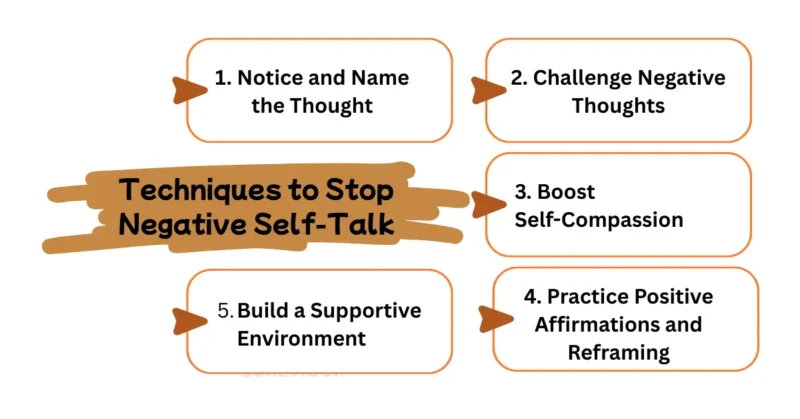
1. Notice and Name the Thought
The first step is awareness. Many people naturally have negative ideas without even recognizing them.
Start by listening to what’s going on inside your head while you’re under pressure. Take a moment to recognize any critical thoughts you hear.
For instance, tell yourself, “This is a negative thought,” rather than embracing the notion, “I am terrible at this.”
You are separated from the notion by this tiny step. It serves as a reminder to your brain that ideas aren’t necessarily true representations of reality.
Deep breathing or short reflection exercises can help increase this awareness.
2. Challenge Negative Thoughts
Once a negative thought is identified, the next step is questioning its accuracy. Many negative beliefs are based on assumptions rather than facts.
Ask yourself simple questions such as:
“Is this thought completely true?”
“What evidence supports or contradicts this belief?”
Often, you will realize the thought is exaggerated or unfair. For example, failing one task does not mean you always fail.
By analyzing thoughts logically, you weaken their emotional power. Over time, the brain learns to evaluate thoughts more realistically.
3. Boost Self-Compassion
Self-compassion means treating yourself with the same kindness you would offer a friend.
If a friend made a mistake, you would likely encourage them rather than harshly criticize them. The same principle should apply to your own inner voice.
Instead of saying, “I am useless,” try saying, “I made a mistake, but I can learn from it.”
Research by psychologist Dr. Kristin Neff, a leading expert in self-compassion, shows that people who practice self-kindness experience lower stress and greater emotional resilience.
Changing your tone toward yourself creates a healthier emotional environment in the mind.
4. Practice Positive Affirmations and Reframing
Positive affirmations are short statements that reinforce supportive beliefs. They help guide the mind toward constructive thinking.
Examples include statements such as “I am capable of learning new skills” or “I am improving every day.”
Reframing is another powerful technique. It means looking at a situation from a different perspective.
For example, instead of thinking “This challenge proves I am not good enough,” reframe it as “This challenge is helping me grow.”
Over time, these practices strengthen positive mental pathways and reduce the influence of negative self-talk.
5. Build a Supportive Environment
Our environment strongly influences our thinking patterns. Surrounding yourself with positive influences can reduce negative mental habits.
Supportive friends, mentors, or communities often encourage healthy perspectives. When self-doubt strikes, they can help you remember your strengths.
Limiting exposure to overly critical environments or negative social media comparisons can also protect mental well-being.
Creating a balanced environment helps reinforce positive thinking and emotional stability.
Benefits of Stopping Negative Self-Talk
When people learn to manage negative thinking, many areas of life begin to improve.
Confidence often increases because individuals trust their abilities more. This confidence encourages them to take healthy risks and pursue new opportunities.
Mental health also improves. Reduced negative thinking lowers stress levels and supports emotional stability.
Relationships can become stronger as well. People who practice self-compassion often communicate more kindly with others.
Over time, a supportive inner voice builds resilience. Instead of fearing failure, individuals view challenges as opportunities to learn.
Challenges People Face When Changing Their Mindset
Changing thought patterns takes patience. The brain has practiced negative thinking for years, so it cannot change overnight.
One common challenge is recognizing negative thoughts quickly enough. At first, many people notice them only after they have already influenced their emotions.
Another difficulty is consistency. Positive self-talk requires daily practice, and it may feel unnatural at first.
Some individuals also fear that self-compassion means lowering standards. In reality, research shows that supportive thinking actually improves motivation.
Understanding these challenges helps people stay patient with the process.
A Simple Daily Checklist for Healthier Thinking
Changing self-talk becomes easier when it becomes part of daily habits.
Begin the day with a positive intention or affirmation. This sets the tone for your mental environment.
Throughout the day, pause occasionally and notice your thoughts. If a negative pattern appears, gently challenge it and replace it with a balanced perspective.
Practice gratitude by reflecting on small positive experiences each day. This trains the brain to notice supportive thoughts.
Before going to sleep, review the day calmly. Instead of focusing only on mistakes, acknowledge what you learned and what went well.
Over time, these small habits reshape the inner dialogue.
Frequently Asked Questions
Q. What is negative self-talk?
The inner voice that questions or criticizes oneself is known as negative self-talk. It often includes thoughts such as “I am not good enough” or “I always fail.”
These thoughts may develop from past experiences, stress, or social comparison. Although they feel real, they are often distorted interpretations rather than facts. Recognizing them is the first step toward changing them.
Q. How to Quiet Negative Self-Talk in Seconds?
You can calm negative thoughts quickly by pausing and taking a slow, deep breath. This signals your brain to relax. Then say, “This is just a thought, not a fact.”
Shift your focus to something real around you, such as your breath or your surroundings. This breaks the loop of overthinking.
Even 10–20 seconds of awareness can reduce the intensity of negative thoughts.
Q. How to Stop Negative Self-Talk to Reduce Stress?
Start by noticing when negative thoughts appear. Do not fight them harshly; just observe them calmly.
Next, question the thought. Ask yourself if it is 100% true. Most of the time, it is not.
Replace it with a balanced thought like, “I am learning, not failing.” This reduces stress and builds emotional control.
Q. How Do You Stop Negative Self-Talk?
Stopping negative self-talk begins with awareness. You need to catch the thought first.
Then challenge it using logic and evidence. Replace it with a kinder, realistic statement.
With daily practice, your brain slowly changes its thinking pattern. Consistency is the key.
Q. What Are the 5 C’s of Negative Thinking?
The 5 C’s are common thinking traps people fall into. They include self-criticism, comparing yourself with others, catastrophizing outcomes, controlling everything, and frequent complaining.
These patterns create stress and reduce confidence.
Understanding these helps you recognize and break negative thought habits.
Q. What Are the 5 P’s of Self-Talk?
The 5 P’s focus on building positive self-talk habits. They include being present, patient, purposeful, positive, and persistent.
These principles guide your inner voice toward growth instead of fear.
Practicing them daily helps develop a calm and supportive mindset.
Q. What Are the 3 C’s of Negative Thinking?
The 3 C’s are cognitive distortions often seen in psychology. They are criticizing themselves, catastrophizing situations, and comparing themselves to others.
These habits make problems feel bigger than they really are.
Recognizing these patterns helps you correct your thinking.
Q. What Is the 3-3-3 Rule for Overthinking?
The 3-3-3 rule helps ground your mind in the present moment.
Name three objects you see, three sounds you hear, and three bodily parts you move while you look around.
This simple exercise shifts focus away from negative thoughts and reduces anxiety quickly.
Q. What Are the Top 10 Negative Emotions?
Common negative emotions include anger, fear, sadness, jealousy, guilt, shame, anxiety, frustration, loneliness, and disappointment.
These emotions are normal but can become harmful if they stay for too long.
Understanding them helps you manage them better instead of suppressing them.
Q. What Are 5 Ways to Control Negative Feelings?
First, pause and breathe deeply to calm your body.
Second, identify what you are feeling without judging it.
Third, challenge negative thoughts logically.
Fourth, talk to someone you trust.
Fifth, engage in a healthy activity, such as walking or journaling.
These steps help you process emotions rather than react impulsively.
Q. What Are Some Quick Mood Boosters?
Simple actions can quickly improve your mood.
Listening to music, taking a short walk, or drinking water can help instantly.
Gratitude also works well. Think of one good thing in your life.
Even a slight smile can trick your brain into feeling better.
Q. How to Stop Negative Self-Talk in Psychology Today?
In contemporary psychology, CBT (Cognitive Behavioral Therapy) in particular recommends recognizing negative beliefs and substituting them with constructive ones.
It also focuses on awareness and self-compassion.
Instead of fighting thoughts, you learn to observe and gently reshape them.
This approach is widely used by therapists and has been proven effective.
Q. How Can Negative Self-Talk Be Harmful?
Negative self-talk increases stress and anxiety. It lowers self-confidence and reduces motivation.
Over time, it can affect relationships and decision-making.
If left untreated, it can potentially result in mental health problems, including depression.
That is why changing your inner voice is very important.
Q. How to Quiet Your Mind?
To quiet your mind, focus on your breath. Slow breathing calms the nervous system.
You can also try mindfulness or short meditation.
Reducing distractions and limiting overthinking triggers also helps.
Even sitting quietly for a few minutes can reset your mental state.
Q. How to Shut Down a Negative Person in Psychology?
Stay calm and do not react emotionally. Set clear boundaries politely.
You can say, “I prefer positive conversations,” or change the topic.
Avoid arguing or trying to fix them.
Protecting your mental space is more important than proving a point.
Q. How to Destroy Negative Self-Talk?
You do not “destroy” it instantly, but you weaken it over time.
Replace harsh thoughts with compassionate ones consistently.
Practice awareness daily and challenge false beliefs.
Over time, positive thinking becomes stronger than negative patterns.
Q. What are the signs of a Negative Person?
A negative person often complains frequently and focuses on problems.
They may criticize others and expect the worst outcomes.
They rarely see positive aspects and drain energy from conversations.
Recognizing these signs helps you manage your interactions better.
Q. How to Remove Negative Personality?
Become conscious of your ideas and feelings first.
Try substituting empathy and understanding for criticism.
Be thankful and concentrate on finding solutions rather than issues.
Surround yourself with positive influences.
With time and effort, personality patterns can change.
Summary
Negative self-talk is a common mental habit that can affect confidence, emotional health, and motivation. It often develops from past experiences, stress, and social comparison.
Understanding how negative thinking works helps people recognize that these thoughts are not permanent truths. They are patterns that can be changed.
Five practical techniques can help reshape this inner dialogue. Awareness of thoughts, logical questioning, self-compassion, positive reframing, and supportive environments all help build healthier thinking patterns.
Although the process requires patience, consistent practice gradually strengthens positive mental pathways. Over time, the inner voice becomes calmer, kinder, and more encouraging.
Conclusion
Changing negative self-talk is not about forcing yourself to be positive all the time. It is about building a balanced, supportive relationship with your own mind.
When you treat yourself with understanding rather than harsh criticism, your thoughts become clearer and more constructive. Challenges begin to feel like opportunities for growth rather than proof of failure.
With awareness, patience, and the techniques discussed in this guide, anyone can gradually transform their inner dialogue. The journey may take time, but the reward is a healthier mindset and a more peaceful life.
A Quick Recap
The best way to quiet negative self-talk is to treat yourself with the same kindness you give others. Speak to yourself like a friend, not a critic. When negative thoughts appear, pause and check if they are actually true. Most of the time, they are not based on real evidence.
Try different affirmations and choose the ones that feel natural to you. What works for one person may not work for another, so give yourself space to explore. Also, take breaks from endless scrolling. Step away, move your body, or do something simple that brings you back to the present moment.
I’d really love to know what helps you shift your thoughts. What works for you when your mind feels heavy?
Read more articles on Health and Balance.
You might like: