

Night shift nutrition made simple: what to eat, when to eat it, and how to time caffeine and meals to avoid crashes and sleep better.
Quick Summary: The best night-shift nutrition strategy aligns your meals with your wake cycle, not the clock. Eat your largest, protein- and fiber-rich anchor meal before your shift starts; keep overnight eating between midnight and 6:00 AM light; hydrate steadily; and choose a small, gentle post-shift snack to support daytime sleep.
- Front-load your nutrition: Make your pre-shift meal your primary fuel source so overnight digestion stays light.
- Protect the midnight–6:00 AM window: Swap heavy, greasy meals for small protein-and-fiber snacks to avoid crashes and reflux.
- Hydrate and time caffeine smartly: Sip water early in your shift and follow a strict caffeine cutoff so daytime sleep stays deep.
Working overnight turns normal daily rhythms upside down, and that friction shows up fastest in how you eat. When your schedule runs from 7:00 PM to 7:00 AM, standard daytime advice like “eat three square meals” or “never eat after dark” falls apart almost immediately.
Most night shift workers end up caught in a frustrating cycle: skipping meals during busy hours, grabbing sugary snacks or heavy takeout at 2:00 AM to fight exhaustion, and climbing into bed with a restless stomach that ruins daytime recovery sleep. Over time, that mismatch leaves you feeling foggy, bloated, and perpetually drained.
You do not need a restrictive diet or complicated calorie math to feel steady on overnight shifts. Once you understand when your body handles food best, what foods keep blood sugar steady without weighing you down, and how to plan around real-world shift obstacles, eating well at night becomes simple and repeatable.
Editorial Note: For shift workers, this resource ‘Night Shift Nutrition’ offers general diet and lifestyle information. It is not medical advice; for individualized dietary recommendations, speak with a certified healthcare provider, especially if you manage conditions like diabetes, PCOS, or GERD.

The Main Issue: You Are Following Daytime Rules at Night
You eat oatmeal, salads, and grilled chicken, yet the scale climbs. Acid reflux attacks you at 4:00 AM. Sugar crashes hit during critical tasks, and you wake after daytime sleep feeling bloated, ravenous, and depleted.
The reason is simple: you have been following daytime nutrition rules in a nighttime biological context. Your pancreas, liver, and gastrointestinal tract operate on circadian clocks independent of your work schedule.
When you eat a “balanced dinner” at 2:00 AM, your body treats it as a metabolic insult, storing calories as visceral fat and triggering inflammatory responses that daytime workers never experience.
Your goal: give your body fuel when it can use it and protect sleep when it needs to recover.
What Should You Eat on Night Shift?
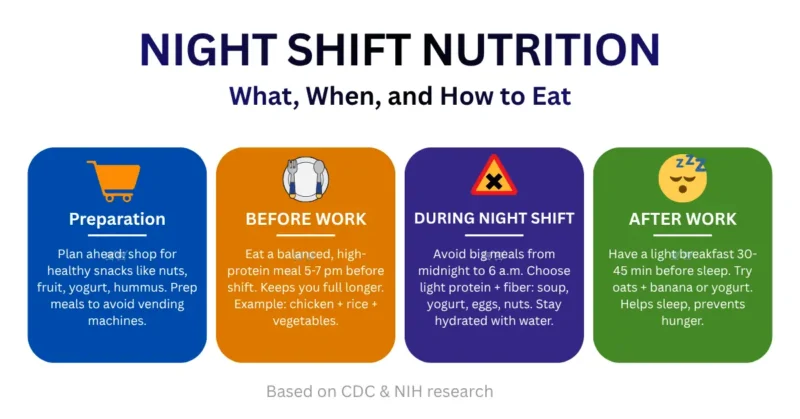
Eat your largest meal before your shift (5–7 PM). During the night, choose small protein-and-fiber combos, Greek yogurt with berries, vegetable soup, eggs, nuts, or a whole-grain sandwich.
Avoid big meals, sugar, and fried foods between midnight and 6 AM, and stop eating 2–3 hours before bed.
Why Your Body Struggles With Night Eating
Two key terms to understand:
- Circadian rhythm—your internal 24-hour clock that tells every organ when to be active.
- Circadian misalignment—when you eat, sleep, or work out of sync with that clock.
Research confirms that eating at night, when your body expects fasting, disrupts metabolism.
An NIH-funded Harvard study found that nighttime eating raised average blood glucose by 6.4% during simulated shift work, while restricting meals to daytime prevented this rise entirely.
Combined with decades of CDC guidance for nurses, the pattern is consistent: timing matters as much as food choice.
Common symptoms of circadian misalignment include bloating, heartburn, the 3 AM energy crash, unexplained weight gain, and poor daytime sleep.
The “3-2-1” Timing Framework
Use this as your daily anchor; adjust it to your shift hours.
- 3 = Three-part eating structure across the shift: pre-shift meal → mid-shift snack or meal → light end-of-shift option
- 2 = Two planned fuel points minimum, so you are never forced into random grazing
- 1 = One cutoff that protects sleep: stop caffeine 6–8 hours before your planned sleep time
When to Eat: Your Full-Time Night Shift Nutrition Guide

Pre-Shift Dinner (5:00–7:00 PM): Your Anchor Meal
This is your most important meal. Skipping it leads to overeating later, sugar and caffeine dependence, and shakiness during the first half of your shift.
Structure: 30 g protein + complex carbs + vegetables
Examples:
- Grilled chicken + brown rice + mixed vegetables
- Turkey wrap with salad + fruit.
- Eggs + oats + berries
Eat this 60–120 minutes before your shift starts.
Early-Shift Top-Up (9:30–11:30 PM)
A small snack if genuinely hungry, not a habitual snack. Keep it under 200 calories, protein-forward.
Midnight to 6 AM Window: The Critical Restriction
CDC guidelines specifically recommend avoiding or reducing food intake in this window. If you must eat, keep it to water, herbal tea, or a small protein snack under 200 calories. Avoid large meals entirely.
The 3 AM decision point, when sleepiness peaks and cravings spike, is where your pre-planning saves you. Have a dedicated snack ready so you don’t grab whatever is fastest.
Best 3 AM snacks:
- Greek yogurt + nuts
- Cottage cheese + berries
- Hummus + carrots + crackers
- Boiled eggs + fruit
- Tuna packet + crackers
- Edamame
Avoid at 3 AM: heavy, greasy meals; candy or pastries; and coffee alone without food.
If genuine hunger hits during the overnight slump, keep portions small and focus on easy-to-digest protein and fiber rather than a full meal.
For 15 ready-to-pack snack ideas, exact portion targets, and job-specific picks for nurses, drivers, and warehouse workers, read our dedicated guide on What to Eat at 3 AM: A Helpful Night-Shift Eating Guide.

Post-Shift Light Meal (7:30–8:30 AM): Sleep Cue
If you are going to sleep soon, choose a small carb-focused option rather than a heavy meal. Large meals worsen reflux and reduce sleep quality.
Good choices: oats with banana, warm milk with dates, yogurt with honey, and a small turkey sandwich.
Avoid: high-fat meals, spicy food, and large portions of anything.
At this stage, carbs help tryptophan cross the blood-brain barrier, supporting melatonin production and better sleep onset.
What to Eat: Building Your Night Shift Nutrition Plate

The 4 Pillars of Night Fuel: Night Shift Nutrition
1. Protein (20–30 g per meal)—slows digestion, stabilizes blood sugar, and reduces “I need sugar now” cravings.
Options: eggs, Greek yogurt, chicken, turkey, lentils, cheese, tofu, tempeh, edamame, tuna or salmon packets, and protein shakes.
2. Fiber-Rich Slow Carbs (Low-GI)—release glucose steadily, preventing spikes and crashes.
Options: oats, quinoa, brown rice, whole-grain bread, sweet potatoes, berries, apples, lentils, and beans.
Carbs that often backfire between 2 and 4 AM: candy, pastries, sugary cereal, sweet coffee drinks, and large portions of white bread or pasta without protein.
3. Hydrating Vegetables and Fruit—combats dehydration, which at night mimics fatigue and hunger.
Options: cucumber, vegetable soup, berries, oranges, watermelon, grapes.
4. Healthy Fats (Small Portions) — Support satiety without heaviness.
Options: almonds, olive oil, avocado, chia or flax seeds, salmon, and nut butters.
Timing note: Eat fats earlier in the shift. Large fat portions near bedtime can trigger reflux and nausea.
Eat This vs. Skip That for Night Shift Nutrition
| Vegetable lentil soup + crackers | Warm, hydrating, high fiber | Fried samosa + chai | Fat + caffeine = reflux and a crash. |
| Greek yogurt + blueberries + almonds | Protein + low-GI + melatonin support | Donut + energy drink | Sugar spike then sleepiness |
| Egg + wholegrain wrap | Portable protein | Instant noodles | Low fiber, high sodium |
| Hummus + carrots | Crunch without heaviness | Chips | Salt triggers thirst and fatigue |

Sample Meal Plans
12-Hour Shift (7 PM – 7 AM)
| 6:00 PM | Pre-shift dinner | Grilled chicken + brown rice + mixed vegetables | Anchor fuel |
| 10:30 PM | Light snack | Vegetable soup + 2 wholegrain crackers | Warm, under 200 cal |
| 3:00 AM | Hydration only | Water + mint tea | Avoid midnight eating |
| 7:45 AM | Post-shift | Oats + banana + 1 tbsp peanut butter | Carbs aid sleep |
8-Hour Shift (10 PM – 6 AM)
| 8:30 PM | Dinner | Daal + quinoa + salad |
| 1:00 AM | Snack | Greek yogurt + berries |
| 6:30 AM | Post-shift | Warm milk + 2 dates |
Rotating Shift
| Wake ~3 PM | Meal 1 | Eggs + roti + vegetables |
| 9 PM (pre-shift) | Meal 2 | Chicken wrap |
| After shift | Meal 3 | Small fruit bowl + yogurt |
Hydration and Caffeine
Hydration Rules
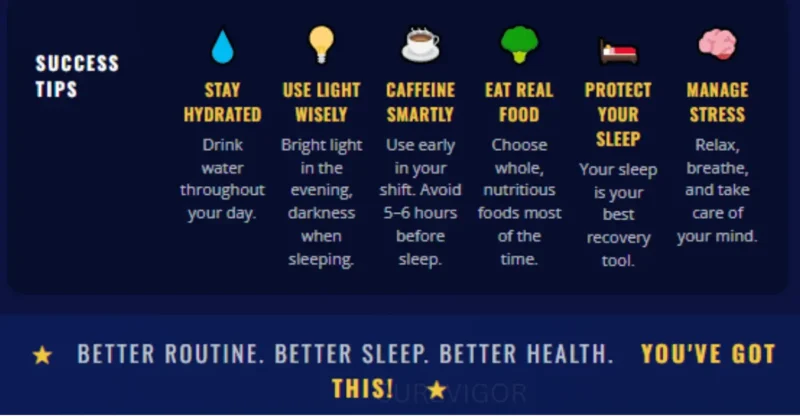
Dehydration feels like hunger at 2 AM. Fatigue, headaches, and cravings can all be dehydration in disguise, especially in dry indoor air or physically active roles.
- Start your shift with 500 ml of water.
- Drink 250–500 ml every 2 hours throughout the shift.
- Alternate each coffee with a glass of water.
- Add electrolytes if you sweat heavily (choose low-sugar versions)
- Target pale yellow urine, not clear, not dark
- Front-load hydration: too much fluid right before sleep causes frequent wake-ups
Caffeine Rules
Caffeine is useful but is also the most common reason daytime sleep falls apart.
Timing:
- 100–200 mg at the start of your shift (one coffee)
- Optional 50 mg top-up before midnight
- Zero caffeine after 3 AM
- Stop caffeine 6–8 hours before planned sleep (if sleeping at 9 AM, stop by 1–3 AM)
Because caffeine stays active in your bloodstream for hours, timing your last cup matters just as much as the amount you drink. Map out your exact shift schedule in:
The Best Caffeine Timing Strategies for Night Shift Workers, and find your safe stop time in What Is the Best Caffeine Cutoff for Night Shift Workers?
Coffee vs. Tea vs. Energy Drinks:
- Coffee: easy to dose; can irritate reflux in some people
- Tea: gentler stimulation, often easier on the stomach
- Energy drinks: combine high caffeine with sugar and acidity, commonly trigger jitters and GI symptoms, and worsen daytime sleep; avoid them
Pair caffeine with food. Caffeine on an empty stomach turns into anxiety, nausea, or reflux. A small protein snack, yogurt, nuts, or eggs, alongside coffee, prevents this.
Night Shift Nutrition for Weight and Blood Sugar

Night workers often gain weight not because they eat “badly” but because they eat during the biological night and sleep too little.
Practical steps:
- Keep your eating window to 10–12 hours, mostly in daylight.
- Make your pre-shift dinner the largest meal of the day.
- Avoid grazing between midnight and 6 AM.
- Walk 10–15 minutes after your pre-shift meal.
- Prioritize vegetables, fruits, whole grains, lean proteins, and low-fat dairy.
- Sleep 7–8 hours in a dark room; poor sleep raises hunger hormones more than any food choice
For blood sugar specifically: choose low-GI foods, keep overnight snacks small and protein-rich, and get regular health screenings. Long-term night-shift work is associated with higher rates of metabolic syndrome; consistent eating patterns are your best defense.
Struggling with mid-shift sluggishness or trouble concentrating after eating? Learn how simple food pairings steady your focus in How Simple Nutrition Tips Beat Fatigue and Brain Fog.

Special Scenarios
No Fridge or Microwave
Build your plan around shelf-stable and cooler-friendly foods: tuna or salmon packets, jerky (watch sodium), mixed nuts with dried fruit (small portions), whole-grain crackers, nut butter packets, roasted chickpeas, apples, bananas, oranges, and oatmeal cups if hot water is available.
A small insulated lunch bag is often the single biggest upgrade you can make.
12-Hour and Double Shifts
Long shifts need full structure: pre-shift meal → mid-shift meal → planned 3 AM snack → hydration strategy → light end-of-shift meal if sleeping soon. On doubles, prioritize steady protein and hydration so fatigue does not drive chaotic eating.
Healthcare Workers With Unpredictable Breaks
Pack for portability: two protein options (bar + tuna packet), two easy carbs (fruit + crackers), and one hydration option (water + electrolytes). This prevents the “nothing all night, then everything at once” pattern.
Rotating Shifts
Focus on structure rather than exact clock times: a meal before work, planned fuel in the middle, and something light before sleep. Your body responds well to predictable patterns even when your schedule is not.
Vegetarian and Vegan Workers
The same principles apply to plant foods. Excellent options: tofu or tempeh bowls, edamame, lentil salads, chickpea pasta with vegetables, hummus with whole-grain crackers, and chia pudding with protein powder. Check that plant-based yogurt alternatives contain adequate protein.
Diabetes, PCOS, and GERD
General strategies that often help: smaller, consistent meals; fewer high-sugar foods between midnight and 4 AM; avoiding heavy or fatty meals close to sleep; and tracking personal trigger foods. For medication timing or glucose targets, clinician guidance is essential.
Common Night Shift Nutrition Mistakes and the Fix
Even when you pack healthy food, a few subtle timing and habit traps can quietly drain your energy or disrupt your daytime recovery sleep. Correcting these six mistakes keeps your nutrition routine realistic and sustainable across demanding weeks:
- Copying a Daytime Eating Clock on an Overnight Schedule: Eating large, heavy meals between midnight and 5:00 AM forces your digestive system to work against your circadian rhythm, triggering sluggishness, bloating, and sharp blood sugar swings.
The fix: Front-load your nutrition with a substantial pre-shift anchor meal before clocking in, and keep overnight eating light. - Skipping Meals Until Exhaustion Hits: Pushing through the first six hours of a shift without eating can cause blood glucose to dip and lead to impulsive, oversized snacking later in the night.
The fix: Follow the 3-2-1 timing framework—plan a small early-shift top-up before genuine hunger or brain fog builds. - Walking Into a Shift Without a Backup Plan: Relying on workplace cafeterias or break-room vending machines at 2:00 AM almost always defaults to refined carbs, salty chips, and sugary snacks.
The fix: Keep a small emergency stash in your bag—unsalted nuts, roasted chickpeas, single-serve nut butter packets, or whole-grain crackers—so you never have to rely on vending-machine sugar. - Eating Heavy or Greasy Food Right Before Daytime Sleep: Going to bed on a full, heavy stomach increases reflux and fragments deep recovery sleep, leaving you exhausted for your next shift.
The fix: If you are hungry after clocking out, choose a small, gentle sleep-cue snack (such as plain yogurt, oats, or a banana with almond butter) at least 60 to 90 minutes before lying down. - Using Caffeine and Sugary Drinks Instead of Water: Mild dehydration can mimic hunger and mental fatigue, yet many shift workers reach for extra coffee or energy drinks instead of plain fluids.
The fix: Drink water steadily during the first two-thirds of your shift, taper fluids slightly before bedtime, and protect your recovery sleep by following What Is the Best Caffeine Cutoff for Night Shift Workers?. - Overcomplicating Your Meal Prep on Days Off: Trying to cook five elaborate recipes before a stretch of 12-hour shifts often leads to burnout and takeout by night three.
The fix: Prep modular building blocks—one batch of lean protein, one whole grain, and two washed vegetables—and keep quick overnight snack ideas handy from What to Eat at 3 AM: A Helpful Night-Shift Eating Guide.

Practical Strategy: How to Make This Stick
Prep on your day off:
Cook 2 soups, 2 proteins, and 1 grain base. Pack in glass containers. Rotate sauces and seasonings so meals feel fresh.
Pack a night kit:
A water bottle, 30g of nuts, fruit, yogurt, and one emergency protein bar with under 5g of sugar.
Set phone alarms:
Set alarms for 6 PM for dinner, 10:30 PM for a snack check, and 3 AM for water only.
Eat mindfully:
Step away from screens. Chew slowly; your gut is already slower at night.
Log for 3 nights:
Note energy at 2 AM and sleep quality. Adjust portion size, not timing.
Track 4 metrics on your phone:
- Energy at 1 AM / 3 AM / 5 AM (scale of 1–10)
- Cravings intensity (1–10)
- GI symptoms (none/mild/moderate/severe)
- Sleep quality after shift (1–10)
This makes your plan personally optimized within two weeks.
7-Day Night Shift Nutrition Reset
Days 1–2: Hydration + Protein
Bring a large water bottle. Add protein to every eating moment. Keep snacks simple and repeatable.
Days 3–4: Timing Consistency
Lock in your pre-shift meal time. Pack one dedicated 3 AM snack you actually enjoy. Reduce random grazing.
Days 5–7: Caffeine Cutoff + End-of-Shift Discipline
Set your caffeine cutoff based on your real sleep time. Replace heavy end-of-shift meals with lighter options. Track sleep quality changes.
Vending Machine Damage Control
Better picks: nuts, jerky, plain popcorn, low-sugar protein bars, peanut butter crackers, sparkling water.
Avoid candy bars as a main meal, large sugary drinks, and pastries without a protein backup.
If the vending machine is the only option, pair whatever carb you choose with a protein and drink extra water to reduce the crash.
Supplements: What the Research Actually Says
Note: Supplements such as melatonin, magnesium, and creatine interact differently with individual medications and health profiles. Always check with a qualified healthcare professional before starting any new supplement, especially if you manage conditions like diabetes, PCOS, or GERD.
Supplements are not a shortcut around poor sleep or bad timing.
But for night-shift workers specifically, emerging science shows that three supplements, melatonin, magnesium, and creatine, have meaningful, well-studied effects worth knowing about.
Here is what the research says, honestly.
Melatonin — The Most Studied Supplement for Shift Workers
Your body naturally produces the hormone melatonin at night to signal it’s time to sleep. The problem for night shift workers is that artificial light suppresses this production almost entirely, leaving the body without its natural recovery signal.
What studies show:
A 2024 meta-analysis found that melatonin reduces sleep onset latency by 10 to 20 minutes and increases total sleep time by 30 to 45 minutes in shift workers.
The evidence is stronger for workers on permanent night shifts than for those on rotating schedules, because rotating schedules allow no stable circadian adaptation. Superpower
A 2024 randomized, double-blind, placebo-controlled clinical trial assigned 72 shift workers with sleep disorders to either 5 mg of melatonin before daytime sleep or a matched placebo.
Results showed melatonin supplementation can significantly enhance sleep quality within just one week.
Cognitive function improvement, however, required four weeks, suggesting that shift workers can expect both short-term and long-term benefits from consistent supplementation. Wiley Online Library
Beyond sleep, a newer line of research has uncovered something more significant.
Normal nighttime melatonin production is suppressed in night-shift workers, which compromises the body’s ability to repair oxidative DNA damage, a byproduct of normal cellular processes, and heightens the risk of certain cancers. News-Medical
Researchers from the BC Cancer Research Institute and the University of British Columbia studied 40 night-shift workers in a randomized, placebo-controlled trial.
A 3 mg melatonin dose taken before daytime sleep raised DNA repair markers by 80%.
This was published in Occupational & Environmental Medicine in 2025 and is among the first trials to directly test whether melatonin can counteract a specific biological pathway linked to cancer risk in shift workers. Technology Networks
Practical guidance:
- Trial doses range from 0.5 mg to 5 mg.
- Take it before daytime sleep, not at the start of your shift.
- Timing matters as much as the dose itself.
- Melatonin does not fully reset your circadian rhythm, especially on rotating schedules; it supports sleep quality, not complete adaptation.
- If you are taking additional medications, managing a chronic condition, or are pregnant, consult a clinician.
Magnesium — Sleep Quality and Stress Reduction
Magnesium supports more than 300 enzymatic processes in the body, including modulating GABA, the neurotransmitter that promotes relaxation and lowers neuronal excitability.
Many adults, particularly those with disrupted sleep, are low in magnesium without knowing it.
What studies show:
A 2024 randomized, placebo-controlled study found that magnesium supplementation notably improved sleep quality and reduced stress levels compared with the placebo group over eight weeks. SCIRP
A 2024 randomized controlled trial on Magnesium L-Threonate found benefits in both objective and subjective sleep quality, along with improved daytime functioning.
Researchers noted that magnesium may regulate GABA, which promotes relaxation, and may enhance the brain’s capacity to adapt to emotional challenges and mitigate stress responses. AJMC
While observational research indicates a consistent relationship between magnesium status and sleep quality, interventional trials have shown mixed outcomes, according to a recent systematic review.
However, mounting evidence now suggests that magnesium supplementation can improve sleep outcomes, with several more randomized trials published in 2024. Taylor & Francis Online
Practical guidance:
- Magnesium glycinate and Magnesium L-Threonate are the forms most studied for sleep.
- Typically taken in the evening, before sleep.
- Effects are more pronounced in people who are already deficient.
- Results vary significantly between individuals; log your sleep quality over 3–4 weeks to gauge your personal response.
- Does not replace sleep timing; works best alongside a consistent post-shift sleep routine.
Creatine — Cognitive Protection During Sleep Deprivation
Creatine is widely known as a muscle supplement, but research is now documenting something equally important for night shift workers: its ability to protect brain function when sleep is insufficient.
What studies show:
Accumulating research indicates that creatine monohydrate can increase brain creatine stores, which may explain improvements in cognitive functioning, particularly during periods of metabolic stress, including sleep deprivation, mental fatigue, and hypoxia. Hapres.
Research published in Scientific Reports found that creatine helped prevent a decrease in brain pH, reducing cellular acidification during sleep deprivation.
Participants who took creatine experienced less fatigue and drowsiness than the placebo group, suggesting that creatine not only improves cognitive performance but also helps maintain alertness and reduces tiredness.
The effects on brain metabolism and cognitive performance were observed three hours after creatine administration, peaked four hours after administration, and lasted up to nine hours. ICNS Instituto
A follow-up study at lower doses found that creatine mitigated sleep deprivation-induced deterioration in logical and numerical tasks, language-related processing speed, and psychomotor vigilance, all functions critical to night-shift performance. MDPI
One study found that creatine supplementation preserved balance, cognitive performance, and mood during 24 hours of sleep deprivation.
The primary benefits observed were in brain-dependent tasks controlled by the prefrontal cortex, including reaction time, movement planning, and emotional state, which are especially meaningful for roles involving complex decision-making and workplace safety. Dr. Kumar’s Discovery.
Practical guidance:
- Researchers caution that the doses used in initial studies were very high (over 20g), which strains the kidneys and is not recommended for regular use. Only if future studies confirm the same cognitive benefits at significantly lower doses (around 5g) could creatine be routinely recommended for long work nights. Medical News Today
- Do not take a single dose the night before a shift and expect results; the brain needs time to build creatine stores.
- If you anticipate a demanding schedule, a loading phase planned a week in advance is the approach supported by current research
- Creatine monohydrate is the form with the most evidence.
- Always consult a clinician before starting, particularly if you have kidney concerns.
The Bottom Line on Supplements
| Melatonin | Faster sleep onset, longer daytime sleep, DNA repair | Before daytime sleep | Dose and timing are critical |
| Magnesium | Sleep quality, stress reduction, relaxation | Evening, before sleep | Results vary; choose glycinate or L-threonate. |
| Creatine | Cognitive protection during sleep deprivation | Requires loading phase in advance | High doses carry kidney risk; research ongoing |
All three supplements show genuine promise for night shift workers specifically. None of them, however, replaces the foundational work: consistent meal timing, hydration, a dark sleep environment, and protecting your sleep window.
Think of supplements as a tool to support that foundation, not a substitute.
Medical note: This section is educational only. Always confirm supplement use with a qualified clinician, especially if you are managing a chronic condition, taking medications, or are pregnant.
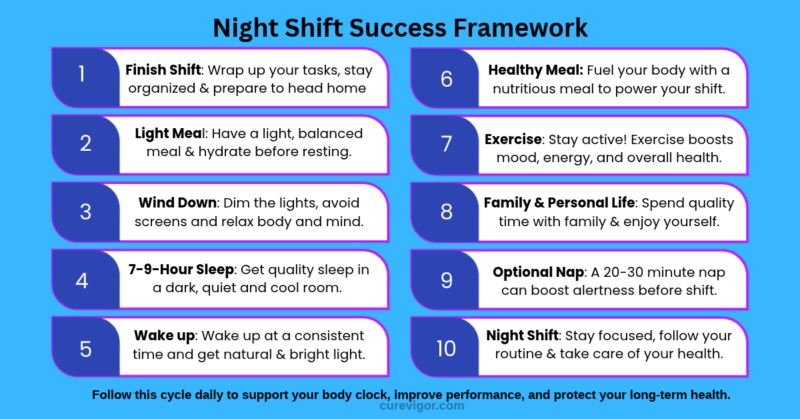
Night Shift Success Framework
Key Takeaways
- Your body digests best in daylight; respect the midnight-to-6 AM break.
- Front-load nutrition: big pre-shift meal, light early snack, minimal overnight eating
- Build every meal around protein, fiber, and water.
- Caffeine early, hydration always, sugar rarely
- A consistent 3-meal structure within a 10–12-hour window protects energy, sleep, and metabolic health better than any supplement.
- Consistency over 14 days matters more than perfection on night one.
FAQs on Night Shift Nutrition
Q. What is the single most important nutrition rule for night shift workers?
Aligning your largest meal with the start of your wake cycle, rather than eating heavily in the middle of the night, is the most impactful shift you can make.
Your body’s insulin sensitivity and digestive efficiency peak earlier in your waking hours and drop sharply between midnight and 5:00 AM. Eating a balanced, protein- and fiber-rich anchor meal before your shift provides steady fuel while keeping overnight digestion light and comfortable.
Q. How should night shift workers eat on their days off without upsetting their stomach?
Avoid swinging abruptly from overnight eating to three heavy daytime meals on your very first day off, as sudden schedule jumps often trigger bloating, sluggishness, and erratic hunger.
Instead, anchor your meals around a consistent three-to-four-hour spacing once you wake up from recovery sleep, keeping portions moderate and protein-focused.
Gradual meal-timing consistency helps your digestive rhythm stay settled across rotating workweeks.
Q. Why do night shift workers crave salty and sugary snacks more than day workers?
Working overnight disrupts circadian hormones that regulate appetite, temporarily raising hunger signals while lowering fullness cues; physical tiredness also drives the brain to seek fast energy from refined sugar and salt.
Mild dehydration from dry indoor air or extra coffee can also masquerade as sudden snack cravings.
Drinking water consistently and pairing lean protein with high-fiber foods earlier in your shift helps keep blood sugar steady and reduces late-night urges.
Q. Is it bad to eat at 3 AM during a night shift?
Eating a small, balanced snack at 3:00 AM is not inherently bad when you are awake and actively working, especially during a demanding 10- or 12-hour shift.
The real problem comes from eating large, heavy, or high-sugar meals in the middle of the night, when your circadian rhythm naturally slows digestion and insulin response.
Choosing a light, protein- and fiber-rich bite helps stabilize your energy and prevents intense hunger without overloading your stomach before morning rest.
Q. How much food should I eat at 3 AM without feeling sluggish?
Aim for a light snack portion of roughly 150 to 250 calories rather than a full dinner-sized plate. At 3:00 AM, your digestive tract processes heavy meals much more slowly, so large portions divert energy toward digestion and trigger post-meal drowsiness.
A small pairing, such as plain Greek yogurt with berries or a boiled egg with a few whole-grain crackers, satisfies genuine hunger while keeping you alert and comfortable on your feet.
Q. Does eating a small snack at 3 AM cause weight gain?
Weight gain is driven by overall daily calorie intake, chronic sleep loss, and hormone shifts, not the clock time of a single small snack.
However, night shift workers often gain weight because fatigue increases cravings for high-sugar vending foods and oversized late-night takeout. Keeping your 3:00 AM snack small, whole-food-based, and planned within your total daily intake supports steady weight management without leaving you deprived.
Q. Is it better to skip food completely between midnight and 6 AM?
If you ate a substantial, protein-rich anchor meal before your shift and feel physically comfortable, skipping food between midnight and 6:00 AM works well for many night workers. Giving your digestive system an overnight break aligns naturally with your body’s circadian rhythm.
That said, if genuine stomach hunger, lightheadedness, or physical labor leaves you drained around 3:00 AM, a small, protein-focused snack is far better than pushing through and overeating later.
Q. Are bananas and yogurt good choices for a 3 AM snack?
Yes, plain Greek yogurt paired with half a banana or a handful of berries is one of the easiest, most balanced 3:00 AM snacks you can pack.
Plain yogurt provides slow-digesting protein that steadies blood sugar, while fruit adds natural fiber, potassium, and gentle energy without a refined-sugar crash. Choose unsweetened yogurt whenever possible so added sugars do not trigger an energy dip an hour later.
Q. Can I eat hard-boiled eggs at 3 AM on a night shift?
Hard-boiled eggs are an ideal 3:00 AM food because they pack high-quality protein and healthy fats into a compact, easy-to-digest portion with zero added sugar.
One or two boiled eggs paired with cherry tomatoes, cucumber slices, or a small piece of fruit keeps you full through the final stretch of your shift. Prep and peel them before work so they are quick to eat during short breaks (just be mindful of shared break-room etiquette).
Q. How can I stop intense sugar cravings at 3 AM?
Intense 3:00 AM sugar cravings usually stem from circadian fatigue, mild dehydration, or skipping protein earlier in your shift, not a true sugar need.
Start by drinking a full glass of water, eating a planned protein-and-fiber snack before cravings peak, and taking a brief two-minute walk or stretch break. Keeping ready-to-eat savory snacks in your bag removes the temptation to rely on break-room candy or vending machines.
Conclusion on Night Shift Nutrition
Night shift nutrition is not about perfect discipline. It is about working with your biology, not against it. Eat with the sun when you can, fuel smart before midnight, and protect your sleep window.
Start with one change tonight: move your biggest meal to 6 PM and swap the 2 AM chips for a bowl of soup. Your energy at 4 AM will tell you it is working.
Safety note: This guide is educational only. If you manage a chronic health condition, consult a qualified clinician before making significant changes to meal timing or supplement use.
Read more about night shift workers’ health.
You might like: