

Struggling to unwind after a long shift? Discover the best relaxation techniques for shift workers to calm your mind, sleep deeper, and recover faster.
You finish your shift wired and exhausted at the same time. Your body’s begging for sleep, but your brain is replaying every difficult moment from the last 12 hours.
Knowing you have to return in a few hours, you lie in bed and stare at the ceiling. The more you attempt to unwind, the harder it seems.
If that’s your reality, you’re not alone, and you’re not broken. You just haven’t found the right tools yet.
Best Relaxation Techniques for Shift Workers That Work

Shift workers face a unique relaxation problem that day workers rarely understand.
Your nervous system is stuck in overdrive at the exact times it should be winding down, and “just relax” advice from the internet usually assumes you’re trying to sleep at a normal hour in a quiet house.
This guide breaks down the best relaxation techniques for shift workers, the ones that actually work when you’re trying to decompress at 8 a.m. while the rest of the world is starting its day.
These techniques have been tested by nurses, paramedics, factory workers, and pilots who needed real solutions, not generic wellness advice.
Why Shift Workers Need a Different Relaxation Playbook
Most relaxation advice was built for people winding down at 10 p.m. after a normal workday. For you, the rules are different. Your cortisol is firing when it shouldn’t be. The sun is rising as you’re trying to shut down.
Your neighbors are mowing the lawn while you’re trying to sleep. The standard “take a warm bath and read a book” advice doesn’t account for any of that.
Effective relaxation for shift workers has to do three things at once. It must calm your overstimulated nervous system.
It must signal to your body that it’s safe to rest, even when the environment says otherwise.
And it must create enough mental separation between work mode and rest mode for your brain to actually let go.
The techniques below were chosen because they hit all three.
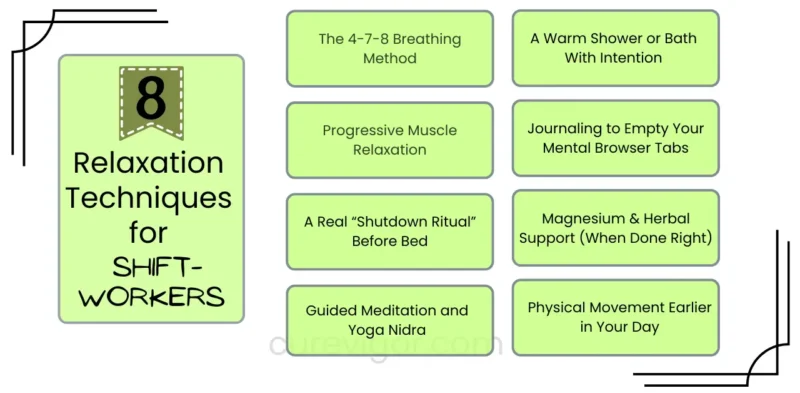
The 8 Best Relaxation Techniques for Shift Workers
Technique 1: The 4-7-8 Breathing Method
If you only learn one relaxation tool, make it this one. The 4-7-8 breathing technique, popularized by Dr. Andrew Weil, is essentially a manual override switch for your nervous system.
It works by activating your parasympathetic (“rest and digest”) response and overriding the sympathetic (“fight or flight”) mode that shift work keeps you locked in.
Here’s how to do it: inhale quietly through your nose for four seconds, hold it for seven, and then fully exhale through your mouth for eight seconds. Repeat the cycle four times. That’s it. The whole thing takes under two minutes.
What makes this so effective for shift workers is that it works fast and works anywhere, in your car before you start driving home, in the bathroom on a break, in bed when your mind won’t quit.
The extended exhale is the key. It physically slows your heart rate and tells your brain it’s time to stand down. Use it consistently for a week, and you’ll notice you can drop into a calmer state much faster than before.
Technique 2: Progressive Muscle Relaxation
After a long shift, your body holds tension in places you don’t even notice: jaw, shoulders, lower back, and hands.
Progressive muscle relaxation (PMR) is a technique in which you systematically tense and release each muscle group, helping your body recognize and release stored stress.
Start at your feet. Observe the difference after tensing the muscles for five seconds and then releasing them for ten. Move up to your calves, thighs, glutes, abs, hands, arms, shoulders, neck, and face.
The whole sequence takes 10–15 minutes and works best when done lying in bed right before sleep.
PMR is especially powerful for shift workers because it gives your busy brain something concrete to focus on.
Instead of fighting racing thoughts, you’re following a clear physical sequence, and by the time you reach the top of your head, most of your mental noise has dissolved on its own.
Many people fall asleep before they even finish the sequence, which, honestly, is the goal.
Technique 3: A Real “Shutdown Ritual” Before Bed
Your brain doesn’t switch from work mode to rest mode just because you walked through your front door.
It needs a clear transition, and the most effective way to create one is with a consistent shutdown ritual, a 20–30-minute sequence you do every single time before bed, in the same order.
A simple version might look like this: Take a warm shower to wash off the shift, change into clean sleep clothes, drink a glass of water, do 10 minutes of light stretching or PMR, dim the lights, and get into bed.
The specific actions matter less than the consistency. When you do the same sequence every time, your brain learns to associate it with sleep, and you start getting drowsy automatically by the end of the routine.
Avoid bringing your phone into the ritual. Scrolling resets your nervous system back to alert mode and undoes everything else you just did. Save it for the morning, or whatever your morning is.
Technique 4: Guided Meditation and Yoga Nidra
If you’ve tried meditation before and decided it wasn’t for you, give guided meditation, especially yoga nidra, a try, sometimes called “yogic sleep.”
Unlike traditional meditation, which asks you to clear your mind (impossible after a brutal shift), guided meditation gives you a voice to follow, which makes it dramatically easier when your brain is fried.
Yoga nidra, in particular, is designed for deep relaxation. You lie down, follow a recorded voice through a body scan and visualization sequence, and your nervous system drops into a state that’s nearly as restorative as sleep itself.
A 20-minute yoga nidra session has been shown in research to deliver benefits comparable to 2–3 hours of light sleep, making it a game-changer for shift workers operating on a sleep deficit.
Free options on YouTube, Insight Timer, and Calm work just as well as paid apps. Find a voice you don’t find annoying (this matters more than you’d think) and make it part of your wind-down routine 3–4 nights a week.
Technique 5: A Warm Shower or Bath With Intention
You’ve probably heard, “Take a warm bath before bed” a thousand times. What you may not have heard is why it works, which is the part that helps you do it right.
When you warm your body with hot water, blood flows to your skin. When you step out into a cooler room, your core temperature drops faster than it would naturally, and that sharp temperature drop is one of the strongest sleep signals your body knows.
Done right, a warm shower 60–90 minutes before bed can cut the time it takes you to fall asleep by 10 minutes or more and measurably improve sleep depth.
For a boost in aromatherapy, add a few drops of essential lavender or eucalyptus oil to the shower floor. Keep the lights dim. Skip the loud music.
Treat the shower as part of the wind-down, not just a chore. The 10 minutes you invest pay off in deeper, more restorative sleep for the next 6–8 hours.
Technique 6: Journaling to Empty Your Mental Browser Tabs
A huge part of post-shift insomnia is unprocessed mental load. The conversations you wish had gone differently, the patient or customer you can’t stop thinking about, and the to-do list for tomorrow that won’t leave you alone.
Writing it down, physically, with pen and paper, gets it out of your head and onto the page where it can wait until later.
You don’t need to journal beautifully. A simple “brain dump” works: spend 5–10 minutes writing whatever comes to mind. Worries, frustrations, plans, random thoughts.
When you’re done, close the notebook. The act of externalizing your thoughts gives your brain permission to stop holding on to them.
If you want structure, end your journaling session by writing three things that went well during the shift, no matter how small.
Gratitude practice has solid research supporting its role in reducing anxiety and improving sleep quality, and shift workers tend to benefit even more than the general population because their jobs rarely offer built-in moments of reflection.
Technique 7: Magnesium and Herbal Support (When Done Right)
This isn’t exactly a relaxation technique, but it amplifies all the others. Many shift workers run low on magnesium, a mineral that plays a direct role in muscle relaxation, nervous system regulation, and sleep quality.
A magnesium glycinate or magnesium L-threonate supplement taken 30–60 minutes before bed can soften the edge of post-shift tension and help you drop off faster.
Herbal teas like chamomile, valerian root, passionflower, and lemon balm have mild calming effects backed by modest research.
They won’t knock you out, but as part of a wind-down ritual, they reinforce the “we’re done now” signal you’re trying to send to your body.
Skip anything with caffeine, and check with your doctor before adding supplements if you take any medications.
Technique 8: Physical Movement Earlier in Your Day
Counterintuitively, one of the best relaxation tools for shift workers happens hours before bedtime. Regular exercise, even 20–30 minutes of walking, yoga, or light strength training, dramatically improves your ability to relax later.
It burns off excess stress hormones, regulates your nervous system, and creates the kind of physical fatigue that makes mental relaxation easier.

The timing matters. Hard workouts within 2–3 hours of your target sleep time can backfire by raising core body temperature and adrenaline levels.
Aim for movement earlier in your wake window, and save your wind-down hours for gentler practices like stretching or restorative yoga.
How to Build Your Personal Relaxation Stack
You don’t need all eight of these techniques. You need 2–3 that work for your life and that you’ll actually do consistently.
A common stack that works well for shift workers looks like this: a warm shower, 10 minutes of progressive muscle relaxation in bed, and a few rounds of 4-7-8 breathing if your mind is still racing. Total time: about 20 minutes. Total impact: significant.
Try one technique at a time for a few days before adding another. The goal isn’t to build a perfect routine overnight; it’s to find what genuinely calms your nervous system and stick with it long enough to feel the compound benefit.
When Relaxation Techniques Aren’t Enough
If you’re consistently using relaxation techniques and still struggling with severe insomnia, persistent anxiety, panic attacks, or symptoms of depression, please talk to a doctor or mental health professional.
Shift work takes a real toll on mental health, and there’s no shame in needing additional support.
Particularly for shift workers, cognitive behavioral treatment for insomnia (CBT-I) has substantial evidence, and many therapists now provide virtual sessions that accommodate unconventional schedules.
You’re not weak for needing help. You’re working against your biology; recognizing when you need more than self-help tools is itself a strength.
FAQs: Relaxation Techniques for Shift Workers
Q. What’s the fastest relaxation technique I can use right after a shift?
The 4-7-8 breathing method takes under 2 minutes and can be done in your car before driving home.
It’s the quickest way to shift your nervous system out of work mode and into a calmer state, without needing any equipment or privacy.
Q. How long should my wind-down routine actually be?
Aim for at least 20–30 minutes. Less than that usually isn’t enough to fully transition your brain out of work mode, but more than 45 minutes tends to feel like a chore and gets skipped. Consistency matters more than length.
Q. Can meditation really help if my mind is constantly racing after work?
Yes, especially guided meditation or yoga nidra. The recorded voice gives your busy brain something specific to follow, which is much easier than trying to “clear your mind” on your own. Most shift workers see noticeable benefits within 1–2 weeks of consistent practice.
Q. Is alcohol a good way to relax after a shift?
It feels like it works, but it actually fragments your sleep and increases anxiety over time. Occasionally, a glass is fine; relying on it nightly will worsen your overall stress, sleep quality, and long-term health. Better tools deliver better results without the rebound effects.
Q. Should shift workers try CBD or melatonin for relaxation?
Both can help some people, but they should be approached carefully. Low-dose melatonin (0.3–0.5 mg) taken at the right time can support sleep, while CBD has more variable effects.
Always check with your doctor first, especially if you take medications or have health conditions.
Q. What if I have only 10 minutes to unwind before sleep?
Stack the highest-impact techniques: 5 minutes of 4-7-8 breathing followed by 5 minutes of progressive muscle relaxation focused on your shoulders, jaw, and hands, the areas that hold the most shift-work tension. It’s short but surprisingly effective when done with focus.
Recap on the Best Relaxation Techniques for Shift Workers
Relaxation isn’t optional for shift workers. It’s survival gear.
Here’s what we covered:
- 4-7-8 breathing to flip your nervous system out of overdrive
- Progressive muscle relaxation to release the tension you didn’t know you were holding
- A consistent shutdown ritual to signal your brain that work is over
- Guided meditation or yoga nidra to quiet a racing mind
- Warm showers to trigger your body’s natural sleep drop
- Journaling to empty your mental clutter onto the page
- Magnesium and herbal support to amplify everything else
- Earlier-in-the-day movement to burn off stress hormones before bed
You don’t need all eight. Pick two or three. Build them into a routine you’ll actually repeat. Stay consistent for a few weeks. That’s where the magic happens: better sleep, steadier mood, real energy.
Final Thoughts on the Best Relaxation Techniques for Shift Workers
Shift work will always push your body and mind harder than a regular schedule. You can’t change that. What you can change is how well you recover between shifts.
The right relaxation techniques don’t just help you sleep better tonight; they protect your long-term health, mood, and energy for years to come.
Small habits, repeated consistently, are what separate the shift workers who burn out from the ones who thrive.
Call to Action
Don’t try to overhaul your entire routine tonight. Pick one technique from this list; the 4-7-8 breathing is the easiest place to start, and commit to using it after every shift this week.
Pay attention to how your body responds. Then add a second technique next week and a third the week after.
Within a month, you’ll have a personalized wind-down ritual that actually works for your schedule and your nervous system.
Share this guide with a coworker who needs it, and explore our related posts on shift-worker sleep, energy, and long-term health to keep building habits that protect you for the long haul.
Read more about night shift workers’ health.
You might like: