

Does every day feel like a repeat of chores? Break the ‘Groundhog Day’ cycle with 7 powerful mindset shifts to reclaim your energy, find your ‘Why,’ and restore life balance.
Thank you for reading this post, don't forget to subscribe!Stop feeling stuck and start living with purpose today.
Some days feel heavier than they should. You wake up, follow your routine, and move from one task to another. Yet even simple chores feel exhausting.
At a Glance: How to Reclaim Your Spark
- The Problem: You aren’t lazy; you’re experiencing Executive Dysfunction or Burnout. When tasks lack meaning, your brain treats them as a threat.
- The Goal: Shift from “survival mode” to “intentional living” by changing your internal dialogue.
- Key Takeaways:
- Prioritize Meaning: Ask why it matters, not just what to do.
- Lower the Bar: “Done” is better than “Perfect.”
- Protect Your ‘Margin’: Build small breaks into your day to recharge your mental battery.
- Address the Root: Check if ADHD, stress, or lack of novelty is the true cause of your fatigue.

The Quiet Weight of “Just Getting Through the Day”
Some days feel heavier than they should. You wake up, follow your routine, and check off tasks. Yet nothing feels satisfying.
Even simple things like answering messages or making tea feel like work.
This feeling is often called the “Groundhog Day effect,” inspired by the movie Groundhog Day. Every day looks the same.
Nothing feels new. Over time, your mind starts to resist even normal tasks.
You may think you are lazy or unmotivated. But that is rarely true. Most of the time, your brain is tired, not broken. You are not failing at life. You are just stuck in a loop that needs a small shift.
This guide will help you change how your life feels. You do not need a new life. You need a new way to see and manage the one you already have.
Why Life Starts Feeling Like a Chore
When everything feels like a chore, it is not about the tasks. It is about your mental and emotional energy.
Your brain is designed to seek meaning and reward. When those are missing, even easy tasks feel hard.
One reason is mental overload. You may be doing too many things without rest. Another reason is emotional fatigue.
You keep going, but nothing feels rewarding anymore. This creates a silent kind of burnout.
Experts like Christina Maslach explain burnout as emotional exhaustion, detachment, and low motivation.
You may not notice it at first. But slowly, everything starts to feel like a burden.
This is not a sign of weakness. It is a signal. Your mind is asking for change, not pressure.
7 Mindset Shifts That Will Change Your Life Forever
When everything feels like a chore, the solution is not to force more discipline. It is to change how you see and approach your daily life.
These mindset shifts help you reduce mental weight, restore energy, and make even simple tasks feel lighter and more purposeful.
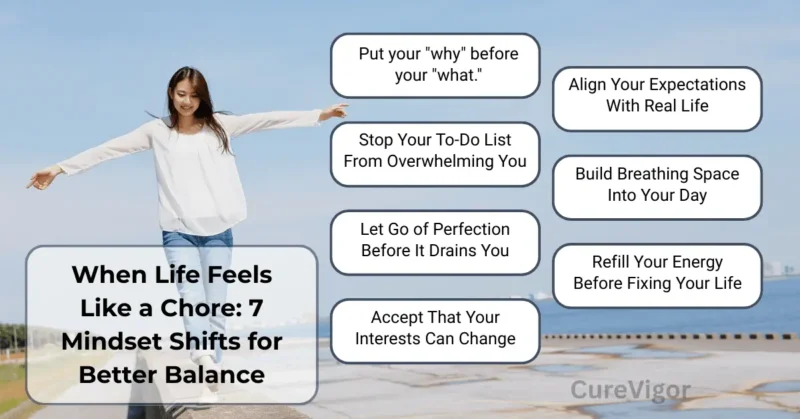
They are small changes, but together, they can completely transform how your day feels.
1. Put your “why” before your “what.”
When your life feels like a list of chores, it often means you have lost connection with your purpose. You are doing things, but you no longer remember why they matter.
Your brain needs meaning to stay engaged. Without meaning, even success feels empty. This is why people can achieve goals and still feel stuck.
Try this simple shift. Instead of asking, “What do I have to do today?” ask, “Why does this matter to me?” Even small answers help.
Cooking becomes caring for your health. Working becomes supporting your future.
This idea is similar to what Viktor Frankl taught. When you find meaning, you can handle almost any task. Meaning turns pressure into purpose.
2. Stop Your To-Do List From Overwhelming You
Many people overload their to-do lists. They write down everything, then expect themselves to finish it all. This creates silent stress before the day even begins.
Your brain sees a long list as a threat. It triggers avoidance. That is why you feel tired before starting anything.
Instead, choose fewer tasks. Focus on what truly matters today. Let the rest wait. This does not make you lazy. It makes you realistic.
You are not a machine. You are a human with limits. When you respect your limits, your energy returns.
3. Let Go of Perfection Before It Drains You
Perfection feels like a good goal. But in real life, it often becomes a trap. You delay tasks because you want the perfect result. Or you feel unhappy even after doing your best.
Perfection creates pressure. Pressure removes joy. Over time, this turns every task into a chore.
Psychologist Brené Brown explains that perfection is not about excellence. It is about fear. Fear of mistakes, judgment, or failure.
Try this shift. Aim for progress, not perfection. Done is better than perfect. When you allow small mistakes, your work feels lighter. You move faster. You feel freer.
4. Accept That Your Interests Can Change
You are not the same person you were last year. Your interests, goals, and energy levels change over time. But many people force themselves to continue things that no longer feel right.
You may keep doing something just because you started it. This creates inner conflict. Part of you wants to move on. Another part feels guilty.
Letting go is not failure. It is growth. When something no longer fits your life, it is okay to let it go.
This idea connects with the concept of a growth mindset, developed by Carol Dweck. Growth means adapting, not staying stuck.
When you allow change, your life feels more alive. You stop dragging yourself through tasks that no longer matter.
5. Align Your Expectations With Real Life
Sometimes the problem is not your effort. It is your expectations. You expect yourself to be productive, happy, focused, and successful every single day.
This is not realistic. Life has ups and downs. Your energy will change. Your mood will shift. That is normal.
When your expectations are too high, everything feels like failure. Even a normal day feels like a bad one.
Try a small shift in language. Replace “I have to do this” with “I get to do this.” This changes how your brain sees the task. It moves from pressure to opportunity.
This does not mean ignoring challenges. It means seeing them in a balanced way.
6. Build Breathing Space Into Your Day
A full schedule may look productive. But it often leads to exhaustion. When your day has no breaks, your mind never resets.
You need space between tasks. This space is called “margin.” It enables your brain to recuperate and rest.
Without margin, even small tasks feel overwhelming. With margin, the same tasks feel manageable.
Take short pauses. Step away from your screen. Sit quietly for a few minutes. These small breaks improve your focus and mood.
Think of your energy like a battery. You cannot keep using it without charging it.
7. Refill Your Energy Before Fixing Your Life
When everything feels like a chore, your first instinct may be to fix your routine. But the real issue is often low energy.
You cannot build a better life on an empty tank. You need to refill your energy first.
Start with basic things. Sleep, food, movement, and rest. These are not luxuries. They are essential.
Neuroscientist Andrew Huberman explains that your brain depends on physical health. When your body is tired, your mind struggles too.
Once your energy improves, your motivation returns. Tasks feel easier. Life feels lighter.
Make Even Boring Tasks Feel Lighter
Not every task can be exciting. Some things will always feel boring. But you can change how you experience them.
Pair tasks with something enjoyable. Listen to music. Set a timer and turn it into a small challenge. Change your environment.
These small changes create positive signals in your brain. Over time, even routine tasks feel less heavy.
You do not need to love every task. You just need to make it easier to start.
The Hidden Science Behind the “Chore Feeling”
If everything feels like a burden, there may be deeper reasons. Conditions like burnout, stress, or attention challenges can affect how you experience tasks.
For example, people with ADHD often struggle with starting tasks. It is not about laziness. It is about how the brain processes motivation and reward.
Trauma can also affect daily life. Your brain may stay in a state of alert. This makes even simple tasks feel exhausting.
Burnout is another common cause. It builds slowly. You may not notice it until everything feels heavy.
Understanding these factors helps you respond with care rather than criticism.
A Simple Reset You Can Try Today
When you feel stuck, do not try to fix everything at once. Start small. Choose one task. Do it slowly and mindfully.
Notice how you feel. Notice what drains you and what gives you energy. This awareness is the first step to change.
You do not need a perfect plan. You need a gentle reset.
Benefits of Finding Your Why (Even in a Busy Life)
Finding your why doesn’t remove chores—but it changes your relationship with life.
More motivation without forcing it
When your actions connect to values, you don’t need constant willpower. Meaning becomes fuel.
Less resentment
You start choosing what matters most, not carrying everything out of habit.
Better decisions
You stop saying yes automatically and start asking, “Does this align?”
Improved emotional steadiness
Your days feel less like survival and more like direction.
Stronger relationships
When you know your why, you communicate more clearly—needs, boundaries, and hopes.
Challenges You Might Face (And How to Stay Realistic)
Purpose is beautiful, but the practice is human.
Challenge: “I don’t have time for purpose.”
Start with 10 minutes. Purpose isn’t time-consuming—it’s direction-setting.
Challenge: “My family/work needs too much from me.”
Your needs matter too. Start with one boundary and one anchor.
Challenge: “I keep falling back into autopilot.”
That’s normal. Autopilot is practised. So is intentional living.
Use a reset phrase: “Back to basics.”
One value. One anchor. One next step.
Challenge: “I’m afraid my why will disappoint others.”
A meaningful life sometimes requires disappointing people who preferred the old version of you.
You can be kind and still be firm. You can love others and still choose yourself.
The Find-Your-Why Checklist (Use This When You Feel Stuck)
The clarity list (10 minutes)
- What is draining me most right now?
- What do I wish I had more of?
- What do I miss about myself?
The values list (5 minutes)
- My top 3 values are ___, ___, and ___.
- The value I need most this season is ___.
The purpose statement (3 minutes)
- “I want to live with ___ because ___ so that ___.”
The anchors (5 minutes)
- Body anchor: ___
- Mind anchor: ___
- Connection anchor: ___
The boundary (2 minutes)
- One boundary I will protect is ___.
Final Takeaway: Turning the Tide on Chores
If you’re feeling overwhelmed, remember that the goal isn’t to get more done—it’s to feel differently about what you do. Here is how to handle a life that feels like a cycle of chores:
- Change the Narrative: Stop seeing tasks as “have-tos.” When you connect a chore to a personal value (like health or comfort), it stops being a burden and starts being a choice.
- Shrink the List: A never-ending list of chores triggers your brain’s “fight or flight” mode. Pick three “must-dos” and let the rest wait.
- Abandon Perfection: Most chores don’t need a gold medal. Aim for “good enough” so you can save your energy for things that actually bring you joy.
- Reclaim Your Energy: You cannot solve a cycle of chores with more discipline if your “battery” is at 5%. Rest, food, and sleep are the first steps to making life feel lighter.
- Audit Your Interest: If a specific chore feels physically impossible, check in with yourself. It might be ADHD executive dysfunction or burnout, not laziness.
- Create “Margins”: Don’t pack your day tight. Adding 10-minute breaks between chores gives your brain the breathing room it needs to avoid the “Groundhog Day” loop.
FAQs about When Life Feels Like a Chore
Q. Why Does Everything Feel Like a Burden?
Everything feels like a burden when your mental energy is low. This can happen due to stress, burnout, or a lack of meaning in your daily life.
Your brain starts to resist tasks because it sees them as effort without reward.
This is not laziness. It is your mind asking for rest, clarity, or change. When you address the root cause, the feeling begins to fade.
Q. How Do ADHD People Do Chores?
Because their brains require higher incentive signals, people with ADHD frequently have trouble starting tasks—not because they don’t want to.
They may use techniques like breaking tasks into very small steps, using timers, or adding rewards. These methods help the brain stay engaged.
Understanding ADHD as a neurological condition, not a personality flaw, is important. With the right strategies, daily tasks become more manageable.
Q. How to Make Life Not Feel Like a Cycle?
Life feels like a cycle when there is no variation or meaning in your routine. To break this pattern, you need small changes.
Add something new to your day. Change your schedule slightly. Try a new activity or hobby. Even small changes create a sense of freshness.
Your brain needs novelty. Without it, everything starts to feel repetitive.
Q. What is the 30% Rule with ADHD?
The 30% rule, popularized by Dr. Russell Barkley, suggests that individuals with ADHD often have an ‘executive age’—the ability to self-regulate and organize—that is about 30% behind their chronological age.
This means a 30-year-old may have the organizational ‘muscle’ of a 21-year-old. Understanding this helps remove the shame when chores feel impossible.
Q. Is Excessive Cleaning a Trauma Response?
In some cases, yes. Excessive cleaning can be a way to cope with stress or anxiety. It creates a sense of control in situations where a person feels uncertain.
However, not all cleaning is linked to trauma. The key difference is how it feels. If it feels forced or driven by anxiety, it may be a coping response.
If it feels balanced and intentional, it is simply a habit.
Q. What Age Do People Stop Enjoying Life?
There is no fixed age when people stop enjoying life. This feeling is more closely tied to life circumstances than to age.
Stress, burnout, or lack of purpose can affect enjoyment at any stage. At the same time, many people find deeper happiness as they grow older.
Enjoyment is not about age. It is about mindset, environment, and emotional health.
Q. What Is the First Stage of a Mental Breakdown?
The first stage often involves emotional overload. You may feel constantly stressed, tired, or unable to cope with daily tasks.
You might notice irritability, lack of focus, or a sense of being overwhelmed. These are early warning signs.
Recognizing these signs early helps you take action before things get worse.
Q. Do I Have ADHD, or Am I Just Lazy?
Laziness is a choice not to do something you are capable of doing. ADHD is Executive Dysfunction—a struggle to start a task even when you want to do it.
If you feel ‘paralyzed’ by a simple task like the dishes, it’s likely a brain-wiring issue, not a character flaw.
Final Thoughts: You Don’t Need a New Life—Just a New Lens
Life does not become easier overnight. But your experience of life can change quickly. Small mindset shifts create big emotional relief.
You are not stuck forever. You are just in a phase. With the right approach, this phase can pass.
Be patient with yourself. Growth is not loud. It is quiet, steady, and real.
Which of these 7 shifts resonated with you most? Let me know in the comments!
Read more Life Balance articles.
You might like: