
Working the third shift can make sleep feel like a daily battle. You finish work when the world is waking up, your bedroom is bright, traffic is noisy, and your body may still be sending “stay awake” signals.
The good news is that you don’t have to accept poor sleep as an unavoidable part of night work. A few changes to light exposure, sleep timing, caffeine, naps, food, and your bedroom environment can make daytime sleep easier to protect.
Read time: 10–12 minutes
Quick answer: The most useful 3rd shift sleep hacks include keeping a consistent sleep schedule, making your bedroom dark and quiet, controlling light exposure, using caffeine earlier in the shift, taking strategic naps, creating a relaxing wind-down routine, and protecting your sleep on days off.

Why 3rd Shift Sleep Problems Happen
Third-shift work goes against the body’s natural sleep-wake rhythm. Your circadian rhythm is influenced strongly by light and darkness, so working through the night and trying to sleep during daylight can create a constant mismatch between your work schedule and your biological clock.
You may feel exhausted after work but suddenly become more alert once you get home. Then, just when you finally fall asleep, sunlight, household noise, phone notifications, or family activities can wake you.
This is why simply saying “sleep more” isn’t always enough. You need to make your sleep period easier for your body to recognize and harder for the outside world to interrupt.
How Circadian Rhythm Disruption Affects Sleep Quality
Your circadian rhythm helps regulate when you feel sleepy and when you feel alert. Light is one of its strongest signals.
For a third-shift worker, this creates an awkward situation. Even if you are working throughout the biological night, your brain will urge you to wake up if you try to fall asleep during the day.
That doesn’t mean your body can never adapt. But permanent night workers often need to deliberately manage light, darkness, sleep timing, and their environment to make the schedule easier to maintain.
Why Daytime Sleep Is Harder: Light, Noise, and Cortisol
Daytime sleep has several built-in obstacles.
Sunlight can promote alertness. Traffic, construction, children, neighbors, and household activity can interrupt sleep. Your body may also naturally become more alert as the morning progresses.
This is why a dark, quiet, cool bedroom is more than a comfort upgrade for night workers. It can become part of your sleep strategy. NIOSH specifically recommends a very dark, quiet, cool, and comfortable sleep environment for people who need to sleep during the day.

Signs Your Sleep Problems May Be Related to Shift Work
Your sleep difficulties may be connected to your work schedule if you regularly:
- Struggle to fall asleep after a night shift
- Wake repeatedly during daytime sleep
- Feel excessively sleepy during work
- Need frequent naps to function
- Sleep much better when you are not working nights
- Have trouble maintaining a consistent sleep schedule
Occasional poor sleep happens to everyone. But persistent insomnia, severe daytime sleepiness, or difficulty functioning safely deserves professional attention.
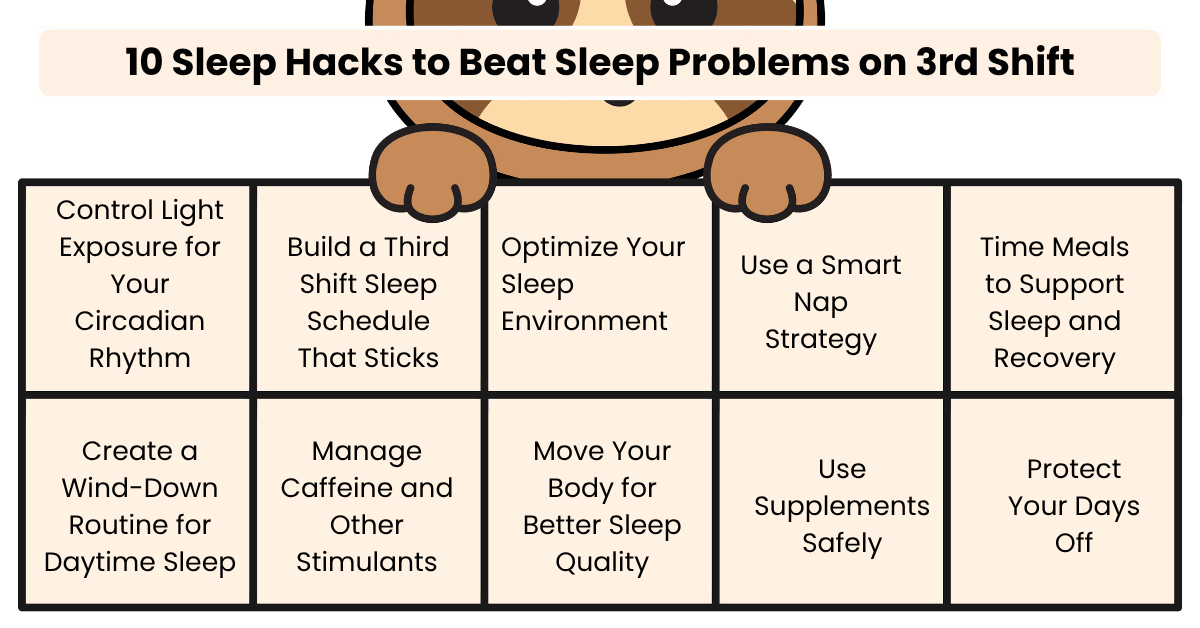
10 Sleep Hacks to Beat Sleep Problems on 3rd Shift
The goal isn’t to create a perfect routine. The goal is to build a routine that you can actually repeat.
1. Control Light Exposure for Your Circadian Rhythm
Light is one of the most powerful tools available to night workers.
During the first part of your shift, brighter light can help support alertness. As your shift moves toward morning, reducing unnecessary bright light can make it easier to transition toward sleep when you get home.
Once you arrive home, think of your bedroom as your artificial nighttime.
Use blackout curtains, an eye mask, and dim lighting before bed. If you use your phone, reduce brightness and avoid letting notifications disturb your sleep.
One important safety point: don’t use dark sunglasses on the drive home if you’re already extremely sleepy. Reducing morning light may support daytime sleep, but drowsy driving is a much more immediate danger. NIOSH recommends extra caution with this strategy.
2. Build a Third Shift Sleep Schedule That Sticks
Your sleep schedule doesn’t need to look normal to everyone else. It needs to be predictable for you.
If you work permanent nights, try to maintain similar sleep and wake times across the week rather than completely switching back to a daytime schedule every weekend.
For example, if you regularly sleep around 8:30 a.m. and wake around 3:30 p.m., keeping that general pattern can reduce the constant back-and-forth.
People with rotating schedules may need a different approach, including sleeping soon after getting home and using a pre-shift nap when needed.
The important thing is to avoid treating every day off as a complete reset.
3. Optimize Your Sleep Environment
If you only change one physical part of your bedroom, start with light.
Your daytime bedroom should be:
- Dark
- Quiet
- Cool
- Comfortable
- Free from unnecessary phone notifications
Blackout curtains can block sunlight. An eye mask can provide another layer of darkness. White noise or earplugs may help reduce unpredictable sounds.

Keep your phone on silent or use a sleep mode. If you need to remain reachable for emergencies, use a setting that allows only essential calls through.
NIOSH recommends blocking light from windows and doorways and reducing noise with earplugs or white noise when necessary.
4. Use a Smart Nap Strategy
A well-timed nap can help increase total sleep and improve alertness before a night shift.
If your main daytime sleep isn’t enough, consider a pre-shift nap when your schedule allows it.
However, waking from a longer nap can leave you temporarily groggy. This is called sleep inertia, and it can affect reaction time and thinking. NIOSH notes that sleep inertia may be particularly noticeable when people nap during the biological night.
Give yourself enough time to become fully alert before driving or performing safety-critical tasks.
For people with shift work disorder and excessive sleepiness, current AASM guidance supports planned naps as part of management, with caffeine sometimes combined with a nap before a night shift.

5. Time Meals to Support Sleep and Recovery
Food timing can make a noticeable difference in how comfortable you feel when trying to sleep.
A huge, greasy, or spicy meal immediately before bed may leave you uncomfortable. If you are genuinely hungry after work, a smaller meal or snack may be easier to tolerate.
NIOSH recommends avoiding heavy or spicy meals close to bedtime and suggests a small snack if hunger is likely to interfere with sleep.
During the shift, focus on practical meals rather than relying on sugary snacks and energy drinks to stay awake.
Think:
- Protein-rich foods
- Whole grains
- Vegetables
- Fruit
- Yogurt
- Nuts and seeds
- Water
You don’t need a special “night shift diet.” You need food that gives you steady energy without leaving you overly full when you’re ready for bed.
6. Create a Wind-Down Routine for Daytime Sleep
Your body may be tired, but your brain can still be switched on after a busy shift.
Create a short routine that tells your brain that work is over.
For example:
Arrive home → light snack if needed → shower → dim lights → quiet activity → bedroom → sleep.
Try not to fill this period with stressful news, work messages, household arguments, or exciting entertainment.
NIOSH recommends using a relaxing pre-sleep routine and lowering light levels before bedtime.
The routine doesn’t have to be complicated. Repetition is more important than perfection.
7. Manage Caffeine and Other Stimulants
Coffee can be a useful tool on third shift, but timing matters.
Caffeine can remain in your system for many hours. NIOSH notes that its average half-life is around five to six hours, although this varies between individuals. A coffee near the end of your shift may therefore interfere with sleep after you get home.
A practical approach is to use caffeine earlier in your shift and reduce or stop it several hours before your planned sleep period.
Don’t assume energy drinks are a better solution. More stimulation isn’t always better, especially if you’re already struggling with daytime sleep.
8. Move Your Body for Better Sleep Quality
Regular physical activity can support sleep, but you don’t need an intense workout after every shift.
Walking, strength training, cycling, stretching, or another activity you enjoy can fit into your schedule.
The best timing depends on how your body responds. Some people find exercise relaxing, while others feel energized afterward.
If vigorous exercise makes it harder for you to fall asleep, finish it several hours before your planned sleep period. NIOSH recommends adjusting exercise timing when late activity interferes with sleep.
9. Use Supplements Safely
Supplements are often marketed as quick fixes for night shift sleep problems, but they shouldn’t replace basic sleep habits.
Melatonin is particularly interesting because it interacts with the body’s sleep-wake timing. Current AASM guidance suggests melatonin for adults with shift work disorder who experience daytime sleep disturbance or insomnia after a night shift, but the recommendation is conditional and does not mean everyone should take it.
Magnesium and other supplements are also widely promoted for sleep, but individual needs and evidence vary.
Before using melatonin, magnesium, L-theanine, or other sleep products regularly, talk with a healthcare professional if you take medications, have an ongoing medical condition, are pregnant, or are unsure whether a supplement is appropriate for you.
More isn’t automatically better.
10. Protect Your Days Off
This is one of the hardest parts of working third shift.
You finally have a day off and want to live like everyone else. You stay awake all day, sleep at night, and then try to return to nights again.
That repeated switch can make your sleep schedule feel like permanent jet lag.
If you work permanent nights, maintaining a relatively consistent sleep window may be easier for your body than completely reversing your schedule every weekend. For rotating workers, however, flexibility may be necessary.
Try to find a middle ground that gives you social time without destroying your recovery sleep.

Sample 3rd Shift Sleep Schedule That Works
There isn’t one perfect third-shift schedule. Your commute, family responsibilities, work hours, and individual sleep needs all matter.
Here’s an example for someone working 11 p.m. to 7 a.m.
Work-Night Example: 11 PM–7 AM
7:00 a.m. — Finish work
7:30 a.m.—Get home; keep light exposure low.
7:45 a.m. — Small meal if hungry
8:00 a.m.—Shower and wind down
8:30 a.m. — Main sleep period
3:30 p.m. — Wake and hydrate
4:00 p.m. — Main meal
5:00 p.m. — Walk, exercise, or personal time
7:00 p.m. — Prepare meals and belongings
9:30 p.m. — Begin getting ready for work
11:00 p.m. — Start shift
This is only a model. If you need more sleep, extend the main sleep period or add a strategically timed nap.
The CDC notes that most healthy adults need at least seven hours of sleep, although individual needs vary.
Pre-Sleep Routine for Daytime Sleep
Try to keep the final 30–90 minutes before bed predictable.
Dim the lights. Put work away. Take a shower. Prepare your room. Silence your phone. Then get into bed.
You are essentially creating an artificial night in the middle of the day.
Weekend Plan for Maintaining Sleep Quality
If your shifts are permanent, avoid making your sleep schedule completely different on your days off.
If you need to attend daytime events, consider adjusting gradually rather than staying awake for an extremely long period simply to “reset” yourself.
If your schedule rotates, don’t force yourself into a permanent night routine when your next work block changes.
Foods and Drinks That Help or Hurt 3rd Shift Sleep
Your night-shift meals don’t need to be complicated.
Sleep-Supporting Food Choices
Choose meals that are satisfying without leaving you overly full.
Good everyday choices include:
- Eggs
- Yogurt
- Oats
- Beans
- Fish
- Chicken
- Vegetables
- Fruit
- Nuts and seeds
- Whole grains
A balanced meal can also help you avoid the cycle of eating sugary snacks whenever your energy drops.
Drinks and Habits That Can Disrupt Sleep
Be cautious with:
- Late-shift caffeine
- Energy drinks
- Alcohol near bedtime
- Very large meals before sleep
- Excessive fluids immediately before bed
Alcohol can make some people feel sleepy initially but may disturb sleep later. NIOSH recommends avoiding alcohol close to bedtime.
Hydration Without Constant Bathroom Trips
Stay hydrated during your waking hours, but avoid drinking excessive amounts immediately before bed if bathroom trips repeatedly wake you.
A large water bottle at work can help you remember to drink, especially during long shifts.
When Sleep Problems Mean It’s More Than Just Night Shift
Sometimes poor sleep isn’t simply a scheduling problem.
Signs of Shift Work Sleep Disorder
Talk with a healthcare professional if you regularly experience significant insomnia or excessive sleepiness connected to your work schedule.
Pay particular attention if you:
- Struggle to sleep despite having enough time available
- Feel dangerously sleepy while driving
- Nearly fall asleep at work
- Have persistent problems concentrating
- Wake repeatedly and cannot return to sleep
- Remain exhausted despite making reasonable sleep changes
Don’t try to solve severe daytime sleepiness with more caffeine alone.
When to Talk to a Doctor
Persistent sleep problems deserve attention, especially when they affect your safety, mood, work performance, or daily life.
A clinician can also check whether another condition—such as sleep apnea, depression, medication effects, or another sleep disorder—could be contributing to your symptoms.
Medical Treatment and CBT-I
If insomnia is part of the problem, cognitive behavioral therapy for insomnia (CBT-I) may be an option.
The AASM’s current guidance suggests CBT-I for adults with shift work disorder who have daytime sleep disturbance or insomnia.
Depending on your situation, a healthcare professional may also discuss light therapy, melatonin timing, sleep scheduling, or other treatments.
The right approach depends on the type and severity of the problem.
Common Mistakes That Make 3rd Shift Sleep Worse
Even a good sleep plan can fail when a few everyday habits work against it.
Breaking Your Sleep Schedule on Days Off
A completely different weekend schedule may feel socially convenient but can make returning to work nights harder.
Using Your Bedroom for TV and Scrolling
If your bedroom becomes your entertainment room, work office, and social media space, it can become harder to mentally associate the room with sleep.
Try to make your sleep environment boring, quiet, dark, and predictable.
Depending on Energy Drinks to Stay Awake
Energy drinks may provide stimulation, but using them repeatedly—especially late in the shift—can create a frustrating cycle: tired → caffeine → poor daytime sleep → more tiredness → more caffeine.
Ignoring Light, Noise, and Temperature
You cannot control every outside disturbance, but you can control many parts of your bedroom.
Blackout curtains, a comfortable temperature, white noise, earplugs, and a phone on silent can turn an ordinary bedroom into a much better daytime sleep environment.
FAQs: 3rd Shift Sleep Hacks
Q. How Many Hours Should I Sleep After a Night Shift?
Aim to get enough total sleep to meet your individual needs. Most healthy adults need at least seven hours per day, and night workers may need to protect their available sleep time carefully because daytime sleep can be shorter or more easily interrupted.
Q. Can You Get Good-Quality Sleep on 3rd Shift?
Yes, but it can require more planning. A consistent schedule, dark bedroom, reduced noise, appropriate light exposure, strategic caffeine use, and adequate time in bed can all help support better sleep.
Q. What’s the Fastest Way to Fall Asleep During the Day?
There is no guaranteed instant method. Start by making the room dark and quiet, reduce bright light, follow the same wind-down routine, and avoid caffeine close to bedtime.
If you regularly cannot fall asleep despite having enough time available, speak with a healthcare professional.
Q. Should I Sleep Immediately After a Night Shift?
For many permanent night workers, going to bed soon after arriving home can help protect the early part of the daytime sleep window. NIOSH specifically advises night workers to go directly to bed after arriving home rather than using that early morning period for chores or errands.
Q. How Do I Fix My Sleep Schedule After Working Nights?
Start by deciding which sleep period you want to protect and gradually make your light exposure, bedtime, wake time, meals, and caffeine fit that schedule. Avoid repeatedly swinging between opposite sleep schedules when your work pattern allows consistency.
Q. How Can I Sleep Better on My Days Off?
If you work permanent nights, keeping a similar sleep schedule can make the transition back to work easier. If you rotate shifts, you may need a more flexible plan. The goal is to protect enough total sleep while minimizing extreme changes between workdays and days off.
Reset Your Sleep Routine One Night at a Time
You don’t need to change everything tonight.
Start with the biggest problem.
If sunlight wakes you, fix the light. If noise interrupts you, add white noise or earplugs. If caffeine keeps you awake, move it earlier in your shift. If your schedule changes every weekend, look for a more consistent sleep window.
The best 3rd shift sleep hacks are usually the simple ones you can repeat.
Night work already asks your body to operate at an unusual time. Your sleep routine should make recovery easier, not add another complicated task to your list.
Protect your sleep like you protect your work schedule. It isn’t wasted time—it is part of being able to work, recover, and feel like yourself again.
Read more about night shift workers’ health.
You might like: