

Trying to control your weight does not mean giving up every sweet or crunchy snack.
Sometimes, the better strategy is choosing a small, satisfying portion of a nutrient-dense food instead of reaching for highly processed snacks when hunger strikes. Dry fruits can fit into that plan—but portion size matters because dried fruits and nuts are concentrated sources of calories.
So, what are the 5 best dry fruits for weight control?
Almonds, walnuts, dates, prunes, and pistachios are five useful choices, each offering different nutritional benefits. But none of them magically “burns fat.”
Their real value comes from nutrients such as fiber, healthy fats, protein, and naturally occurring carbohydrates that can make a balanced eating pattern easier to follow.
For night shift workers, convenient snack options can be provided when planned carefully around meals, energy needs, exercise, and sleep.
Read time: 9–11 minutes
Quick Answer: Which Dry Fruits Are Best for Weight Control?
The five choices covered in this article are
- Almonds: a protein- and fibre-containing snack that may help with appetite control.
- Walnuts: rich in unsaturated fats and omega-3 ALA.
- Dates: naturally sweet and useful when you want a small alternative to sugary snacks.
- Prunes: dried plums that provide fiber and may support digestive health.
- Pistachios: a satisfying nut that can work well as a portion-controlled snack.
The important point is how you eat them.
A handful of nuts added on top of everything else you eat is different from using a measured portion to replace cookies, chips, or another snack.
Research generally does not support the idea that nuts automatically cause weight gain. Large reviews of randomized trials have found no meaningful adverse effect of nut consumption on body weight, although nuts are still energy-dense and portion size matters.
Read the NIH blog here.
What Are Dry Fruits?
In South Asian usage, “dry fruits” often refers to a mixture of nuts and dried fruits.
That means the term can include foods such as
- Almonds
- Walnuts
- Pistachios
- Cashews
- Dates
- Prunes
- Raisins
- Dried apricots
Nuts and dried fruits are not nutritionally identical.
Nuts tend to provide more fat and protein.
Dried fruits generally contain concentrated natural sugars and carbohydrates, along with fibre and other nutrients.
Both can be part of a healthy diet. The key is to understand their differences and choose portions that fit your overall calorie needs.
How Dry Fruits Can Support Weight Management

Dry fruits do not directly melt or burn body fat.
Instead, some can make a weight-control eating pattern more satisfying.
They Can Make Snacks More Nutrient-Dense
A small serving of nuts provides protein, unsaturated fats, fiber, vitamins, minerals, and other compounds.
That is different from a snack made mostly of refined carbohydrates or added sugar.
Some Provide Fiber
Fiber can support digestive health and can contribute to feelings of fullness.
Almonds and pistachios provide fiber, as do dried fruits such as prunes.
Nuts Can Be Satisfying
Research on nuts suggests they can reduce hunger in some situations, though this does not necessarily mean they reduce total calorie intake. One meta-analysis found lower hunger after nut consumption but no overall effect on weight or fullness.
This is why portion size and food substitution matter.
They Are Convenient
This can be especially useful when you are busy.
Instead of buying a large bag of cookies or chips when hunger appears, you can prepare a small container of nuts or a measured dried-fruit portion in advance.
Convenience can make a healthy choice easier to repeat.
Top 5 Dry Fruits for Weight Control
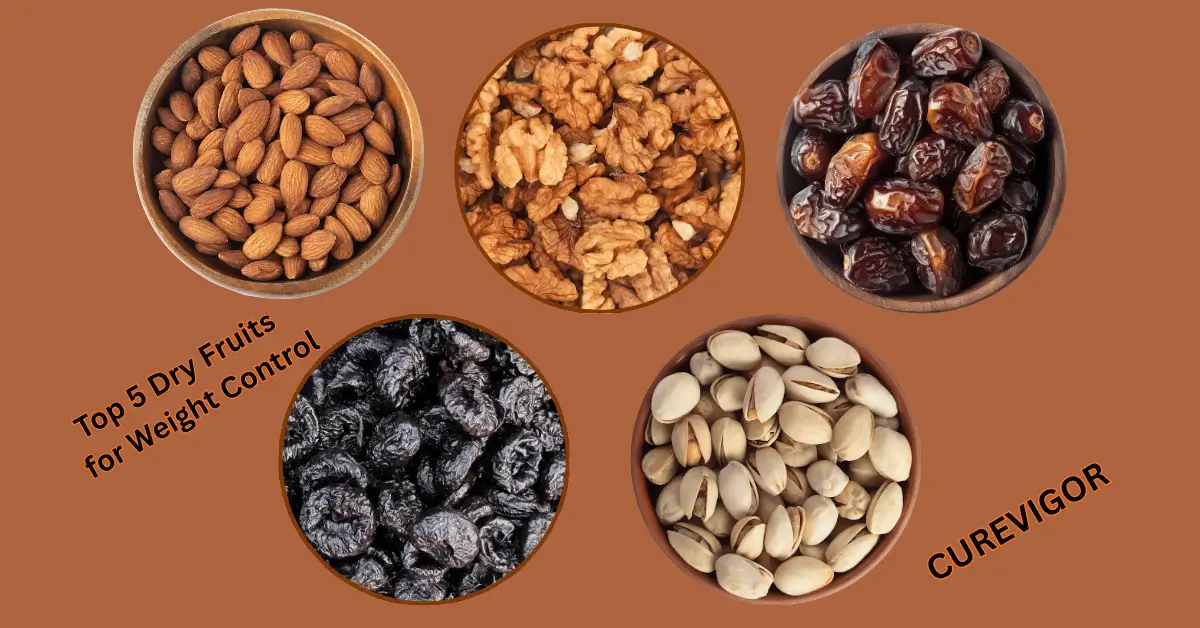
1. Almonds: A Protein- and Fiber-Rich Snack
Almonds are among the best choices for a weight-conscious snack because they provide a combination of protein, fiber, and unsaturated fats.
Research on almonds is encouraging but should not be exaggerated. A 2024 systematic review and dose-response meta-analysis of 37 randomized controlled trials found improvements in certain body composition and hunger measures under specific conditions, particularly with longer interventions and higher almond intake. However, the researchers also noted that more well-designed trials are needed.
Another one-year randomized trial found that replacing a discretionary snack with almonds improved diet quality without causing a significant difference in body weight compared with biscuits.
How to Eat Almonds for Weight Control
Try a small measured portion rather than eating directly from the packet.
Good combinations include:
- Almonds with plain yogurt
- Almonds with fresh fruit
- Chopped almonds over oatmeal
- A small portion with a balanced breakfast
- Almonds as a replacement for biscuits or candy
The goal is substitution—not simply adding more calories to your day.
2. Walnuts: Healthy Fats and Omega-3 ALA
Walnuts are known for their high content of polyunsaturated fats, including plant-based omega-3 fatty acid alpha-linolenic acid (ALA).
They are calorie-dense, so they should be portioned rather than eaten by the handful without thinking.
Importantly, walnuts should not be marketed as a “metabolism booster.” A systematic review and dose-response meta-analysis found that walnut interventions overall did not significantly change body weight, BMI, waist circumference, or fat mass.
That does not make walnuts a poor choice.
It simply means their value is better understood as part of a nutrient-rich eating pattern, not as a fat-burning food.
How to Eat Walnuts for Weight Control
Try:
- Chopped walnuts over oatmeal
- Walnuts with plain yogurt
- A small serving with fruit
- Walnuts added to a salad
- Crushed walnuts over whole-grain meals
Choose plain or lightly prepared walnuts rather than varieties heavily coated with sugar or salt.
3. Dates: Naturally Sweet and Convenient
Dates are different from almonds and walnuts because they are dried fruit rather than nuts.
They are naturally sweet and provide carbohydrates, fiber, and minerals. But their sweetness also means that portion control matters.
Dates should not be described as a food that “burns fat.”
In a randomized controlled trial involving adults with type 2 diabetes, consuming three dates daily for 16 weeks did not significantly change BMI or HbA1c, although some lipid measures improved. The study supports the idea that moderate date consumption can fit into a diet, but it does not establish dates as a weight-loss food.
How to Eat Dates for Weight Control
Because dates are sweet, use them intentionally.
Try:
- One or two dates with a few almonds
- Chopped dates in plain oatmeal
- A date with unsweetened yogurt
- A small amount in a homemade energy bite
- Dates as an alternative to candy when you want something sweet
Avoid turning a small date serving into a large dessert made with added sugar, syrups, or chocolate.
4. Prunes: Fiber and Digestive Support
Prunes are dried plums and are particularly known for their fiber content.
They may be useful when you want a naturally sweet snack while also increasing fiber intake.
Research has found evidence for digestive benefits. A systematic review of randomized trials found that prunes improved stool frequency and consistency in people with constipation, although evidence for other gastrointestinal outcomes was less certain.
Prunes should still be eaten in reasonable portions because drying concentrates the fruit.
How to Eat Prunes for Weight Control
Try:
- A few prunes with plain yogurt
- Chopped prunes in oatmeal
- Prunes with a small serving of nuts
- Chopped prunes in a homemade trail mix
- A small portion alongside breakfast
If you are not used to eating much fiber, increase it gradually and drink enough fluids.
5. Pistachios: A Practical Portion-Controlled Snack
Pistachios can be a particularly useful snack because you can portion them before eating.
They provide protein, fiber, unsaturated fats, and several micronutrients.
Research on pistachios does not show dramatic weight-loss effects. A systematic review and meta-analysis of randomized trials found that pistachio consumption reduced BMI slightly in the pooled analysis but did not significantly change body weight or waist circumference.
That is a good example of why “best for weight control” does not mean “causes weight loss.”
Pistachios can simply be a nutritious replacement for less nutritious snack foods.
How to Eat Pistachios for Weight Control
Choose:
- Unsalted or lightly salted pistachios
- A measured portion
- Pistachios with fresh fruit
- Pistachios with plain yogurt
- Pistachios as a replacement for chips or crackers
If possible, choose pistachios that require shelling. The extra step may encourage slower, more mindful eating.
Dry Fruits for Night Shift Workers: Energy, Fitness, and Long-Term Health
Night shift workers face a different eating challenge.
Your body may be awake and active when your usual biological rhythm calls for rest. Meal timing can become irregular, and tiredness can make highly processed snacks especially tempting.
Recent research continues to show that shift workers commonly experience disruptions in both food choices and meal timing. A 2026 scoping review found frequent dietary disruption among shift workers, including greater intake of saturated fat and simple carbohydrates in many studies and lower fiber intake in a substantial portion of the evidence.
This is where a planned dry-fruit snack can be useful.
For Steady Energy During a Shift
Instead of relying only on sweets or sugary drinks, pair a small amount of dried fruit with a protein- or fat-containing food.
For example:
2 dates + a few almonds
or
a small portion of pistachios + fresh fruit
The combination can be more balanced than eating a large serving of dried fruit alone.
For Night Shift Fitness
If you exercise before or after a shift, your food choices should support your overall training and energy needs.
Dry fruits can be convenient around exercise, but they are not a replacement for a balanced diet.
For a longer workout, carbohydrate-rich foods can be useful for fueling activity. For everyday fitness, the bigger picture matters: sufficient protein, vegetables, fruits, whole grains, fluids, healthy fats, and an appropriate total calorie intake.
For Long-Term Heart and Metabolic Health
Nuts are particularly useful because they provide unsaturated fats and other nutrients.
Research suggests that regular nut intake does not inherently promote weight gain, despite nuts being energy-dense.
For night workers, the bigger goal is to make nutrient-dense choices easier to access during a schedule that can encourage irregular eating.
For Better Sleep
Dry fruits should not be treated as sleep remedies.
Instead, think about when and how much you eat.
NIOSH guidance for night workers recommends avoiding large meals close to the main sleep episode and suggests a small snack before daytime sleep if hunger is likely to wake you. It also recommends avoiding heavy, fatty, or spicy foods and limiting caffeine several hours before sleep.
So if you finish a night shift hungry before bed, a small snack such as:
plain yogurt + a few almonds
may be more sensible than a large, heavy meal.
Your individual tolerance matters, especially if certain foods cause digestive discomfort.
Best Time to Eat Dry Fruits on the Night Shift
There is no universal “perfect” time.
The better timing depends on your shift, main meals, hunger, exercise, and sleep schedule.
A practical approach might look like this:
Before the shift: Have a balanced meal containing protein, vegetables, whole grains or another quality carbohydrate, and healthy fats.
During the shift: If hungry, choose a small portion of nuts or dried fruit paired with another nutritious food.
Near the end of the shift: Avoid turning tiredness into a large snack session.
Before daytime sleep: If genuinely hungry, choose a small, easy-to-digest snack rather than a heavy meal.
NIOSH recommends reducing food intake between midnight and 6 a.m. where practical and following a more normal day-night meal pattern as much as possible, while recognizing that individual shift schedules differ.
How Much Dry Fruit Should You Eat for Weight Control?
This is one of the most important questions.
There is no single portion that works for everyone because calorie needs vary.
For nuts, a practical starting point is often a small handful—roughly 1 ounce (28 g)—rather than eating freely from a large packet.
For dried fruit, a smaller portion can make sense because the fruit has lost its water and become more concentrated.
Instead of asking:
“How much can I eat?”
Ask:
“What amount fits my overall meal and snack plan?”
If you are trying to lose weight, the total pattern of food intake still matters more than any single dry fruit.
Tips for Incorporating Dry Fruits Into Your Diet
Measure Before You Eat
Put your serving into a bowl instead of eating directly from the packet.
Choose Unsalted Options
This is particularly useful if you are already eating a high-sodium diet.
Avoid Sugar-Coated Versions
Chocolate-covered, caramelized, honey-coated, or heavily sweetened products can turn a simple snack into a much more calorie-dense treat.
Pair Dried Fruit With Protein or Healthy Fat
Try dates or prunes with:
- Almonds
- Walnuts
- Pistachios
- Plain yogurt
This can create a more balanced snack than eating a large amount of dried fruit on its own.
Use Them as Replacements
This is perhaps the most important strategy.
Replace:
cookies → almonds
candy → one or two dates
chips → pistachios
sweet dessert → plain yogurt with chopped prunes
The goal is not to add dry fruits on top of your normal calorie intake.
Common Mistakes to Avoid
Eating Straight From the Packet
A small portion can quickly become several servings.
Assuming Healthy Means Unlimited
Nuts are nutritious, but they are also energy-dense.
Healthy food still needs appropriate portions.
Believing Dry Fruits Burn Fat
No individual dry fruit can selectively burn belly fat or automatically cause weight loss.
Weight control depends on your overall eating pattern, physical activity, sleep, energy balance, and other factors.
Eating Large Amounts of Dates or Other Dried Fruits
Because dried fruit is concentrated, it can be easy to eat more than you realize.
Buying Heavily Sweetened Products
Check the ingredient list.
Choose products without unnecessary added sugars when possible.
Using Dry Fruits Instead of Complete Meals
A handful of nuts is a snack—not necessarily a complete meal.
Night shift workers especially need balanced meals rather than relying on snacks throughout the shift.
Almonds vs. Walnuts vs. Dates vs. Prunes vs. Pistachios
| Dry fruit | Main strength | Weight-control consideration | Easy snack idea |
|---|---|---|---|
| Almonds | Protein, fibre, healthy fats | Energy-dense; portion matters | Almonds + yogurt |
| Walnuts | Unsaturated fats, ALA | Do not treat it as a metabolism booster. | Walnuts + fruit |
| Dates | Natural sweetness, carbohydrates | More concentrated sugar; use smaller portions. | 1–2 dates + almonds |
| Prunes | Fiber, digestive support | Concentrated dried fruit | Prunes + plain yogurt |
| Pistachios | Protein, fiber, healthy fats | Portion control still matters. | Pistachios + fruit |
Are Dry Fruits Better Than Processed Snacks?
Often, they can be a more nutrient-dense choice.
For example, a measured serving of unsalted nuts generally offers more protein, fiber, healthy fats, vitamins, and minerals than many highly processed snack foods.
But the comparison depends on the actual foods and portions.
A large bowl of nuts eaten mindlessly is not automatically a better weight-control strategy than a properly portioned snack.
Food quality and quantity both matter.
A Simple Night Shift Dry-Fruit Snack Plan
If you work a typical overnight shift, you could organize your food like this:
Before Work
Eat a balanced meal.
Example:
Grilled chicken or beans + vegetables + whole grains + yogurt
Mid-Shift
If hungry:
A small portion of pistachios + fresh fruit
or
A few almonds + plain yogurt
Later in the Shift
If you need a small snack:
1–2 dates + a few walnuts
Keep the portion modest.
Before Sleep
If hunger is likely to interfere with sleep:
A small, light snack
Avoid a large meal immediately before your main sleep period. NIOSH specifically recommends avoiding large meals 1–2 hours before the main sleep episode.
Can Dry Fruits Help With Long-Term Weight Control?
They can be part of a long-term weight-control pattern, but they are not a standalone solution.
The strongest evidence is for nuts as foods that can fit into healthy eating patterns without necessarily increasing body weight. Meta-analyses have found no meaningful adverse effect of nut consumption on body weight and, in some analyses, associations with lower adiposity.
For dried fruits such as dates and prunes, the evidence for weight loss is much less direct.
So think of dried fruits as supporting foods, not weight-loss treatments.
Your long-term results will depend on your complete routine:
- Balanced meals
- Appropriate portions
- Regular physical activity
- Adequate sleep
- Stress management
- Consistent eating habits
- Limited highly processed foods
- Sustainable calorie intake
FAQs About Using Dry Fruits for Weight Control
Q. Which dry fruit is best for weight loss?
There is no single dry fruit proven to cause weight loss. Almonds and pistachios are useful options because they provide protein, fibre, and healthy fats, while walnuts offer unsaturated fats. They work best when used in appropriate portions as part of a balanced diet.
Q. Can I eat dry fruits every day while trying to lose weight?
Yes, most people can include appropriate portions of nuts and dried fruits in a weight-control eating pattern. The key is portion size and what the dried fruits replace in your diet.
Q. Do almonds burn belly fat?
No. Almonds do not specifically burn belly fat. Research suggests that almonds can fit into weight-management diets and may influence appetite or body composition measures under some conditions, but they should not be promoted as a targeted fat-burning food.
Q. Are dates good for weight control?
Dates can fit into a weight-control diet, especially when used in small portions as an alternative to candy or other highly processed sweets. However, dates are concentrated in natural sugars and carbohydrates, so eating large amounts can add substantial calories.
Q. Are prunes good for weight management?
Prunes can be a useful source of fiber and may support digestive health. Evidence suggests they can improve bowel function in people with constipation, but that does not mean prunes directly cause weight loss.
Q. Are pistachios good for weight control?
Pistachios can be included in a weight-control diet. Research has found no significant increase in body weight from pistachio-enriched diets, and some studies have found modest improvements in BMI.
Q. What is the best dry fruit for night shift workers?
There is no single best choice. Almonds, walnuts, and pistachios can provide a convenient source of protein, fiber, and healthy fats, while small portions of dates or prunes can provide carbohydrates and natural sweetness. Choose based on your hunger, meal plan, activity, and tolerance.
Q. Can night shift workers eat dry fruits before sleeping?
A small snack may be reasonable if hunger is likely to disturb sleep. NIOSH advises avoiding large meals close to the main sleep period and suggests a small snack when hunger could interfere with sleep.
Q. Can dry fruits give energy during a night shift?
They can provide energy because nuts and dried fruits contain calories from fats, carbohydrates, and in some cases protein. However, they are not a substitute for adequate sleep, balanced meals, hydration, and regular physical activity.
Conclusion: Use Dry Fruits Wisely for Weight Control
The best dry fruits for weight control are not necessarily the ones with the loudest “fat-burning” claims.
Almonds, walnuts, dates, prunes, and pistachios can all have a place in a balanced diet—but each should be used differently.
Choose nuts when you want a satisfying source of healthy fats, protein, and fiber.
Choose small portions of dates or prunes for naturally sweet dried fruit.
And most importantly, use dried fruit to replace less nutritious snacks rather than simply adding extra calories to your day.
For night shift workers, planning matters even more. A small container of measured nuts or dried fruit can be a much easier choice than grabbing whatever snack is available at 2 a.m.
Your goal is not to find one food that burns fat.
Your goal is to build an eating pattern you can maintain—one that supports your weight, energy, fitness, sleep, and long-term health.
Read more articles on health tips.
You might like to read: