

Most working parents feel like they are living on an invisible seesaw: when you’re winning at work, you feel like you’re failing at home—and when you’re present for your kids, your inbox is screaming for attention.
But “balance” isn’t a perfect 50/50 split you achieve once and keep forever. It’s a dynamic, daily practice of choosing what matters most in the moment without losing yourself in the process.
In an “always-on” culture, finding harmony between professional ambition and family life can feel like an impossible math problem.
This guide dispels the myth of the “perfect balance” and offers 9 evidence-based strategies to help busy families reclaim their time.
From setting “hard sunset” boundaries at the office to mastering the art of the 15-minute quality connection.
You’ll learn how to reduce burnout, boost your productivity, and show up fully for the people who matter most.
Being a Working Parent
As a mother and a professional dedicated to life balance, I’ve spent years trying to solve the ‘perfect balance’ equation.
What I’ve learned in the trenches of parenting and career-building is this: Our children don’t need a perfect parent; they need a present one.
I realized that trying to give 100% to both at the exact same time was the fastest route to burnout.
True harmony began when I stopped aiming for perfection and started focusing on being fully where my feet are—whether that’s at my desk or on the living room floor.
Why Balance Feels So Hard for Working Parents
For working parents, balance is rarely about having enough hours in the day. The real struggle is switching between roles without feeling pulled in different directions.

One moment, you are answering emails, joining meetings, or solving problems at work. The next moment, you are helping with homework, packing lunches, calming a child, or thinking about dinner.
That is why many parents feel tired even when they seem organized on the outside. It is not only the workload that drains them.
It is the constant mental shifting. Work asks for focus, speed, and results. Family life asks for patience, care, and presence. Holding both at once can feel heavy.
Balance also changes from week to week. A smooth routine can suddenly be disrupted by a sick child, a school event, a missed bus, a deadline, or simple exhaustion. So the goal is not a perfect life where everything runs on time.
The goal is a workable rhythm that helps parents do what matters most without burning out.
The good news is that balance does not always require big changes. In many homes, small systems make the biggest difference.
A better morning routine, a shared calendar, a clearer boundary after work, or one honest talk with a partner can reduce daily pressure more than people expect.
9 Proven Tips for Working Parents to Balance Work and Family Life
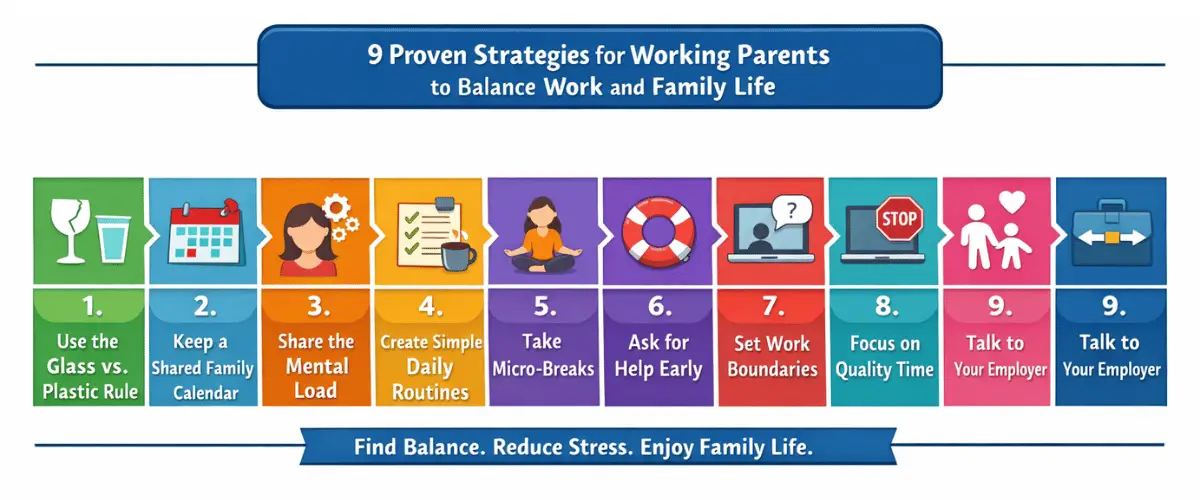
Tip 1: Use the Glass vs. Plastic Rule to Set Daily Priorities
One of the best ways to reduce stress is to stop treating every task like an emergency.
The glass vs. plastic rule is simple: glass items crack when dropped. Plastic tasks can bounce for a while.
A school pickup is glass. A non-urgent email may be plastic. A doctor visit is a glass. Folding laundry right now may be plastic.
This idea helps working parents make quick decisions when the day gets messy. Instead of trying to save everything at once, they can ask one clear question.
What truly cannot be dropped today? That question cuts through guilt and noise. It also helps parents protect the few things that matter most to their family and their work.
This rule is powerful because it works in real life, not just in theory. Most parents do not need another long productivity system.
They need a fast mental filter. When a meeting runs late, and dinner still needs attention, this rule helps them respond calmly rather than in panic. It shifts the focus from doing more to choosing better.
Over time, this habit also lowers resentment. Parents begin to notice that some pressure comes from real duties, but some comes from self-made urgency. Not every message needs an instant reply.
Not every home task must be done today. When parents learn to protect the glass and let some plastic wait, life starts to feel lighter.

Tip 2: Keep a Centralized Family Calendar Everyone Can Follow
A shared family calendar removes guesswork from daily life. It gives working parents one place to see school timings, office meetings, bill dates, sports practice, parent-teacher meetings, birthdays, and meal plans.
When everyone follows the same system, there are fewer surprises and fewer last-minute conflicts.
This works best when the calendar is simple and easy to see. Some families use a phone app. Others use a paper calendar in the kitchen.
The tool matters less than the habit. What matters is that both parents, or all caregivers, can check it quickly and trust that it is up to date. A calendar only helps when people truly use it.
A good family calendar also does more than track events. It shows pressure points before they happen.
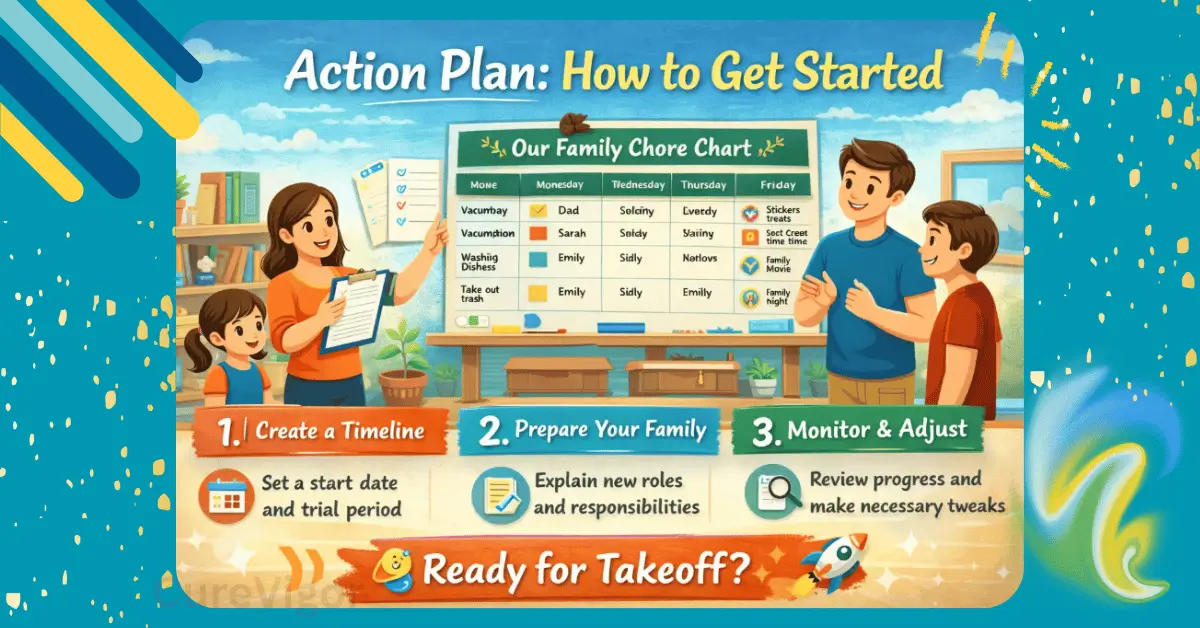
Parents can spot a hard Wednesday before Wednesday arrives. They can see when one person has too much on their plate.
That makes it easier to plan school runs, meals, or backup childcare before stress takes over.
Children benefit from this too. When kids know what is coming, the home often feels calmer.
They can prepare for school activities, sleep routines, or family plans with less confusion.
For working parents, that means fewer repeated reminders and less emotional friction during busy parts of the day.
Tip 3: Share the Mental Load, Not Just the Chores
Many families talk about splitting chores, but the deeper issue is the mental load.
The mental load includes remembering the child needs new shoes, knowing the school project is due Friday, tracking the grocery list, planning meals, and noticing that the soap is almost finished.
It is the invisible management work behind the visible tasks.
This is where many working parents, especially mothers, feel overwhelmed. Even when chores are shared, one person may still be doing most of the thinking, reminding, and planning.
That creates a tiredness that is harder to explain because it is not always apparent to others. The body may rest, but the mind stays on duty.
A fair system means sharing ownership, not just helping after being asked. If one parent owns bedtime, they should fully manage it.

If one person handles school communication, they should track it from start to finish. This reduces the need for one parent to act like the family manager for every small detail.
The shift may feel awkward at first, but it builds trust over time. Families become stronger when each adult can carry full responsibility in certain areas.
It is not about perfection. It is about reducing hidden strain. When the mental load is shared, parents often feel less alone, less resentful, and more like a team.
Tip 4: Build Small Routines That Reduce Daily Decision Fatigue

Working parents make hundreds of decisions every day. What should the kids wear? What will everyone eat? Who will do the pickup? When should homework happen? Which call can wait?
Too many small choices drain energy. That is why simple routines matter so much. They reduce decision fatigue and create calm.
Morning and evening routines are often the most useful place to start.
A set bedtime, clothes prepared the night before, school bags checked early, and a repeated breakfast plan can save a surprising amount of energy.
These routines may look basic, but they remove friction from the busiest parts of the day.
Routines also help children know what to expect. That matters because predictability lowers resistance. Kids are less likely to argue about every step when the sequence feels normal and familiar.
For parents, that means fewer emotional battles before school or sleep. A smoother home routine often improves the whole family’s mood.
The key is to keep routines small enough to stick. A routine should support life, not control it. If a system is too strict, it breaks as soon as life changes. But a simple pattern can hold steady even on messy days.
That is why the best routines are not fancy. They are realistic, repeatable, and easy to return to after a hard week.
Tip 5: Schedule Micro-Breaks Without Feeling Guilty
Many working parents think rest must come in large blocks to count. That idea causes more stress because large blocks are rare.
A better approach is to use micro-breaks. A micro-break may be five quiet minutes before school pickup, a short walk after a meeting, two deep breaths before entering the house, or a cup of tea without a phone.
These short pauses matter because they help parents reset between roles. The move from work mode to family mode is not always automatic.

If a parent finishes a hard task and jumps straight into home demands, they may still be carrying stress in their voice, body, and attention. A small break can soften that transition.
Micro-breaks are not laziness. They are maintenance. Just like a phone battery works better after charging, people respond better after a brief recovery.
Parents who pause for a moment often return with more patience, clearer thinking, and better emotional control. That can change the feel of the whole evening.
The important part is to remove guilt from rest. Many parents believe they must earn every pause. But rest is not a reward for being perfect.
It is part of staying functional. When parents protect even tiny moments of recovery, they are not taking away from the family. In most cases, they are making family life more stable.
Tip 6: Ask for Help Before You Reach Burnout
Many parents wait too long to ask for help. They keep going until they feel snappy, drained, forgetful, or emotionally flat. By then, even small tasks feel hard.
Burnout often grows quietly. It does not always arrive in one dramatic moment. It builds through weeks of overload, poor recovery, and the belief that asking for support means weakness.
Real strength often looks different. It looks like calling a relative for school pickup once a week. It looks like trading childcare with a trusted friend.
It looks like saying no to one extra duty. It looks like telling a partner, “I cannot keep carrying all of this alone.” These are not failures. They are wise adjustments.
Support can come from many places. Family, neighbors, paid help, school communities, flexible work options, or older children who can manage age-appropriate tasks can all reduce pressure.
Every home has different resources, so the answer will not look the same for everyone. What matters is knowing that no parent is meant to carry everything alone.
Asking for help early also protects relationships. When parents stay silent for too long, stress often manifests as anger or shutdown.
A simple request made sooner is usually kinder than an emotional breakdown later.
Help does not need to be dramatic to matter. Sometimes one small support point is enough to change the week.
Tip 7: Set Clear Boundaries Between Work Time and Family Time
When work intrudes into every corner of the day, family life begins to feel like an interruption rather than a priority.
That is why boundaries matter. Boundaries tell your mind, your employer, and your home when work starts and ends. Without them, parents at only half present even when they are physically with their children.
A clear boundary can be simple. It may mean no work messages during dinner. It may mean shutting the laptop at a set time.
It may mean not checking email after the children go to bed unless there is a real emergency. These small lines help protect attention, which is often the most valuable thing a parent can give.
Parents who work from home need this even more. When the office is inside the house, the line between job and family can disappear quickly.
A short transition ritual can help. Changing clothes, taking a walk, closing the office door, or even washing your face after work can signal that one role has ended and another has begun.
Boundaries also teach children something important. They show that work is valuable, but so is family time.
Children do not need a perfect parent who is available every second. They need a parent who is truly present sometimes.
A protected thirty minutes of real attention often means more than hours of distracted togetherness.
Tip 8: Make Limited Family Time More Meaningful

Working parents often worry that they do not spend enough time with their children. That fear is common, but total hours are not the full story.
Children remember tone, attention, and connection. Even when time is limited, it can still feel rich if the parent is mentally there and the child feels seen.
Meaningful time does not need to be expensive or elaborate. It may be dinner without screens, a bedtime chat, a short walk, a silly game in the kitchen, or a daily check-in after school.
These moments may seem small on the outside, but they build emotional safety. They tell a child, “You matter to me, even on busy days.”
This is also where parents can let go of pressure. Family life does not need to look like a perfect social media post to be good.
Children usually do not need constant entertainment. They need warmth, interest, and predictability. A few steady rituals often matter more than big occasional events.
For parents, this way of thinking is freeing. Instead of chasing perfect balance, they can focus on meaningful presence.
That shift changes the question from “How can I do everything?” to “How can I make the time I do have count?” In many homes, that is where peace begins.
Tip 9: Talk Openly With Your Employer About Flexible Solutions

Many working parents assume they must silently adjust to every pressure point. But in some cases, one honest conversation at work can improve daily life more than any home hack.
Flexible start times, hybrid schedules, a protected lunch break, meeting limits, or clearer expectations may be possible when parents ask early and clearly.
The best workplace conversations are calm and practical. Instead of focusing solely on stress, it helps to explain the issue and suggest a workable solution.
For example, a parent may say that a shifted start time would help with school drop-off while still allowing full productivity. Employers often respond better when they see planning rather than panic.
Not every workplace is equally flexible, and that reality should be respected. Still, many parents never ask because they assume the answer is no.
That assumption can keep families stuck in avoidable stress. Even a small change, like one remote day or fewer late meetings, can create real breathing room across the week.
This kind of communication can also strengthen work performance. Parents who are given a realistic structure often work with better focus and less hidden strain.
When family pressure is slightly lower, energy at work often improves too. Balance not only helps the home. It can support better decisions, steadier output, and healthier long-term work habits.
What Changes When Working Parents Find a Better Rhythm
When a family finds a rhythm that fits real life, the home usually feels less tense. There are still hard days, missed steps, and surprise problems.
But the general feeling changes. Parents react with less panic. Children know what to expect more often. Small tasks stop turning into major stress.
Parents also begin to feel more emotionally present.
They may still be busy, but not as scattered. That matters because presence shapes relationships.
A parent who is less overloaded often listens better, speaks more gently, and notices small things they were too rushed to see before. That creates a warmer family atmosphere over time.
A better rhythm can also lower guilt. Many parents feel they are always behind at work or at home.
When systems improve, that guilt often softens. Not because life becomes perfect, but because there is more clarity about what matters, who is doing what, and where energy needs to go.
In the long run, this kind of balance supports both family life and career life. It helps parents stay steadier, rather than always swinging between overwork and exhaustion.
That steadiness is often what creates long-term success. Not speed. Not hustle. Just a healthier pattern that people can actually live with.
Final Thoughts
Working parents do not need flawless routines to build a good life. They need practical systems, honest communication, and enough breathing room to keep going without losing themselves.
Balance is not a fixed point where everything is equal. It is a living rhythm that changes with seasons, work demands, and family needs.
That is why the best advice is often the most grounded advice. Protect what glass is. Share the mental load. Build small routines.
Rest in small moments. Ask for help sooner. Guard family time. Use the time you have with care. Speak up at work when a better structure is possible. These steps are simple, but their effect can be strong.
If this article is published, it will be strongest after a human editor adds lived examples, family scenarios, or first-hand insights from real working parents.
That kind of experience-rich layer makes the piece more trustworthy, more useful, and more aligned with Google’s people-first content guidance.
At the end of the day, I’ve realized that the ‘invisible seesaw’ of work and family life never truly sits still. As a parent, I’ve had to learn that some days work takes the lead, and other days, my family needs the spotlight.
By letting go of the myth of the ‘perfect 50/50 split,’ I’ve found something better: integration.
We aren’t just workers or just parents; we are real-world humans doing our best to blend both with intention.
FAQs for Working Parents
Q. How can I balance parenting and work?
Balancing parenting and work starts with clear priorities and a simple routine. Focus on the tasks that truly matter at home and at work each day.
Use a shared calendar, prep things the night before, and protect a few daily family moments. Balance gets easier when you stop chasing perfection and build a rhythm that fits your real life.
Q. What is parenting and work-life balance?
Parenting and work-life balance mean giving both areas the care they need without feeling pulled apart.
It does not mean splitting equally every day. It means creating systems that reduce stress, like shared responsibilities, fixed routines, and healthy work boundaries. The goal is a life that feels stable, not a schedule that looks perfect.
Q. How do I balance my work and personal life?
To balance work and personal life, start by setting limits on when work begins and ends.
Avoid letting emails, calls, and tasks take over your time at home. Make space for rest, family, and small personal habits that help you reset.
Even short breaks, quiet time, or a daily walk can improve your energy and focus.
Q. How can a working mom balance work and family?
A working mom balancing work and family often carries both visible tasks and the hidden mental load. That is why support, planning, and shared responsibility matter so much.
A realistic routine, open communication, and early help-seeking can make daily life easier. Small changes done consistently often bring more peace than trying to do everything alone.
Q. How can I balance family and work?
Balancing family and work becomes easier when you decide what needs your attention now and what can wait. Family life works better when routines are simple and expectations are realistic.
Work feels lighter when you plan ahead and communicate clearly about your time. Balance is not about doing more, but about doing the right things at the right time.
Q. How do I balance full-time work and family?
Balancing full-time work and family requires structure, flexibility, and honest planning. Use time blocks for work, family tasks, and rest to make the day feel more manageable.
Prepare meals, clothes, and school items in advance to reduce pressure. It also helps to protect quality family time, even if it is short, because connection matters more than long hours together.
Q. What is work-life balance wellbeing?
Work-life balance wellbeing is about protecting your mental, emotional, and physical health while meeting daily duties.
When work takes over everything, stress builds, and family time starts to feel harder to come by.
Healthy boundaries, enough sleep, short recovery breaks, and support from others can improve well-being. A better balance often leads to calmer parenting and clearer thinking at work.
Q. What are the best work-life balance activities?
Work-life balance activities do not have to be big or expensive to help.
Simple things like a family meal, an evening walk, reading with your child, light exercise, journaling, or quiet tea time can lower stress.
These small habits help you shift out of work mode and feel more present. The best activities are the ones that fit easily into your normal week.
Get in touch and read more articles on Healthy Living.
You might like: