

Discover how mindfulness for Work can boost focus and productivity. Learn 7 science-backed techniques to reduce stress and work smarter.
Did you know 47% of workers feel distracted by constant notifications? If you are reading this while secretly worrying about an unanswered email, you are not alone. The modern workplace is a noisy place.
Between chat pings, meeting requests, and endless to-do lists, it is incredibly challenging to sit down and simply do your work.
Over time, this constant switching takes a heavy toll. Stress builds up. Focus slips. By the end of the day, you might feel drained, even if you can’t pinpoint what you accomplished.

There is a better way to work. Mindfulness for work, simple, science-backed practices, can sharpen your focus and boost your productivity without leading to burnout.
You do not need to change your entire life or move to a quiet mountain to see these benefits.
By learning a few basic techniques, you can reduce daily stress, protect your attention, and get more done with less effort.
If workplace tension is already taking a toll on your health, you might find it helpful to read our guide on Work-Life Harmony: Strategic Ways to Alleviate Stress and Increase Focus before diving into these focus strategies.
Why Mindfulness for Work Matters
Mindfulness often sounds like a buzzword, but its meaning is very simple. Expert Jon Kabat-Zinn defines it as present-moment awareness without judgment.
This means noticing what is happening right now, without labeling it as good or bad.
Mindfulness for work is so simple. At work, this looks like giving your full attention to the report you are writing, rather than worrying about the presentation you have to give tomorrow.
It means noticing that your shoulders are tight and choosing to relax them, rather than pushing through the pain.
Many of us have been taught to pride ourselves on multitasking. We think answering emails while on a phone call makes us efficient. Science provides a different perspective.
Multitasking is a myth. What we are actually doing is task-switching, which rapidly drains the brain.
Every time you switch from one task to another, your brain takes a few seconds to adjust. Those seconds add up to lost hours over the course of a week.
Single-tasking, on the other hand, is a true superpower. When you focus on just one thing, you enter a state of deep concentration.
You make fewer mistakes and finish your work faster. Studies show mindful workers are 20% more productive, according to research from Harvard University.
They are not working harder; they are just working with fewer mental distractions.
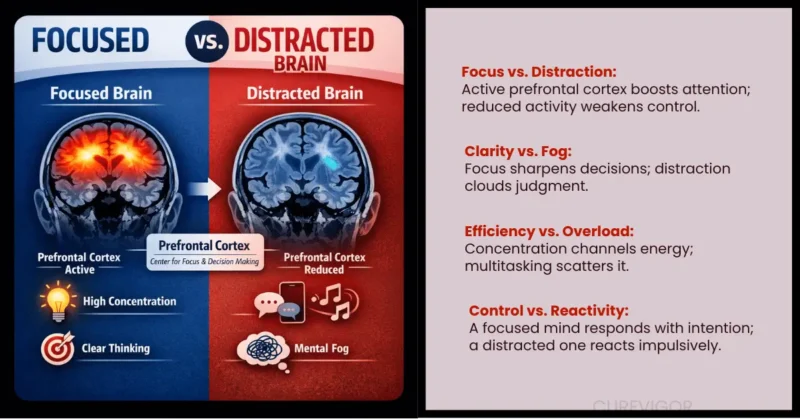
Mindfulness for Work: Focus and Productivity
It can be hard to believe that simply sitting quietly can change how you work. But the science of mindfulness for productivity shows real, physical changes in the brain.
Your brain has a property called neuroplasticity. This means the brain can change and adapt based on what you do. If you practice a musical instrument, the part of your brain that controls your fingers gets stronger.
The same is true for focus. When you practice mindfulness, you actually thicken the prefrontal cortex.
This is the area of the brain responsible for attention, decision-making, and controlling impulses. A stronger prefrontal cortex means you are less likely to get distracted by a passing notification.
Major organizations have seen this science in action. Google created a popular internal course called “Search Inside Yourself.”
The program focuses heavily on mindfulness and emotional intelligence. After taking the course, employees reported feeling much calmer, more focused, and better at collaborating with their teams.
The American Psychological Association has also published research showing that mindfulness greatly reduces mind-wandering.
A wandering mind is a stressed mind. When your thoughts drift to past mistakes or future fears, your body reacts as if the threat is happening right now.
Mindfulness pulls you back to the present, which signals to your body that you are safe. When your body feels safe, your brain can focus on the task at hand.
Top 7 Mindfulness Techniques to Improve Focus at Work
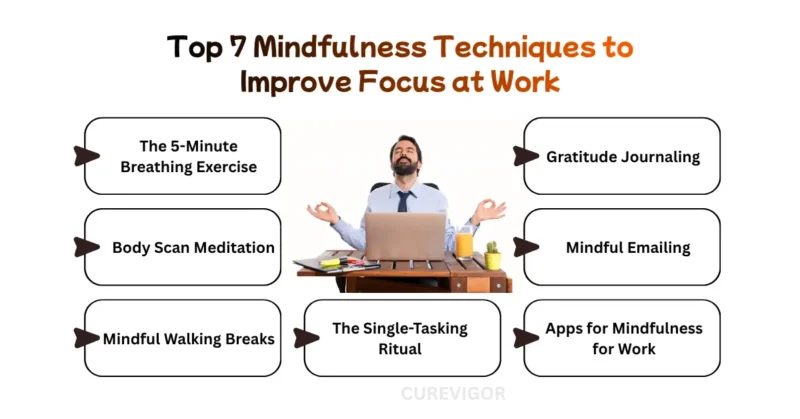
You don’t need a meditation cushion or an hour of free time to practice mindfulness at work. You can use these seven techniques right at your desk, even on your busiest days.
1. The 5-Minute Breathing Exercise
When you feel overwhelmed, your breathing gets short and shallow. This tells your nervous system that you are in danger. You can reverse the anxiety with a simple breathing exercise.
- Step 1: Close your eyes or look softly at your desk.
- Step 2: Breathe in slowly through your nose for a count of four.
- Step 3: Hold that breath gently for a count of four.
- Step 4: Exhale slowly through your mouth for a count of six.
- Step 5: Repeat this cycle for five minutes. This specific rhythm lowers your heart rate and brings instant calm, giving you a clear head to return to your work.
2. Body Scan Meditation
Stress often manifests as physical tension. You might not notice that you are clenching your jaw or gripping your mouse too tightly until the end of the day. A body scan helps you find and release this tension.
- Close your eyes for one minute.
- Bring your attention to the top of your head. Notice any tightness.
- Slowly move your attention down your face, your neck, your shoulders, and down to your toes.
- When you find a tense spot, do not judge yourself for it. Just take a deep breath and imagine the muscle softening. This is incredibly helpful during tight deadlines when physical stress is at its highest.
3. Mindful Walking Breaks
Sitting at a computer for hours on end stalls your thinking. A short walk is beneficial, but a mindful walk is even better.
Whether you work in a large office or at home, you can try this method. When you walk to the water cooler or the kitchen, just slow down a little.
Notice the feeling of your feet touching the floor. Feel the shift of your weight from your heel to your toe.
Notice the air temperature and the sounds around you. By tuning into your senses, you give your busy brain a much-needed break from processing information.
4. The Single-Tasking Ritual
You can combine mindfulness with a time-management method like the Pomodoro Technique to double your output. Set a timer for 25 minutes. For those 25 minutes, choose exactly one task. Close all other browser tabs.
Put your phone out of reach. If your mind wanders to other tasks, simply notice the thought and gently bring your focus back to your single task. When the timer goes off, take a five-minute break. This ritual trains your brain to stay put.
5. Gratitude Journaling
You might wonder what being thankful has to do with getting work done. The truth is, procrastination is often driven by negative emotions like dread, anxiety, or feeling like you are not good enough.
Gratitude shifts your mindset. At the end of your workday, write down three specific things that went well. They can be as small as a lovely cup of coffee or a nice chat with a coworker.
This simple evening practice ends the cycle of negative thinking and helps you start the next day with a clearer, more positive mindset.
6. Mindful Emailing
Email is a massive source of distraction. We often react to emails with anxiety, type out quick replies we later regret, or get pulled into long threads that waste time.
To practice mindful emailing, try the “pause.” When an email arrives, do not click it immediately. Finish the sentence you are typing. When you do open the email, take one deep breath before you start reading.
Before you hit reply, ask yourself if a reply is actually necessary. This pause cuts distractions and stops you from spreading your stress to others.
7. Apps for Mindfulness for Work
Sometimes it helps to have a gentle guide. Apps can be great tools for building a habit. Mindfulness and Healthy Living are two highly rated options that offer short, guided exercises specifically designed for the workday.
They can remind you to take breaks and walk you through breathing exercises when you are too stressed to focus on your own.
Real-World Examples: Mindfulness for Work
It is easy to think these ideas only work for certain types of people. But mindfulness for work is being used successfully in some of the world’s most high-pressure environments.
Tech leaders have been embracing these practices for years. Marc Benioff, the CEO of Salesforce, is a strong supporter of mindfulness.
He has even had meditation rooms built on every floor of Salesforce’s headquarters.
He credits the practice with helping him and his team stay focused, make better decisions, and lead with more empathy.
When leadership prioritizes mental well-being, it shifts the company’s entire culture. People feel less afraid to make mistakes, and they focus better on their work.
You do not need to be a CEO to see these results. We would love to hear from you. Share your story in the comments below about how taking a moment to pause has changed your workday.
Common Challenges and How to Overcome Them
Trying something new at work is rarely perfectly smooth. Here are the most common hurdles people face when starting mindfulness, along with ways to overcome them.
Challenge: “I do not have the time.”
- Solution: Micro-practices under two minutes. You do not need to find 30 spare minutes. Try taking three deep breaths before a meeting starts.
Pause for ten seconds to look out a window. These tiny moments add up and reset your focus without costing you valuable work time.
Challenge: “I am sceptical, and it feels silly.”
- Solution: Try a 7-day trial with a progress tracker. You do not have to believe in mindfulness for work. Treat it like a science experiment.
Try a breathing exercise every morning for a week. At the end of the week, look at your tracker. Did your stress levels drop? Did you finish your tasks faster? Let your own results change your mind.
Challenge: “My office is too loud and busy.”
- Solution: Discreet techniques like mindful listening. You cannot always control your environment. Instead of fighting the noise, use it. Close your eyes and simply listen to the sounds around you without labeling them.
Notice the hum of the air conditioner, the sound of typing, the muffled voices. This turns a distracting environment into a grounding mindfulness exercise.
Overcoming these mindfulness-for-work challenges just requires a little creativity and a willingness to start small.
Getting Started: Your 30-Day Mindfulness Productivity Plan
Reading about mindfulness is helpful, but doing it is what changes your brain. Here is a simple, step-by-step plan to build a lasting habit over the next month.
Week 1: Building the Foundation
Your only goal this week is daily 5-minute breathwork. Set an alarm for the same time every day.
It could be right when you sit at your desk or right after lunch. Do the 4-4-6 breathing exercise mentioned earlier. If you miss a day, do not worry. Just try the next day again.
Week 2: Adding One Technique
Now that breathing feels a bit more natural, add one mindful technique to your routine. Choose the one that sounds most helpful to your specific struggles.
If you sit all day, add a mindful walking break. If you procrastinate out of anxiety, try the single-tasking ritual with a 25-minute timer on your hardest project.
Week 3: Managing Reactions
This week, focus on how you react to others. Practice mindful emailing. Take one breath before answering the phone.
During meetings, practice mindful listening. Focus entirely on the person speaking, rather than planning what you will say next. Notice how your communication improves when you are fully present.
Week 4: Ending the Day Well
Add the gratitude journaling practice to the end of your workday. Before you shut your computer down, write down three good things. This helps you leave work at work, rather than carrying the stress of the day into your evening.
Track Your Metrics
To know if this is working, you need a way to measure it. You can keep a sticky note on your desk. At the end of each day, jot down two things:
- How many hours of deep focus did I have today?
- How many main tasks did I complete? Compare your answers at the end of the month to the beginning. You will likely see your focus hours going up.
To make tracking even easier, [subscribe to our newsletter to get a free 30-day tracking template].
Conclusion on Mindfulness for Work
The modern workplace will not stop being busy. Notifications will not stop pinging. But you do not have to be a victim of the chaos. By practicing mindfulness for work, you can create a quieter space in your mind.
The benefits are clear. You will experience sharper focus, higher productivity, and much less stress at the end of the day. Your brain will literally become better at ignoring distractions and sticking to the task that matters.
You do not need to start big. Try one technique today, comment below, and let us know which one you chose. If you want more tips on how to work smarter and protect your peace, [subscribe to our newsletter].
For more reading on the medical and psychological benefits of these practices, you can explore NIH mindfulness resources.
Frequently Asked Questions on Mindfulness for Work
Q. How does mindfulness for work increase productivity?
Mindfulness increases productivity by cutting down the time you waste on distractions and stress. When you practice being present, you stop task-switching, which drains your mental energy.
Instead, you can dive deep into one task and finish it much faster. A calmer mind also means fewer afternoon energy crashes, keeping your output steady all day.
Q. How does mindfulness improve focus and concentration?
Mindfulness works like a workout for your brain’s attention span. Every time your mind wanders, and you gently pull it back to your breathing, you are strengthening your focus muscles.
Over time, this builds up the prefrontal cortex, the brain area that controls concentration. Because of this, outside noises and stray thoughts bother you much less.
Q. How can mindfulness help you at work?
At work, mindfulness helps you stay calm when things get chaotic or deadlines loom. It gives you the space to pause before reacting to a stressful email or a tough comment from a coworker.
You will also notice physical tension earlier, like a tight neck, so you can relax it before it turns into a headache. Overall, it makes you a clearer thinker and a better teammate.
Q. How to improve focus and productivity at work?
To improve your focus, start by tackling just one task at a time instead of trying to do everything at once. Close your extra browser tabs and put your phone out of reach so notifications cannot break your attention.
Use a timer to work in short, focused bursts, followed by quick breaks to rest your eyes. Adding a simple two-minute breathing exercise before a big project can also clear your head.
Q. What are the 6 benefits of mindfulness?
The six main benefits of mindfulness are better focus, lower stress levels, and improved emotional control.
It also leads to higher productivity, boosts your creativity by giving your brain a break from constant overthinking, and improves your sleep quality.
Together, these benefits help you feel more energized and less overwhelmed by daily life.
Q. What is the 3-3-3 rule in mindfulness?
The 3-3-3 rule is a quick grounding exercise that brings you back to the present moment when you feel anxious. You start by naming three things you can see right in front of you, like a coffee mug or a tree.
Next, name three things you can hear, like the hum of a fan or distant traffic. Finally, you move three parts of your body, like wiggling your toes and rolling your shoulders.
Read more Health and Wellness articles.
You might like: