
Learn how coffee naps can transform your shift work performance. Learn the science, timing, and step-by-step method to beat fatigue and stay sharp on any shift. (156 characters)
A coffee nap entails having a cup of coffee right before napping for 15 to 20 minutes. Caffeine takes roughly 20 minutes to absorb into the bloodstream, so it kicks in just as you wake up, clearing adenosine (the sleep-pressure chemical) from your brain and delivering a powerful, science-backed boost in alertness. For shift workers, this strategy is one of the most effective fatigue-management tools available.
Why Shift Workers Are Always Exhausted and What Science Says About It
You already know the feeling. It is 3 a.m.; your shift has three more hours to go; your eyes feel like sandpaper; and no amount of coffee seems to be working. You are not weak or lazy; your body is fighting your schedule at a biological level.

Your circadian rhythm, the internal 24-hour clock that controls when you feel awake and tired, gets thrown off by working shifts. Your body is virtually permanently jet-lagged when you work evenings or rotating shifts.
Shift workers are more likely than their day-shift counterparts to have fatigue-related errors, accidents, and long-term health issues, according to studies published in the journal Occupational and Environmental Medicine.
Here is the good news: you can fight back, and one of the most powerful tools requires nothing more than a cup of coffee and a quiet corner.
Coffee naps, sometimes called caffeine naps or nappuccinos, combine two well-researched strategies into one approach that is greater than the sum of its parts.
This guide will walk you through exactly how they work, when to use them, and how to fit them into your shift routine.
What Is a Coffee Nap?
A coffee nap is a short sleep of approximately 15 to 20 minutes taken immediately after consuming a caffeinated drink.
The goal is to let sleep do its job of clearing adenosine, the chemical that accumulates in your brain during wakefulness and makes you feel tired, while caffeine travels through your digestive system.
When you wake up, both mechanisms activate at the same time, producing alertness that is measurably greater than either caffeine or a nap alone would deliver.
Key Definition — Adenosine: Adenosine is a naturally occurring chemical in the brain that builds up the longer you are awake. It binds to receptors that make you feel drowsy. Sleep clears it. Caffeine temporarily blocks it. A coffee nap does both simultaneously.
The Science Behind Why Coffee Naps Work
To understand why coffee naps are so effective, you need to understand a little brain chemistry. When you are awake, adenosine molecules accumulate and bind to receptors in your brain, progressively increasing sleepiness. This is called sleep pressure.

Caffeine works by mimicking adenosine’s shape and blocking those receptors, temporarily preventing the sleepy signal from getting through. However, caffeine does not actually clear adenosine. It just delays the message.
The moment caffeine wears off, the adenosine that was waiting rushes back in, often producing the notorious “caffeine crash.”

Sleep, on the other hand, actively clears adenosine from the brain. Even a short 15–20-minute nap can meaningfully reduce adenosine levels, lowering sleep pressure.
When you combine sleep with caffeine, the result is a clean sweep: sleep removes adenosine, and caffeine blocks the remaining adenosine.
Your receptors are clear, and no blocking chemical is present either. You wake up genuinely refreshed rather than just artificially stimulated.
What Research Shows
Additional research published in Sleep, the journal of the Sleep Research Society, confirmed that the combination approach yields greater reductions in subjective sleepiness and improved performance on cognitive tasks than either intervention alone.
The Perfect Timing: How Long Should a Coffee Nap Be?
Timing is everything with coffee naps. Get the duration wrong and you will either miss the caffeine window or tumble into deep sleep — making things worse.
| 10 minutes | Light sleep (Stage 1–2) | Moderate boost, minimal grogginess | Very short breaks |
| 15–20 minutes ✓ | Light sleep (Stage 1–2) | Maximum boost: caffeine syncs perfectly | Coffee naps — ideal window |
| 30 minutes | May enter deep sleep | Risk of sleep inertia (grogginess) | Not recommended for coffee naps |
| 60–90 minutes | Full cycle including REM | Deep restoration, but slower wake-up | Extended rest between long shifts |
15 to 20 minutes is your goal. This ensures you wake up when the caffeine takes effect, keeping you in the lighter stages of sleep and allowing adenosine to clear.
Setting an alarm is non-negotiable; oversleeping into deep sleep stages produces sleep inertia, a groggy, disoriented state that could last 30 minutes or more, which is the last thing you need mid-shift.
How to Take a Coffee Nap: Step-by-Step Guide
The Coffee Nap Method — 6 Steps
- Choose the right time. The best window is your mid-shift low point, typically 3–4 a.m. for night workers or early afternoon for day-shift fatigue. Avoid coffee naps within 6 hours of your intended main sleep to prevent disrupting it.
- Drink your coffee quickly. Consume a standard cup of coffee (about 100–200 mg of caffeine) in under 5 minutes. Cold brew, espresso, or caffeinated energy drinks work too. The goal is a consistent caffeine dose, not a leisurely drink.
- Find a dark, quiet place immediately. Lie down or recline in a comfortable position. Even a car seat, a staff room sofa, or a reclining chair works. Darkness and quiet matter. Use an eye mask and earplugs if needed.
- Set a timer for 20 minutes. Use your phone’s alarm. Do not trust yourself to “just wake up.” The 20-minute mark is your target, whether or not you feel you actually slept.
- Do not stress about falling asleep. Simply resting with your eyes closed reduces adenosine levels and allows some recovery, even if you remain in a light state of drowsiness. Many shift workers find they fall asleep faster than expected because they are already significantly fatigued.
- Wake up and move. When the alarm sounds, get up, move your body, splash cold water on your face if available, and expose yourself to bright light if possible. Within 5–10 minutes, you should feel the caffeine-plus-cleared-adenosine effect: alert, refreshed, and ready.
When Should Shift Workers Take a Coffee Nap?
Not every moment in a shift is equal. Your body follows a predictable rhythm of alertness and sleepiness regardless of your schedule, and understanding that rhythm helps you time your coffee nap for maximum impact.

Best Times for Night Shift Workers
You may notice that sleepiness peaks dramatically between 2 a.m. and 5 a.m. This is when your circadian system most strongly promotes sleep.
A coffee nap taken during your break in this window, say, at 2:30 a.m. or 3:00 a.m., can carry you through to the end of your shift with noticeably improved focus and reaction time.
Best Times for Rotating Shift Workers
If your schedule rotates, your fatigue patterns shift too. Your goal should be to take a coffee nap at whatever point falls roughly halfway through your shift’s most challenging hours.
For early-morning shifts (starting at 4–6 a.m.), a coffee nap at lunchtime can prevent the early-afternoon energy crash that often follows a very early wake-up.
Before a Double Shift
If you know a double shift is coming, a prophylactic coffee nap, taken before fatigue sets in, can extend your window of alertness. Research shows that napping before sleep deprivation is nearly as effective as napping during it. Think of it as pre-loading your energy reserves.
Important Caution: Avoid coffee naps within 6 hours of your main sleep period. Caffeine has a half-life of 5–7 hours. Taking a coffee nap too close to your bedtime will disrupt the quality of sleep you need to actually recover between shifts.
Coffee Nap vs Regular Nap vs Coffee Alone: A Direct Comparison
| Strategy | Alertness Boost | Risk of Grogginess | Caffeine Crash Later | Ease of Use |
|---|---|---|---|---|
| Regular nap (20 min) | Moderate | Low | None | Easy |
| Coffee alone | Moderate | None | Yes | Very easy |
| Coffee nap ✓ | High | Very low | Reduced | Moderate |
| Long nap (60–90 min) | High | High | N/A | Difficult on breaks |
Practical Tips for Shift Workers to Make Coffee Naps Work
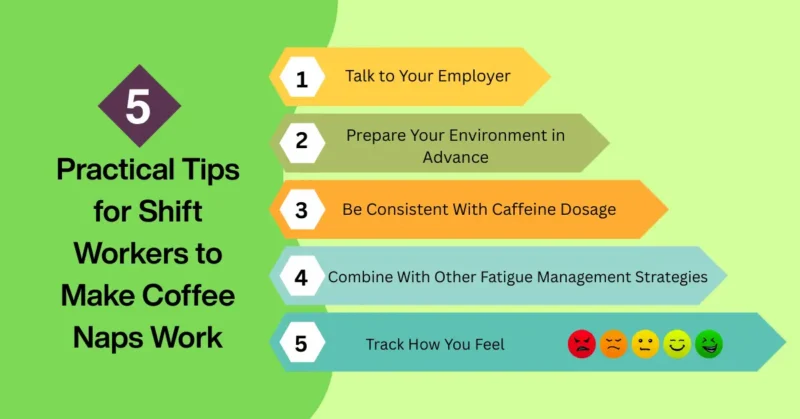
1. Talk to Your Employer
Many workplaces now support short rest breaks for safety-critical roles, particularly in healthcare, transport, and manufacturing.
If your employer does not have an official nap policy, you may be surprised how open managers are when you frame coffee naps as a performance and safety tool, which they genuinely are.
2. Prepare Your Environment in Advance
Identify a quiet, dimly lit space before your shift starts. Keep an eye mask in your locker. Install a white noise app on your mobile device. Your results will improve if you can go from drinking to resting more quickly.
3. Be Consistent With Caffeine Dosage
Different caffeinated drinks vary widely in caffeine content. A consistent dose of 100–200 mg, roughly one shot of espresso or one standard drip coffee, is the sweet spot for most people. Too little and the effect is minimal; too much increases the risk of disrupting subsequent sleep.

4. Combine With Other Fatigue Management Strategies
Coffee naps are powerful, but they work best as part of a broader strategy. To enhance circadian stability, you should also prioritize blackout curtains for daytime sleep, adhere to a regular sleep pattern even on days off, limit alcohol consumption (which can disrupt sleep), and maintain regular mealtimes.
5. Track How You Feel
Keep a simple note on your phone: what time you took the coffee nap, how long it lasted, and how you felt for the following two hours. After a week or two, patterns will emerge, and you will be able to fine-tune your timing for your specific schedule, body clock, and caffeine metabolism.
Common Mistakes That Ruin Coffee Naps
- Napping too long. Sleeping for more than 25 minutes increases the risk of entering deep slow-wave sleep, which can make you feel worse on waking.
- Waiting too long after coffee to sleep. If you sip your coffee over 30 minutes, the caffeine starts absorbing before you nap, defeating the purpose.
- Using coffee naps too close to bedtime. This is the most common error — the caffeine will directly sabotage your main recovery sleep.
- Relying on coffee naps instead of adequate sleep. Coffee naps manage fatigue; they do not replace the 7–9 hours of sleep your body needs for true physiological recovery.
- Skipping the dark and quiet. Trying to nap in a brightly lit, noisy break room will prevent you from reaching even the light sleep stages needed. Invest in an eye mask and earplugs.
Key Takeaways
- A coffee nap combines immediate caffeine consumption with a 15–20 minute nap, producing greater alertness than either alone.
- The science works because sleep clears adenosine while caffeine blocks its receptors, creating a synergistic effect.
- The ideal duration is 15–20 minutes; longer naps risk sleep inertia and reduce the benefit.
- Night shift workers should aim for the 2–4 a.m. window; rotating shift workers should target their mid-shift low point.
- Avoid coffee naps within 6 hours of your planned sleep to protect sleep quality.
- Track your results over 1–2 weeks to find the timing and caffeine dose that works best for your body.
- Coffee naps are a management tool, not a substitute for adequate, quality sleep.
Frequently Asked Questions
Q. Do coffee naps actually work, or is it just a myth?
Yes, coffee naps are scientifically proven to work. Peer-reviewed research shows they improve alertness and cognitive performance more effectively than either caffeine or a nap taken alone.
Coffee naps are scientifically validated, not a myth. Multiple peer-reviewed studies, including research from Loughborough University published in the journal Sleep, demonstrate that a 15–20-minute nap taken immediately after consuming caffeine produces measurably greater alertness and cognitive performance than either caffeine or a nap alone.
The mechanism is well understood: sleep reduces adenosine (the drowsiness-inducing chemical), while caffeine blocks its receptors in the brain, and the two effects compound when timed correctly.
The key variables are the caffeine dose (100–200 mg), nap duration (under 25 minutes), and consuming the coffee quickly before lying down.
Q. What Is a Coffee Nap?
A coffee nap is a short 15–20-minute sleep taken immediately after drinking a caffeinated beverage so that caffeine activates in the bloodstream at the exact moment you wake up, producing a sharper, faster alertness boost than either alone.
Here is what makes it different from just drinking coffee and hoping for the best: caffeine takes approximately 20–30 minutes to be absorbed through the gut and reach the brain.
That absorption window is exactly long enough for a light sleep cycle. So instead of fighting drowsiness while you wait for caffeine to kick in, you use that window productively, letting your brain rest and clear adenosine at the same time.
How It Compares
| Method | Adenosine Cleared? | Receptors Blocked? | Result |
|---|---|---|---|
| Caffeine alone | No | Yes | Alertness with later crash |
| Nap alone | Yes | No | Moderate refresh |
| Coffee Nap ✓ | Yes | Yes | Maximum alertness |
The concept is not new; Japanese researchers studied it as early as the 1990s under the term “caffeine nap.” It has since gained traction in occupational health, sports science, and productivity research as one of the few fatigue interventions that is free, fast, and genuinely evidence-based.
Q. How long should a coffee nap be for shift workers?
The optimal length for a coffee nap is 15 to 20 minutes. This duration keeps you in the lighter stages of sleep (Stage 1 and Stage 2), which are sufficient for adenosine clearance and cognitive restoration without triggering the deep slow-wave sleep that leads to sleep inertia, the heavy, groggy feeling that makes waking up feel worse than staying awake.
For shift workers with a standard 30-minute break, the math works perfectly: drink coffee, walk to a rest area (5 minutes), nap for 20 minutes, wake up, and freshen up (5 minutes). Always set an alarm to avoid oversleeping.
Q. What type of coffee is best for a coffee nap?
Any caffeinated drink that delivers 100–200 mg of caffeine quickly will work for a coffee nap.
A standard 8 oz drip coffee contains approximately 95–140 mg. A double shot of espresso delivers around 120–140 mg of caffeine. Cold brew coffee is also effective.
The most important factor is speed: you need to consume the drink within 5 minutes so that the caffeine absorption window aligns with your nap duration.
Avoid large milky drinks that slow absorption, and be aware that decaf coffee will not produce a coffee nap effect regardless of nap timing.
Q. Can I take a coffee nap if I work a 12-hour shift?
Yes, in fact, coffee naps may be even more valuable on 12-hour shifts, where the total fatigue load is substantially higher. On a 12-hour night shift, the most beneficial timing is typically between hours 6 and 8, targeting your deepest circadian sleepiness window.
If your break schedule allows, a single well-timed coffee nap during that window can maintain alertness and reaction time through the final hours of the shift.
For healthcare workers, transport operators, and industrial workers on 12-hour rotations, coffee naps are increasingly recognized as a legitimate fatigue-management and safety strategy.
Q. Are coffee naps safe for everyone?
Coffee naps are safe for most healthy adults, but there are important exceptions. People with caffeine sensitivity, anxiety disorders, heart arrhythmias, high blood pressure, or gastrointestinal conditions should consult a healthcare provider before relying on coffee naps as a strategy.
Pregnant individuals are advised to significantly limit caffeine intake, making coffee naps less appropriate. Additionally, people with certain sleep disorders, including insomnia, may find that even short caffeine use exacerbates their symptoms.
If you have underlying health conditions or are on medications that interact with caffeine, seek medical advice before adopting this approach.
Q. Is there any research specifically on coffee naps for healthcare shift workers?
Research on fatigue management in healthcare settings is growing, with coffee naps increasingly discussed as evidence-based strategies for nurses, doctors, and paramedics working extended shifts.
Organizations, including the National Sleep Foundation and various occupational health bodies, have highlighted the value of strategic napping for safety-critical professions.
While randomized controlled trials specifically on coffee naps in clinical shift-work settings remain limited, the underlying sleep science, validated in general population studies, applies directly to healthcare workers.
Several hospitals, particularly in the UK and Scandinavia, have begun piloting formalized nap-break policies for overnight staff.
Conclusion: Your Shift, Your Strategy
Working shifts is genuinely hard on your body, and anyone who says otherwise has never done it. Your body was built to sleep at night and work by daylight, but fighting that biology takes a real toll. But you are not powerless.
The coffee nap is one of the most practical, evidence-backed tools available to you, and it costs nothing more than a cup of coffee and 20 minutes of rest.
By clearing adenosine through brief sleep and blocking its receptors with caffeine simultaneously, you give yourself a genuine, physiologically grounded boost rather than just forcing your tired brain through another hour on willpower alone.
Your goal should be to make coffee naps a planned part of your shift strategy, not a desperate last resort at 4 a.m.
Time them to your circadian low point, protect your main sleep period by avoiding caffeine too close to bedtime, and track your results to refine your approach over time.
You can improve your performance, reduce your fatigue-related errors, and protect your long-term health, one careful 20-minute nap at a time. Start with your next shift. The science is on your side.
Read more about the health of night-shift workers.
You might like: